The Economics category has 353 audiobooks on Listento.it, with an average listener rating of 4.4★ across 2,738 ratings. The most-rated is Stealing Fire.

Conspiracy of Credit
Summary
The Conspiracy of Credit is a must listen. It contains the most raw and comprehensive information you will ever find on credit. If you ever wondered, why the credit bureaus want you to have bad credit or why credit is for poor people, this audiobook will shock you with answers. Conspiracy of Credit explains why identity theft is nothing more than a new product created by the credit bureaus and banks to make money. This book will break down the reason behind retail and grocery store loyalty cards as well as the use of re-identification software. The speed of light money age is here, and never before has any book provided a blueprint for the future of credit and banking.
©2013 Corey P. Smith (P)2014 Corey P. Smith

Final Voyage
Summary
In 1871, an entire fleet of whaling ships was caught in an arctic ice storm and destroyed. Though few lives were lost, the damage would forever shape one of America's most distinctive commodities: oil. New Bedford, Massachusetts, was fertile ground for this country's first multimillion-dollar industry. Founded by assiduous Quaker merchants seeking refuge for their austere religion, the town also lent unparalleled access to the high seas. The combination would lead to what would become the most successful whaling industry in America, and with it, the world's first oil hegemony. Oyl, or oil derived from whale blubber, revolutionized New England commerce. And as intrepid New Bedford whalers ventured farther into uncharted waters in search of untapped resources, the town saw incomparable wealth. But with all of the town's resources tethered to this dangerous industry and the fickle sea, success was fragile. Final Voyage is the story of one fateful whaling season that illuminates the unprecedented rise and devastating fall of America's first oil industry. Peter Nichols deftly captures what New Bedford life was like for its Quaker inhabitants and, using a wealth of primary resources, has created a vivid picture of the evolution of whaling and how its demise was destined even before that devastating voyage.
©2009 Peter Nichols (P)2009 Tantor
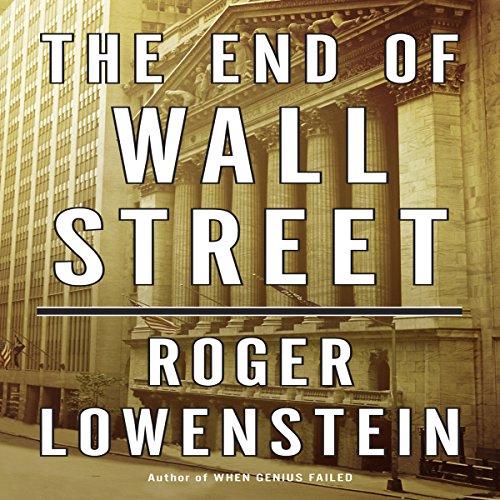
The End of Wall Street
Summary
The roots of the mortgage bubble and the story of the Wall Street collapse - and the government's unprecedented response - from our most trusted business journalist. The End of Wall Street is a blow-by-blow account of America's biggest financial collapse since the Great Depression. Drawing on 180 interviews, including sit-downs with top government officials and Wall Street CEOs, Lowenstein tells, with grace, wit, and razor-sharp understanding, the full story of the end of Wall Street as we knew it. Displaying the qualities that made When Genius Failed a timeless classic of Wall Street, his sixth sense for narrative drama, and his unmatched ability to tell complicated financial stories in ways that resonate with ordinary readers and listeners, Roger Lowenstein weaves a financial, economic, and sociological thriller that indicts America for succumbing to the siren song of easy debt and speculative mortgages. The End of Wall Street is rife with historical lessons and bursting with fast-paced action. Lowenstein introduces his story with precisely etched, laserlike profiles of Angelo Mozilo, the Johnny Appleseed of subprime mortgages, who spreads toxic loans across the landscape like wild crabapples, and moves to a damning explication of how rating agencies helped gift wrap faulty loans in the guise of triple-A paper and a takedown of the academic formulas that - once again - proved the ruin of investors and banks. Lowenstein excels with a series of searing profiles of banking CEOs, such as the ferretlike Dick Fuld of Lehman and the bloodless Jamie Dimon of JP Morgan, and of government officials, from the restless, deal-obsessed Hank Paulson and the overmatched Tim Geithner to the cerebral academic Ben Bernanke, who sought to avoid a repeat of the one crisis he spent a lifetime trying to understand: the Great Depression. Finally, we come to understand the majesty of Lowenstein's theme of liquidity and capital, which explains the origins of the crisis and that positions the collapse of 2008 as the greatest ever of Wall Street's unlearned lessons. The End of Wall Street will be essential reading as we work to identify the lessons of the market failure and start to rebuild.
©2010 Roger Lowenstein (P)2010 Penguin

A Diary of a Euro Crisis in Cyprus
Summary
This audiobook tells the story of the euro crisis in Cyprus from the inside. Written by the former Governor of the Central Bank of Cyprus, Panicos Demetriades, who was in office during this turbulent period, this audiobook shows how the crisis unravelled through a series of key events that occurred during his tenure. Written in chronological order and broadly based on the author’s personal diary, starting from his first day in office, this volume brings together economics, banking, regulation, governance, history, politics and international relations. Presenting personal witness statements, including records of noteworthy telephone conversations, informal meetings and other milestones, it examines crucial questions like: How did Cyprus become so systemically important to the rest of the euro area? Why was Cyprus treated so differently in comparison to other peripheral countries in Europe? Why were bank depositors targeted? What role did Cyprus’ links with Russia play in the design of the programme? What has been the toxic fallout from the bail-in? Are there any longer-term implications for the euro? What are the lessons for regulators around the world? The audiobook will appeal to listeners interested in financial crises, the euro’s architecture, the evolution of the European Monetary Union and those with an interest in how Europe and the IMF dealt with crises in peripheral European countries. Cover credit: Samantha Johnson. PLEASE NOTE: When you purchase this title, the accompanying reference material will be available in your Library section along with the audio on our Desktop Site.
©2017 Panicos Demetriades (P)2020 Audible, Ltd

What Is to Be Done?
Summary
What Is to Be Done? Burning Questions of Our Movement (1902) is a political pamphlet written by the Russian revolutionary Vladimir Lenin. Lenin contends that the working class will not become politically aware simply by struggling with employers over wages, hours and working conditions. He maintains that Marxists should form a political party of committed revolutionaries to spread Marxist political ideas among the workers. The pamphlet was partly responsible for the split of the Russian Social Democratic Labor Party into Lenin's Bolsheviks and the Mensheviks. Claiming that socialist theory was the product of the "revolutionary socialist intellectuals", Lenin states that the working class was able to develop only a “trade-union consciousness". He points out that Karl Marx and Friedrich Engels, the founders of modern scientific socialism, belonged to this bourgeois intelligentsia.
Public Domain (P)2020 Museum Audiobooks

Floating Coast
Summary
The first-ever comprehensive history of Beringia, the Arctic land and waters stretching from Russia to Canada, Floating Coast breaks away from familiar narratives to provide a fresh and fascinating perspective on an overlooked landscape. The unforgiving territory along the Bering Strait had long been home to humans - the Inupiat and Yupik in Alaska, and the Yupik and Chukchi in Russia - before Americans and Europeans arrived with revolutionary ideas for progress. Rapidly, these frigid lands and waters became the site of an ongoing experiment: How, under conditions of extreme scarcity, would the great modern ideologies of capitalism and communism control and manage the resources they craved? Drawing on her own experience living with and interviewing indigenous people in the region, as well as from archival sources, Demuth shows how the social, the political, and the environmental clashed in this liminal space. Through the lens of the natural world, she views human life and economics as fundamentally about cycles of energy, bringing a fresh and visionary spin to the writing of human history. Floating Coast is a profoundly resonant tale of the dynamic changes and unforeseen consequences that immense human needs and ambitions have brought, and will continue to bring, to a finite planet.
©2019 Bathsheba Demuth (P)2020 Tantor

The General Theory of Employment, Interest, and Money
Summary
Keynes’ The General Theory of Employment, Interest, and Money remains, approaching a century after it first appeared, one of the most important documents on economics, along with Adam Smith’s The Wealth of Nations and Karl Marx’s Capital. Hugely important for much of the 20th century, the General Theory was seemingly overtaken by monetarists but won a new, enduring respect among a new generation of economists and politicians following the financial difficulties which began in 2007-8. John Maynard Keynes (1883-1946) promoted a middle way between the Marxist approach of total governmental control and those committed to, essentially, allowing markets to operate largely free of restraints. He saw the need for central intervention, especially at times of crisis, but always acknowledged the importance and the contribution of individual enterprise within a free market system. First published in 1936, Keynes’ ideas had evolved during the difficulties following World War I in Europe, and the US crash and the Depression of the 1920s-'30s and the misery of mass unemployment. He deplored the situation where a few individuals or companies stored massive wealth while vast numbers experienced poverty and insecurity (his alarm bells ring today!) and sought to promote initiatives where governments could intervene with social projects to keep money fluctuating. The General Theory is a stimulating and challenging work. Keynes presents his case with minimum jargon and admirable clarity. He does use formulae to support and clarify his case, and in some cases these have been included in the narrative in a manner which can be absorbed. In the few more complicated cases, the formulae are available on pdfs which can be downloaded with this recording. Introduction by Mark G Spencer. PLEASE NOTE: When you purchase this title, the accompanying reference material will be available in your Library section along with the audio.
Public Domain (P)2018 Ukemi Productions Ltd

The Honey Bee
Summary
A business parable that teaches the value of cultivating multiple streams of income - the surest, most achievable means of creating generational wealth. The Honey Bee tells the story of Noah - a disappointed, disaffected salesman who feels like his life is going nowhere until the day he has a chance encounter with a man named Tom Barnham, the beekeeper. In his charming, down-home way, Tom the “Bee Man” teaches Noah and his wife Emma how to grow their personal wealth using the lessons he learned from his beekeeping passion. Full of concrete lessons delivered through chapter after chapter of engaging vignettes, each of which includes actionable advice for new or aspiring entrepreneurs. Workbook-style sections at the end of each chapter help bring the lessons home, including questions to help you apply the lessons to your own business, and links to rich digital resources for even more information on how to get started creating your own multiple streams of income.
©2020 Jake Stenziano (P)2020 Greenleaf Book Group

The Classical School
Summary
A fascinating chronicle of the lives of 20 economists who played major roles in the evolution of global economic thought. What was Adam Smith really talking about when he mentioned the "invisible hand"? Did Karl Marx really predict the end of capitalism? Did Thomas Malthus (from whose name the word Malthusian derives) really believe that famines were desirable? In The Classical School, Callum Williams debunks popular myths about these great economists and explains the significance of their ideas in an engaging way. After listening to this audiobook, you will know much more about the very famous (Smith, Ricardo, Mill) and the not-quite-so-famous (Bernard de Mandeville, Friedrich Engels, Jean-Baptiste Say). The audiobook offers an assessment of what they wrote, the impact it had, and the worthiness of their ideas. It's far from the final word on any of these people but a useful way of understanding what they were all about, at a time when understanding these economic giants is perhaps more important than ever.
©2020 The Economist Newspaper Ltd (P)2020 Hachette Audio

The Downfall of Money
Summary
An economic horror story: The complete meltdown of a major modern country’s financial system, and its disastrous effects on every aspect of society. A hundred years ago, many theorists believed - just as they did at the beginning of our 21st century - that the world had reached a state of economic perfection, a never-before-seen human interdependence that would lead to universal growth and prosperity. Then, as now, the German mark was one of the most trusted currencies in the world. Yet the early years of the Weimar Republic in Germany witnessed the most calamitous meltdown of a developed economy in modern times. The Downfall of Money will tell anew the dramatic story of the hyperinflation that saw the mark - worth 4.2 to the dollar in 1914 - plunge until it traded at over 4 trillion to 1 by the autumn of 1923. The story of the Weimar Republic’s financial crisis clearly resonates today, when the world is again anxious about what money is, what it means, and how we can judge if its value is true. It is a trajectory of events uncomfortably relevant for our own uncertain world. Frederick Taylor - one of the leading historians of Germany writing today - explores the causes of the crisis and what the collapse meant to ordinary people and traces its connection to the dark decades that followed. Drawing on a wide range of sources and accessibly presenting vast amounts of research, The Downfall of Money is a timely and chilling exploration of a haunting episode in history.
©2013 Frederick Taylor (P)2013 Audible Inc.

Turbulent Empires
Summary
As Europe rebuilt after the devastation of the Second World War, the former colonies of the major imperial powers sought their independence at the same time the US extended its economic and political power globally. In Turbulent Empires, Mike Mason analyzes the struggles for postcolonial sovereignty and economic domination and how these competing forces led to conflicts and shifting alliances around the postwar world. Turbulent Empires surveys the major polities and economies of Africa, Asia, Latin America, Russia, and the West and traces the trajectory of nationalist ruling classes bent on exercising sovereign control over economic resources. It emphasizes the convulsions that brought about unanticipated realignments and shocking reversals, such as the rise and fall of regimes, continuous interventions in the Muslim world, the sudden collapse of the commodities supercycle, and the continuing challenge of inequality. By the second decade of the 21st century, the global economic crisis of 2008 raised the question of a new global order while the question of American decline, captured in the slogan "Make America Great Again”, became commonplace. Both erudite and accessibly written, Turbulent Empires provides an insightful and sweeping analysis of world political and economic history that is an ideal introduction to postwar political science, history, and development studies. "A gem of a book - accomplished with impressive erudition, written with panache, brimming with insight. A book like this is the result a lifetime of learning." (Jonathan Levy, University of Chicago)
©2018 McGill-Queen's University Press (P)2018 Redwood Audiobooks

Bankrupting America
Summary
Before we can fix our economic problems, we must first diagnose what is causing them. Many of our political and intellectual leaders call for more government intervention to fix the economy. They tell us that it creates jobs, corrects "market failures", and boosts economic growth. And they insist that we need such intervention to help the poor, to coddle the consumer, and to protect the worker. But they're dead wrong. Government intervention is not the solution to our economic problems; it's the cause. Bankrupting America: How Government Intervention Is Wrecking the Economy analyzes all the major categories of government intervention in the economy - from taxes, deficits, antitrust, and price controls to regulation, protectionism, central banking, and wealth redistribution. In this book, you'll find out: Why protectionist policies such as tariffs destroy more jobs than they save Why the antitrust laws penalize the most productive, successful companies Why price controls cause shortages Why the minimum wage increases unemployment Why regulation stifles productivity Why high taxes, chronic deficits, and excessive government debt hinder economic growth Why government-provided services cost twice as much as those provided by the private sector Why private charity is more effective than government welfare Why the Federal Reserve's manipulation of interest rates exacerbates the business cycle Why government "stimulus" spending during a recession does not accelerate a recovery And much more Backed by numerous academic studies and sound economic logic, the conclusion is incontestable: Government intervention simply doesn't work. It stifles saving, investment, and capital accumulation. All of this translates to higher unemployment, higher consumer prices, and lower economic growth. To fix the American economy, we need much less government intervention, not more.
©2016 Michael Dahlen (P)2016 Michael Dahlen

Jimmy Stewart Is Dead
Summary
Discover how the global financial plague is poised to return, and what can be done to stop it This is not your father's financial system. Jimmy Stewart, the trustworthy, honest banker in the movie, It's a Wonderful Life, is dead. And so is his small-town bank, Bailey Savings & Loan. Instead, we're watching It's a Horrible Mess with Wall Street (aka the Vegas Strip) playing ever larger craps with our economy and our tax dollars. This audiobook, written by one of the world's most respected economists, describes in lively, humorous, simple, but also deadly serious terms the big con underlying the big game - the web of interconnected financial, political, and regulatory malfeasance that culminated in financial meltdown and brought us to our economic knees. But is also proposes a solution - Limited Purpose Banking, a straightforward and easily implemented plan to make Wall Street safe for Main Street. Outlines the first and only proposal to fundamentally fix our financial disaster for good Written by a leading economist whose insights on this topic are unparalleled Explains the tenets of the plan, such as the regained government control of the money supply and the new role of insurance companies Jimmy Stewart Is Dead will fundamentally change the way you think about the economy, financial markets, and the government - and even if you don't agree with Kotlikoff's conclusion, you'll find his analysis of the crisis and his simple solution a true economic eye-opener.
©2010 Laurence J. Kotlikoff (P)2009 Audible, Inc.

Study Guide: The Worldly Philosophers by Robert Heilbroner (SuperSummary)
Summary
SuperSummary, a modern alternative to SparkNotes and CliffsNotes, offers high-quality instructional study guides for challenging works of literature. This audio study guide for The Worldly Philosophers by Robert L. Heilbroner includes detailed summary and analysis of each chapter and an in-depth exploration of the novel’s multiple symbols, motifs, and themes such as including the idea of economics as a market system analysis and economists' viewpoints as functions of the eras in which they lived. Featured content also includes commentary on major characters, 25 important quotes, essay questions, and discussion topics. Published in 1953, and written by an American economist and historian, “The Worldly Philosophers” is a regularly assigned textbook on the history of economics and western economic thought, exploring thinkers from Adam Smith to Karl Marx This audio study guide presents the same expert content - written by experienced teachers, professors, and literary scholars - in an easy-to-access audio format. SuperSummary study guides demonstrate an authoritative voice, present expert analysis, offer big picture ideas, and help listeners understand a work’s underlying meanings and conclusions.
©2020 SuperSummary (P)2020 SuperSummary

The Market Revolution
Summary
In The Market Revolution, one of America's most distinguished historians, Charles Sellers, offers a major reinterpretation of a pivotal moment in United States history. Based on impeccable scholarship and written with grace and style, this volume provides a sweeping political and social history of the entire period from the diplomacy of John Quincy Adams to the birth of Mormonism under Joseph Smith, from Jackson's slaughter of the Indians in Georgia and Florida to the Depression of 1819, and from the growth of women's rights to the spread of the temperance movement. Equally important, he offers a provocative new way of looking at this crucial period, showing how the boom that followed the War of 1812 ignited a generational conflict over the republic's destiny, a struggle that changed America dramatically. Sellers stresses throughout that democracy was born in tension with capitalism, not as its natural political expression, and he shows how the massive national resistance to commercial interests ultimately rallied around Andrew Jackson. An unusually comprehensive blend of social, economic, political, religious, and cultural history, this accessible work provides a challenging analysis of this period, with important implications for the study of American history as a whole. It will revolutionize thinking about Jacksonian America.
©1991 Charles Sellers (P)2019 Charles Sellers

Macroeconomics
Summary
Macroeconomics takes a broad perspective on the economy of a country or region; it studies economic changes in the aggregate, collecting data on production, unemployment, inflation, consumption, investment, trade, and other aspects of national and international economic life. Policymakers depend on macroeconomists' knowledge when making decisions about such issues as taxes and the public budget, monetary and exchange rate policies, and trade policies-all of which, in turn, affect decisions made by individuals and businesses. This volume in the MIT Press Essential Knowledge series offers an introduction to the basics of macroeconomics accessible to the noneconomist. The author, an academic economist and two-time Chilean Finance Minister, devotes a substantial part of his analysis to economic development, explaining why some countries achieve continuing economic growth while others become stagnant. He discusses the links between economic activity and employment; employment and unemployment rates; factors behind economic growth; money, inflation, and exchange rate systems; fiscal deficits; balance of payment crises; consumption and savings; investment decisions; fiscal policy; and the process of globalization and its macroeconomic implications.
©2020 Massachusetts Institute of Technology (P)2020 Gildan Media

Fur, Fortune, and Empire
Summary
From the best-selling author of Leviathan comes this sweeping narrative of one of America’s most historically rich industries. Beginning his epic history in the early 1600s, Eric Jay Dolin traces the dramatic rise and fall of the American fur trade industry, from the first Dutch encounters with the Indians to the rise of the conservation movement in the late 19th century. Dolin shows how the fur trade, driven by the demands of fashion, sparked controversy, fostered economic competition, and fueled wars among the European powers as North America became a battleground for colonization and imperial aspirations. The trade in beaver, buffalo, sea otter, and other animal skins spurred the exploration and the settlement of the vast American continent, while it alternately enriched and gravely damaged the lives of America’s native peoples. Populated by a larger-than-life cast, including Dutch governor Peter Stuyvesant, President Thomas Jefferson, America’s first millionaire John Jacob Astor, and mountain man Kit Carson, Fur, Fortune, and Empire is the most comprehensive and compelling history of the American fur trade ever written.
©2010 Eric Jay Dolin (P)2010 Blackstone Audio, Inc.

A History of Money and Banking in the United States: The Colonial Era to World War II
Summary
In what is sure to become the standard account, Rothbard traces inflations, banking panics, and money meltdowns from the colonial period through the mid-20th century to show how government's systematic war on sound money is the hidden force behind nearly all major economic calamities in American history. Never has the story of money and banking been told with such rhetorical power and theoretical vigor. You will treasure this volume. From the introduction by Joseph Salerno: "Rothbard employs the Misesian approach to economic history consistently and dazzlingly throughout the volume to unravel the causes and consequences of events and institutions ranging over the course of US monetary history, from the colonial times through the New Deal era. One of the important benefits of Rothbard's unique approach is that it naturally leads to an account of the development of the US monetary system in terms of a compelling narrative linking human motives and plans that oftentimes are hidden and devious, leading to outcomes that sometimes are tragic. And one will learn much more about monetary history from reading this exciting story than from poring over reams of statistical analysis. Although its five parts were written separately, this volume presents a relatively integrated narrative, with very little overlap, that sweeps across 300 years of US monetary history."
©2005 Ludwig von Mises Institute (P)2010 Ludwig von Mises Institute

Hoodwinked
Summary
John Perkins has seen the signs of today's economic meltdown before. The subprime mortgage fiascos, the banking industry collapse, the rising tide of unemployment, the shuttering of small businesses across the landscape are all too familiar symptoms of a far greater disease. In his former life as an economic hit man, he was on the front lines both as an observer and a perpetrator of events, once confined only to the third world, that have now sent the United States - and in fact the entire planet - spiraling toward disaster. Here, Perkins pulls back the curtain on the real cause of the current global financial meltdown. He shows how we've been hoodwinked by the CEOs who run the corporatocracy - those few corporations that control the vast amounts of capital, land, and resources around the globe - and the politicians they manipulate. These corporate fat cats, Perkins explains, have sold us all on what he calls predatory capitalism, a misguided form of geopolitics and capitalism that encourages a widespread exploitation of the many to benefit a small number of the already very wealthy. Their arrogance, gluttony, and mismanagement have brought us to this perilous edge. The solution is not a "return to normal". But there is a way out. As Perkins makes clear, we can create a healthy economy that will encourage businesses to act responsibly, not only in the interests of their shareholders and corporate partners (and the lobbyists they have in their pockets), but in the interests of their employees, their customers, the environment, and society at large. We can create a society that fosters a just, sustainable, and safe world for us and our children. Each one of us makes these choices every day, in ways that are clearly spelled out in this book. "We hold the power", he says, "if only we recognize it." Hoodwinked is a powerful polemic that shows not only how we arrived at this precarious point in our history but also what we must do to stop the gl...
©2009 John Perkins (P)2009 Random House

Basics of Statistics Explained
Summary
What do you know about statistics? Are you a business student? Are you a manager of some company? Do you want to be an economist? If yes, this course is for you. Principles of statistics are the basics of economics. Most of the time, people find such courses very boring and difficult. In fact statistics is really a boring thing. In this book you will hear that the whole course is detailed in an easy-to-understand way. While having a cup of tea, study it and get to know all about the principles of statistics. In simple words, it is a complete course that will help you understand the principles of statistics. What you'll learn in this book: Basics of statistics Population and sample Descriptive and inferential statistics Variables Measures of center Measures of variation Standard deviation Organization of data What is estimation? Hypothesis testing Summarization of bivariate data
©2015 Can Akdeniz (P)2016 Can Akdeniz