The Philosophy category has 1,858 audiobooks on Listento.it, with an average listener rating of 4.5★ across 25,891 ratings. The most-rated is 12 Rules for Life.

LSD and the Mind of the Universe
Summary
A professor of religious studies meticulously documents his insights from 73 high-dose LSD sessions conducted over the course of 20 years. Chronicles, with unprecedented rigor, the author’s systematic journey into a unified field of consciousness that underlies all physical existence Makes a powerful case for the value of psychedelically induced spiritual experience and discusses the challenge of integrating these experiences into everyday life Shows how psychedelic experience can take you beyond self-transformation into collective transformation and help birth the future of humanity On November 24, 1979, Christopher M. Bache took the first step on what would become a life-changing journey. Drawing from his training as a philosopher of religion, Bache set out to explore his mind and the mind of the universe as deeply and systematically as possible - with the help of the psychedelic drug LSD. Following protocols established by Stanislav Grof, Bache’s 73 high-dose LSD sessions over the course of 20 years drew him into a deepening communion with cosmic consciousness. Journey alongside Professor Bache as he touches the living intelligence of our universe - an intelligence that both embraced and crushed him - and demonstrates how direct experience of the divine can change your perspective on core issues in philosophy and religion. Chronicling his 73 sessions, the author reveals the spiral of death and rebirth that took him through the collective unconscious into the creative intelligence of the universe. Making a powerful case for the value of psychedelically induced spiritual experience, Bache shares his immersion in the fierce love and creative intent of the unified field of consciousness that underlies all physical existence. He describes the incalculable value of embracing the pain and suffering he encountered in his sessions and the challenges he faced integrating his experiences into his everyday life. His journey documents a shift from individual consciousness to collective consciousness, from archetypal reality to Divine Oneness and the Diamond Luminosity that lies outside cyclic existence. Pushing the boundaries of theory and practice, the author shows how psychedelic experience can take you beyond self-transformation into collective transformation, beyond the present into the future, revealing spirit and matter in perfect balance.
©2019 Christopher M. Bache, PhD All Rights Reserved. (P)2020 Inner Traditions Audio. All Rights Reserved.

The Art of Living
Summary
Epictetus, one of the greatest of the ancient thinkers, believed that the primary mission of philosophy is to help ordinary people meet the challenges of daily life and deal with losses, disappointments, and grief. His prescription for the good life: master desires, perform one's duties, and learn to think clearly about oneself and the larger community. This recording includes an interview with philosopher Jacob Needleman on the significance of Epictetus' work.
Recording (P)1997 by Audio Literature; Copyright ©1995 by Sharon Lebell

The Secret of Secrets
Summary
This series of talks is on one of the most esoteric treatises in the world. It will show you the way to become more than the body and the way to bloom - how not to remain a seed but to become a golden flower. What, in India, they call the one thousand-petalled lotus, in China they call the golden flower. It is a symbol that represents perfection, totality. Moreover, the flower represents the actualization of the potential - the beauty, the grandeur, the splendor of being. This treatise, The Secret of Secrets: The Secret of the Golden Flower, is very ancient, possibly one of the most ancient treatises in the world - at least 25 centuries old. But 25 centuries can be traced back very easily. And this treatise is also, uniquely, a great synthesis of all the great religions. The Bible belongs to the Christians, the Talmud belongs to the Jews, the Vedas belong to the Hindus, the Dhammapada to the Buddhists, the Tao Te Ching to the Taoists. But this small book, The Secret of Secrets: The Secret of the Golden Flower, belongs to no one in particular, or it belongs to all. It is heavily based on Taoist teachings, a flowering of the Taoist approach to life and existence. But it is not only that. Zarathustra has played a role; his teachings are incorporated within it. Buddhist teachings have also been integrated, and a certain esoteric school of Christians, the Nestorians, have played their part. It is one of the most synthetical approaches. These 31 talks will introduce you to a world of consciousness, meditation, and a transformative space - it's a pure joy to listen to Osho.
©1978 OSHO International Foundation (P)2016 OSHO International Foundation

How Proust Can Change Your Life
Summary
For anyone who ever wondered what Marcel Proust had in mind when he wrote the one-and-a-quarter-million words of In Search of Lost Time (while bedridden no less), Alain de Botton has the answer. For, in this stylish, erudite and frequently hilarious book, de Botton dips deeply into Proust’s life and work - his fiction, letters, and conversations – and distils from them that rare self-help manual: one that is actually helpful. Here, tendered in prose almost as luminous as its subject’s, is advice on cultivating friendships, suffering successfully, recognising love, and understanding why you should never sleep with someone on the first date. And here, too, is a generously perceptive literary biography that suggests that the master is as relevant today as he was in fin de siècle Paris.
©1997 Alain de Botton (P)2010 Bolinda Publishing Pty Ltd

Discipline & Punish
Summary
Two hundred and fifty years ago, a man condemned of attempting to assassinate the King of France was drawn and quartered in a grisly spectacle that suggested an unmediated duel between the violence of the criminal and the violence of the state. This groundbreaking audiobook by Michel Foucault, the most influential philosopher since Sartre, compels us to reevaluate our assumptions about all the ensuing reforms in the penal institutions of the West. For as Foucault examines innovations that range from the abolition of torture to the institution of forced labor and the appearance of the modern penitentiary, he suggests that punishment has shifted its focus from the prisoner's body to his soul - and that our very concern with rehabilitation encourages and refines criminal activity. Lucidly reasoned and deftly marshaling a vast body of research, Discipline and Punish is a genuinely revolutionary audiobook, whose implications extend beyond the prison to the minute power relations of our society.
©1975 Editions Gallimard, Paris (P)2013 Tantor

Lost in Math
Summary
A contrarian argues that modern physicists' obsession with beauty has given us wonderful math but bad science Whether pondering black holes or predicting discoveries at CERN, physicists believe the best theories are beautiful, natural, and elegant, and this standard separates popular theories from disposable ones. This is why, Sabine Hossenfelder argues, we have not seen a major breakthrough in the foundations of physics for more than four decades. The belief in beauty has become so dogmatic that it now conflicts with scientific objectivity: observation has been unable to confirm mindboggling theories, like supersymmetry or grand unification, invented by physicists based on aesthetic criteria. Worse, these "too good to not be true" theories are actually untestable and they have left the field in a cul-de-sac. To escape, physicists must rethink their methods. Only by embracing reality as it is can science discover the truth.
©2018 Sabine Hossenfelder (P)2018 Brilliance Publishing, Inc., all rights reserved.
![Cover art for The Art of War [Blackstone Version]](https://m.media-amazon.com/images/I/41GT0YiEwJL._SL500_.jpg)
The Art of War [Blackstone Version]
Summary
For more than two thousand years, The Art of War has stood as a cornerstone of Chinese culture, a lucid epigrammatic text that reveals as much about human psychology, politics, and economics as it does about battlefield strategy. The influence of Sun-Tzu's text has grown tremendously in the West in recent years, with military leaders, politicians, and corporate executives alike finding valuable insight in these ancient words. In this crisp, accessible new translation, eminent scholar John Minford brings this seminal work to life, presenting the core text in two formats, first the unadorned 13 chapters of the original work by Sun-Tzu followed by the same text with extensive running commentary by classical Chinese scholars as well as Minford himself. The result is an opportunity for Western readers to experience Sun-Tzu's work in all its intensity as it applies to many aspects of our lives.
©2002 John Minford (P)2008 Blackstone Audiobooks

Advice for Future Corpses (and Those Who Love Them)
Summary
You get ready to die the way you get ready for a trip. Start by realizing you don't know the way. Listen to a few travel guides. Study the language, look at maps, gather equipment. Let yourself imagine what it will be like. Pack your bags. This book is one of those travel guides - a guide to preparing for your own death and the deaths of people close to you. The fact of death is hard to believe. Sallie Tisdale explores our fears and all the ways death and talking about death make us uncomfortable - but she also explores its intimacies and joys. Tisdale looks at grief, what the last days and hours of life are like, and what happens to dead bodies. Advice for Future Corpses includes exercises designed to make you think differently about the inevitable. She includes practical advice, personal experience, a little Buddhist philosophy, and stories. But this isn't a book of inspiration or spiritual advice - Advice for Future Corpses is about how you can get ready. Start by admitting that we are all future corpses.
©2018 Sallie Tisdale (P)2018 HighBridge, a division of Recorded Books

The Tao Made Easy
Summary
May you live during interesting times: so goes an ancient Chinese blessing - or some say curse. That wish has come true for us. Now what? In this radically illuminating audiobook, Alan Cohen delves into one of the world’s most venerated wisdom texts for answers and brings the lofty and enigmatic concepts of the Tao Te Ching down to earth in fresh, easy-to-grasp language with practical, personal examples we can use to uplift our daily lives. Most other interpretations of the Tao march through the stanzas one by one. Here Alan Cohen calls forth the ancient verses around themes that are central to our modern lives - from love to work to the lessons we learn from pain. Then he brings each message to life in short vignettes where he imagines himself a student of Lao Tse and interacts with the master directly and intimately. He invites you to join the ancient sage and the contemporary seeker as they wend their way through the challenges and triumphs of the same journey you’re taking yourself.
©2018 Hay House (P)2018 Hay House

The Cave and the Light
Summary
The Cave and the Light reveals how two Greek philosophers became the twin fountainheads of Western culture, and how their rivalry gave Western civilization its unique dynamism down to the present.
©2013 Arthur Herman (P)2013 Recorded Books
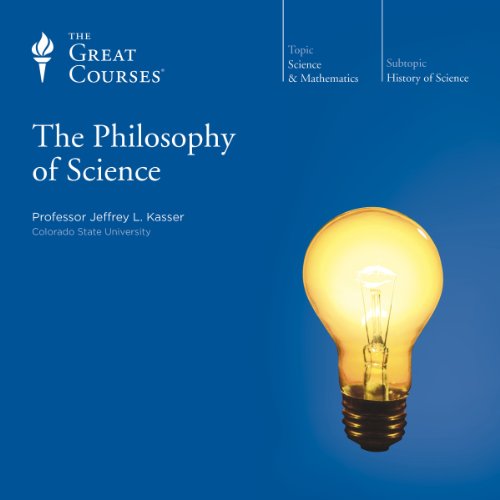
Philosophy of Science
Summary
What makes science science? Why is science so successful? How do we distinguish science from pseudoscience? This exciting inquiry into the vigorous debate over the nature of science covers important philosophers such as Karl Popper, W. V. Quine, Thomas Kuhn, Paul Feyerabend, Imre Lakatos, Carl Hempel, Nelson Goodman, and Bas van Fraassen. These thinkers responded in one way or another to logical positivism, the dominant movement influencing the philosophy of science during the first half of the 20th century - a movement whose eventual demise is an object lesson in how truly difficult it is to secure the logical foundations of a subject that seems so unassailably logical: science. The philosophy of science can be abstract and theoretical, but it is also surprisingly practical. Science plays a pivotal role in our society, and a rigorous study of its philosophical foundations sheds light on the ideas, methods, institutions, and habits of mind that have so astonishingly and successfully transformed our world. In the course of these 36 stimulating lectures, you will investigate a wide range of philosophical approaches to science, including empiricism, constructivism, scientific realism, and Bayesianism. You'll also examine such concepts as natural kinds, bridge laws, Hume's fork, the covering-law model, the hypothetico-deductive model, and inference to the best explanation (mistakenly called "deduction" in the Sherlock Holmes stories). Professor Kasser shows how these and other tools allow us to take apart scientific arguments and examine their inner workings - all the while remaining an impartial guide as you navigate the arguments among different philosophers during the past 100 years. PLEASE NOTE: When you purchase this title, the accompanying reference material will be available in your Library section along with the audio.
©2006 The Teaching Company, LLC (P)2006 The Great Courses

The Lost Art of Good Conversation
Summary
Cutting through all the white noise, chatter, and superficiality our cell phones and social media cause, one of Tibet's highest and most respected spiritual leaders offers simple and practical advice to help us increase our attentions spans, become better listeners, and strive to appreciate the people around us.
In a world of iPhones and connectivity to social media and email, we are all in constant connection with one another. Then why are so many people feeling burned out, distant from colleagues, and abandoned by family and friends? In this new book from the best-selling author of Running with the Mind of Meditation, the Sakyong uses the basic principles of the Shambhala tradition - meditation and a sincere belief in the inherent wisdom, compassion, and courage of all beings - to help listeners to listen and speak more mindfully with loved ones, coworkers, strangers, and even ourselves.
In this easy to understand and helpful book, Sakyong Mipham provides inspiring ideas and practical tips on how to be more present in your day-to-day life, helping us to communicate in ways that elevate the dignity of everyone involved. Great for families, employees and employers, and everyone who spends too much time on Facebook and Instagram and feels disconnected in our connected world, Good Conversation is a journey back to basics.
©2017 Sakyong Mipham (P)2017 Random House Audio

Miracles
Summary
The definitive book on miracles from the New York Times best-selling author of Bonhoeffer, Eric Metaxas. What are miracles, and why do we believe in them? Is it for comfort, to explain the inexplicable, or do we simply long for a connection with something larger than ourselves? And why do some people dismiss them out of hand, as if they can never happen? What Heaven is for Real did for near-death experiences, Miracles does for the miraculous - provides undeniably compelling evidence that there's something real to be reckoned with, whatever one has thought of this topic before. It provides a wide range of real stories of the miraculous and will engage the listener in the serious discussion that this fascinating and rich subject deserves. Miracles is in some ways a more personal, anecdotal, and updated version of C. S. Lewis's 1947 book on the subject. Metaxas's Miracles is an exploration and an exhortation to view miracles as not only possible, but as far more widespread than most of us had ever imagined. Eric Metaxas says it is not a question of whether miracles happen - the evidence that they do is overwhelming in this audiobook alone - but rather, what exactly are miracles, why do they happen, and how can we to understand them in our own lives?
©2014 Eric Metaxas (P)2014 Penguin Audio

The Myth of Sisyphus
Summary
One of the most influential works of this century, The Myth of Sisyphus and Other Essays is a crucial exposition of existentialist thought. Influenced by works such as Don Juan and the novels of Kafka, these essays begin with a meditation on suicide; the question of living or not living in a universe devoid of order or meaning. With lyric eloquence, Albert Camus brilliantly posits a way out of despair, reaffirming the value of personal existence and the possibility of life lived with dignity and authenticity.
©1955 Alfred A. Knopf. Inc. (P)2019 Recorded Books

In the Buddha's Words
Summary
This landmark collection is the definitive introduction to the Buddha's teachings - in his own words. The American scholar-monk Bhikkhu Bodhi, whose voluminous translations have won widespread acclaim, here presents selected discourses of the Buddha from the Pali Canon, the earliest record of what the Buddha taught. Divided into 10 thematic chapters, In the Buddha's Words reveals the full scope of the Buddha's discourses, from family life and marriage to renunciation and the path of insight. A concise, informative introduction precedes each chapter, guiding the listener toward a deeper understanding of the texts that follow. In the Buddha's Words allows even listeners unacquainted with Buddhism to grasp the significance of the Buddha's contributions to our world heritage. Taken as a whole, these texts bear eloquent testimony to the breadth and intelligence of the Buddha's teachings, and point the way to an ancient, yet ever-vital path. Students and seekers alike will find this systematic presentation indispensable. PLEASE NOTE: When you purchase this title, the accompanying reference material will be available in your Library section along with the audio.
©2005 Bhikkhu Bodhi (P)2016 Audible, Inc.

Becoming Animal
Summary
As the climate veers toward catastrophe, the innumerable losses cascading through the biosphere make vividly evident the need for a metamorphosis in our relation to the living land. For too long we've inured ourselves to the wild intelligence of our muscled flesh, taking our primary truths from technologies that hold the living world at a distance. This audiobook subverts that distance, drawing listeners ever deeper into their animal senses in order to explore, from within, the elemental kinship between the body and the breathing Earth. The shapeshifting of ravens, the erotic nature of gravity, the eloquence of thunder, the pleasures of being edible: all have their place in Abram's investigation. He shows that from the awakened perspective of the human animal, awareness (or mind) is not an exclusive possession of our species but a lucid quality of the biosphere itself - a quality in which we, along with the oaks and the spiders, steadily participate. With the audacity of its vision and the luminosity of its prose, Becoming Animal sets a new benchmark for the human appraisal of our place in the whole.
©2010 David Abram (P)2017 Tantor

As Many Reps as Possible
Summary
Jason Khalipa's actions and accomplishments speak for themselves: devoted father, world champion, global businessman. After years of rigorous training, Jason earned the title of fittest man on earth and finished first in the 2008 CrossFit Games. Hard work and insatiable drive paid off, and his company, NCFIT, grew to success. Jason thought he had overcome insurmountable obstacles throughout his career, but nothing prepared him for the moment when his daughter, Ava, was diagnosed with leukemia. Tasked with facing what no parent should have to confront, he had two choices: succumb to overwhelming anger or jump headfirst into the fight. He chose the latter. In his first audiobook, As Many Reps as Possible (AMRAP), Jason reveals the invaluable principles that helped him and his wife dedicate every minute of their lives to Ava's battle. The backbone of Jason's success is a simple and accessible process that, with dedication, will help you take control of life, harness your true potential, and triumph in every way. Borrowing from the fitness idea of completing as many reps as possible of an exercise in a given time period, Jason developed the AMRAP mentality, a proven system that will help you discover your why, focus on what you can control, work hard, and ultimately blow past your goals. With clear insight, personal anecdotes, and directed listener exercises, this audiobook will help you get where you're going, wherever that may be. Be prepared to dream big, dig in your heels, roll up your sleeves, and get to work. The AMRAP mentality is here. Life is waiting for you.
©2018 Jason Khalipa (P)2019 Jason Khalipa

Solitude
Summary
Governor General's Award-winner Michael Harris explores the profound emotional and intellectual benefits of solitude, and how we may achieve it in our fast-paced world.
The capacity to be alone - properly alone - is one of life's subtlest skills. Real solitude is a contented and productive state that garners tangible rewards: It allows us to reflect and recharge, improving our relationships with ourselves and, paradoxically, with others. Today, the zeitgeist embraces sharing like never before. Fueled by our dependence on online and social media, we have created an ecosystem of obsessive distraction that dangerously undervalues solitude. Many of us now lead lives of strangely crowded loneliness - we are ever-connected, but only shallowly so.
Award-winning author Michael Harris examines why our experience of solitude has become so impoverished and how we may grow to love it again in the frenzy of our digital landscape. Solitude is an optimistic and encouraging story about discovering true quiet inside the city, inside the crowd, inside our busy and urbane lives. Harris guides listeners away from a life of ceaseless pings toward a state of measured connectivity, one that balances solitude and companionship.
Rich with true stories about the life-changing power of solitude, and interwoven with reporting from the world's foremost brain researchers, psychologists, and tech entrepreneurs, Solitude is a beautiful and convincing statement on the benefits of being alone.
©2017 Michael Harris (P)2018 Doubleday Canada

The Most Good You Can Do
Summary
Peter Singer's books and ideas have been disturbing our complacency ever since the appearance of Animal Liberation. Now he directs our attention to a new movement in which his own ideas have played a crucial role: effective altruism. Effective altruism is built upon the simple, but profound, idea that living a fully ethical life involves doing the "most good you can do". Such a life requires an unsentimental view of charitable giving: To be a worthy recipient of our support, an organization must be able to demonstrate that it will do more good with our money or our time than other options open to us. Singer introduces us to an array of remarkable people who are restructuring their lives in accordance with these ideas and shows how living altruistically often leads to greater personal fulfillment than living for oneself. The Most Good You Can Do develops the challenges Singer has made to those who donate to the arts, and to charities focused on helping our fellow citizens, rather than those for whom we can do the most good. Effective altruists are extending our knowledge of the possibilities of living less selfishly and of allowing reason, rather than emotion, to determine how we live. The Most Good You Can Do offers new hope for our ability to tackle the world's most pressing problems.
©2015 Yale University (P)2018 Tantor

Moral Tribes
Summary
Our brains were designed for tribal life, for getting along with a select group of others (Us) and for fighting off everyone else (Them). But modern times have forced the world’s tribes into a shared space, resulting in epic clashes of values along with unprecedented opportunities. As the world shrinks, the moral lines that divide us become more salient and more puzzling. We fight over everything from tax codes to gay marriage to global warming, and we wonder where, if at all, we can find our common ground. A grand synthesis of neuroscience, psychology, and philosophy, Moral Tribes reveals the underlying causes of modern conflict and lights the way forward. Greene compares the human brain to a dual-mode camera, with point-and-shoot automatic settings (“portrait,” “landscape”) as well as a manual mode. Our point-and-shoot settings are our emotions—efficient, automated programs honed by evolution, culture, and personal experience. The brain’s manual mode is its capacity for deliberate reasoning, which makes our thinking flexible. Point-and-shoot emotions make us social animals, turning Me into Us. But they also make us tribal animals, turning Us against Them. Our tribal emotions make us fight—sometimes with bombs, sometimes with words—often with life-and-death stakes. An award-winning teacher and scientist, Greene directs Harvard University’s Moral Cognition Lab, which uses cutting-edge neuroscience and cognitive techniques to understand how people really make moral decisions. Combining insights from the lab with lessons from decades of social science and centuries of philosophy, the great question of Moral Tribes is this: How can we get along with Them when what they want feels so wrong to Us? Ultimately, Greene offers a set of maxims for navigating the modern moral terrain, a practical road map for solving problems and living better lives. Moral Tribes shows us when to trust our instincts, when to reason, and how the right kind of reasoning can move us forward. A major achievement from a rising star in a new scientific field, Moral Tribes will refashion your deepest beliefs about how moral thinking works and how it can work better.
©2013 Joshua D. Greene (P)2013 Brilliance Audio, all rights reserved. Excerpt from “My Favorite Things,” music by Richard Rodgers and lyrics by Oscar Hammerstein II. © 1959 by Richard Rodgers and Oscar Hammerstein II. Copyright renewed. Williamson Music owner of publication and allied rights throughout the world. International copyright secured. All rights reserved. Used by permission.