Peter Wickham has narrated 62 audiobooks on Listento.it by 42 authors, with an average listener rating of 4.6★ across 83 ratings. The most-rated is Tallarn.

The Wealth of Nations
Summary
It was Adam Smith (1723-1790) who first established economics as a separate branch of knowledge, and many would say his work has never been surpassed. The Wealth of Nations, which appeared in 1776, is the definitive text for all who believe that economic decisions are best left to markets, not governments. At the heart of Smith's doctrine is an optimistic view of the effects of self-interest. Though each individual seeks only personal gain, the collective result is increased prosperity, which benefits society as a whole. PLEASE NOTE: When you purchase this title, the accompanying PDF will be available in your Audible Library along with the audio.
Public Domain (P)2020 Naxos Audiobooks

The Story of My Life, Volume 3
Summary
The Story of My Life is the explosive and exhilarating autobiography by the infamous libertine Giacomo Casanova. Intense and scandalous, Casanova's extraordinary adventures take the listener on an incredible voyage across 18th-century Europe - from France to Russia, Poland to Spain, and Turkey to Germany, with Venice at their heart. He falls madly in love, has wild flings, and delirious orgies, and encounters some of the most brilliant figures of his time, including Catherine the Great, Louis XV, and Benjamin Franklin. He holds a verbal duel with Voltaire, a pistol duel with a Polish noble, and finds himself hauled before the court multiple times, including in London, where the judge in question turns out to be none other than Henry Fielding. His appetite for life is voracious; for him, a life lived close to the precipice is the only life worth living. The book is divided into six sections. This third volume contains the fifth and sixth sections: the fifth section, "In London and Moscow", and the sixth section, "Spanish Passions". PLEASE NOTE: When you purchase this title, the accompanying PDF will be available in your Audible Library along with the audio.
Public Domain (P)2018 Naxos Audiobooks

The Golden Reef
Summary
When a lifeboat marked 'Valparaiso I' is discovered, a strange mystery unfolds. The Valparaiso had been sunk by a Japanese submarine nearly a year earlier whilst carrying a million pounds of gold bullion. In the lifeboat is a man with a question mark tattooed on his left forearm; but he can shed no light on the situation because his memory has gone - or so he claims. Two other survivors from the Valparaiso, Rains and Jones, have doubts about the man's professed amnesia. They decide to stick around because a million pounds in gold bullion is worth anybody's time and, if necessary, more than a little violence.
©2003 James Pattinson (P)2004 Soundings

The Travels of Marco Polo
Summary
The Travels of Marco Polo is the classic account of Marco Polo's journey to China from Venice, and his discoveries as an emissary to the great Kublai Khan. Polo explores everywhere from Baghdad, Armenia and Russia to the Caspian Sea, the Gobi Desert and the small fishing villages of China, describing the geography, architecture and customs of these exotic places. He tells stories of assassins, cannibals, fantastical animals, feasts and battles, and gives a fascinating account of the multicultural empire of Kublai Khan. The Travels is said to have inspired the voyages of Magellan and Columbus, the latter having kept an annotated copy among his belongings. It remains one of the most entertaining travelogues in existence. PLEASE NOTE: When you purchase this title, the accompanying PDF will be available in your Audible Library along with the audio.
Public Domain (P)2018 Naxos Audiobooks

Stand Up Virgin Soldiers
Summary
The worst has happened. On the eve of their return to Blighty, Brigg and his fellow National Servicemen find themselves sentenced to another six months in Panglin Barracks. Many of the surviving characters from The Virgin Soldiers live again in these pages: dogged Tasker, the odious Sergeant Wellbeloved, the vulnerable Colonel Bromley Pickering, and the comically touching Juicy Lucy. But we encounter new characters too: the fanatical and demented Lieutenant Grainger; the endearing Welshman, Morris Morris - strong as a horse but bafflingly buxom; US Private Clay - mysteriously lost in transit by the American Army; and last, but not least, Bernice Harrison, the sporting nurse who threatens to replace the wayward Lucy in Brigg's affections.
©2005 Leslie Thomas (P)2009 Random House Audio

Democracy in America
Summary
Sent by the French government to examine the American prison system, Alexis de Tocqueville spent nine months touring the United States between 1831 and 1832. However, fascinated by the success of America's democratic system, de Tocqueville took advantage of his stay to examine the country's foundations and glean ideas that might rescue his homeland from the manacles of social inequality. He leaves no stone unturned, exploring each branch of government, the constitution, economics, religion, race, the judiciary, laws, principles, education, culture, and views on wealth and poverty. Many of his observations have been praised for their prescience and foresight, and many are still relevant, offering fresh and piercing insights into American life today. PLEASE NOTE: When you purchase this title, the accompanying PDF will be available in your Audible Library along with the audio.
Public Domain (P)2020 Naxos AudioBooks

Death of an Airman
Summary
George Furnace, flight instructor at Baston Aero Club, dies instantly when his plane crashes into the English countryside. People who knew him are baffled - Furnace was a first-rate pilot, and the plane was in perfect condition - and the inquest records a verdict of death by misadventure. An Australian visitor to the aero club, Edwin Marriott, Bishop of Cootamundra, suspects that the true story is more complicated. Could this be a dramatic suicide - or even murder? Together with Inspector Bray of Scotland Yard, the intrepid bishop must uncover a cunning criminal scheme.
©2015 Introduction Martin Edwards (P)2016 Soundings

The Shining Skull
Summary
Little Marcus Fallbrook was kidnapped in 1976, and when he never returned home, his grieving family assumed the worst. Thirty years later, teenage singing star Leah Wakefield disappears and DI Wesley Peterson has reason to suspect that the same kidnapper is responsible. Meanwhile, archaeologist Neil Watson's gruesome task of exhuming the dead from a local churchyard yields a mystery of its own when a coffin is found to contain one corpse too many: a corpse that may be linked to a strange religious sect dating back to Regency times. As Wesley's investigations pursue the line of recovered memories, he discovers that the past can be a very dangerous place indeed.
©2007 Kate Ellis (P)2007 Soundings

The Blood Pit
Summary
DI Wesley Peterson is called to an unusual crime scene. The victim, Charles Marrick, has been murdered, his body drained of blood. Described by those who knew him as "evil", it seems there won't be a shortage of suspects. But when a popular local vet is murdered in an identical fashion, Wesley wonders what the two men could possibly have in common. Meanwhile, Wesley's archaeologist friend Neil Watson is alarmed when he starts getting disturbing anonymous letters about macabre events at a medieval abbey. Neil fears that the author of the letters is the killer that Wesley is tracking. As the sinister truth unfolds, both Wesley and Neil are forced to face shocking revelations.
©2007 Kate Ellis (P)2008 Soundings

The English Constitution
Summary
Though published in 1867 when the British Empire was approaching its height, Walter Bagehot’s essay "The English Constitution" is not only one of the great political classics but is also an unquestionably relevant document for our times. Despite the passing of more than 150 years, despite huge changes in enfranchisement, in attitudes and in world order, this fascinating document prompts us to re-evaluate the process of government - wherever we live. And what is more, it is written with grace, elegance - and wit! Of course, it is a document of its time. It appeared just as the working classes of Britain were enfranchised by the Reform Act of 1867, which meant that Bagehot had to bring out another edition with an extended introduction. His comments are shrewd in some cases and will raise 21st-century eyebrows in others. Nevertheless, the body of the book remains a clear and astute look at how the famously ‘unwritten’ English Constitution operates, with all its pros and its cons...a system that emerged over centuries to become a unique constitutional monarchy. The work is divided into nine chapters, including "The Cabinet", "The Monarchy", "The House of Lords", "The House of Commons", and "Its Supposed Checks and Balances". Overall, Bagehot (1826-1877) casts an admiring but coolly analytical eye over the whole construction. In a fascinating section, still apposite today, he compares the cabinet government of England with the presidential government of the US, pointing out that in the former, the executive and legislative functions are joined, whereas in the latter they are separated. Not surprisingly, Bagehot unequivocally prefers the former. He salutes the political temperance of English constitutional monarchy - though he acknowledges the performance of the individual on the throne can and does vary with the individual. When he refers appreciatively to his current monarch - ‘she’ - one could almost be excused for thinking that he is speaking of Queen Elizabeth II! This appraisal of the English form of government, which evolved over time rather than being implanted with form and structure complete, is absorbing listening to all who are interested in the governing of societies, politics and England. This is true particularly because of the immense changes and challenges we are experiencing today. A classic commentary on its subject, it is read admirably by Peter Wickham.
Public Domain (P)2020 Ukemi Productions Ltd

The Division Bell Mystery
Summary
Through the double clamour of Big Ben and the shrill sound of the bell rang a revolver shot. A financier is found shot in the House of Commons. Suspecting foul play, Robert West, a parliamentary private secretary, takes on the role of amateur sleuth. Used to turning a blind eye to covert dealings, West must now uncover the shocking secret behind the man's demise, amid distractions from the press and the dead man's enigmatic daughter. Originally published in 1932, this was the only mystery novel to be written by Ellen Wilkinson, one of the first women to be elected to Parliament. Wilkinson offers a unique insider's perspective of political scandal, replete with sharp satire.
©2018 Rachel Reeves MP (P)2019 Soundings

Sea Fury
Summary
It was an oddly assorted company of passengers that boarded the S.S. Chetwynd in Hong Kong and Singapore to take passage to Freemantle. The old vessel, operated by a line that had a poor reputation, was the kind of ship that could hardly attract the finest of officers or crew and was patronised only by the least demanding or affluent of passengers. In this company, living in such close quarters, there was inevitably a certain amount of friction. But human passions would prove insignificant by comparison when the indescribable fury of the storm that hit.
©2004 James Pattinson (P)2005 Soundings

Philosophy of Mind
Summary
Philosophy of Mind is the third and final part of the Encyclopaedia of the Philosophical Sciences, the collection in which Hegel (1730-1831) offered an overview of his life’s work. Though originally written in 1817, he revised it in 1830, thus providing a finished form the year before his death. Hegel used the three parts of the Encyclopaedia - Science of Logic, Philosophy of Nature and Philosophy of Mind - as a basis for lectures at the Universities of Heidelberg which he joined in 1816, and in Berlin in 1820. Philosophy of Mind is itself divided into three parts. Section 1 is titled Mind Subjective - The Soul (with subsections Anthropology, Phenomenology of Mind, and Psychology); section 2 is titled Mind Objective (with subsections Law, The Morality of Consciousness and the Moral Life); and Section 3 Absolute Mind (Art, Revealed Religion, Philosophy). So Hegel follows the development of the human mind through the various layers of consciousness, then institutions and structures of society and finally through art, religion and philosophy. The classic translation by William Wallace is based on Hegel’s final 1830 version.
Public Domain (P)2018 Ukemi Productions Ltd

The Descent of Man, and Selection in Relation to Sex
Summary
First published in 1871, The Descent of Man, and Selection in Relation to Sex sees Darwin apply his evolutionary theory to the human race, controversially placing apes in our family tree. The book covers a range of adjacent themes, including differences between different peoples, the dominance of women in mate choice, and the relevance of evolutionary theory to general society. After the criticism of his On the Origin of Species, Darwin was apprehensive about the possible public reception of The Descent of Man. However, there was an immediate interest in the book, and it had to be reprinted within three weeks of publication, leading a relieved Darwin to remark that "Everybody is talking about it without being shocked". PLEASE NOTE: When you purchase this title, the accompanying PDF will be available in your Audible Library along with the audio.
Public Domain (P)2020 Naxos AudioBooks

Maxwell's Inspection
Summary
There comes a time in every teacher's life when he must face his nemesis - the Ofsted Inspection. On the third day, with the atmosphere at Leighford High decidedly fraught, one of the Inspectors is found stabbed to death. Events move quickly, and the Head is arrested on suspicion of the murder. But Peter Maxwell, Head of Sixth Form, cannot help but notice that Sally Meninger, the Ofsted Humanities expert, is not as distraught at her colleague's death as one might expect. But is it that simple? Aided by his inside informant, lover DS Jacquie Carpenter, Maxwell sets out to prove that the Head is innocent. And the only way to do it is to take on the Inspectors one by one....
©2003 M. J. Trow (P)2005 Soundings

The Great Darkness
Summary
Cambridge, 1939. The opening weeks of the Second World War, and the first blackout - The Great Darkness - covers southern England, enveloping the city. Detective Inspector Eden Brooke, a wounded hero of the Great War, takes his nightly dip in the cool waters of the Cam. Daylight reveals a corpse on the riverside, the body torn apart by some unspeakable force. Brooke investigates, calling on the expertise and inspiration of a faithful group of fellow 'nighthawks' across the city, all condemned, like the detective, to a life lived away from the light. Within hours The Great Darkness has claimed a second victim. War, it seems, has many victims, but what links these crimes of the night?
©2018 Jim Kelly (P)2018 Isis Publishing Ltd

The Enneads Volume 2 (4-6)
Summary
Plotinus (204/5 -270CE), born in Lycopolis, Egypt, when it was part of the Roman Empire, was a major figure in the philosophical school later called Neoplatonism. Neoplatonists viewed reality as deriving from a single force or figure expressed as 'the One'. Two further concepts from Plotinus, 'the Intellect' and 'the Soul', are also principal features of his philosophy. These proposals led to the work of Plotinus forming a bridge between Plato and the monotheistic religions of Christianity, Judaism and Islam as well as Gnosticism. Yet Plotinus, who spoke Greek, did not actually leave a written legacy of his ideas. His work was written down and compiled by a pupil, Porphyry of Tyre (c234-c305 CE). Porphyry presented Plotinus' work in six Enneads, each containing nine Tractates (ennea = nine in Greek), amounting to 54 treatises in all. They were originally arranged into three volumes, but in this Ukemi recording they are divided into two equal parts, Volume One and Volume Two. Volume One contains the first three Enneads prefaced by the fascinating biography written by Porphyry, who describes Plotinus as a highly singular figure - he declined to sit for a painter or sculptor, he wouldn't eat meat from animals reared for the table, and he 'caught philosophy at the age of 20'. This recording is Volume Two, which contains The Enneads 4-6. The Fourth Ennead concerns epistemological matters, opening with 'On the Essence of the Soul' (First Tractate) and concludes with 'Are All Souls One?' The Fifth Ennead is concerned with intellectual matters, opening with 'On the Three Primary Hypostases' and concluding with 'On Intellect, the Forms and Being'. The Sixth Ennead concerns being in general and the One above intellect, opens with 'On the Kinds of Being' and concludes with 'On the Good and the One'. Translated by Stephen MacKenna.
Public Domain (P)2017 Ukemi Productions Ltd
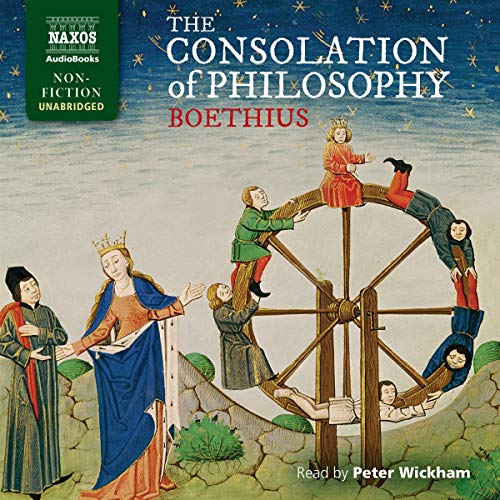
The Consolation of Philosophy
Summary
Charged with treason under Theodoric the Great in sixth-century Rome, Boethius served one year's imprisonment, awaiting trial and eventual execution. During this time, he wrote The Consolation of Philosophy, which would go on to be one of the most popular philosophical works of all time, contributing much to medieval thought and influencing the likes of Dante and Chaucer, as well as Renaissance writers, such as Milton and Shakespeare. Grieving over the injustice of his imprisonment, Boethius meditates on the nature of God, the fickleness of fortune, the idea of free will, why bad things happen to good people, and the nature of happiness. His arguments take the form of a rich and exquisite dialogue between himself and Lady Philosophy and make many allusions to classical Greek and Roman literature in an attempt to create a coherent philosophy that supports his world view. It has been declared a "golden volume not unworthy of the leisure of Plato or Tully" (Edward Gibbon). PLEASE NOTE: When you purchase this title, the accompanying PDF will be available in your Audible Library along with the audio.
Public Domain (P)2019 Naxos Audiobooks

The Elements of Theology
Summary
Proclus - or Proclus of Athens, as he is sometimes known - is widely and rightly considered to be one of the most significant later Neoplatonist philosophers. At age 40 (c.437 CE) or so, Proclus became head of the revived Plato’s Academy in Athens. In his role for the next 50 years, the unmarried Proclus worked hard, combining effectively the roles of administrator, teacher and writer. Astronomy, ethics, mathematics, physics, theology - Proclus tackled all of those topics that together fell under the umbrella of philosophy in his time. The Elements of Theology was his most important work. Elements contains 211 separate propositions. Each proposition, or theorem, is followed by a brief description, or explanation, of the proposition. And each successive proposition builds on those that had come before. Propositions 1 through 112 lay out various Neoplatonic antitheses: 'one' and 'many'; 'cause' and 'effect’; the 'moved' and the 'unmoved'; the 'perpetual' and the 'dated existence in a part of time'; 'wholes and parts'; 'active' and 'passive'; 'finite' and 'infinite'; etc. Propositions 113 through 211 work within and between those now-established antitheses showing the relations between 'divine henads, or gods', 'intelligences' and 'souls.' Translation: Thomas Taylor. This recording opens with a helpful introduction to the life and work of Proclus by Mark G. Spencer.
Public Domain (P)2018 Ukemi Productions Ltd

The Dark Night of the Soul
Summary
At the center of The Dark Night of the Soul (La noche oscura del alma) is a poem written by the 16th century Spanish poet and mystic St John of the Cross. Consisting of eight stanzas, each of five lines, the poem outlines the journey in pursuit of divine union, within which the only source of light comes from the soul. This recording in English includes the poem itself and St John's two accompanying treatises (1584-1585), essentially commentaries, which offer line-by-line explanations of the poem. Many modern listeners have found guidance and consolation in this work. PLEASE NOTE: When you purchase this title, the accompanying PDF will be available in your Audible Library along with the audio.
Public Domain (P)2020 Naxos Audiobooks