Alan Jacobs has 4 audiobooks on Listento.it, narrated by 4 narrators, with an average listener rating of 4.5★ across 17 ratings. The most-rated is How to Think.

How to Think
Summary
How to Think is a contrarian treatise on why we're not as good at thinking as we assume - but how recovering this lost art can rescue our inner lives from the chaos of modern life. As a celebrated cultural critic and a writer for national publications like The Atlantic and Harper's, Alan Jacobs has spent his adult life belonging to communities that often clash in America's culture wars. And in his years of confronting the big issues that divide us - political, social, religious - Jacobs has learned that many of our fiercest disputes occur not because we're doomed to be divided but because the people involved simply aren't thinking. Most of us don't want to think, Jacobs writes. Thinking is trouble. Thinking can force us out of familiar, comforting habits, and it can complicate our relationships with like-minded friends. Finally, thinking is slow, and that's a problem when our habits of consuming information (mostly online) leave us lost in the spin cycle of social media, partisan bickering, and confirmation bias. In this smart, endlessly entertaining book, Jacobs diagnoses the many forces that act on us to prevent thinking - forces that have only worsened in the age of Twitter, "alternative facts", and information overload - and he also dispels the many myths we hold about what it means to think well. (For example: It's impossible to "think for yourself".) Drawing on sources as far-flung as novelist Marilynne Robinson, basketball legend Wilt Chamberlain, British philosopher John Stuart Mill, and Christian theologian C. S. Lewis, Jacobs digs into the nuts and bolts of the cognitive process, offering hope that each of us can reclaim our mental lives from the impediments that plague us all. Because if we can learn to think together, maybe we can learn to live together, too.
©2017 Alan Jacobs (P)2017 Random House Audio

The Narnian
Summary
The White Witch, Aslan, fauns and talking beasts, centaurs and epic battles between good and evil: these have become a part of our collective imagination through the classic volumes of The Chronicles of Narnia. Yet who was the man who created this world? This audiobook attempts to unearth the making of the first Narnian, C. S. Lewis himself. One of the intellectual giants of the twentieth century and arguably the most influential religious writer of his day, Lewis was also an Oxford don and a scholar of medieval literature who loved to debate philosophy at his local pub. Yet one of the most intriguing aspects of Clive Staples Lewis remains unanswered. How did a bachelor professor, nearly 50, and living in a wholly adult world, turn to the writing of stories for children, stories that would become among the most popular and beloved ever written? Alan Jacobs masterfully tells the story of C.S. Lewis. From his childhood days in Ireland to his horrific experiences in the trenches of the First World War, to his friendship with J.R.R. Tolkein (and other members of the "Inklings") and his remarkable late-life marriage to Joy Davidman, Jacobs traces the events and people that shaped Lewis's philosophy, theology, and fiction. The story of a profound mind and extraordinary imagination, The Narnian is a remarkable tale of a man who knew great loss and great delight, but who knew above all that the world holds far more richness and meaning than the average eye can see.
©2005 Alan Jacobs (P)2005 HarperCollins Publishers
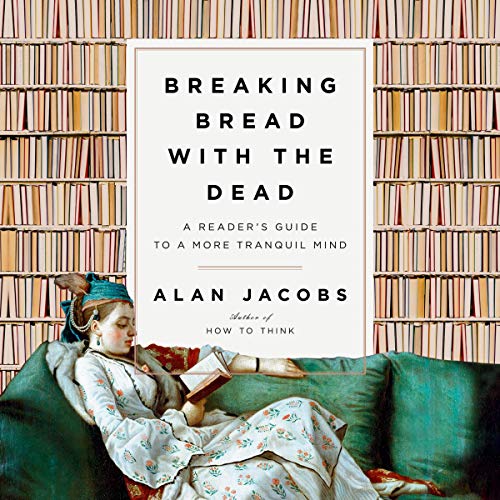
Breaking Bread with the Dead
Summary
From the author of How to Think and The Pleasures of Reading in An Age of Distraction, a literary guide to engaging with the voices of the past to stay sane in the present W. H. Auden once wrote that "art is our chief means of breaking bread with the dead." In his brilliant and compulsively listenable new treatise, Breaking Bread with the Dead, Alan Jacobs shows us that engaging with the strange and wonderful writings of the past might help us live less anxiously in the present - and increase what Thomas Pynchon once called our "personal density." Today we are battling too much information in a society changing at lightning speed, with algorithms aimed at shaping our every thought - plus a sense that history offers no resources, only impediments to overcome or ignore. The modern solution to our problems is to surround ourselves only with what we know and what brings us instant comfort. Jacobs's answer is the opposite: to be in conversation with, and challenged by, those from the past who can tell us what we never thought we needed to know. What can Homer teach us about force? How does Frederick Douglass deal with the massive blind spots of America's Founding Fathers? And what can we learn from modern authors who engage passionately and profoundly with the past? How can Ursula K. Le Guin show us truths about Virgil's female characters that Virgil himself could never have seen? In Breaking Bread with the Dead, a gifted scholar draws us into close and sympathetic engagement with texts from across the ages, including the work of Anita Desai, Henrik Ibsen, Jean Rhys, Simone Weil, Edith Wharton, Amitav Ghosh, Claude Lévi-Strauss, Italo Calvino, and many more. By hearing the voices of the past, we can expand our consciousness, our sympathies, and our wisdom far beyond what our present moment can offer.
©2020 Alan Jacobs (P)2020 Penguin Audio

The Year of Our Lord 1943
Summary
By early 1943, it had become increasingly clear the Allies would win the Second World War. Around the same time, it also became increasingly clear to many Christian intellectuals on both sides of the Atlantic the soon-to-be-victorious nations were not culturally or morally prepared for their success. A war won by technological superiority merely laid the groundwork for a post-war society governed by technocrats. These Christian intellectuals - Jacques Maritain, T. S. Eliot, C. S. Lewis, W. H. Auden, and Simone Weil, among others - sought both to articulate a sober and reflective critique of their own culture and to outline a plan for the moral and spiritual regeneration of their countries in the post-war world. In this audiobook, Alan Jacobs explores the poems, novels, essays, reviews, and lectures of these five central figures, in which they presented, with great imaginative energy and force, pictures of the very different paths now set before the Western democracies. The Year of Our Lord 1943 is the first audiobook to weave together the ideas of these five intellectuals and shows why, in a time of unprecedented total war, they all thought it vital to restore Christianity to a leading role in the renewal of the Western democracies.
©2018 Alan Jacobs (P)2018 HighBridge Company