Ayn Rand has 23 audiobooks on Listento.it, narrated by 16 narrators, with an average listener rating of 4.5★ across 666 ratings. The most-rated is The Fountainhead.

The Fountainhead
Summary
One of the 20th century's most challenging novels of ideas, The Fountainhead champions the cause of individualism through the story of a gifted young architect who defies the tyranny of conventional public opinion. The struggle for personal integrity in a world that values conformity above creativity is powerfully illustrated through three characters: Howard Roarke, the genius who is resented because he creates purely for the delight of his own work and on no other terms; Gail Wynand, the newspaper mogul and self-made millionaire whose power was bought by sacrificing his ideals to the lowest common denominator of public taste; and Dominique Francon, the devastating beauty whose desperate search for meaning has been twisted, through despair, into a quest to destroy the single object of her desire: Howard Roarke. Dramatic, poetic, and demanding, The Fountainhead remains one of the towering books on the contemporary intellectual scene.
©1943 The Bobbs-Merrill Company; 1968 Ayn Rand; 1993 Leonard Peikoff (P)1994 Blackstone Audio Inc.
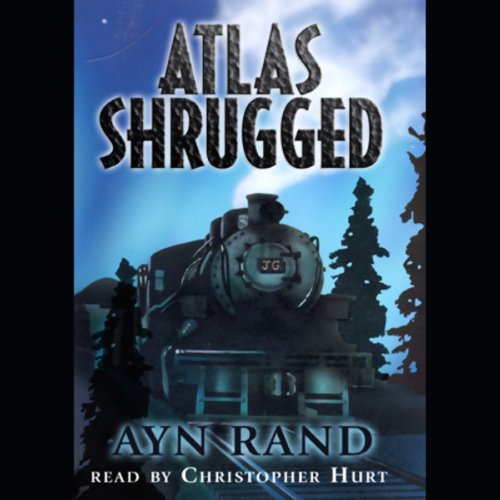
Atlas Shrugged
Summary
Atlas Shrugged is the "second most influential book for Americans today" after the Bible, according to a joint survey conducted by the Library of Congress and the Book of the Month Club. This is the story of a man who said that he would stop the motor of the world - and did. Is he a destroyer or a liberator? Why does he fight his hardest battle not against his enemies, but against the woman he loves? Tremendous in scope, breathtaking in its suspense, Atlas Shrugged is Ayn Rand's magnum opus and launched an ideology and a movement. With the publication of this work in 1957, Rand gained an instant following and became a phenomenon. Atlas Shrugged emerged as a premier moral apologia for capitalism, a defense that had an electrifying effect on millions of readers (and now listeners) who had never heard capitalism defended in other than technical terms.
©1957 Ayn Rand, 1985 renewed Eugene Winick, Paul Gitlin, and Leonard Peikoff, Introduction 1992 Leonard Peikoff (P)1991 Blackstone Audio Inc.

Atlas Shrugged
Summary
In a scrap heap within an abandoned factory, the greatest invention in history lies dormant and unused. By what fatal error of judgment has its value gone unrecognized, its brilliant inventor punished rather than rewarded for his efforts? In defense of those greatest of human qualities that have made civilization possible, one man sets out to show what would happen to the world if all the heroes of innovation and industry went on strike. Is he a destroyer or a liberator? And why does he fight his hardest battle not against his enemies but against the woman he loves? Tremendous in scope and breathtaking in its suspense, Atlas Shrugged is Ayn Rand's magnum opus, an electrifying moral defense of capitalism and free enterprise which launched an ideological movement and gained millions of loyal fans around the world.
©1985 Eugene Winick, Paul Gitlin and Leonard Peikoff (P)2008 Blackstone Audio, Inc.

Atlas Shrugged
Summary
"Who is John Galt?" is the immortal question posed at the beginning of Ayn Rand's masterpiece. The answer is the astonishing story of a man who said he would stop the motor of the world and did. As passionate as it is profound, Atlas Shrugged is one of the most influential novels of our time. In it, Rand dramatizes the main tenets of objectivism, her philosophy of rational selfishness. She explores the ramifications of her radical thinking in a world that penalizes human intelligence and integrity. Part mystery, part thriller, part philosphical inquiry, part volatile love affair, Atlas Shrugged is the book that confirmed Ayn Rand as one of the most popular novelists and most respected thinkers of the 20th century.
©1957 Ayn Rand, renewed 1985 Estate of Ayn Rand (P)2000 HighBridge Company

The Fountainhead
Summary
The Fountainhead studies the conflict between artistic genius and social convention, a theme Ayn Rand later developed into the idealistic philosophy knows as Objectivism. Rand's hero is Howard Roark, a brilliant young architect who won't compromise his integrity, especially in the unconventional buildings he designs. Roark is engaged in ideological warfare with a society that despises him, an architectural community that doesn't understand him, and a woman who loves him but wants to destroy him. His struggle raises questions about society's attitude toward revolutionaries. Since this book's publication in 1943, Rand's controversial ideas have made her one of the best-selling authors of all time.
©1943 The Bobbs-Merrill Company, renewed 1971 Ayn Rand (P)1994 Penguin-HighBridge Audio

Anthem
Summary
"Anthem" is set in a distant collectivist future, when every form and emblem of individualism has been erased and society has reverted to a preindustrial level. In this novella, as many of her writings, Ayn dramatizes her philosophy of Objectivism in the main character. Its hero is a scientist in a world where the pursuit of knowledge is a crime, and he struggles against the established society to discover the meaning of individual freedom.
©2018 Ayn Rand (P)2018 AB Books

The Virtue of Selfishness
Summary
Ayn Rand here sets forth the moral principles of Objectivism, the philosophy that holds human life - the life proper to a rational being - as the standard of moral values and regards altruism as incompatible with human nature, with the creative requirement of survival, and with a free society. Ms. Rand's unique philosophy, Objectivism, has gained a worldwide audience. The fundamentals of her philosophy are set forth in this insightful piece of nonfiction.
©1961 Ayn Rand; 1961 by the Objectivist Newsletter Incorporated (P)2000 Blackstone Audiobooks

Capitalism
Summary
The foundations of capitalism are being battered by a flood of altruism, which is the cause of the modern world's collapse. This was the view of Ayn Rand, a view so radically opposed to prevailing attitudes that it constituted a major philosophic revolution. In this series of essays, she presented her stand on the persecution of big business, the causes of war, the default of conservatism, and the evils of altruism. Here is a challenging look at modern society by a woman who was one of the most provocative intellectuals on the American scene. Ms. Rand's unique philosophy, Objectivism, has gained a worldwide audience.
©1946 Ayn Rand (P)2000 Blackstone Audiobooks

Philosophy
Summary
Who needs philosophy? Ayn Rand's answer: Everyone.
This collection of essays was the last work planned by Ayn Rand before her death in 1982. In it, she summarizes her view of philosophy and deals with a broad spectrum of topics. According to Ayn Rand, the choice we make is not whether to have a philosophy, but which one to have: a rational, conscious, and therefore practical one, or a contradictory, unidentified, and ultimately lethal one.
Written with all the clarity and eloquence that have placed Ayn Rand's objectivist philosophy in the mainstream of American thought, these essays range over such basic issues as education, morality, censorship, and inflation to prove that philosophy is the fundamental force in all our lives.
©1982 Leonard Peikoff, Executor, Estate of Ayn Rand (P)2006 Blackstone Audio Inc.
We the Living
Summary
We the Living portrays the impact of the Russian Revolution on three people who demand the right to live their own lives. At its center is a girl whose passionate love is her fortress against the cruelty and oppression of a totalitarian state. Rand said of this book: "It is as near to an autobiography as I will ever write."
©1936 Ayn Rand (P)1991 Blackstone Audio, Inc.

Return of the Primitive
Summary
In the 1960s and early '70s, the most prominent, vocal cultural movement was the New Left, a movement that condemned America and everything it stood for: individualism, material wealth, science, technology, capitalism. While the New Left achieved limited political success, it brought about vast cultural changes that remain with us to this day. The reason is that while its representatives faced some political opposition, they faced little-to-no fundamental intellectual opposition. Ayn Rand was the exception. In her essays from this period, anthologized in The New Left: The Anti-Industrial Revolution, she opposed the New Left as no one else did. The audience for the book, she wrote, is "all those who are concerned about college students and about the state of modern education" and who are seeking "a voice of reason to turn to". In her essays, Ayn Rand identified the essential evils of the New Left and their cause. Where most viewed the New Left and its violent college protests, its worship of untouched nature, and its orgiastic mob celebrations as some sort of inexplicable, youthful rebellion against the "establishment", Ayn Rand identified these "rebels" as in fact dutiful, consistent practitioners of the ideas taught to them by their teachers. Return of the Primitive is an expanded edition of The New Left. It features the entire contents of the original edition authorized by Ayn Rand, plus two of her other essays, "Racism" and "Global Balkanization", which are highly relevant to today's campuses and world. Additionally, it features three essays written after her death by Peter Schwartz, analyzing some of the ideologies that the New Left helped spawn, such as multiculturalism and environmentalism. For those who seek to understand the state of American culture today, Return of the Primitive is required reading.
©1999 Peter Schwartz (P)2009 Blackstone Audio, Inc.

The Romantic Manifesto
Summary
In this beautifully written and brilliantly reasoned collection of essays, Ayn Rand throws new light on the nature of art and its purpose in human life. Once again, Rand demonstrates her bold originality and her refusal to let conventional ideas define her sense of the truth.
Rand eloquently asserts that one cannot create art without infusing it with one's own value judgments and personal philosophy - even an attempt to withhold moral overtones only results in a deterministic or naturalistic message. Because the moral influence of art is inescapable, she argues, art should always strive to elevate the human spirit.
The Romantic Manifesto takes its place beside The Fountainhead and Atlas Shrugged as one of the most important achievements of our time.
©1971 The Objectivist, Inc. (P)2008 Blackstone Audio, Inc.

Anthem
Summary
Equality 7-2521 is a young man who yearns to understand “the Science of Things”, but he lives in a bleak, dystopian future where independent thought is a crime and where science and technology have regressed to primitive levels. All expressions of individualism have been suppressed in his world: Personal possessions are nonexistent, individual preferences are condemned as sinful, and romantic love is forbidden. Obedience to the collective is so deeply ingrained that the very word “I” has been erased. In pursuit of his quest for knowledge, Equality 7-2521 struggles to answer the questions that burn within him.
Public Domain (P)2019 Dreamscape , LLC

The Voice of Reason
Summary
In the years between her first public lecture in 1961 and her last in 1981, Ayn Rand spoke and wrote about topics as different as education, medicine, Vietnam, and the death of Marilyn Monroe. In The Voice of Reason, these pieces are gathered together in book form for the first time. Written in the last decades of Rand's life, they reflect a life lived on principle, a probing mind, and a passionate intensity. With them are five essays by Leonard Peikoff, Rand's longtime associate and literary executor. The work concludes with Peikoff's epilogue, "My Thirty Years with Ayn Rand: An Intellectual Memoir," which answers the question "What was Ayn Rand really like?" Important reading for all thinking individuals, this collection communicates not only Rand's singular worldview, but also the penetrating cultural and political analysis to which it gives rise.
©1989 the Estate of Ayn Rand and Leonard Peikoff (P)2008 Blackstone Audio, Inc.

Ayn Rand Answers
Summary
After the publication of Atlas Shrugged in 1957, Ayn Rand occasionally lectured in order to bring her philosophy of Objectivism to a wider audience and apply it to current cultural and political issues. These taped lectures and the question-and-answer sessions that followed added not only an eloquent new dimension to Ayn Rand's ideas and beliefs, but a fresh and spontaneous insight into Ayn Rand herself. Here, Rand presents her provocative ideas in a personable question-and-answer session from which one can gain new insights and a fuller appreciation of her thought and a sense of what she was like as a person.
©2008 The Estate of Ayn Rand (P)2008 Blackstone Audio, Inc.

For the New Intellectual
Summary
This is Ayn Rand's challenge to the prevalent philosophical doctrines of our time and the "atmosphere of guilt, of panic, of despair, of boredom, and of all-pervasive evasion" that they create. One of the most controversial figures on the intellectual scene, Ayn Rand was the proponent of a moral philosophy, an ethic of rational self-interest, that stands in sharp opposition to the ethics of altruism and self-sacrifice. The fundamentals of this morality, "a philosophy for living on earth", are here vibrantly set forth by the spokesman for a new class,
For The New Intellectual.
Miss Rand's unique philosophy, Objectivism, has gained a worldwide audience. The fundamentals of her philosophy are set forth in four nonfiction books: Introduction to Objectivist Epistemology, For the New Intellectual, The Virtue of Selfishness, and Capitalism: The Unknown Ideal.
©1961 Ayn Rand (P)2000 Blackstone Audiobooks

The Art of Nonfiction
Summary
In 1958, and again in 1969, Ayn Rand gathered a small group of her friends and acquaintances and gave an informal course on writing. At once a fascinating philosophical discourse on the art of creation and an invaluable guide for the aspiring writer, these edited transcripts are a treasure that will challenge, edify, and illuminate the way to more powerful writing. Rand takes listeners step by step through the writing process, providing insightful observations and invaluable techniques along the way. She discusses the psychological aspects of writing and the roles played by the conscious and subconscious mind. She talks about articles and books, explaining how to select a subject and theme, how to identify your audience, and how to write the first draft.
©2001 Estate of Ayn Rand (P)2003 Blackstone Audiobooks

Ideal
Summary
Author Ayn Rand's novel Ideal, available for the first time ever - a landmark event for fans of the groundbreaking philosopher. Originally conceived as a novel but then transformed into a play by Ayn Rand, Ideal is the story of beautiful but tormented actress Kay Gonda. Accused of murder, she is on the run and turns for help to six fans who have written letters to her, each telling her that she represents their ideal - a respectable family man, a far-left activist, a cynical artist, an evangelist, a playboy, and a lost soul. Each reacts to her plight in his own way, providing a glimpse into their secret selves and their true values. In the end their responses to her pleas give Kay the answers she has been seeking. Ideal was written in 1934 as a novel, but Ayn Rand thought the theme of the piece would be better realized as a play and put the novel aside. Now both versions of Ideal are available for the first time ever to the millions of Ayn Rand fans around the world, giving them a unique opportunity to explore the creative process of Rand as she wrote first a book then a play and the differences between the two.
©1934 Ayn Rand (P)2015 Blackstone Audio, Inc.

Anthem
Summary
Through her fiction, Ayn Rand sought to popularize her self-created philosophy of Objectivism, which advocated a libertarian individualism as the ideal foundation for a healthy society and which staunchly opposed any form of authoritarian control. The classic dystopian novella, Anthem, is one of the earliest books to explore a theme which has become a standard motif in science fiction literature: the search for individualistic expression in a repressive and rigorously organized society.
Public Domain (P)2020 Voices of Today

Three Plays
Summary
Published together for the first time are three of Ayn Rand's compelling stage plays. The courtroom drama Night of January 16th, a 1935 Broadway success famous for leaving the verdict to the audience, is presented here in its definitive, final revised text - a superb dramatization of Rand's vision of human strengths and weaknesses. Also included are two of Rand's unproduced plays: Think Twice, a clever philosophical murder mystery, and Ideal, a bitter indictment of people's willingness to betray their highest values, as symbolized by a Hollywood goddess suspected of a crime and fleeing the authorities.
©1984 Leonard Peikoff, Paul Gitlin, Eugene Winick, Executors of the Estate of Ayn Rand (P)2009 Blackstone Audio, Inc.