Barbara Ehrenreich has 6 audiobooks on Listento.it, narrated by 7 narrators, with an average listener rating of 4.6★ across 21 ratings. The most-rated is Nickel and Dimed.
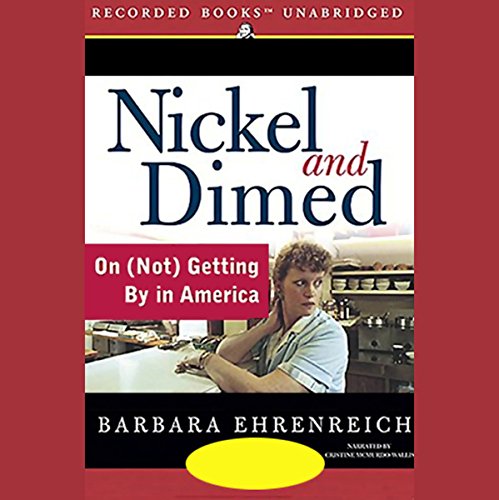
Nickel and Dimed
Summary
This engrossing piece of undercover reportage has been a fixture on the New York Times best seller list since its publication. With nearly a million copies in print, Nickel and Dimed is a modern classic that deftly portrays the plight of America's working-class poor. A successful author, Barbara Ehrenreich decides to see if she can scratch out a comfortable living in a blue-collar America obsessed with welfare "reform". Her first job is waitressing, which pulls in a measly $2.43 an hour plus tips. She moves around the country, trying her hand as a maid, a nursing home assistant, and a Wal-Mart salesperson. What she discovers is a culture of desperation, where workers take multiple thankless jobs just to keep a roof overhead. Often humorous and always illuminating, Nickel and Dimed is a remarkable expose of the ugly flip side of the American dream.
©2001 Barbara Ehrenreich (P)2004 Recorded Books, LLC

Natural Causes
Summary
Best-selling author of Nickel and Dimed, Barbara Ehrenreich explores how we are killing ourselves to live longer, not better. A razor-sharp polemic that offers an entirely new understanding of our bodies, ourselves, and our place in the universe, Natural Causes describes how we overprepare and worry way too much about what is inevitable. One by one, Ehrenreich topples the shibboleths that guide our attempts to live a long, healthy life - from the importance of preventive medical screenings to the concepts of wellness and mindfulness, from dietary fads to fitness culture. But Natural Causes goes deeper - into the fundamental unreliability of our bodies and even our "mind-bodies", to use the fashionable term. Starting with the mysterious and seldom-acknowledged tendency of our own immune cells to promote deadly cancers, Ehrenreich looks into the cellular basis of aging and shows how little control we actually have over it. We tend to believe we have agency over our bodies, our minds, and even over the manner of our deaths. But the latest science shows that the microscopic subunits of our bodies make their own "decisions", and not always in our favor. We may buy expensive antiaging products or cosmetic surgery, get preventive screenings and eat more kale, or throw ourselves into meditation and spirituality. But all these things offer only the illusion of control. How to live well, even joyously, while accepting our mortality - that is the vitally important philosophical challenge of this book. Drawing on varied sources, from personal experience and sociological trends to pop culture and current scientific literature, Natural Causes examines the ways in which we obsess over death, our bodies, and our health. Both funny and caustic, Ehrenreich then tackles the seemingly unsolvable problem of how we might better prepare ourselves for the end - while still reveling in the lives that remain to us.
©2018 Barbara Ehrenreich (P)2018 Hachette Audio
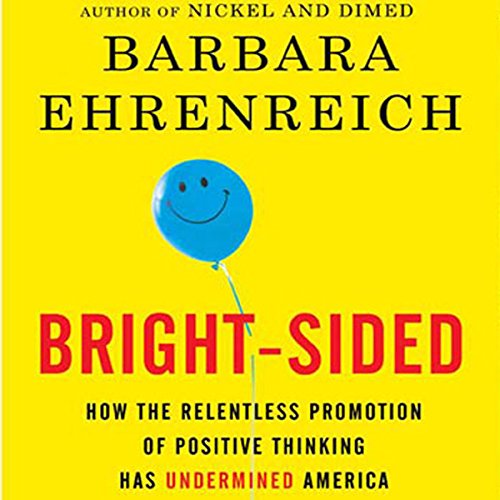
Bright-sided
Summary
Barbara Ehrenreich's Bright-sided is a sharp-witted knockdown of America's love affair with positive thinking and an urgent call for a new commitment to realism. Americans are a "positive" people - cheerful, optimistic, and upbeat: this is our reputation as well as our self-image. But more than a temperament, being positive, we are told, is the key to success and prosperity. In this utterly original take on the American frame of mind, Barbara Ehrenreich traces the strange career of our sunny outlook from its origins as a marginal 19th-century healing technique to its enshrinement as a dominant, almost mandatory, cultural attitude. Evangelical mega-churches preach the good news that you only have to want something to get it, because God wants to "prosper" you. The medical profession prescribes positive thinking for its presumed health benefits. Academia has made room for new departments of "positive psychology" and the "science of happiness." Nowhere, though, has bright-siding taken firmer root than within the business community, where, as Ehrenreich shows, the refusal even to consider negative outcomes - like mortgage defaults - contributed directly to the current economic crisis. With the mythbusting powers for which she is acclaimed, Ehrenreich exposes the downside of America's penchant for positive thinking: On a personal level, it leads to self-blame and a morbid preoccupation with stamping out "negative" thoughts. On a national level, it's brought us an era of irrational optimism resulting in disaster. This is Ehrenreich at her provocative best - poking holes in conventional wisdom and faux science, and ending with a call for existential clarity and courage.
©2009 Barbara Ehrenreich (P)2009 Macmillan Audio

Living with a Wild God
Summary
In middle age, Ehrenreich came across the journal she had kept during her tumultuous adolescence and set out to reconstruct that quest, which had taken her to the study of science and through a cataclysmic series of uncanny - or as she later learned to call them, "mystical" - experiences. A staunch atheist and rationalist, she is profoundly shaken by the implications of her life-long search. Part memoir, part philosophical and spiritual inquiry, Living with a Wild God brings an older woman's wry and erudite perspective to a young girl's uninhibited musings on the questions that, at one point or another, torment us all. Ehrenreich's most personal audiobook ever will spark a lively and heated conversation about religion and spirituality, science and morality, and the "meaning of life." Certain to be a classic, Living with a Wild God combines intellectual rigor with a frank account of the inexplicable, in Ehrenreich's singular voice, to produce a true literary achievement.
©2014 Barbara Ehrenreich (P)2014 Hachette Audio
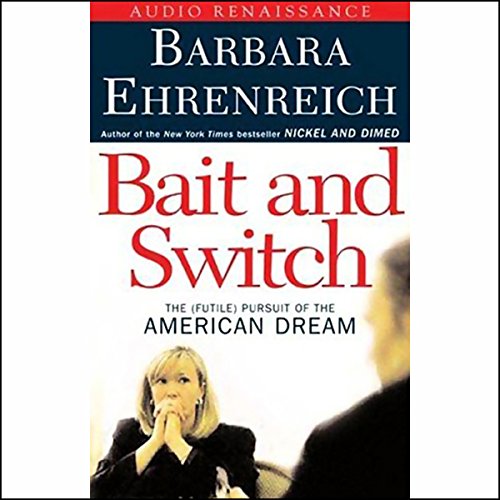
Bait and Switch
Summary
The best-selling author of Nickel and Dimed goes back undercover to do for America's ailing middle class what she did for the working poor. Barbara Ehrenreich's Nickel and Dimed explored the lives of low-wage workers. Now, in Bait and Switch, she enters another hidden realm of the economy: the world of the white-collar unemployed. Armed with a plausible resume of a professional "in transition", Ehrenreich attempts to land a middle class job undergoing career coaching and personality testing, then begins trawling a series of EST-like boot camps, job fairs, networking events, and evangelical job-search "ministries". She gets an image makeover to prepare her for the corporate world and works hard to project the winning attitude recommended for a successful job search. She is proselytized, scammed, lectured, and, again and again, rejected. Bait and Switch highlights the people who've done everything right: gotten college degrees, developed marketable skills, and built up impressive resumes, yet have become repeatedly vulnerable to financial disaster and not simply due to the vagaries of the business cycle. Today's ultra-lean corporations take pride in shedding their "surplus" employees, plunging them, for months or years at a stretch, into the twilight zone of white-collar unemployment, where job-searching becomes a full-time job in itself. As Ehrenreich discovers, there are few social supports for the new disposable workers, and little security even for those who have jobs.
©2005 Barbara Ehrenreich (P)2005 Audio Renaissance, a division of Holtzbrinck Publishers, LLC

Fear of Falling
Summary
A brilliant and insightful exploration of the rise and fall of the American middle class by New York Times best-selling author Barbara Ehrenreich. One of Barbara Ehrenreich's most classic and prophetic works, Fear of Falling closely examines the insecurities of the American middle class in an attempt to explain its turn to the right during the last two decades of the 20th century. Weaving finely-tuned expert analysis with her trademark voice, Ehrenreich traces the myths about the middle class to their roots, determines what led to the shrinking of what was once a healthy percentage of the population, and how, in its ambition and anxiety, that population has retreated from responsible leadership. Newly reissued and timely as ever, Fear of Falling places the middle class of yesterday under the microscope and reveals exactly how we arrived at the middle class of today.
©2020 Barbara Ehrenreich (P)2020 Twelve