Carlos Fuentes has 10 audiobooks on Listento.it, narrated by 10 narrators, with an average listener rating of 4.5★ across 6 ratings. The most-rated is The Death of Artemio Cruz.

The Death of Artemio Cruz
Summary
As the novel opens, Artemio Cruz, the all-powerful newspaper magnate and land baron, lies confined to his bed and, in dreamlike flashes, recalls the pivotal episodes of his life. Carlos Fuentes manipulates the ensuing kaleidoscope of images with dazzling inventiveness, layering memory upon memory, from Cruz’s heroic campaigns during the Mexican Revolution, through his relentless climb from poverty to wealth, to his uneasy death. Perhaps Fuentes’ masterpiece, The Death of Artemio Cruz is a haunting voyage into the soul of modern Mexico.
©1962 Carlos Fuentes. Translation copyright 1991 Farrar, Straus and Giroux. (P)2014 Audible, Inc.

Vlad
Summary
"Vlad" is Vlad the Impaler, of course, whose mythic cruelty was an inspiration for Bram Stoker's Dracula. In this sly sequel, Vlad really is undead. More than a postmodern riff on "the vampire craze", Vlad is also an anatomy of the Mexican bourgeoisie, as well as our culture's ways of dealing with death. For - as in Dracula - Vlad has need of both a lawyer and a real-estate agent in order to establish his new kingdom, and Yves Navarro and his wife Asuncion fit the bill nicely. Having recently lost a son, might they not welcome the chance to see their remaining child live forever? More importantly, are the pleasures of middle-class life enough to keep one from joining the legions of the damned?
©2004, 2012 Carlos Fuentes (P)2012 Dreamscape Media, LLC

The Crystal Frontier
Summary
From Mexico’s preeminent man of letters, "a Balzacian novel in nine masterly stories" (Vanity Fair) that explores the "uneven and painful meshing of two North American cultures" (Washington Post Book World). A New York Times Notable Book of the Year. A Los Angeles Times Best Book of the Year. Translated by Alfred Mac Adam.
©1995 Carlos Fuentes, Translation copyright 1997 by Farrar, Straus and Giroux, Inc. (P)2014 Audible, Inc.

Where the Air Is Clear
Summary
Where the Air Is Clear, Carlos Fuentes' first novel, is an unsparing portrayal of Mexico City's upper class. Departing from a traditional linear narrative, Fuentes overlays Mexican myths onto contemporary settings, showing that even the rich and powerful must succumb to the indomitable spirit of Mexico, which undermines all institutions and shapes all destinies.
©1995 Carlos Fuentes. Translation copyright 1997 Farrar, Straus and Giroux, Inc. (P)2014 Audible, Inc.
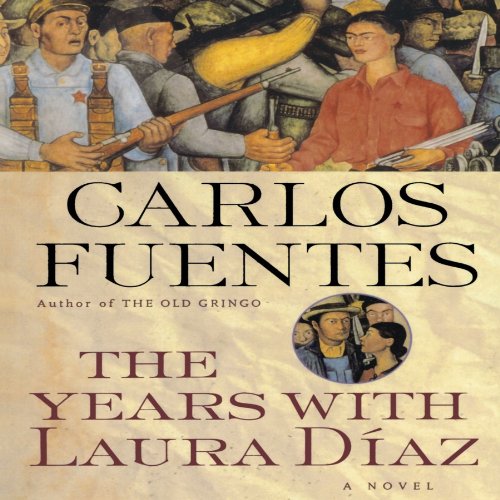
The Years with Laura Diaz
Summary
A radiant and epic new novel that is among the finest achievements of Mexico's greatest man of letters.
The Years with Laura Diaz is Carlos Fuentes' most important novel in several decades. Like his masterpiece The Death of Artemio Cruz, the action begins in the state of Veracruz and moves to Mexico City - tracing a migration during the Revolution and its aftermath that was a feature of Mexico's demographic history and that is a significant element in Fuentes' fictional world.
Now the principle figure is not Artemio Cruz (who, however, makes a brief appearance) but Fuentes' first major female protagonist, the extraordinary Laura Diaz. Carlos Fuentes' richly woven narrative tapestry - filled with a multitude of dramatic scenes both witty, amusing, and heartbreaking - shows us this wonderful creature as she grows into a politically committed artist who is also a wife and mother, a lover of great men, a complicated and alluring heroine whose brave honesty prevails despite her losing a son and grandson to the darkest forces of Mexico's repressive, corrupt regimes. In the end, Laura Diaz herself dies, after a life filled with tragedy and loss, but she is a happy woman, for she has borne witness to, and helped to affect, the course of history and has vindicated the aims and intentions of the highest art.
©1999 Carlos Fuentes. Translation copyright 2000 Farrar, Straus and Giroux, LLC. (P)2014 Audible, Inc.
![Cover art for La muerte de Artemio Cruz [The Death of Artemio Cruz]](https://m.media-amazon.com/images/I/51rLRTCGVML._SL500_.jpg)
La muerte de Artemio Cruz [The Death of Artemio Cruz]
Summary
Un verdadero clásico de la literatura mexicana del siglo XX, que situó a Carlos Fuentes en la vanguardia de lo que algunos años más tarde se conocería como la nueva novela hispanoamericana. La muerte de Artemio Cruz, novela de 1962 de Carlos Fuentes, es una visión panorámica de la historia del México contemporáneo tal como la rememora un industrial y político agonizante. Una reflexión sobre el México surgido de la Revolución Mexicana, pero también de cuestiones tan universales y permanentes como la soledad, el poder o el desamor. Un clásico de la literatura mexicana del siglo XX, que es a su vez una exploración de las posibilidades de representación en la literatura, a través de la superposición de niveles de tiempo, espacio y consciencia narrativos. En su lecho de muerte, durante su último medio día, el anciano y enfermo Artemio Cruz recuerda: no siempre fue ese triste saco de huesos y fermentos corporales; alguna vez fue joven, osado, vigoroso. Y tuvo ideales, sueños, fe. Para defender todo eso, incluso combatió en una revolución. Más la rapiña, la codicia y la corrupción extinguieron su fuego y aniquilaron su esperanza. Tal vez por ello perdió a la única mujer que de verdad lo amó. Las revoluciones las hacen los hombres de carne y hueso y no los santos, y todas acaban por crear una nueva casta privilegiada.... La crítica ha opinado: "Sin duda Carlos Fuentes es uno de los más importantes gestores de la transformación sufrida por la novela hispanoamericana en los últimos años, y La muerte de Artemio Cruz una de sus obras más conocidas. Plantea con intensidad (#) la necesidad de representar una realidad que ya no se presenta a la mente perceptora de manera unívoca, clara, concreta, mensurable en sus leyes de causalidad; por el contrario, todo esfuerzo de captación obliga a imaginarla en diversos estratos, cuyo contenido y contornos de deslinde no son siempre determinables con exactitud." (Hernán Vidal) "Carlos Fuentes organizó esta novela en trece capítulos. En esas escalas, como si fuera un trío de jazz, leemos - escuchamos - un ensamble a contratiempo que va y viene por la mente de un moribundo.... Con esa estructura no convencional, la historia fluye - por distintas fugas - a través de seis décadas del siglo XX mexicano. Desde el rural novecento y hasta la más cosmopolita década de los años sesenta, vemos a Artemio Cruz exhibiendo, a semejanza de algunos de nuestros connacionales públicos, a un tipo que va en un ascenso público constante, pero con una historia interna desintegrada." (Antonio Valle, La Jornada) Please note: This audiobook is in Spanish.
©1962 Carlos Fuentes (P)2020 Penguin Random House Grupo Editorial

Terra Nostra
Summary
One of the great masterpieces of modern Latin American fiction, Terra Nostra is concerned with nothing less than the history of Spain and of South America, with the Indian Gods and with Christianity, with the birth, the passion, and the death of civilizations. Fuentes skillfully blends a wide range of literary forms, stories within stories, Mexican and Spanish myth, and famous literary characters in this novel that is both a historical epic and an apocalyptic vision of modern times. Terra Nostra is that most ambitious and rare of creations - a total work of art.
©1976 Translation copyright 1976 by Farrar, Straus and Giroux, Inc., Originally published in Spanish, copyright 1975 by Editorial Joaquin Mortiz, S.A., Mexico, Afterword 1983 by Milan Kundera (P)2014 Audible, Inc.

Aura (Spanish edition)
Summary
Una de las mejores obras de la narrativa mexicana. Felipe Montero encuentra un día un anuncio en el periódico en el que se ofrece un empleo en la calle Doceles 815, editando las memorias de un general. Atraído por el salario, acepta el trabajo a pesar de su única condición: tiene que vivir en la oscura casona junto con la viuda del militar y su sobrina, la misteriosa Aura, de hermosos ojos verdes y una melena azabache. Aura es una de las novelas icónicas de la literatura mexicana del siglo XX y una de las más importantes de Carlos Fuentes, autor de La muerte de Artemio Cruz. Please note: This audiobook is in Spanish.
©2018 Penguin Random House Grupo Editorial (P)2018 Penguin Random House Grupo Editorial

The Old Gringo
Summary
One of Carlos Fuentes’s greatest works, The Old Gringo tells the story of Ambrose Bierce, the American writer, soldier, and journalist, and of his last mysterious days in Mexico living among Pancho Villa’s soldiers, particularly his encounter with General Tomas Arroyo. In the end, the incompatibility of the two countries (or, paradoxically, their intimacy) claims both men, in a novel that is, most of all, about the tragic history of two cultures in conflict.
©1985 Fonda de Cultura Económica. Translation copyright 1985 by Farrar, Straus and Giroux, Inc. (P)2014 Audible, Inc.

Midnight Obsession
Summary
In Wall Street Journal bestselling author Melinda Leigh's edgy new thriller, Louisa Hancock thought she was safe...but there's a new killer in town. When a mysterious package lands on Louisa Hancock's doorstep, the Philadelphia museum curator can hardly anticipate the nightmare that's about to envelop her. The package is addressed to her father - an expert in Viking culture - and inside is a ninth-century sword, a chilling thank-you note, and photos of two dead bodies in a tableau evoking a Nordic funeral. The gruesome images match a recent crime scene. But before the police can investigate the killer's connection to Louisa's father, Ward Hancock vanishes. Sports bar owner Conor Sullivan wants nothing more than to spend his life with Louisa. Devoted and protective, he refuses to leave her side after her father's disappearance. When a troubled young boxer he's been coaching is suspected of the murders, Conor is pulled in even deeper. Desperate, Louisa and Conor take it upon themselves to find her father, but soon another ritualistic slaying makes it clear there's a Viking-obsessed serial killer on the loose. And he has a new target: Louisa.
©2016 Melinda Leigh. (P)2016 Brilliance Audio, all rights reserved.