David W. Blight has 4 audiobooks on Listento.it, narrated by 6 narrators, with an average listener rating of 5★ across 16 ratings. The most-rated is Frederick Douglass.
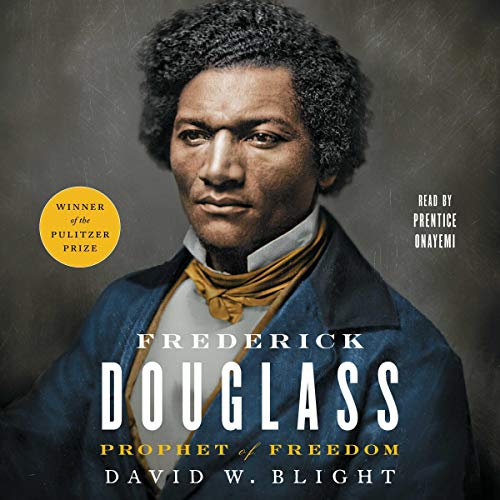
Frederick Douglass
Summary
Pulitzer Prize, History, 2019 The definitive, dramatic biography of the most important African American of the 19th century: Frederick Douglass, the escaped slave who became the greatest orator of his day and one of the leading abolitionists and writers of the era. As a young man, Frederick Douglass (1818-1895) escaped from slavery in Baltimore, Maryland. He was fortunate to have been taught to read by his slave owner mistress, and he would go on to become one of the major literary figures of his time. He wrote three versions of his autobiography over the course of his lifetime and published his own newspaper. His very existence gave the lie to slave owners: with dignity and great intelligence, he bore witness to the brutality of slavery. Initially mentored by William Lloyd Garrison, Douglass spoke widely, often to large crowds, using his own story to condemn slavery. He broke with Garrison to become a political abolitionist, a Republican, and eventually a Lincoln supporter. By the Civil War and during Reconstruction, Douglass became the most famed and widely traveled orator in the nation. He denounced the premature end of Reconstruction and the emerging Jim Crow era. In his unique and eloquent voice, written and spoken, Douglass was a fierce critic of the US as well as a radical patriot. He sometimes argued politically with younger African Americans, but he never forsook either the Republican party or the cause of Black civil and political rights. In this remarkable biography, David Blight has drawn on new information held in a private collection that few other historian have consulted, as well as recently discovered issues of Douglass’ newspapers. Blight tells the fascinating story of Douglass’ two marriages and his complex extended family. Douglass was not only an astonishing man of words, but a thinker steeped in Biblical story and theology. There has not been a major biography of Douglass in a quarter century. David Blight’s Frederick Douglass affords this important American the distinguished biography he deserves.
©2018 David W. Blight (P)2018 Simon & Schuster

Race and Reunion
Summary
No historical event has left as deep an imprint on America's collective memory as the Civil War. In the war's aftermath, Americans had to embrace and cast off a traumatic past. David Blight explores the perilous path of remembering and forgetting, and reveals its tragic costs to race relations and America's national reunion. In 1865, confronted with a ravaged landscape and a torn America, the North and South began a slow and painful process of reconciliation. The ensuing decades witnessed the triumph of a culture of reunion, which downplayed sectional division and emphasized the heroics of a battle between noble men of the Blue and the Gray. Nearly lost in national culture were the moral crusades over slavery that ignited the war, the presence and participation of African Americans throughout the war, and the promise of emancipation that emerged from the war. Race and Reunion is a history of how the unity of white America was purchased through the increasing segregation of black and white memory of the Civil War. Blight delves deeply into the shifting meanings of death and sacrifice, Reconstruction, the romanticized South of literature, soldiers' reminiscences of battle, the idea of the Lost Cause, and the ritual of Memorial Day. He resurrects the variety of African-American voices and memories of the war and the efforts to preserve the emancipationist legacy in the midst of a culture built on its denial. Blight's sweeping narrative of triumph and tragedy, romance and realism, is a compelling tale of the politics of memory, of how a nation healed from civil war without justice. By the early 20th century, the problems of race and reunion were locked in mutual dependence, a painful legacy that continues to haunt us today.
©2001 the President and Fellows of Harvard College (P)2019 Tantor

Narrative of the Life of Frederick Douglass: An American Slave, Written by Himself
Summary
Frederick Douglass (1818-1895) was a former slave and great American abolitionist, author, and orator. Narrative of the Life of Frederick Douglass is his best-selling autobiography, written in 1845.
Public Domain (P)2019 Yashiki Audio

A Slave No More
Summary
Slave narratives are extremely rare. Of the 100 or so of these testimonies that survive, a mere handful are first-person accounts by slaves who ran away and freed themselves. Now, two newly uncovered narratives, and the biographies of the men who wrote them, join that exclusive group. Wallace Turnage was a teenage field-hand on an Alabama plantation, John Washington an urban slave in Virginia. They never met. But both men saw opportunity in the chaos of the Civil War, both escaped North, and both left us remarkable accounts of their flights to freedom. Handed down through family and friends, these narratives tell gripping stories of escape. Working from an unusual abundance of genealogical material, historian David W. Blight has reconstructed Turnage's and Washington's childhoods as sons of white slaveholders and their climb to black working-class stability in the North, where they reunited their families. In A Slave No More, the untold stories of two ordinary men take their place at the heart of the American experience.
©2007 David W. Blight (P)2007 Random House, Inc. Random House Audio, a division of Random House, Inc.