Elizabeth Wayland Barber has 3 audiobooks on Listento.it, narrated by 3 narrators, with an average listener rating of 5★ across 2 ratings. The most-rated is Women's Work.
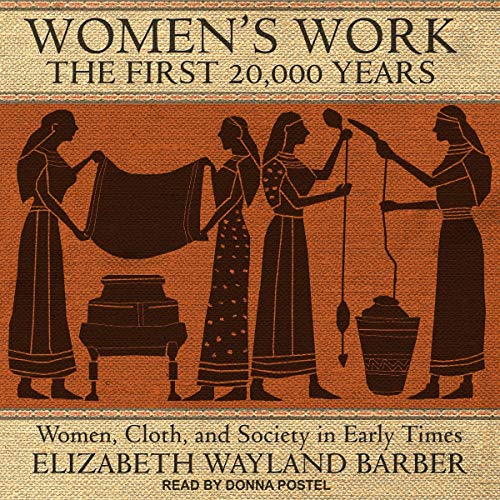
Women's Work
Summary
New discoveries about the textile arts reveal women's unexpectedly influential role in ancient societies. Twenty thousand years ago, women were making and wearing the first clothing created from spun fibers. In fact, right up to the Industrial Revolution the fiber arts were an enormous economic force, belonging primarily to women. Despite the great toil required in making cloth and clothing, most books on ancient history and economics have no information on them. Much of this gap results from the extreme perishability of what women produced, but it seems clear that until now descriptions of prehistoric and early historic cultures have omitted virtually half the picture. Elizabeth Wayland Barber has drawn from data gathered by the most sophisticated newer archaeological methods - methods she herself helped to fashion. In a "brilliantly original book" (Katha Pollitt, Washington Post Book World), she argues that women were a powerful economic force in the ancient world, with their own industry: fabric.
©1994 Elizabeth Wayland Barber (P)2019 Tantor

When They Severed Earth from Sky
Summary
Why were Prometheus and Loki envisioned as chained to rocks? What was the Golden Calf? Why are mirrors believed to carry bad luck? How could anyone think that mortals like Perseus, Beowulf, and St. George actually fought dragons, since dragons don't exist? Strange though they sound, however, these "myths" did not begin as fiction. This absorbing book shows that myths originally transmitted real information about real events and observations, preserving the information sometimes for millennia within nonliterate societies. Geologists' interpretations of how a volcanic cataclysm long ago created Oregon's Crater Lake, for example, is echoed point for point in the local myth of its origin. The Klamath tribe saw it happen and passed down the story - for nearly 8,000 years. We, however, have been literate for so long that we've forgotten how myths encode reality. Recent studies of how our brains work, applied to a wide range of data from the Pacific Northwest to ancient Egypt to modern stories reported in newspapers, have helped the Barbers deduce the characteristic principles by which such tales both develop and degrade through time. Myth is in fact a quite reasonable way to convey important messages orally over many generations - although reasoning back to the original events is possible only under rather specific conditions. Our oldest written records date to 5,200 years ago, but we have been speaking and mythmaking for perhaps 100,000. This groundbreaking book points the way to restoring some of that lost history and teaching us about human storytelling. The book is published by Princeton University Press.
©2004 Princeton University Press (P)2010 Redwood Audiobooks

The Dancing Goddesses
Summary
A fascinating exploration of an ancient system of beliefs and its links to the evolution of dance. From southern Greece to northern Russia, people have long believed in female spirits, bringers of fertility, who spend their nights and days dancing in the fields and forests. So appealing were these spirit-maidens that they also took up residence in 19th-century Romantic literature. Archaeologist and linguist by profession, folk dancer by avocation, Elizabeth Wayland Barber has sleuthed through ethnographic lore and archaeological reports of east and southeast Europe, translating enchanting folktales about these "dancing goddesses" as well as eyewitness accounts of traditional rituals - texts that offer new perspectives on dance in agrarian society. She then traces these goddesses and their dances back through the Romans and Greeks to the first farmers of Europe. Along the way, she locates the origins of many customs, including coloring Easter eggs and throwing rice at the bride. The result is a detective story like no other and a joyful reminder of the human need to dance.
©2013 Elizabeth Wayland Barber (P)2013 Audible, Inc.