Fareed Zakaria has 7 audiobooks on Listento.it, narrated by 6 narrators, with an average listener rating of 4.9★ across 174 ratings. The most-rated is Ten Lessons for a Post-Pandemic World.

Ten Lessons for a Post-Pandemic World
Summary
COVID-19 is speeding up history, but how? What is the shape of the world to come? Lenin once said, “There are decades when nothing happens and weeks when decades happen.” This is one of those times when history has sped up. CNN host and best-selling author Fareed Zakaria helps listeners to understand the nature of a post-pandemic world: the political, social, technological, and economic impacts that may take years to unfold. In the form of 10 straightforward “lessons”, covering topics from globalization and threat-preparedness to inequality and technological advancement, Zakaria creates a structure for listeners to begin thinking beyond the immediate impacts of COVID-19. Ten Lessons for a Post-Pandemic World speaks to past, present, and future, and, while urgent and timely, is sure to become an enduring staple.
©2020 Fareed Zakaria. All rights reserved. (P)2020 Simon & Schuster, Inc. All rights reserved.

The Enneagram
Summary
This runaway best seller shows both the basic logic of the Enneagram and its harmony with the core truths of Christian thought from the time of the early Church forward. Experience author Richard Rohr's expertise and advanced thought on the subject, easily laid out for all audiences. PLEASE NOTE: When you purchase this title, the accompanying PDF will be available in your Audible Library along with the audio.
©2018 Dreamscape Media, LLC (P)2020 Dreamscape Media, LLC

The Post-American World 2.0
Summary
Here is the New York Times and international best seller, revised and expanded with a new afterword. This is the essential update of Fareed Zakaria's analysis about America and its shifting position in world affairs. The Post-American World pointed to the rise of the rest - the growth of countries China, India, Brazil, and others - as the great story of our time, the story that will undoubtedly shape the future of global power. Since its publication, the trends Zakaria identified have proceeded faster than anyone could have anticipated. The 2008 financial crisis turned the world upside down, stalling the United States and other advanced economies. Meanwhile, emerging markets have surged ahead, coupling their economic growth with pride, nationalism, and a determination to shape their own future. In this new edition, Zakaria makes sense of this rapidly changing landscape. With his customary lucidity, insight, and imagination, he draws on lessons from the two great power shifts of the past 500 years - the rise of the Western world and the rise of the United States - to tell us what we can expect from the third shift, the rise of the rest. The great challenge for Britain was economic decline. The challenge for America now is political decline, for as others have grown in importance, the central role of the United States, especially in the ascendant emerging markets, has already begun to shrink. As Zakaria eloquently argues, Washington needs to begin a serious transformation of its global strategy, moving from its traditional role of dominating hegemon to that of a more pragmatic, honest broker. It must seek to share power, create coalitions, build legitimacy, and define the global agenda - all formidable tasks. None of this will be easy for the greatest power the world has ever known - the only power that for so long has really mattered. America stands at a crossroads. In a new global era in which the United States no longer dominates the worldwide economy, orchestrates geopolitics, or overwhelms cultures, can the nation continue to thrive?
©2008 Fareed Zakaria (P)2011 Simon & Schuster

The Future of Freedom
Summary
More democracy means more freedom. Or does it? American democracy is, in many people's minds, the model for the rest of the world. Fareed Zakaria points out that the American form of democracy is one of the least democratic in use today. Members of the Supreme Court and the Federal Reserve, institutions that fundamentally shape our lives, are appointed, not elected. The Bill of Rights enumerates a set of privileges to which citizens are entitled, no matter what the majority says. By restricting our democracy, we enhance our freedom.
©2003 Fareed Zakaria (P)2003 Blackstone Audiobooks

In Defense of a Liberal Education
Summary
New York Times best-selling author of The Post-American World and host of CNN's Fareed Zakaria GPS argues for a renewed commitment to the world's most valuable educational traditions in this fascinating audiobook. The liberal arts educational system is under attack. Governors in Texas, Florida, and North Carolina have announced that they will not spend taxpayer money subsidizing the liberal arts. Majors like English and history - which were once very popular and highly respected - are in steep decline, and President Obama has recently advised students to keep in mind that technical training could be more valuable than a degree in art history when deciding on an educational path. In this timely and urgently needed audiobook, Fareed Zakaria explains that this turn away from the liberal arts is a mistake. A liberal education provides the foundation for finding your voice, writing, speaking your mind, and ultimately learning - all immensely valuable skills no matter your profession. Technology and globalization are making these skills even more valuable and necessary as routine mechanical and even computing tasks can be done by machines. More than just a path to a career, Zakaria argues that a liberal education is an exercise in freedom, and above all it feeds the most basic urge of the human spirit - to know.
©2015 Fareed Zakaria. All rights reserved. (P)2015 Simon & Schuster, Inc. All rights reserved.
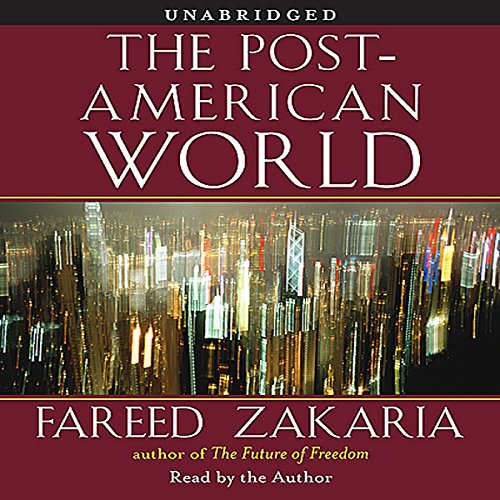
The Post-American World
Summary
For Fareed Zakaria, the great story of our times is not the decline of America but rather the rise of everyone else - the growth of countries such as China, India, Brazil, Russia, South Africa, Kenya, and many, many more.
This economic growth is generating a new global landscape where power is shifting and wealth and innovation are bubbling up in unexpected places. It's also producing political confidence and national pride. As these trends continue, the push of globalization will increasingly be joined by the pull of nationalism - a tension that is likely to define the next decades.
With his customary lucidity, insight, and imagination, Zakaria draws on lessons from the two great power shifts of the past 500 years - the rise of the Western world and the rise of the United States - to tell us what we can expect from the third shift, the "rise of the rest".
Washington must begin a serious transformation of global strategy and seek to share power, create coalitions, build legitimacy, and define the global agenda. None of this will be easy for the greatest power the world has ever known - the only power that for so long has really mattered. But all that is changing now. The future we face is the post-American world.
©2008 Fareed Zakaria (P)2008 Simon and Schuster, Inc.
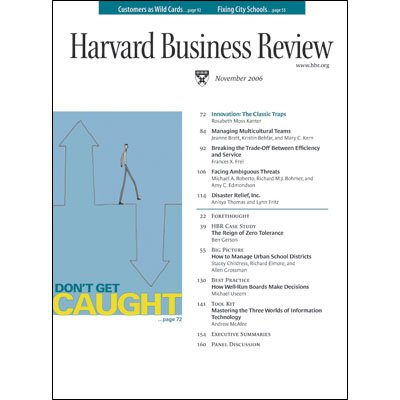
Harvard Business Review, November 2006
Summary
This month's issue includes three complete articles. From "Forethought," Ian Bremmer and Fareed Zakaria explain how to hedge your political risk in China. Then, in "Innovation, The Classic Traps," Rosabeth Moss Kanter offers practical tips on how to keep your creative team from getting bogged down. The third article, by Michael Useem, explores "How Well Run Boards Make Decisions." Plus, you'll hear OnPoint summaries of two other articles: "Breaking the Trade-Off of Efficiency and Services," and "Facing Ambiguous Threats." Finally, you'll get Executive Summaries for the five remaining articles, along with special commentary by Harvard Business Review's Senior Editor Gardiner Morse.
©2006 by the President and Fellows of Harvard College, All Rights Reserved (P)2006 Audible Inc.