Franz Kafka has 19 audiobooks on Listento.it, narrated by 32 narrators, with an average listener rating of 4.2★ across 202 ratings. The most-rated is Metamorphosis.

Metamorphosis
Summary
Benedict Cumberbatch reads Franz Kafka's famous story of man-turned-insect, Metamorphosis.
Winner of AudioFile Earphones Award © AudioFile
After a night of troubled dreams, Gregor Samsa wakes to discover that he has turned into a huge, monstrous, cockroach-like creature, with an armour-plated back and multiple limbs.
Gradually, he comes to terms with his new state - but his parents and sister are horrified and increasingly revolted. To them, Gregor is unclean, verminous and entirely repellent, and as he becomes more and more of a burden, their horror turns to a terrible indifference....
First published in 1915, Kafka's surreal existential novella explores concepts such as the absurdity of life, alienation and the disconnect between mind and body. Read by Benedict Cumberbatch (Sherlock, Star Trek, The Imitation Game), this tale - often described as one of the greatest in the history of fiction - is chilling, captivating and darkly comic.
©2018 BBC Digital Audio (P)2018 BBC Digital Audio

The Metamorphosis
Summary
"This fine version, with David Cronenberg's inspired introduction and the new translator's beguiling afterword, is, I suspect, the most disturbing though the most comforting of all so far; others will follow, but don't hesitate: this is the transforming text for you." (Richard Howard) Franz Kafka's 1915 novella of unexplained horror and nightmarish transformation became a worldwide classic and remains a century later one of the most widely read works of fiction in the world. It is the story of traveling salesman Gregor Samsa, who wakes one morning to find himself transformed into a monstrous insect. This hugely influential work inspired George Orwell, Albert Camus, Jorge Louis Borges, and Ray Bradbury, while continuing to unsettle millions of readers. In her new translation of Kafka's masterpiece, Susan Bernofsky strives to capture both the humor and the humanity in this macabre tale, underscoring the ways in which Gregor Samsa's grotesque metamorphosis is just the physical manifestation of his longstanding spiritual impoverishment.
©2014 Susan Bernofsky. Introduction 2014 David Cronenberg. (P)2014 Audible Inc.

The Trial
Summary
Josef K. is an employee at a bank, an Everyman without any particular qualities or ambitions. His inconsequence makes doubly strange his "arrest" by an officer of the court, made with no formal charges or explanation. Disoriented and consumed with guilt for a "crime" he does not understand, Josef K. must justify his life to a "court" with which he cannot communicate. The defendant can only ask questions, but receives no answers to clarify the surreal world in which he is compelled to wander. Through the court's relentless bureaucratic proceedings and absurd juxtapositions of different hypotheses of cause and effect, the whole rational structure of the world is undermined. The trial of Josef K. becomes a chilling existential metaphor for life itself, where every sentence is a sentence of death.
©1998 Schocken Books, Inc. (P)1998 Blackstone Audio, Inc.

The Trial
Summary
Brought to you by Penguin. This Penguin Classic is performed by Kobna Holdbrook-Smith, winner of the 2019 Laurence Olivier Award for Best Actor in a Musical. A terrifying psychological trip into the life of one Joseph K., an ordinary man who wakes up one day to find himself accused of a crime he did not commit, a crime whose nature is never revealed to him. Once arrested, he is released, but must report to court on a regular basis - an event that proves maddening, as nothing is ever resolved. As he grows more uncertain of his fate, his personal life - including work at a bank and his relations with his landlady and a young woman who lives next door - becomes increasingly unpredictable. As K. tries to gain control, he succeeds only in accelerating his own excruciating downward spiral.
Public Domain (P)2019 Penguin Audio

The Castle
Summary
This new edition of Kafka's terrifying and comic masterpiece is the product of an international team of experts who used Kafka's original text and notes to render this story as close to the author's vision as possible. Kafka's final novel tells the haunting tale of a man's relentless struggle with authority in order to gain entrance to the Castle. The story of K - the unwanted land surveyor who is never to be admitted to the Castle and yet cannot go home - seems to depict, like a dream from the deepest recesses of consciousness, an inexplicable truth about the nature of existence. A perpetual human condition lies at the heart of this labyrinthine world: dualities of certainty and doubt, hope and fear, reason and nonsense, harmony and disintegration. An unfinished novel that feels strangely complete, The Castle uses absurd fantasy to reveal a profound truth.
©1998 Schocken Books, Inc. (P)1998 Blackstone Audio, Inc.
The Metamorphosis
Summary
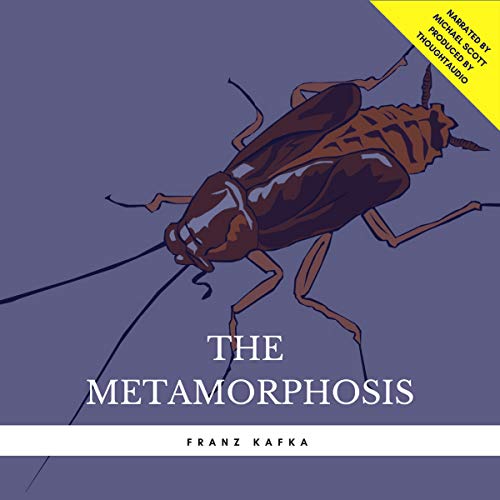
"The Metamorphosis", first published in 1915, is the story of Gregor Samsa, a young traveling salesman who lives with his family and financially supports his parents and younger sister. One morning he awakes to discover that during the night he has been transformed into a horrible bug. Although somewhat of a horror genre, the story is often very funny as Gregor, his family, and those around him deal with their own transformations as a result of this odd predicament.
©2018 Franz Kafka (P)2018 AB Books

Der Process
Summary
Der bekannteste und vielleicht bedeutendste Roman der Weltliteratur ist ein Fragment. Im Sommer 1914 begann Franz Kafka mit der Arbeit, machte rasche Fortschritte, schloss aber die Arbeit bereits im Januar 1915 ab und überließ das Manuskript im unvollendeten Zustand, in einer Mappe, als ungeordnete Sammlung von einzelnen Kapiteln. Sein langjähriger Freund Max Brod veröffentlichte den Roman ein Jahr nach Kafkas Tod im Jahr 1925 in seiner bis heute befolgten Sortierung der Kapitel. "Jemand mußte Josef K. verwechselt haben, denn ohne daß er etwas Böses getan hätte, wurde er eines Morgens verhaftet." Mit den wohl auch berühmtesten Eingangsworten beginnt die Erzählung mit der geheimnisvollen Verhaftung des 30-jährigen Bank-Prokuristen Josef K. durch rätselhafte Herren in Gestalt zweier Wächter und eines Aufsehers. Josef K. ist - so erfährt er schließlich - wohl verhaftet, kann aber sein Leben weiterführen ohne in seiner "gewöhnlichen Lebensweise (...) gehindert" zu sein. So gerät Josef K., der bis dahin das liderliche Leben eines Typus der Moderne, eines "Rechners" geführt hat, von nun immer mehr in eine Leidenschaft, das "Gericht" selbst zu suchen. In einem Gebäude, das er aufsucht stellt er etwa fest, dass er eigentlich hinter jeder Tür das Gericht auffinden werde. Auf weiteren Stationen, nach vergeblichen Hilfe-Stellungen durch Advokaten und Frauenbekanntschaften, gibt ihm ein Künstler den Hinweis, dass ja "alles das Gericht" sei. Im zentralen Dom-Kapitel erhält Josef K. im Gespräch mit dem Geistlichen und durch dessen Erzählung der "Türhüterlegende" weitere Hinweise. In gewisser Weise zeigt sich bei Josef K. eine Entwicklung. Im Nachlasskapitel "Fahrt zur Mutter" schließlich deutet sich eine Besinnung und Selbstermächtigung an. In der ausgesonderten Erzählung "Ein Traum", eine Versöhnung mit dem Tod. Die Hinrichtung Josef K.'s im Schlusskapitel - Kafka hatte dieses Kapitel neben dem Eingangs-Kapitel zuerst verfasst - lässt den Erfolg einer Umwendung und Neuorientierung Josef K.'s offen. In deiner Audible-Bibliothek findest du für dieses Hörerlebnis eine PDF-Datei mit zusätzlichem Material.
©2019 onomato verlag (P)2019 onomato verlag

The Metamorphosis and Other Stories
Summary
In the bizarre world of Franz Kafka, salesmen turn into giant bugs, apes give lectures at college academies, and nightmares probe the mysteries of modern humanity’s unhappiness. More than any other modern writer in world literature, Kafka captures the loneliness and misery that fill the lives of 20th-century humanity. The Metamorphosis and Other Stories reveals the author’s extraordinary talent in a variety of forms—prose poems, short stories, sketches, allegories, and novelettes—and showcases the straight–faced humor, startling psychological insight, and haunting imagination for which he is revered as a modern master. In this brilliant new translation, prize–winning translator Joachim Neugroschel preserves the delicate balance, rich timbre, and wondrous language of Kafka’s original works. In addition to "The Metamorphosis", this collection includes "Early Stories", "Contemplation", "The Judgement", "The Stoker", "In the Penal Colony", and "A Country Doctor".
Public Domain (P)1995 Recorded Books, LLC

Amerika
Summary
A Brilliant new translation of the great writer's least Kafkaesque novel, based on a German-language text that was produced by a team of international scholars and that is more faithful to Kafka's original manuscript than anything we have had before. With the same expert balance of precision and nuance that marked his translation of Kafka's The Castle, the award-winning translator Mark Harman now restores the humor and particularity of language to Amerika. Here is the story of 17-year-old Karl Rossman, who, following a scandal involving a housemaid, is banished by his parents to America. With unquenchable optimism and in the company of two comic-sinister companions, he throws himself into misadventure after misadventure, eventually landing in Oklahoma, where a career in the theater beckons. Like much of Kafka's work, Amerika remained unfinished at the time of his death. Though we can never know how Kafka planned to end the novel, Mark Harman's superb translation allows us to appreciate as closely as possible, what Kafka did commit to the page.
©2008 Preface and Translation © 2008 Mark Harmon. Publisher's note © 2008 Shocken Books a Division of Random House, Inc. This translation is based on the German language text , Der Verschollebe Kritische Ausguabe, edited by Jost Schillemeit, published by S.Fisher Verlag, Frankfurt am Main, in 1983. (c) 1983 by Schoken Books, a division of Random House,Inc. Amerika was originally published in German in different form by Kurt Wolff Verlag A.G.,Munich ,in 1927, (P)2009 Gildan Media Corp

The Best of Franz Kafka's Short Stories
Summary
Lotte Lenya reads "Up In The Gallery", "The Cares of a Family Man", "The Bucket Rider", "A Hunger Artist", and "A Fratricide".
©2011 Saland Publishing (P)2011 Saland Publishing

The Trial
Summary
One of the great works of the 20th century, Kafka's The Trial has been read as a study of political power, a pessimistic religious parable, or a crime novel where the accused man is himself the problem. In it, a man wakes up one morning to find himself under arrest for an offence which is never explained. Faced with this ambiguous but threatening situation, Josef K. gradually succumbs to its psychological pressure. One of the iconic figures of modern world literature, Kafka writes about universal problems of guilt, responsibility, and freedom. He offers no solutions, but provokes his listeners to arrive at meanings of their own. Mike Mitchell's translation captures Kafka's distinctive style. Based on the best available German text, it includes not only the main text but the chapters Kafka left incomplete.
©2009 Translation © Mike Mitchell, Editorial material © Ritchie Robertson (P)2012 Audible, Inc.

Metamorphosis
Summary
As travelling salesman Gregor Samsa awoke one morning from uneasy dreams, he found himself transformed in his bed into a gigantic insect. He was lying on his hard - as if it were armor-plated - back, and when he lifted his head a little he could see his domelike brown belly divided into stiff arched segments, on top of which the bed quilt could hardly stay in place and was about to slide off completely. His numerous legs, which were pitifully thin compared to the rest of his bulk, waved helplessly before his eyes.
Public Domain (P)2016 Cherry Hill Publishing, LLC

La Tana
Summary
La tana è uno degli ultimi racconti di Franz Kafka, scritto durante la sua permanenza a Berlino nel 1923, all'incirca sei mesi prima della morte. Il racconto narra dei continui disperati sforzi intrapresi da un protagonista - per metà umano e per metà animale - di costruirsi un'abitazione perfetta, così da potersi proteggere efficacemente dai suoi nemici invisibili. In tutto il testo (rimasto incompiuto) vi è l'idea ossessiva di riuscir a realizzare una complessa opera architettonica, e dalla paura d'esser attaccato da potenziali nemici i quali però non danno mai prova d'esistenza reale: la tana, creata in questa costante ricerca di perfezione, non produce però quella pace e tranquillità che s'attendeva di trovare ma, piuttosto, ciò gli provoca ansie crescenti. Franz Kafka è uno dei più celebri interpreti della complessità del vissuto umano e delle angosce che turbano la nostra epoca. Nacque a Praga nel 1883, figlio di un agiato negoziante, gretto e autoritario, con cui visse sempre in conflitto. Trascorse un’esistenza apparentemente monotona e priva di grandi avvenimenti. Poco dopo la laurea s’impiegò in un ente pubblico, dove rimase fino a due anni prima della sua prematura scomparsa nel 1924.
©2020 SAGA Egmont (P)2020 SAGA Egmont

Il Castello
Summary
"Il Castello" (Das Schloß), pubblicato postumo nel 1926, è un romanzo incompiuto, spesso oscuro, paradossale e a volte surreale, centrato sui temi della burocrazia, della legge come ordine globale, dell'alienazione e della frustrazione continua dell'uomo che tenta di integrarsi in un sistema che mentre lo invita, contemporaneamente lo allontana, emarginandolo. Le vicende dell'agrimensore K. rappresentano la proiezione dell'impotenza e delle frustrazioni dell'uomo moderno, il quale si trova schiacciato da una realtà che sfugge ai suoi criteri di valutazione. Il protagonista si sente ovunque solo e alienato, il suo rapporto con il mondo esterno è completamente compromesso, e la presenza cupa e minacciosa del castello rappresenta un'entità superiore negativa che finisce per determinare e opprimere l'esistenza dell'uomo. In questa prospettiva, si è perduto il senso di ogni cosa. Il romanzo di Kafka ha dato vita a numerose interpretazioni critiche nel corso del Novecento: da quella teologica dell'amico Max Brod curatore dell'opera, a quella psicoanalitica di Fromm e altri, da quella sociologica di Adorno, Benjamin e Lukacs a quella filosofica di Guattari e Deleuze. Traduzione di Marlene McLoughlin e Alberto Rossatti, illustrazione di copertina di Marlene McLoughlin.
©2018 il Narratore S.r.l. (P)2018 il Narratore S.r.l.

Thalia Book Club: Studio 360 Explores Franz Kafka's The Metamorphosis
Summary
The Metamorphosis, first published in 1915, has captivated readers and artists for 100 years. Studio 360's Kurt Andersen leads spirited conversation exploring the classic story and its impact on arts and culture with guests Ben Marcus (Leaving the Sea), Helen Phillips (The Beautiful Bureaucrat), Eric Jarosinski (NeinQuarterly), and translator Susan Bernofsky. With a reading by Heather Burns (Bored to Death).
©2015 Symphony Space (P)2015 Symphony Space

I racconti di Franz Kafka
Summary
Ne "I racconti", di Franz Kafka, l’assurdo, la beffa, l’inganno, l’imponderabile della condizione umana, affiorano senza contaminare e appesantire, questo ineguagliabile capolavoro della letteratura di tutti i tempi. L’autore descrive con una sorta di discrezione, di uomini condannati a vivere in un mondo spesso estraneo e ostile, con un genio e una capacità di coinvolgere ed emozionare, che in questa versione è esaltata dall’eccellente interpretazione degli attori, e dall’ambientazione arricchita da un sound design che fa vivere un’esperienza sonora esaltante. In questo audiolibro: La Sentenza; La Metamorfosi; Il nuovo avvocato; Un medico di campagna; Nella colonia penale; In Galleria.
©2012 Public Domain (P)2012 GOODmood

Der Verschollene
Summary
New York zu Beginn des 20. Jahrhunderts. Der siebzehnjährige Karl Roßmann wird wegen eines erotischen Verhältnisses mit einem Dienstmädchen von seinen Eltern hart bestraft: Sie schicken ihn nach Amerika. Mit großen Augen sucht er seinen Platz in dieser neuen Welt, die ihn zunächst mit offenen Armen empfängt. Alles scheint möglich. Doch der amerikanische Traum trügt und wendet sich allzu bald in sein Gegenteil.
©2011 Der Hörverlag in der Verlagsgruppe Random House GmbH, München (P)2011 Südwestrundfunk
![Cover art for A Metamorfose [The Metamorphosis]](https://m.media-amazon.com/images/I/51NSn8a1-GL._SL500_.jpg)
A Metamorfose [The Metamorphosis]
Summary
“Numa manhã, ao despertar de sonhos inquietantes, Gregório Samsa deu por si na cama transformado em um gigantesco inseto.” É assim que começa a história do caixeiro viajante Gregório, publicada em 1915 e que se tornou a obra mais conhecida e estudada de Kafka. O texto aborda as relações humanas em meio à sociedade burocrática, misturando absurdo, tragédia e realismo, temas recorrentes nos trabalhos deste mestre da literatura ficcional. Please note: This audiobook is in Portuguese.
Public Domain (P)2018 Audible, Inc.

La Metamorfosis
Summary
Este audiolibro está narrado en Español neutral. La historia comienza cuando Gregorio Samsa despierta de un sueño intranquilo y se da cuenta de que se convirtió en un monstruoso insecto con innumerables patas, un abdomen abombado, un caparazón y nuevas y fuertes mandíbulas. La transformación de Gregorio, un viajante de comercio de telas, desencadena una serie de problemas para él y su familia, compuesta por sus padres y su hermana, debido a que es el único sostén de los Samsa. Desde entonces, en la casa se vive una mezcla de emociones y determinadas situaciones que llegan al límite por la presencia de más personajes. La situación de Gregorio empeora y se convierte en un problema y en una vergüenza, mientras las relaciones familiares empiezan a tensarse hasta hacer imposible la convivencia. Es un relato desolador que logra conmover al lector de principio a fin. Escrito en 1912 y publicado en 1916, este clásico inaugura la literatura del absurdo y es considerado una de las obras maestras del siglo XX por sus innegables rasgos precursores y por el caudal de ideas e interpretaciones que ha suscitado. Franz Kafka (1883-1924) es un autor de origen judío, nacido en Praga, que escribía en lengua alemana. Su obra constituye una de las cumbres de la literatura alemana, y se cuenta entre las más influyentes e innovadoras del siglo XX. Miembro destacado de la Escuela de Praga, su escritura se caracterizó por una marcada vocación metafísica y una síntesis de absurdo, ironía, lucidez, pesimismo y atmósferas asfixiantes, todo lo cual ha dado lugar al término kafkiano, que alude precisamente a autores cuyas obras se encuentran influidas por Kafka y que presentan estas características. Su obra más celebrada es La metamorfosis, publicada en 1915. Además, fue autor de otras importantes novelas aunque inacabadas, como El proceso, América o El castillo.
©2020 SAGA Egmont (P)2020 SAGA Egmont