Friedrich Nietzsche has 34 audiobooks on Listento.it, narrated by 27 narrators, with an average listener rating of 4.4★ across 406 ratings. The most-rated is Metro 2034.

Metro 2034
Summary
The Metro books have put Dmitry Glukhovsky in the vanguard of Russian speculative fiction alongside the creator of Night Watch, Sergei Lukyanenko. A year after the events of Metro 2033, the last few survivors of the apocalypse, surrounded by mutants and monsters, face a terrifying new danger as they hang on for survival in the tunnels of the Moscow Metro. Featuring blistering action, vivid and tough characters, claustrophobic tension and dark satire, the Metro books have become bestsellers across Europe.
©2009 Dmitry Glukhovsky; English translation 2013 Andrew Bromfield (P)2014 Audible Inc.

Beyond Good and Evil
Summary
Continuing where Thus Spoke Zarathustra left off, Nietzsche's controversial work Beyond Good and Evil is one of the most influential philosophical texts of the 19th century and one of the most controversial works of ideology ever written. Attacking the notion of morality as nothing more than institutionalised weakness, Nietzsche criticises past philosophers for their unquestioning acceptance of moral precepts. Nietzsche tried to formulate what he called "the philosophy of the future". Alex Jennings reads this new translation by Ian Johnston. PLEASE NOTE: When you purchase this title, the accompanying reference material will be available in your Library section along with the audio.
©2008 Naxos Audiobooks (P)2008 Naxos Audiobooks

Thus Spoke Zarathustra
Summary
Thus Spoke Zarathustra is one of the most extraordinary - and important - texts in Western philosophy. It was written by Friedrich Nietzsche between 1883 and 1885. He cast it in the form of a novel in the hope that his urgent message of the 'death of God' and the rise of the superman (Ubermensch) would have greater emotional as well as intellectual impact. Though tarnished somewhat by inappropriate adoption by the Nazi movement in the mid-20th century, Zarathustra remains an immensely important and influential work, particularly as it exhorts the individual to question standard conventions of society in order to pursue a truly ethical and spiritual path. After 10 years in solitude in the mountains, Zarathustra decides it is time to return to the world so that people can benefit from the fruits of his pondering: 'I would like to bestow and distribute, until the wise have once more become joyous in their folly, and the poor happy in their riches.' Thus Spoke Zarathustra is a challenging text, but once encountered and absorbed, it cannot be forgotten for both its content and style. Translation: Thomas Common - revised and updated.
Public Domain (P)2015 Ukemi Productions Ltd

On the Genealogy of Morals
Summary
This is one of the most accessible of Nietzsche's works. It was published in 1887, a year after Beyond Good and Evil, and he intended it to be a continuation of the investigation into the theme of morality. In the first work, Nietzsche attacked the notion of morality as nothing more than institutionalized weakness, and he criticized past philosophers for their unquestioning acceptance of moral precepts. In On the Genealogy of Morals, subtitled "A Polemic", Nietzsche furthers his pursuit of a clarity that is less tainted by imposed prejudices. He looks at the way attitudes towards 'morality' evolved and the way congenital ideas of morality were heavily colored by the Judaic and Christian traditions. PLEASE NOTE: When you purchase this title, the accompanying reference material will be available in your Library section along with the audio.
Public Domain (P)2013 Naxos AudioBooks

Friedrich Nietzsche Collection: Thus Spoke Zarathustra and Beyond Good and Evil
Summary
Enjoy this Friedrich Nietzsche collection combining two of Nietzsche's most noteworthy pieces, Thus Spoke Zarathustra and Beyond Good and Evil, into one audiobook!
Public Domain (P)2018 Combray Media

The Will to Power
Summary
Nietzsche never recovered from his mental breakdown in 1889 and therefore was unable to further any plans he had for the ‘magnum opus’ he had once intended, bringing together in a coherent whole his mature philosophy. It was left to his close friend Heinrich Köselitz and his sister Elizabeth Förster-Nietzsche to go through the remaining notebooks and unpublished writings, choosing sections of particular interest to produce The Will to Power, giving it the subtitle An Attempted Transvaluation of All Values. It was published in 1901, was expanded in subsequent years and was translated into English in its expanded form in 1910 by Anthony M Ludovici, who had done so much to bring Nietzsche’s work to the English-speaking public. Ludovici explains that for Nietzsche, the Will to Power was the fundamental principle of all life, a view that could be found in many of his earlier texts, including Thus Spoke Zarathustra: ‘Where there is life, there is also will: not, however, Will to Life, but - so teach I thee - Will to Power!’ (In this, Nietzsche was concerned to overtake Schopenhauer’s concept of the ‘Will to Live’.) This posthumous compilation is arranged in four books (divided into 1,067 sections): European Nihilism A Criticism of the Highest Values That Have Prevailed Hitherto The Principles of a New Valuation Discipline and Breeding Among the themes given prominence by this compilation - and it is, it must be remembered, basically an anthology - are nihilism, metaphysics and the future of Europe. Nietzsche identified Christianity (and its claim to be ‘higher and better’) and its ‘meek/weak’ attitude as one cause of the nihilism that so concerned him. Another side of the coin was the ineluctable basic human nature of ’the will to power’. Deny that, and nihilism results. But passive nihilism (following the breakdown of social conventions, including conventional religion) can be counteracted by active nihilism and the role of the ‘ubermensch’, the self-reliant. In aphorism after aphorism he argued for the creation of new values based on acceptance that there is nothing beyond ourselves. It remains his conviction that it is the men who are the masters of themselves - a dominating elite - who must lead. But a deeply human initiative, not the creation of a master race! Aphorism 22 posits, ‘Nihilism. It may be two things: A. Nihilism as a sign of enhanced spiritual strength: active Nihilism. B. Nihilism as a sign of the collapse and decline of spiritual strength: passive Nihilism.’ Nietzsche’s powerful, uncompromising language continues right to the closing moments, where he concludes, ‘And even you yourselves are this will to power - and nothing besides!’ Translation by Anthony M Ludovici.
Public Domain (P)2019 Ukemi Productions Ltd

Human, All Too Human
Summary
It was with Human, All Too Human, first published in 1878, that Nietzsche developed the aphoristic style that so suited his challenging views and uncompromising style. The text is divided into three main sections: 'Of the First and Last Things', 'History of the Moral Feelings' and 'The Religious Life'. But the style remains the same: he declares the subjects - dream and civilisation; private ethics and world ethics; gratitude and revenge; well-wishing; vanity - and then discusses them in a few sentences or sometimes in a longer passage. This style enables him to cover an extraordinarily wide range of topics as his fertile and lively mind wander over man in his element. This audiobook also contains the two parts of volume II: 'Miscellaneous Maxims' and 'The Wanderer and His Shadow'. These two collections are less well known - unjustly so, as they are packed with Nietzsche's wonderfully uncompromising views and observation on a lucky dip of topics including debauchery, bach, danger in admiration, deception in love and dishonest praise. Here is an example: 'End and goal. Not every end is the goal. The end of a melody is not its goal, and yet if a melody has not reached its end, it has also not reached its goal. A parable.' All in all, this 15-hour collection in an appropriately conversational reading by Michael Lunts is a fascinating, at times infuriating yet always entertaining discovery.
Public Domain (P)2016 Ukemi Audiobooks

Thus Spoke Zarathustra
Summary
Composed in four parts between 1883 and 1885, Thus Spoke Zarathustra is the most famous and influential work of German philosopher Friedrich Nietzsche. The work is a philosophical novel in which the character of Zarathustra, a religious prophet-like figure, delivers a series of lessons and sermons in a Biblical style that articulate the central ideas of Nietzsche's mature thought. Key to the philosophy of Thus Spoke Zarathustra is a rejection of traditional systems of religious morality, the idea of the will to power, and a vision of a new, higher mode of being, the ubermensch" or "Superman," one of Nietzsche's most famous and controversial figures. As innovative stylistically as it is philosophically, Thus Spoke Zarathustra is both a literary masterpiece and an enduring classic of moral thought. This version of Thus Spoke Zarathustra is the translation by Thomas Common.
Public Domain (P)2011 Tantor

The Birth of Tragedy Out of the Spirit of Music
Summary
One of Nietzsche’s earliest works, The Birth of Tragedy (1872) is a remarkable source of inspiration. It is here that the philosopher expresses his frustration with the contemporary world and urges man to embrace Dionysian energy once more. He refutes European culture since the time of Socrates, arguing that it is one-sidedly Apollonian and prevents man from living in optimistic harmony with the sufferings of life. It is argued that the healthier culture can be perceived in the traditions of ancient Greece as the spectators of the tragic plays experienced Dionysus and Apollo in perfect harmony. However, Nietzsche has great faith in the human soul and presents a laudatory portrayal of Wagner, contending that his artistic spirit is the savior of Europe; Wagner’s music has sown the seeds for a period of liberating rebirth.
Public Domain (P)2013 Naxos AudioBooks

The Gay Science (The Joyful Wisdom)
Summary
The Gay Science (The Joyful Wisdom) is one of Nietzsche's greatest books. His wonderfully fertile mind roams over mankind, his thoughts, his emotions, his behaviour and his weaknesses with remarkable clarity, with insight - but also with humour! In this work are 383 separate paragraphs, some short, some long, but all singular observations - the epitome of his famous aphoristic style. 'Morality is the herd instinct in the individual.' 'The world is overfull of beautiful things, but it is nevertheless poor, very poor, in beautiful moments.' Being intellectual, he declares, is not equivalent to 'taking things seriously': why not laugh while thinking! When should one be an Epicurean and when a Stoic? Nietzsche may be best known for Thus Spoke Zarathustra (The Gay Science was published in 1882, a year before Zarathustra, and actually contains its opening paragraph!) but with its potpourri of comments, some wild, some sharp, some rather odd, it is totally different in tone. The Gay Science represents the Friedrich Nietzsche one would want to meet. All of the 77 poems included by Nietzsche in The Gay Science have been placed at the end of the main text, to be enjoyed by dedicated Nietzscheans. The aphorisms and poems are persuasively read by Michael Lunts.
Public Domain (P)2016 Ukemi Productions Ltd

Philosophie pour tous : 100 citations de Friedrich Nietzsche
Summary
Lire Nietzsche, c'est apprendre à philosopher à coups de marteau. Dans les bibliothèques universitaires, ce sont les livres de Nietzsche qui sont les plus souvent volés. Pas étonnant : la rencontre avec Nietzsche fascine et apprend à penser, voire à se rebeller. Sa pensée est radicale, parfois violente, souvent ironique ; ses écrits sont à la frontière de la philosophie et de la poésie. Ses aphorismes en particulier véhiculent toute la force de sa pensée de façon directe, efficace, et souvent pleine d'humour. Ces 100 citations vous feront plonger dans l'abîme, des pensées lapidaires de Humain, trop humain, à Ainsi parlait Zarathoustra, Par-delà le bien et le mal, et d'autres œuvres majeures et moins connues.
©Domaine public (P)2016 Compagnie du Savoir

The Antichrist, Ecce Homo
Summary
The Antichrist and Ecce Homo were two of the last works written by Friedrich Nietzsche just before his mental collapse in 1889. Though both written in 1888, they are very different in content and style. In The Antichrist, Nietzsche expands on his view that the submissive nature of Christianity undermined Western society, depressing and sapping energy. Using a challenging, aphoristic style, he considers 'good' and 'bad', Buddhism and Christianity, and criticises the concepts of sin, faith, and pity as proposed in the Christian tradition, declaring that they undermined a zest for life. Ecce Homo is effectively Nietzsche's autobiography. Writing in his idiosyncratic, urgent manner, he focuses on carefully chosen topics as he reviews his life and work. Among the chapter headings are: 'Why I Am so Wise' and 'Why I Am so Clever'. But like so much of Nietzsche, the effect is not quite as bombastic as might be expected - it is a fascinating document.
Public Domain (P)2015 Ukemi Productions Ltd

Beyond Good and Evil
Summary
In Beyond Good and Evil, Friedrich Nietzsche attacks past philosophers for their alleged lack of critical sense and their blind acceptance of Christian premises in their consideration of morality. The work moves into the realm "beyond good and evil" in the sense of leaving behind the traditional morality, which Nietzsche subjects to a destructive critique, in favor of what he regards as an affirmative approach that fearlessly confronts the contextual nature of knowledge and the perilous condition of the modern individual. This is a major work by the philosopher Friedrich Nietzsche, whose writings have been deeply influential on subsequent generations of philosophers.
Public Domain (P)2009 Blackstone Audio, Inc.

Untimely Considerations
Summary
Untimely Considerations contain four essays: 'David Strauss - Writer and Confessor'; 'On the Use and Abuse of History for Life'; 'Schopenhauer as Educator'; and 'Richard Wagner at Bayreuth'. The essays date from the early part of Nietzsche’s life when his Romantic view on life and art was coloured by the powerful writings and personalities of such figures as Schopenhauer and Wagner - as the titles of two of the essays proclaim. Published between 1873 and 1876, they were presented under the umbrella title 'Unzeitgemässe Betrachtungen', which has been variously translated as 'Thoughts Out Of Season', 'Untimely Meditations', 'Unfashionable Observations' - and 'Untimely Considerations'. They reflect his early interest particularly in culture, philosophy, and the interplay between art, science and life - topics which he would revisit over the following years. In ‘David Strauss: the Confessor and Writer’, he labels Strauss - a prominent Protestant theologian of the time - as a Philistine, in humorous but derogatory style. In ‘On the Use and Abuse of History for Life’ Nietzsche sets out to re-examine the role of history in informing contemporary life, and, controversially promotes the importance of individual ‘great men’ rather than the ‘masses’. This theme is continued, in a way, in the third essay, ‘Schopenhauer as Educator’, where he lauds those individual and honest qualities of his philosophic mentor. However, Nietzsche faced more difficulty with the final essay - where he considers both the work and the personality of Wagner - because his own attitudes towards the challenging composer were changing. These four works together present a fascinating portrait of the younger Nietzsche emerging into the highly charged and figure he was to become. Translations: David Strauss and Richard Wagner - Anthony M Ludovici ; On the Use and Abuse of History for Life - Ian Johnston; Schopenhauer as Educator by Adrian Collins.
Public Domain (P)2018 Ukemi Productions Ltd

Nietzsche's The Birth of Tragedy
Summary
In this, his first book, Nietzsche developed a way of thinking about the arts that unites the Greek gods Apollo and Dionysus as the central symbol of human existence. Although tragedy serves as the focus of this work, music, visual art, dance, and the other arts can also be viewed using Nietzsche's analysis and integration of the Apollonian and the Dionysian. The Birth of Tragedy stands alongside Aristotle's Poetics as an essential work for all who seek to understand poetry and its relationship to human life. © Agora Publications
©2015 Agora, New Internet Technologies (P)2015 Agora, New Internet Technologies
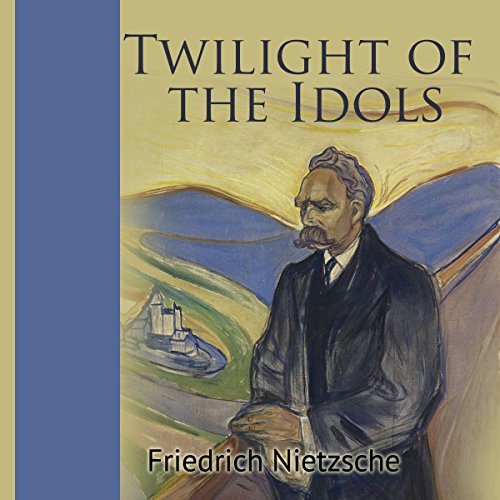
Twilight of the Idols
Summary
In Twilight of the Idols, Nietzsche criticizes German culture of the day as unsophisticated and nihilistic, and shoots some disapproving arrows at key French, British, and Italian cultural figures who represent similar tendencies. In contrast to all these alleged representatives of cultural "decadence", Nietzsche applauds Caesar, Napoleon, Goethe, Thucydides, and the Sophists as healthier and stronger types. The book states the transvaluation of all values as Nietzsche's final and most important project, and gives a view of antiquity wherein the Romans for once take precedence over the ancient Greeks. The book is divided into 12 sections.
Public Domain (P)2018 Bassett Publishing
![Cover art for Grandes de la filosofia [Greats of Philosophy]](https://m.media-amazon.com/images/I/51wDC3qz-SL._SL500_.jpg)
Grandes de la filosofia [Greats of Philosophy]
Summary
La filosofía es el estudio de una variedad de problemas fundamentales acerca de cuestiones como la existencia, el conocimiento, la verdad, la moral, la belleza, la mente y el lenguaje. Al abordar estos problemas, la filosofía se distingue del misticismo, el esoterismo, la mitología y la religión por su énfasis en los argumentos racionales sobre los argumentos de autoridad, y de la ciencia porque generalmente realiza sus investigaciones de una manera no empírica,? sea mediante el análisis conceptual, los experimentos mentales? la especulación u otros métodos a priori, aunque sin desconocer la importancia de los datos empíricos. La filosofía occidental ha tenido una profunda influencia y a su vez se ha visto profundamente influida por la ciencia, la religión y la política occidentales. Titulos incluidos: El ocaso de los idolos (Nietzsche) Etica las gran moral (Aristoteles) Metafisica del amor (Schopenhauer) Por la paz perpetua (Kant) Discurso del metodo (Descartes) Please note: This audiobook is in Spanish.
Public Domain (P)2020 Jaime Arredondo

Von den ersten und letzten Dingen
Summary
Von den ersten und letzten Dingen: Das erste Hauptstück des ersten Bandes von Nietzsches philosophischer Schrift Menschliches, Allzumenschliches.
©gemeinfrei (P)2021 Bäng Management & Verlags GmbH & Co. KG

Le Gai Savoir
Summary
Écrit entre 1881 et 1887, après une période sombre, de bouleversement psychologique et philosophique Nietzsche propose d'affronter, de s'accomoder d'un monde ne soit pas là pour nous faire plaisir, sa pensée n'est plus une sombre méditation mais une exaltation de la vie. Il tente par des aphorismes de dégager des vérités claires sans chercher d'absolu. Ce livre audio est au programme de français-philosophie des CPGE (classes préparatoires aux grandes écoles) scientifiques avec pour thème "La force de vivre". Traduction de Henri Albert.
©1882 Domaine public. Traduit par Henri Albert. (P)2020 Éditions Thélème

Thus Spoke Zarathustra
Summary
You look up when you wish to be exalted. And I look down because I am exalted.
The higher we soar the smaller we appear to those who cannot fly.
One repays a teacher badly if one always remains nothing but a pupil.
There is more wisdom in your body than in your deepest philosophy.
But the worst enemy you can meet will always be yourself; you lie in wait for yourself in caverns and forests. Lonely one, you are going the way to yourself! And your way goes past yourself, and past your seven devils! You will be a heretic to yourself and witch and soothsayer and fool and doubter and unholy one and villain. You must be ready to burn yourself in your own flame: how could you become new, if you had not first become ashes?
©2018- 2028 Martin Laredo Publishers (P)2018 Martin Laredo Publishers