Henry Kissinger has 4 audiobooks on Listento.it, narrated by 3 narrators, with an average listener rating of 4.8★ across 76 ratings. The most-rated is No Walls and the Recurring Dream.

No Walls and the Recurring Dream
Summary
A NEW YORK TIMES BEST SELLER "A memoir as fierce, freewheeling, and passionate as her music." (O, The Oprah Magazine) A memoir by the celebrated singer-songwriter and social activist Ani DiFranco In her new memoir, No Walls and the Recurring Dream, Ani DiFranco recounts her early life from a place of hard-won wisdom, combining personal expression, the power of music, feminism, political activism, storytelling, philanthropy, entrepreneurship, and much more into an inspiring whole. In these frank, honest, passionate, and often funny stories is the tale of one woman's eventful and radical journey to the age of 30. Ani's coming of age story is defined by her ethos of fierce independence - from being an emancipated minor sleeping in a Buffalo bus station, to unwaveringly building a career through appearances at small clubs and festivals, to releasing her first album at the age of 18, to consciously rejecting the mainstream recording industry and creating her own label, Righteous Babe Records. In this audiobook, as in life, she never hesitates to question established rules and expectations, maintaining a level of artistic integrity that has inspired and challenged more than a few. Ani continues to be a major touring and recording artist as well as a celebrated activist and feminist, standing as living proof that you can overcome all personal and societal obstacles to be who you are and to follow your dreams.
©2019 Ani DiFranco (P)2019 Penguin Audio

World Order
Summary
Henry Kissinger has traveled the world, advised presidents, and been a close observer and participant in the central foreign policy events of our era. Now he offers his analysis of the twenty first century's ultimate challenge: how to build a shared international order in a world of divergent historic perspectives, violent conflict, proliferating technology, and ideological extremism. There has never been a true "world order," Kissinger observes. For most of history, civilizations defined their own concepts of order. Each considered itself the center of the world, and envisioned its distinct principles as universally relevant. China conceived of a global cultural hierarchy with the Emperor at its pinnacle. In Europe, Rome imagined itself surrounded by barbarians; when Rome fragmented, European peoples refined a concept of an equilibrium of sovereign states and sought to export it across the world. Islam considered itself the world's sole legitimate political unit, destined to expand indefinitely until the world was brought into harmony by Muslim principles. The United States was born of a conviction about the universal applicability of democratic principles - a conviction that has guided its policies ever since. Now international affairs take place on a global basis, and these historic concepts of world order are meeting. Every region participates in questions of high policy in every other, often instantaneously. Yet there is no consensus among the major actors about the rules and limits guiding this process, or its ultimate destination. The result is mounting tension. Grounded in Kissinger's deep study of history and experience as national security advisor and secretary of state, World Order guides readers on a tour of the globe. It examines the events and ideas that formed the historic concepts of order, their manifestations in contemporary controversies, and the ways in which they might ultimately be reconciled.
©2014 Henry Kissinger (P)2014 Penguin Audio
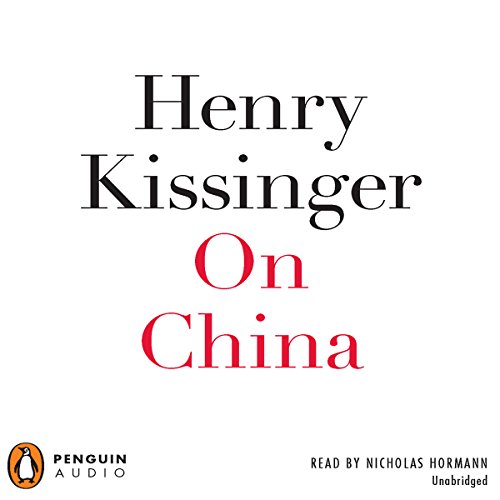
On China
Summary
The eminent historian and strategist reflects on how China's past illuminates its 21st-century trajectory, drawing on 40 years of intimate acquaintance with the country and its leaders. In On China, Henry Kissinger turns for the first time at book length to the country he has known intimately for decades and whose modern relations with the West he helped shape. Drawing on historical records as well as on his conversations with Chinese leaders over the past 40 years, Kissinger examines how China has approached diplomacy, strategy, and negotiation throughout its history and reflects on the consequences for the 21st-century world. As Kissinger underscores, the unique conditions under which China developed continue to shape its policies and attitudes toward the outside world. For centuries, China rarely encountered other societies of comparable size and sophistication. China was the "Middle Kingdom", treating the peoples on its periphery as vassal states. At the same time, Chinese statesmen - facing threats of invasion from without and the contests of competing factions within - developed a canon of strategic thought that prized the virtues of subtlety, patience, and indirection over feats of martial prowess. On China examines key episodes in Chinese foreign policy, from the earliest days through the 20th century, with a particular emphasis on the modern era. Kissinger illuminates the inner workings of Chinese diplomacy during such events as the initial encounters between China and modern European powers, the formation and breakdown of the Sino-Soviet alliance, the Korean War, the opening of relations with the United States, the Tiananmen Square crackdown, and China's accession to the World Trade Organization. With a final chapter on China's 21st-century world role, On China provides a sweeping historical perspective on Chinese foreign policy from one of the premier statesmen of the 20th century.
©2011 Henry Kissinger (P)2011 Penguin

Diplomacy
Summary
A brilliant, sweeping history of diplomacy that includes personal stories from the noted former Secretary of State, including his stunning reopening of relations with China. The seminal work on foreign policy and the art of diplomacy... Moving from a sweeping overview of history to blow-by-blow accounts of his negotiations with world leaders, Henry Kissinger describes how the art of diplomacy has created the world in which we live, and how America's approach to foreign affairs has always differed vastly from that of other nations. Brilliant, controversial, and profoundly incisive, Diplomacy stands as the culmination of a lifetime of diplomatic service and scholarship. It is a must-listen for anyone concerned with the forces that have shaped our world today and will impact upon it tomorrow.
©1994 Henry A. Kissinger (P)2019 Tantor