Ian Stewart has 6 audiobooks on Listento.it, narrated by 4 narrators, with an average listener rating of 4.5★ across 18 ratings. The most-rated is The Science of Discworld II: The Globe.

The Science of Discworld II: The Globe
Summary
The acclaimed Science of Discworld centred on an original Pratchett story about the Wizards of Discworld. In it they accidentally witnessed the creation and evolution of our universe, a plot which was interleaved with a Cohen & Stewart non-fiction narrative about Big Science. In The Science of Discworld II our authors join forces again to see just what happens when the wizards meddle with history in a battle against the elves for the future of humanity on Earth. London is replaced by a dozy Neanderthal village. The Renaissance is given a push. The role of fat women in art is developed. And one very famous playwright gets born and writes The Play. Weaving together a fast-paced Discworld novelette with cutting-edge scientific commentary on the evolution and development of the human mind, culture, language, art, and science, this is a book in which 'the hard science is as gripping as the fiction'. (The Times)
©2002 Terry and Lyn Pratchett, Joat Enterprises, Jack Cohen (P)2012 Random House AudioGo

Letters to a Young Mathematician
Summary
Mathematician Ian Stewart tells listeners what he wishes he had known when he was a student. He takes up subjects ranging from the philosophical to the practical - what mathematics is and why it’s worth doing, the relationship between logic and proof, the role of beauty in mathematical thinking, the future of mathematics, how to deal with the peculiarities of the mathematical community, and many others.
©2006 Joat Enterprises (P)2014 Audible Inc.

The Science of Discworld III
Summary
Roundworld is in trouble again, and this time it looks fatal. Having created it in the first place, the wizards of Unseen University feel vaguely responsible for its safety. They know the creatures who lived there escaped the impending Big Freeze by inventing the space elevator - they even intervened to rid the planet of a plague of elves, who attempted to divert humanity onto a different time track. But now it's all gone wrong - Victorian England has stagnated and the pace of progress would embarrass a limping snail. Unless something drastic is done, there won't be time for anyone to invent spaceflight and the human race will be turned into ice pops. Why, though, did history come adrift? Was it Sir Arthur Nightingale's dismal book about natural selection? Or was it the devastating response by an obscure country vicar called Charles Darwin, whose bestselling Theology of Species made it impossible to refute the divine design of living creatures? Either way, it's no easy task to change history, as the wizards discover to their cost. Can the God of Evolution come to humanity's aid and ensure Darwin writes a very different book? And who stopped him writing it in the first place?
©2012 Terry and Lyn Pratchett, Joat Enterprises and Jack Cohen (P)2012 Random House AudioGo

The Science of Discworld IV
Summary
The fourth book in the Science of Discworld series, and this time around dealing with the really big questions, Terry Pratchett’s brilliant new Discworld story Judgement Day is annotated with very big footnotes (the interleaving chapters) by mathematician Ian Stewart and biologist Jack Cohen, to bring you a mind-mangling combination of fiction, cutting-edge science and philosophy. Marjorie Daw is a librarian, and takes her job – and indeed the truth of words – very seriously. She doesn’t know it, but her world and ours – Roundworld – is in big trouble. On Discworld, a colossal row is brewing…The Wizards of Unseen University feel responsible for Roundworld (as one would for a pet gerbil). After all, they brought it into existence by bungling an experiment in Quantum ThaumoDynamics. But legal action is being brought against them by Omnians, who say that the Wizards’ god-like actions make a mockery of their noble religion. As the finest legal brains in Discworld (a zombie and a priest) gird their loins to do battle – and when the Great Big Thing in the High Energy Magic Laboratory is switched on – Marjorie Daw finds herself thrown across the multiverse and right in the middle of the whole explosive affair. As God, the Universe and, frankly, Everything Else is investigated by the trio, you can expect world-bearing elephants, quantum gravity in the Escher-verse, evolutionary design, eternal inflation, dark matter, disbelief systems – and an in-depth study of how to invent a better mousetrap.
©2013 Terry and Lyn Pratchett, Joat Enterprises and Jack Cohen 2013 (P)2013 Random House Audiobooks

Do Dice Play God?
Summary
A celebrated mathematician explores how math helps us make sense of the unpredictable We would like to believe we can know things for certain. We want to be able to figure out who will win an election, if the stock market will crash, or if a suspect definitely committed a crime. But the odds are not in our favor. Life is full of uncertainty - indeed, scientific advances indicate that the universe might be fundamentally inexact - and humans are terrible at guessing. When asked to predict the outcome of a chance event, we are almost always wrong. Thankfully, there is hope. As award-winning mathematician Ian Stewart reveals, over the course of history, mathematics has given us some of the tools we need to better manage the uncertainty that pervades our lives. From forecasting, to medical research, to figuring out how to win, Let's Make a Deal, Do Dice Play God? is a surprising and satisfying tour of what we can know, and what we never will.
©2019 Ian Stewart (P)2019 Hachette Audio
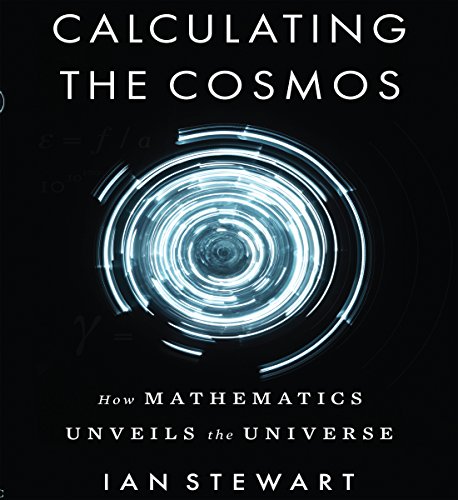
Calculating the Cosmos
Summary
In Calculating the Cosmos, Ian Stewart presents an exhilarating guide to the cosmos, from our solar system to the entire universe. He describes the architecture of space and time, dark matter and dark energy, how galaxies form, why stars implode, how everything began, and how it's all going to end. He considers parallel universes, the fine-tuning of the cosmos for life, what forms extraterrestrial life might take, and the likelihood of life on Earth being snuffed out by an asteroid. Beginning with the Babylonian integration of mathematics into the study of astronomy and cosmology, Stewart traces the evolution of our understanding of the cosmos: How Kepler's laws of planetary motion led Newton to formulate his theory of gravity. How, two centuries later, tiny irregularities in the motion of Mars inspired Einstein to devise his general theory of relativity. How, 80 years ago, the discovery that the universe is expanding led to the development of the Big Bang theory of its origins. How single-point origin and expansion led cosmologists to theorize new components of the universe, such as inflation, dark matter, and dark energy. But does inflation explain the structure of today's universe? Does dark matter actually exist? Could a scientific revolution that will challenge the long-held scientific orthodoxy and once again transform our understanding of the universe be on the way? In an exciting and engaging style, Calculating the Cosmos is a mathematical quest through the intricate realms of astronomy and cosmology. PLEASE NOTE: When you purchase this title, the accompanying reference material will be available in your Library section along with the audio.
©2016 Massachusetts Institute of Technology (P)2016 Gildan Media LLC