Johann Wolfgang von Goethe has 15 audiobooks on Listento.it, narrated by 30 narrators, with an average listener rating of 4.4★ across 103 ratings. The most-rated is Faust.

Faust
Summary
Faust is one of the pillars of Western literature. This classic drama presents the story of the scholar Faust, tempted into a contract with the Devil in return for a life of sensuality and power. Enjoyment rules, until Faust’s emotions are stirred by a meeting with Gretchen, and the tragic outcome brings Part 1 to an end. Part 2, written much later in Goethe’s life, places his eponymous hero in a variety of unexpected circumstances, causing him to reflect on humanity and its attitudes to life and death.
Public Domain (P)2011 Naxos Audiobooks

Faust: Parts I & II
Summary
Faust has long been considered one of the most important works of European literature ever published. Johann Wolfgang von Goethe began writing Faust in the 1770s while still a young man, spending most of his adult life on the project. Faust was finally finished almost 50 years later, near the end of his life.
Faust is a philosophical drama full of humor, satire, and tragedy. In Part 1, the demon Mephistopheles makes a bet with God that he can lure Faust from the path of good. Faust is in the middle of a personal crisis when he is visited by the demon. Mephistopheles successfully lures Faust into putting his soul on the line for a chance at true happiness but the deal only leads to tragedy.
In Part 2, the tragedy has faded and Faust now finds himself on a new path of adventure as he strives to redeem himself and is eventually released from his evil pact with the demon.
Public Domain (P)2018 Take 2 Studios

The Sorrows of Young Werther
Summary
The Sorrows of Young Werther was Goethe's first major success, turning him from an unknown into a celebrated author practically overnight. Napoleon Bonaparte considered it one of the great works of European literature. He thought so highly of it that he wrote a soliloquy in Goethe's style in his youth and carried Werther with him on his campaigning to Egypt. It also started the phenomenon known as the "Werther-Fieber" ("Werther Fever") which caused young men throughout Europe to dress in the clothing style described for Werther in the novel. Werther made Goethe one of the first international literary celebrities. Towards the end of his life, a personal visit to Weimar became crucial to any young man's tour of Europe. Werther was an important novel of the Sturm und Drang period in German literature, and influenced the later Romantic literary movement.
Public Domain (P)2012 Trout Lake Media

Egmont
Summary
Das Trauerspiel "Egmont" von Johann Wolfgang von Goethe wurde erstmals 1789 in Mainz aufgeführt. Es schildert eine Episode aus dem Freiheitskampf der Niederlande gegen die spanische Krone. Im Gegensatz zu Wilhelm von Oranien, der die Unabhängigkeitsbewegung anführt, erkennt sein Mitstreiter Egmont von Gavre die Gefahr zu spät, in der er als Gegner der Unfreiheit und damit des spanischen Statthalters schwebt. Unbekümmert vertraut er auf seine Beliebtheit im Volk, das aber aus Angst vor den spanischen Waffen nichts für seine Rettung unternimmt. So wird Egmont, der sich zu offenherzig dem spanischen Statthalter gegenüber geäußert hatte, am Ende hingerichtet. Der Hessische Rundfunk hat das Drama 1949 in der Bearbeitung von Hans Steiner als Hörspiel gesendet. Regie: Theodor Steiner.
©2016 gemeinfrei (P)1949 hr

The Best German Short Stories
Summary
A golden collection of gems from classic German literature, ranging from early Sturm und Drang, through Gothic horror, to some of the finest stories from later German Romanticism."The Criminal from Lost Honour", by Friedrich Schiller"The Story of Brave Kasper and Fair Annie", by Clemens Brentano"The Mad Veteran of Fort Ratonneau" by Ludwig Achim von Arnim"The Jew’s Beech Tree", by Annette von Droste-Hülshoff"The Severed Hand", by Wilhelm Hauff"The Mines of Falun", by E. T. A. Hoffmann"Story", by Johann Wolfgang von Goethe"The Scholar", by Ludwig Tieck"Immensee", by Theodor Storm
Public Domain (P)2014 Red Door Audiobooks

Wilhelm Meisters Lehrjahre
Summary
Beeinflusst durch die Ereignisse der französischen Revolution und die aufkeimende Freundschaft zu Schiller reifte blickt dieser Roman auf die Lehrzeit eines poetisch gesonnenen Bürgermanns in der vorrevolutionären Gegenwart. Als Finacier einer Schauspielertruppe bricht Wilhelm aus seiner engen bürgerlichen Herkunft aus und blickt hinein in die Welt des Theaters. Was als Irrweg erscheint, entwickelt sich zum Lebensweg; immer wieder neues Irren lehrt Wilhelm zu leben. Lebendige Darstellung der Leidenschaft wechselt sich mit ruhigen Elementen ab.
©gemeinfrei (P)2018 Aufbau Verlag GmbH & Co KG, Berlin

Die Wahlverwandtschaften
Summary
Charlotte und Eduard leben in völliger Abgeschiedenheit als trautes Ehepaar. Als Ottilie und der Hauptmann Otto in ihr Leben eintreten, wird auf einmal alles anders... "Die Wahlverwandtschaften" werden als Goethes bester Roman eingeschätzt.
©gemeinfrei (P)2019 Bäng Management & Verlags GmbH & Co. KG

100 citazioni di Johann Wolfgang von Goethe
Summary
Queste 100 citazioni mirano a fornire l'accesso a un'opera o a una vita eccezionale, attraverso una selezione dei pensieri più eclatanti, in un formato accessibile a tutti. Una citazione è più di un estratto di un'affermazione, può essere un colpo di mente, una sintesi di un pensiero complesso, una massima, un'apertura a una riflessione più profonda. Si dice che certe frasi possono cambiare la vita. Altri ragioneranno dentro di voi per un tempo infinito, facendo eco a una personale ricerca intellettuale o spirituale.
©2020 Compagnie du Savoir (P)2020 Compagnie du Savoir
Faust
Summary
Goethe's masterpiece and perhaps the greatest work in German literature, Faust has made the legendary German alchemist one of the central myths of the Western world. Here indeed is a monumental Faust, an audacious man boldly wagering with the devil, Mephistopheles, that no magic, sensuality, experience or knowledge can lead him to a moment he would wish to last forever.
Public Domain (P)2012 Audible, Inc.

Den unge Werthers lidelser
Summary
Med forord af Peter Asmussen. Goethes verdensberømte roman Den unge Werthers lidelser er den enkle historie om en ung mand, der forelsker sig i den kønne og livlige Lotte. Hun er imidlertid forlovet med embedsmanden Albert, som hun senere gifter sig med. Werther styres af sine voldsomme følelser for Lotte og mister gradvis kontrollen over sig selv, hvilket resulterer i selvmord.
©2015 Gyldendal (P)2015 Gyldendal

Gert Westphal liest Johann Wolfgang von Goethe
Summary
Der König der Vorleser trifft den Dichterfürsten. Wenn Deutschlands größter Dichter und Deutschlands bekannteste Stimme zusammenkommen, so ist das ein großer Glücksmoment für den Hörer. Denn wer könnte Goethes Figuren treffender charakterisieren, seine Sprachkunst funkelnder zur Geltung bringen, seine Gedanken souveräner nachvollziehen als der große Goethe-Interpret Gert Westphal? Es scheint, Goethe hat beim Schreiben dieser Worte schon den König der Vorleser vor sich gesehen: "Wenn ihr's nicht fühlt, ihr werdet's nicht erjagen, / Wenn es nicht aus der Seele dringt / Und mit urkräftigem Behagen / Die Herzen aller Hörer zwingt." Enthält: Goethes Autobiografie "Dichtung und Wahrheit", den Reisebericht "Italienische Reise", den Roman "Die Leiden des jungen Werthers", das Versepos "Reineke Fuchs", die Gedichtsammlung "West-Östlicher Diwan", weitere Gedichte und Balladen sowie Goethes Gespräche mit Eckermann. In deiner Audible-Bibliothek findest du für dieses Hörerlebnis eine PDF-Datei mit zusätzlichem Material.
©2017 der Hörverlag (P)2017 der Hörverlag
Wilhelm Meister's Apprenticeship
Summary
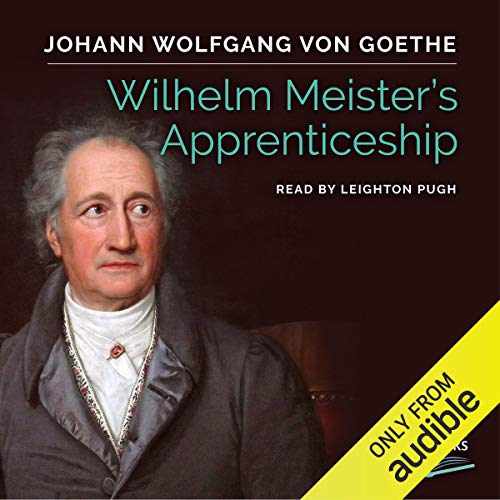
Wilhelm Meister’s Apprenticeship - Wilhelm Meisters Lehrjahre was the original German title - was Goethe’s second novel, published 1795-6, almost two decades after The Sorrows of Young Werther. It again focuses on a young man but this time on his growing understanding and maturity as he makes his way in the world. As such, it is regarded as the founding work in the ‘coming of age’ genre: the ‘bildungsroman’ ( a term actually coined some 30 years later), which characterised a philosophical novel tracing the cultural, emotional and educational development of an individual from youth to adulthood. Disdaining to follow his father’s advice to pursue a bourgeois life in business and disappointed in love, Wilhelm Meister searches for a more fulfilling path - and is initially drawn to the arts. He becomes involved in a theatre troupe, the works of Shakespeare and specifically Hamlet beckon. But his artistic life is interrupted when mundane brutality in the form of an attack by bandits intrudes. Wilhelm, despite being wounded, survives the encounter, which leads him to another level of understanding, and his personal journey to maturity continues. The novel was hugely influential throughout the 19th century and beyond and remains a key work in classic European literature. Thomas Carlyle’s admired but slightly archaic translation has been lightly revised for this recording which features a sensitive reading by Leighton Pugh.
Public Domain (P)2020 Ukemi Productions Ltd
![Cover art for Iphigenie Auf Tauris [Iphigenia on Tauris]](https://m.media-amazon.com/images/I/61Dam31R+nL._SL500_.jpg)
Iphigenie Auf Tauris [Iphigenia on Tauris]
Summary
Iphigenie auf Tauris als Hörbuch - Mit Audiobook das Drama der Weimarer Klassik neu erleben Johann Wolfgang von Goethes Drama “Iphigenie auf Tauris” als professionell gesprochenes Audiobook Johann Wolfgang von Goethes “Iphigenie auf Tauris” als Audiobook genießen wegweisendes Werk der Weimarer Klassik in moderner Form Sie erfahren die Geschichte einer jungen Frau, die mit der Frage nach Humanität verbunden wird Ideal für einen ruhigen Nachmittag zu Hause, als Lernhilfe für Schüler oder als Geschenk für Eltern, Großeltern und Freunde Spannende Geschichte einer starken Frau auf der Suche nach Autonomie Die von Goethe 1787 vollendete Iphigenie auf Tauris gehört zu den klassischen Dramen in der Geschichte. Es erfüllt alle Elemente des Dramas nach Aristoteles: Einheit der Handlung, Einheit der Zeit und Einheit des Ortes. Wegen seiner klaren Dramenstruktur ist auch als Unterrichtslektüre für die oberen Jahrgänge beliebt. Schüler haben mit dieser Version eine Möglichkeit, sich den Stoff über ein modernes Medium anzueignen. Das Audiobook bietet einen einfachen Zugang zur schweren Thematik zu finden. In der Iphigenie verbindet Goethe die persönliche Geschichte einer nach Selbstbestimmung suchenden Frau, die Selbstbestimmung will, mit der Verhandlung humanistischer Ideale. Dadurch ist das Drama auch heute hochaktuell. Anstelle von Lügen und Gewalt setzt Goethe den rationalen Dialog vernünftiger Individuen . Klassisches Drama im antiken Griechenland professionell gesprochen genießen Das klassische Drama liegt hier in der von Nadja Schulz-Berlinghoff gesprochenen römischen Fassung vor. Berlinghoff ist Schauspielerin mit jahrzehntelanger Bühnenerfahrung und arbeitet auch als professionelle Sprecherin. Durch ihren Sprecheinsatz verschafft sie dem klassischen Stoff neue Lebendigkeit, und macht das Werk für alle Menschen leichter zugänglich. Please note: This audiobook is in German.
©1779 Johann Wolfgang von Goethe (P)2020 Partner Audio Pty Ltd

Doktor Faust
Summary
Nachdem der alte Doktor Heinrich Faust alles gelernt hat, was es zu lernen gibt, ist sein Wissensdurst noch immer nicht befriedigt, sodass er sich der Magie ergibt und einen Pakt mit dem sardonischen Teufel Mephisto eingeht. Verjüngt und von der Last seiner Arbeit befreit, verliebt er sich in das junge, unschuldige Gretchen, ohne zu sehen, in welche Gefahr er das Mädchen bringt... Schon lange, bevor Johann Wolfgang von Goethe mit seiner zweiteiligen Tragödie das vielleicht wichtigste Werk der deutschen Literatur schuf, waren zahllose Varianten der Sage vom strebsamen Doktor Faust und seinem dämonischem Treiben im Umlauf.
©2017 Holysoft GmbH (P)2017 Holysoft GmbH

Faust
Summary
"Faust" is a tragic play in two parts by Johann Wolfgang von Goethe, usually known in English as Faust, Part One and Faust, Part Two. Although rarely staged in its entirety, it is the play with the largest audience numbers on German-language stages. Faust is considered by many to be Goethe's magnum opus and the greatest work of German literature. The earliest forms of the work, known as the Urfaust, were developed between 1772 and 1775; however, the details of that development are not entirely clear. Urfaust has twenty-two scenes, one in prose, two largely prose and the remaining 1,441 lines in rhymed verse. The manuscript is lost, but a copy was discovered in 1886. The first appearance of the work in print was Faust, a Fragment, published in 1790. Goethe completed a preliminary version of what is now known as Part One in 1806. Its publication in 1808 was followed by the revised 1828-29 edition, the last to be edited by Goethe himself. Goethe finished writing Faust Part Two in 1831; it was published posthumously the following year. In contrast to Faust Part One, the focus here is no longer on the soul of Faust, which has been sold to the devil, but rather on social phenomena such as psychology, history and politics, in addition to mystical and philosophical topics. The second part formed the principal occupation of Goethe's last years. Among the most significant works Johann Wolfgang von Goethe: "Faust", "The Sorrows of Young Werther", "Wilhelm Meister's Apprenticeship", "Elective Affinities", "Prometheus", "Zur Farbenlehre", "Italienische Reise", West-östlicher Divan" and many more.
©2020 Strelbytskyy Multimedia Publishing (P)2020 Strelbytskyy Multimedia Publishing