José Saramago has 12 audiobooks on Listento.it, narrated by 8 narrators, with an average listener rating of 3.8★ across 62 ratings. The most-rated is Blindness.
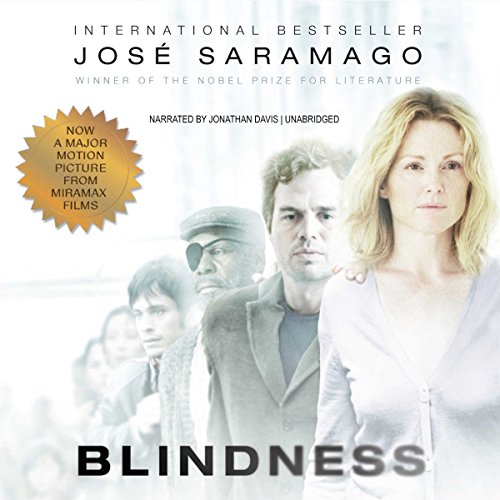
Blindness
Summary
A city is hit by a sudden and strange epidemic of "white blindness", which spares no one. Authorities confine the blind to an empty mental hospital, but there social conventions quickly crumble and the struggle for survival brings out the worst in people. There is one eyewitness to this nightmare who guides seven strangers -among them a boy with no mother, a girl with dark glasses, a dog of tears - out of their prison and through the barren streets, and the procession becomes as uncanny as the surroundings are harrowing. A magnificent parable of loss and disorientation and a vivid evocation of the horrors of the 20th century, by Nobel Prize-winning author Jose Saramago, Blindness has swept the masses with its powerful portrayal of man's worst appetites and weaknesses - and man's ultimately exhilarating spirit. English translation by Juan Sager.
©1997 Juan Sager (English translation); 1995 Jose Saramago and Editorial Caminho (P)2008 BBC Audiobooks America

The Gospel According to Jesus Christ
Summary
A wry, fictional account of the life of Christ by Nobel laureate Jose Saramago. A brilliant skeptic, Jose Saramago envisions the life of Jesus Christ and the story of his Passion as things of this earth: A child crying, the caress of a woman half asleep, the bleat of a goat, a prayer uttered in the grayish morning light. His idea of the Holy Family reflects the real complexities of any family, and, as only Saramago can, he imagines them with tinges of vision, dream, and omen. The result is a deft psychological portrait that moves between poetry and irony, spirituality and irreverence of a savior who is at once the Son of God and a young man. In this provocative, tender novel, the subject of wide critical discussion and wonder, Saramago questions the meaning of God, the foundations of the Church, and human existence itself.
©1994 Jose Saramago (P)2011 Audible, Inc.

Death with Interruptions
Summary
Nobel Prize-winner Jose Saramago's brilliant new novel poses the question: What happens when the grim reaper decides there will be no more death? On the first day of the new year, no one dies. This of course causes consternation among politicians, religious leaders, morticians, and doctors. Among the general public, on the other hand, there is initially celebration - flags are hung out on balconies, people dance in the streets. They have achieved the great goal of humanity: eternal life. Then reality hits home - families are left to care for the permanently dying, life-insurance policies become meaningless, and funeral parlors are reduced to arranging burials for pet dogs, cats, hamsters, and parrots. Death sits in her chilly apartment, where she lives alone with scythe and filing cabinets, and contemplates her experiment: What if no one ever died again? What if she, death with a small d, became human and were to fall in love?
©2009 Jose Saramago (P)2011 Audible, Inc.

All the Names
Summary
Senhor Jose is a low-grade clerk in the city's Central Registry, where the living and the dead share the same shelf space. A middle-aged bachelor, he has no interest in anything beyond the certificates of birth, marriage, divorce, and death that are his daily routine. But one day, when he comes across the records of an anonymous young woman, something happens to him. Obsessed, Senior Jose sets off to follow the thread that may lead him to the woman-but as he gets closer, he discovers more about her, and about himself, than he would ever have wished. The loneliness of people's lives, the effects of chance, the discovery of love - all coalesce in this extraordinary novel that displays the power and art of Jose Saramago in brilliant form.
©1997 Jose Saramago (P)2011 Audible, Inc.

The History of the Siege of Lisbon
Summary
"If proofreaders were given their freedom and did not have their hands and feet tied by a mass of prohibitions more binding than the penal code, they would soon transform the face of the world, establish the kingdom of universal happiness, giving drink to the thirsty, food to the famished, peace to those who live in turmoil, joy to the sorrowful... for they would be able to do all these things simply by changing the words...." The power of the word is evident in Portuguese author José Saramago's novel, The History of the Siege of Lisbon. His protagonist, a proofreader named Raimundo Silva, adds a key word to a history of Portugal and thus rewrites not only the past, but also his own life. Brilliantly translated from the Portuguese by Giovanni Pontiero, The History of the Siege of Lisbon is a meditation on the differences between historiography, historical fiction, and "stories inserted into history". The novel is really two stories in one: the reimagined history of the 1147 siege of Lisbon that Raimundo feels compelled to write and the story of Raimundo's life, including his unexpected love affair with the editor, Maria Sara. In Saramago's masterful hands, the strands of this complex tale weave together to create a satisfying whole.
©1989 Jose Saramago (P)2011 Audible, Inc.

Cain
Summary
The late Nobel laureate's final novel, a radical retelling of the Old Testament. In this, his last novel, Saramago daringly reimagines the characters and narratives of the Bible through the story of Cain. Condemned to wander forever after he kills Abel, he is whisked around in time and space. He experiences the almost-sacrifice of Isaac by Abraham, the Tower of Babel, the destruction of Sodom and Gomorrah, Joshua at the battle of Jericho, Jobe's ordeal, and finally Noah's ark and the Flood. And over and over again Cain encounters an unjust, even cruel God. A startling, beautifully written, and powerful book, in all ways a fitting end to Saramago's extraordinary career.
©2011 Jose Saramago (P)2011 Audible, Inc.
![Cover art for El viaje del elefante [The Elephant's Journey]](https://m.media-amazon.com/images/I/41uzC-OEI2L._SL500_.jpg)
El viaje del elefante [The Elephant's Journey]
Summary
José Saramago narra el insólito viaje del elefante Salomón a través de la Europa del siglo XVI. Escucha esta aventura épica llena de humanidad, humor y sabiduría. «Siempre acabamos llegando a donde nos esperan.» LIBRO DE LOS ITINERARIOS A mediados del siglo XVI el rey Juan III ofrece a su primo, el archiduque Maximiliano de Austria, un elefante asiático. Esta novela cuenta el viaje épico de ese elefante llamado Salomón que tuvo que recorrer Europa por caprichos reales y absurdas estrategias. El viaje del elefante no es un libro histórico, es una combinación de hechos reales e inventados que nos hace sentir la realidad y la ficción como una unidad indisoluble, como algo propio de la gran literatura. Una reflexión sobre la humanidad en la que el humor y la ironía, marcas de la implacable lucidez del autor, se unen a la compasión con la que José Saramago observa las flaquezas humana. Escrita diez años después de la concesión del Premio Nobel, El viaje del elefante nos muestra a un Saramago en todo su esplendor literario. Escúchala ahora en formato audiolibro. Please note: This audiobook is in Spanish.
©2008 José Saramago y Editorial Caminho, S.A. (P)2019 Penguin Random House Grupo Editorial, S.A.U.
![Cover art for Ensayo sobre la ceguera [Blindness]](https://m.media-amazon.com/images/I/51GGJ3QgnkL._SL500_.jpg)
Ensayo sobre la ceguera [Blindness]
Summary
Ensayo sobre la ceguera es la ficción de un autor que nos alerta sobre «la responsabilidad de tener ojos cuando otros los perdieron». «Dentro de nosotros hay algo que no tiene nombre, esa cosa es lo que somos.» Un hombre parado ante un semáforo en rojo se queda ciego súbitamente. Es el primer caso de una «ceguera blanca» que se expande de manera fulminante. Internados en cuarentena o perdidos en la ciudad, los ciegos tendrán que enfrentarse con lo que existe de más primitivo en la naturaleza humana: la voluntad de sobrevivir a cualquier precio. Ensayo sobre la ceguera es la ficción de un autor que nos alerta sobre «la responsabilidad de tener ojos cuando otros los perdieron». José Saramago traza en este libro una imagen aterradora y conmovedora de los tiempos que estamos viviendo. En un mundo así, ¿cabrá alguna esperanza? Escuchar este audiolibro supone una experiencia imaginativa única. En un punto donde se cruzan literatura y sabiduría, José Saramago nos obliga a parar, cerrar los ojos y ver. Recuperar la lucidez y rescatar el afecto son dos propuestas fundamentales de una novela que es, también, una reflexión sobre la ética del amor y la solidaridad. Las mejores obras de nuestro tiempo en formato audiolibro. Please note: This audiobook is in Spanish.
©1995 José Saramago (P)2018 Penguin Random House Grupo Editorial, S.A.U.

Baltasar and Blimunda
Summary
Portugal, 1711: an amorous friar is pursued naked through the rubble-strewn streets of Lisbon; an enthusiastic procession of flagellants roars with pleasure over the damnation of adultery; a royal prince uses hapless sailors for target practice; and women dressed in colorful finery watch as lapsed converts and sorcerers are put to death by flames. In the midst of the terrors of the Inquisition and the plague, a seemingly mismatched couple discovers the wonders of love. This poetic tale, graced with exquisite historical detail and full of magic and adventure, is a tapestry of human folly and human will. The best-loved of all of the great Jose Saramago's works, this novel radiates with achievement.
©1998 Jose Saramago (P)2011 Audible, Inc.

The Stone Raft
Summary
What if, one day, Europe was to crack along the length of the Pyrenees, separating the Iberian peninsula? In Saramago's lovely fable, the new island is sent spinning, like a great stone raft, towards the Azores. While the authorities panic and tourists and investors flee, three men, two women, and a dog are drawn together by portents that burden them with a bemusing sense of responsibility. Travelling at first packed into a car, then into a wagon, they take to the road to explore the limits of their now finite land, adrift in a world made new by this radical shift in perspective.
©1995 Jose Saramago (P)2011 Audible, Inc.
![Cover art for Las intermitencias de la muerte [Death with Interruptions]](https://m.media-amazon.com/images/I/513xu75qJWL._SL500_.jpg)
Las intermitencias de la muerte [Death with Interruptions]
Summary
¿Y si la gente dejara de morirse? Una brillante sátira del Nobel de Literatura que juega con el miedo más profundo del ser humano. «Sabremos cada vez menos qué es un ser humano.» Libro de las previsiones En un país cuyo nombre no será mencionado, se produce algo nunca visto desde el principio del mundo: la muerte decide suspender su trabajo letal, la gente deja de morir. La euforia colectiva se desata, pero muy pronto dará paso a la desesperación y al caos. Sobran los motivos. Si es cierto que las personas ya no mueren, eso no significa que el tiempo se haya detenido. El destino de los humanos será una vejez eterna. Se buscarán maneras de forzar a la muerte a matar aunque no lo quiera, se corromperán las conciencias en los «acuerdos de caballeros» explícitos o tácitos entre el poder político, las mafias y las familias, los ancianos serán detestados por haberse convertido en estorbos irremovibles. Hasta el día en que la muerte decide volver... Arrancando una vez más de una proposición contraria a la evidencia de los hechos corrientes, José Saramago desarrolla una narrativa de gran fecundidad literaria, social y filosófica que sitúa en el centro la perplejidad del hombre ante la impostergable finitud de la existencia. Parábola de la corta distancia que separa lo efímero de lo eterno, Las intermitencias de la muerte bien podría terminar tal como empieza: «Al día siguiente no murió nadie.» Please note: This audiobook is in Spanish.
©2005 Herederos de José Saramago (P)2021 Penguin Random House Grupo Editorial, S.A.U.
![Cover art for Ensayo sobre la lucidez [Seeing]](https://m.media-amazon.com/images/I/51ugv5GgjqL._SL500_.jpg)
Ensayo sobre la lucidez [Seeing]
Summary
Saramago, un escritor que se ha convertido en la conciencia lúcida de una época cegada por los mecanismos del poder, lanza una llamada de alerta: "Puede suceder que un día tengamos que preguntarnos '¿Quién ha firmado esto por mí?'". Ese día puede ser hoy. "Aullemos, dijo el perro." (Libro de los Contrarios) Durante las elecciones municipales de una ciudad sin nombre, la mayoría de sus habitantes decide individualmente ejercer su derecho al voto de una manera inesperada. El gobierno teme que ese gesto revolucionario, capaz de socavar los cimientos de una democracia degenerada, sea producto de una conjura anarquista internacional o de grupos extremistas desconocidos. Las cloacas del poder se ponen en marcha: los culpables tienen que ser eliminados. Y si no se hallan, se inventan. Los protagonistas de esta novela de Saramago, un inspector de policía y la mujer que conservó la vista en la epidemia de luz blanca de Ensayo sobre la ceguera, dan muestras de la altura moral que los ciudadanos anónimos pueden alcanzar cuando deciden ejercer la libertad. Please note: This audiobook is in Spanish.
©2004 Herederos de José Saramago (P)2020 Penguin Random House Grupo Editorial, S.A.U.