Kai Bird has 4 audiobooks on Listento.it, narrated by 4 narrators, with an average listener rating of 4★ across 4 ratings. The most-rated is American Prometheus.

American Prometheus
Summary
Pulitzer Prize, Biography/Autobiography, 2006 National Book Critics Circle Award, Biography, 2006 J. Robert Oppenheimer is one of the iconic figures of the 20th century, a brilliant physicist who led the effort to build the atomic bomb for his country in a time of war and who later found himself confronting the moral consequences of scientific progress. When he proposed international controls over atomic materials, opposed the development of the hydrogen bomb, and criticized plans for a nuclear war, his ideas were anathema to powerful advocates of a massive nuclear buildup during the anti-Communist hysteria of the early 1950s. They declared that Oppenheimer could not be trusted with America's nuclear secrets. In this magisterial biography, 25 years in the making, the authors capture Oppenheimer's life and times, from his early career to his central role in the Cold War.
©2005 Kai Bird; 2007 Blackstone Audio Inc.
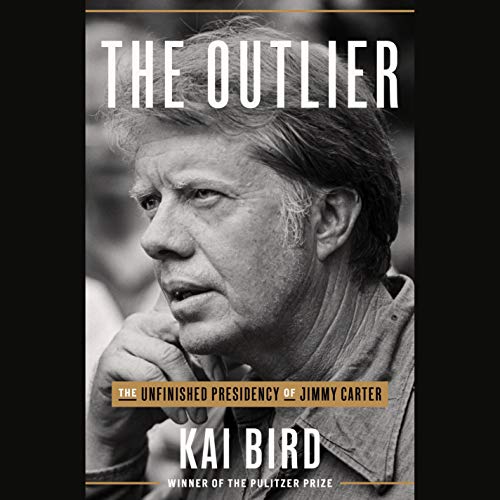
The Outlier
Summary
An essential re-evaluation of the complex triumphs and tragedies of Jimmy Carter's presidential legacy - from the expert biographer and Pulitzer Prize-winning author of American Prometheus “This is superior history, superbly researched and marvelously written.” (Douglas Brinkley, New York Times best-selling author of American Moonshot) Four decades after Ronald Reagan’s landslide win in 1980, Jimmy Carter’s one-term presidency is often labeled a failure; indeed, many Americans view Carter as the only ex-president to have used the White House as a stepping-stone to greater achievements. But in retrospect the Carter political odyssey is a rich and human story, marked by both formidable accomplishments and painful political adversity. In this deeply researched, brilliant account, Kai Bird expertly unfolds the Carter saga as a tragic tipping point in American history. As president, Carter was not merely an outsider, but an outlier. He was the only president in a century to grow up in the heart of the Deep South, and his born-again Christianity made him the most openly religious president in memory. This outlier brought to the White House a rare mix of humility, candor - and unnerving self-confidence that neither Washington nor America was ready to embrace. Decades before today’s public reckoning with the vast gulf between America’s ethos and its actions, Carter looked out on a nation torn by race and demoralized by Watergate and Vietnam and prescribed a radical self-examination from which voters recoiled. The cost of his unshakable belief in doing the right thing would be a second term - and the ascendance of Reagan. In this remarkable book, Pulitzer Prize-winning biographer Bird traces the arc of Carter’s administration, from his aggressive domestic agenda to his controversial foreign policy record, taking listeners inside the Oval Office and through Carter’s battles with both a political establishment and a Washington press corps that proved as adversarial as any foreign power. Bird shows how issues still hotly debated today - from national health care to growing inequality and racism to the Israeli-Palestinian conflict - burned at the heart of Carter’s America, and consumed a president who found a moral duty in solving them. Drawing on interviews with Carter and members of his administration and recently declassified documents, Bird delivers a profound, clear-eyed evaluation of a leader whose legacy has been deeply misunderstood. The Outlier is the definitive account of an enigmatic presidency - both as it really happened and as it is remembered in the American consciousness.
©2021 Kai Bird (P)2021 Random House Audio

Crossing Mandelbaum Gate
Summary
Through a blend of memoir and history, Pulitzer Prize-winning writer Kai Bird recounts the Western experience in the Middle East and just why it has been so turbulent. Through Bird ’s Zelig-like presence, the reader experiences the Suez War of 1956, the June 1967 War, and the Black September hijackings of 1970 that led to the Jordanian Civil War. Bird's memoir also shows how all of these momentous events led to the rise and tragic downfall of a secular Arab nationalist ethos—only to be replaced by the rise of a fundamentalist, politically reactionary Islamist movement. In narrative history, Bird tells the stories of such illuminating figures as life-long Jerusalem resident George Antonius, author of The Arab Awakening, and his charismatic wife; Jordan’s King Hussein and his CIA connections; the businessman Salem bin Laden, Osama’s older brother and a family friend; Saudi kings Faisal and Khalid; President Nasser of Egypt; and Leila Khaled, the striking young Palestinian radical who hijacked one of the Black September planes. Bird’s personal insights and unique connections create a portal into the sensibilities and psyche of these lands that is sure to fascinate both those fluent in the history of the Middle East and the many who simply want to understand this region that the West seems to be both fighting for and against.
©2010 Kai Bird (P)2010 HighBridge Company

The Good Spy
Summary
The Good Spy is Pulitzer Prize-winning biographer Kai Bird’s compelling portrait of the remarkable life and death of one of the most important operatives in CIA history - a man who, had he lived, might have helped heal the rift between Arabs and the West. On April 18, 1983, a bomb exploded outside the American Embassy in Beirut, killing 63 people. The attack was a geopolitical turning point. It marked the beginning of Hezbollah as a political force, but even more important, it eliminated America’s most influential and effective intelligence officer in the Middle East - CIA operative Robert Ames. What set Ames apart from his peers was his extraordinary ability to form deep, meaningful connections with key Arab intelligence figures. Some operatives relied on threats and subterfuge, but Ames worked by building friendships and emphasizing shared values - never more notably than with Yasir Arafat’s charismatic intelligence chief and heir apparent Ali Hassan Salameh (aka "The Red Prince"). Ames’ deepening relationship with Salameh held the potential for a lasting peace. Within a few years, though, both men were killed by assassins, and America’s relations with the Arab world began heading down a path that culminated in 9/11, the War on Terror, and the current fog of mistrust. Bird, who as a child lived in the Beirut Embassy and knew Ames as a neighbor when he was 12 years old, spent years researching The Good Spy. Not only does the book draw on hours of interviews with Ames’ widow, and quotes from hundreds of Ames’ private letters, it’s woven from interviews with scores of current and former American, Israeli, and Palestinian intelligence officers as well as other players in the Middle East "Great Game". What emerges is a masterpiece-level narrative of the making of a CIA officer, a uniquely insightful history of 20th-century conflict in the Middle East, and an absorbing hour-by-hour account of the Beirut Embassy bombing. Even more impressive, Bird draws on his reporter’s skills to deliver a full dossier on the bombers and expose the shocking truth of where the attack’s mastermind resides today.
©2014 Kai Bird (P)2014 Random House Audio