Kathryn Harkup has 3 audiobooks on Listento.it, narrated by 3 narrators, with an average listener rating of 4★ across 3 ratings. The most-rated is Death by Shakespeare.

Death by Shakespeare
Summary
Bloomsbury presents Death By Shakespeare by Kathryn Harkup, read by Nicky Diss. William Shakespeare found dozens of different ways to kill off his characters, and audiences today still enjoy the same reactions - shock, sadness, fear - that they did more than 400 years ago when these plays were first performed. But how realistic are these deaths, and did Shakespeare have the knowledge to back them up? In the Bard’s day, death was a part of everyday life. Plague, pestilence and public executions were a common occurrence, and the chances of seeing a dead or dying body on the way home from the theatre were high. It was also a time of important scientific progress. Shakespeare kept pace with anatomical and medical advances, and he included the latest scientific discoveries in his work, from blood circulation to treatments for syphilis. He certainly didn’t shy away from portraying the reality of death onstage, from the brutal to the mundane and the spectacular to the silly. Elizabethan London provides the backdrop for Death by Shakespeare, as Kathryn Harkup turns her discerning scientific eye to the Bard and the varied and creative ways his characters die. Was death by snakebite as serene as Shakespeare makes out? Could lack of sleep have killed Lady Macbeth? Can you really murder someone by pouring poison in their ear? Kathryn investigates what actual events may have inspired Shakespeare, what the accepted scientific knowledge of the time was and how Elizabethan audiences would have responded to these death scenes. Death by Shakespeare will tell you all this and more in a roller coaster of Elizabethan carnage, poison, swordplay and bloodshed, with an occasional death by bear-mauling for good measure.
©2020 Kathryn Harkup (P)2020 Bloomsbury Publishing Plc
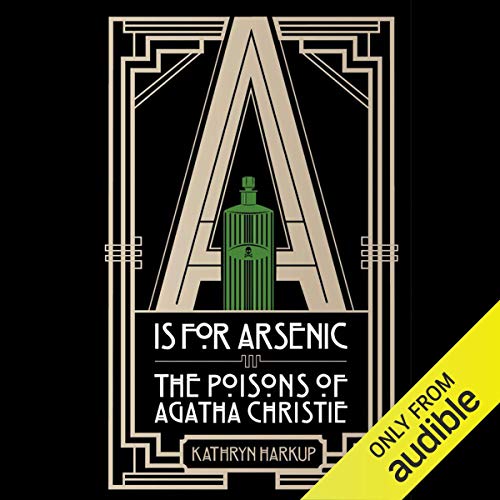
A Is for Arsenic
Summary
Agatha Christie's detailed plotting is what makes her books so compelling. Christie used poison to kill her characters more often than any other murder method, with the poison itself being a central part of the novel, and her choice of deadly substances was far from random; the chemical and physiological characteristics of each poison provide vital clues to the discovery of the murderer. With gunshots or stabbings the cause of death is obvious, but not so with poisons. How is it that some compounds prove so deadly and in such tiny amounts? Christie demonstrated her extensive chemical knowledge (much of it gleaned from her working in a chemists during both world wars) in many of her novels, but this is rarely appreciated by the reader. A is for Arsenic celebrates the use of science in Christie's work. Written by Christie fan and research chemist Kathryn Harkup, each chapter takes a different novel and investigates the poison (or poisons) the murderer used. A is for Arsenic looks at why certain chemicals kill, how they interact with the body, and the feasibility of obtaining, administering and detecting these poisons both at the time the novel was written and today. This book is published as part of the 125th anniversary celebration of Christie's birth.
©2015 Kathryn Harkup (P)2015 Audible, Inc.

Making the Monster
Summary
The year 1818 saw the publication of one of the most influential science fiction stories of all time. Frankenstein: Or, Modern Prometheus by Mary Shelley had a huge impact on Gothic horror and science fiction genres. The name Frankenstein has become part of our everyday language, often used in derogatory terms to describe scientists who have overstepped a perceived moral line. But how did a 19-year-old woman with no formal education come up with the idea for an extraordinary novel such as Frankenstein? The period 1790-1820 saw huge advances in our understanding of electricity and physiology. Sensational science demonstrations caught the imagination of the general public, and newspapers were full of tales of murder and resurrectionists. It is unlikely that Frankenstein would have been successful in his attempts to create life back in 1818. However, advances in medical science mean we have overcome many of the stumbling blocks that would have thwarted his ambition. We can resuscitate people using defibrillators, we can save lives using blood transfusions and we can prolong life through organ transplants - these procedures are nowadays considered almost routine. Many of these modern achievements are a direct result of 19th-century scientists conducting their gruesome experiments on the dead. Making the Monster explores the science behind Shelley's book. From tales of reanimated zombie kittens to electrical experiments on human cadavers, Kathryn Harkup examines the science and scientists that influenced Mary Shelley and inspired her most famous creation, Victor Frankenstein. While thankfully we are still far from being able to recreate Victor's 'creature', scientists have tried to create the building blocks of life, and the dream of creating life forms from scratch is now tantalisingly close.
©2018 Kathryn Harkup (P)2018 Audible, Ltd