Milton Friedman has 4 audiobooks on Listento.it, narrated by 4 narrators, with an average listener rating of 4.8★ across 59 ratings. The most-rated is Free to Choose.

Free to Choose
Summary
Milton Friedman and his wife, Rose, teamed up to write this most convincing and readable guide, which illustrates the crucial link between Adam Smith's capitalism and the free society. They show how freedom has been eroded and prosperity undermined through the rapid growth of governmental agencies, laws, and regulations. While a large central government may have good intentions, the results it produces are lamentable. More than another indictment of government planning and bureaucracy, however, Free to Choose offers several convincing and creative remedies to the world's woes.
©1979 John McDermott, Forward 1990 Milton Friedman and Rose D. Friedman (P)2007 Blackstone Audio Inc.

Capitalism and Freedom, Fortieth Anniversary Edition
Summary
How can we benefit from the promise of government while avoiding the threat it poses to individual freedom? In this classic book, Milton Friedman provides the definitive statement of his immensely influential economic philosophy - one in which competitive capitalism serves as both a device for achieving economic freedom and a necessary condition for political freedom. The result is an accessible text that has sold well over half a million copies in English, has been translated into 18 languages, and shows every sign of becoming more and more influential as time goes on. This updated edition includes a new preface by the author.
©1962, 1982, 2002 The University of Chicago (P)2017 Blackstone Audio, Inc.

Money Mischief
Summary
What kind of mischief can result from misunderstanding the monetary system? The work of 2 obscure Scottish chemists destroyed the presidential prospects of William Jennings Bryan, as well as Franklin D. Roosevelt's decision to appease a few senators from the American West who helped communism triumph in China, are just 2 such mishaps cited in this important work by Nobel Prize-winning economist Milton Friedman. This accessible work also provides an in-depth discussion on the creation of value: from stones to feathers to gold; the central role of monetary theory and how it can act to ignite or deepen inflation; and what the present monetary system means for both the domestic and global economy.
©1992 Milton Friedman (P)1992 Blackstone Audiobooks
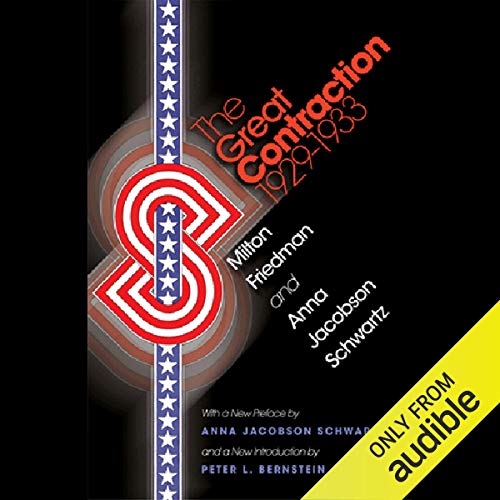
The Great Contraction, 1929-1933
Summary
Friedman and Schwartz's A Monetary History of the United States, 1867-1960, published in 1963, stands as one of the most influential economics books of the 20th century. A landmark achievement, the book marshaled massive historical data and sharp analytics to support the claim that monetary policy--steady control of the money supply--matters profoundly in the management of the nation's economy, especially in navigating serious economic fluctuations. The chapter entitled "The Great Contraction, 1929-33" addressed the central economic event of the century, the Great Depression. Published as a stand-alone paperback in 1965, The Great Contraction, 1929-1933 argued that the Federal Reserve could have stemmed the severity of the Depression, but failed to exercise its role of managing the monetary system and ameliorating banking panics. The book served as a clarion call to the monetarist school of thought by emphasizing the importance of the money supply in the functioning of the economy--a concept that has come to inform the actions of central banks worldwide. This edition of the original text includes a new preface by Anna Jacobson Schwartz, as well as a new introduction by the economist Peter Bernstein. It also includes comments from the current Federal Reserve chairman, Ben Bernanke, originally made on the occasion of Milton Friedman's 90th birthday, on the enduring influence of Friedman and Schwartz's work and vision.
©2008 Milton Friedman (P)2009 Audible, Inc.