R. J. Rushdoony has 7 audiobooks on Listento.it, narrated by 1 narrator. The most-rated is Sermons in Obadiah & Jonah.

Faith & Wellness
Summary
Statist regulations. Quackery. Addiction. These are the modern symptoms of a disease that has infected Western medicine for thousands of years: the disease of humanism. In a series of 13 "medical reports", R. J. Rushdoony traced the Christian and pagan roots of Western medicine in history, and demonstrated how humanist thought has produced vicious fruit in both modern medical practices and in the expectations of patients. How do we heal the medical profession? Rushdoony understood that finger-pointing will not solve our problems. Because the plague of humanism will inevitably lead to death and no wellness, it is the responsibility of the Church - and the Christian medical professionals with her - to develop a thoroughly Biblical theology of medicine and to teach it. Rushdoony lays foundations for this by explaining the connection between salvation and healing, establishing the vital importance of treating the whole man (body and spirit), and renewing the vision for doctors to embrace their priestly callings. This is an essential listen for anyone who wants to reform heath care.
©2016 Chalcedon (P)2020 Chalcedon

Intellectual Schizophrenia
Summary
When this brilliant and prophetic book was first published in 1961, the Christian homeschool movement was years away, and even Christian day schools were hardly considered a viable educational alternative. But this book and the author's later Messianic Character of American Education were a resolute call to arms for Christians to get their children out of the pagan public schools and provide them with a genuine Christian education. Dr. Rushdoony had predicted that the humanist system, based on anti-Christian premises of the enlightenment, could only get worse. Rushdoony was indeed a prophet. He knew that education divorced from God and from all transcendental standards would produce the educational disaster and moral barbarism we have today. The title of this audiobook is particularly significant in that Dr. Rushdoony was able to identify the basic contradiction that pervades a secular society that rejects Gods sovereignty, but still needs law and order, justice, science, and meaning to life. As Dr. Rushdoony writes, "there is no law, no society, no justice, no structure, no design, no meaning apart from God". And so, modern man has become schizophrenic because of his rebellion against God.
©2014 Chalcedon Foundation (P)2021 Chalcedon Foundation

God's Plan for Victory
Summary
An entire generation of victory-minded Christians, spurred by the victorious postmillennial vision of Chalcedon, has emerged to press what the Puritan fathers called "the Crown Rights of Christ the King" in all areas of modern life. Central to that optimistic generation is Rousas John Rushdoony's jewel of a study God's Plan for Victory (originally published in 1977). The founder of the Christian Reconstruction movement set forth in potent, cogent terms the older Puritan vision of the irrepressible advancement of Christ's kingdom by his faithful saints employing the entire law-word of God as the program for earthly victory.
©1977, 1997, 2019 Mark R Rushdoony (P)2021 Chalcedon Foundation

Larceny in the Heart
Summary
Why are the most successful and advanced members of society often deemed to be the criminals? In a word - Envy. The envious man finds superiority in others intolerable, and he wishes to level and equalize all things. Many sociologists and social scientists turn this hatred and resentment into "virtue" under the guise of "social science" by calling it a demand for fraternity and equality. In this concise volume, Rushdoony uncovers the larceny in the heart of man and its results: class warfare and conflict society in which the rise of hostility and envy are seen as steps toward social progress, when in fact they lead to disaster. The political solutions posited lead to an inflationary economy and an overbearing state. This book is a must-listen to gain a biblical understand of the underlying tenets of this codified coveting and the only certain long-term cure.
©1982, 2002 Chalcedon Foundation (P)2021 Chalcedon Foundation

Van Til and the Limits of Reason
Summary
The Enlightenment was an intellectual movement of the late 17th and 18th centuries that was a self-conscious move away from the Reformation's emphasis on faith and revelation. It was the mind of man that became the new standard. "My own mind is my own church," wrote Thomas Paine in his Age of Reason (Part First, 1794), which was an attack on all religion that claimed to be authoritative and Christianity in particular. It is not without cause that Paine's title is sometimes used as a synonym for the Enlightenment. Its rationalism saw faith as a blind confidence, a belief in nothing, while Hebrews 11:3 tells us it is "through faith we understand..." The Christian must see faith in God's revelation as opening up understanding, as thinking God's thoughts after him, and rationalism as a restriction of thought to the narrow confines of human understanding. Reason is a gift of God, but we must not make more of it than it is. To see our reason as supreme is to see ourselves as supreme, and thereby repeat the sin of seeking to \"be as gods\" (Gen. 3:5). The first three essays of this volume were published in a small booklet in 1960 as a tribute to the thought of Dr. Cornelius Van Til, titled Van Til. The last four essays were written some time later and are published here for the first time.
©2013 Chalcedon (P)1960, 2013 Chalcedon
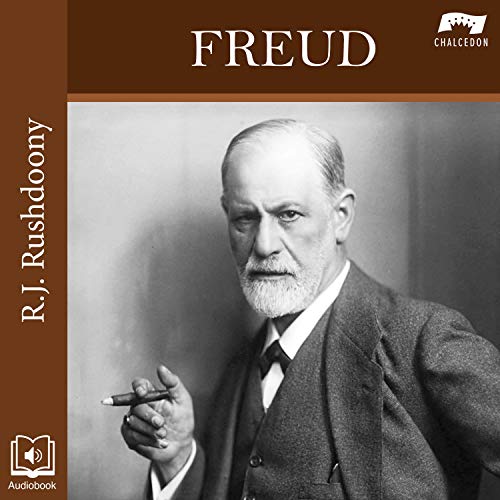
Freud
Summary
Why listen to a book on Freud? As long as man views guilt as a problem for science instead of religion, the influence of Sigmund Freud will remain lurking in the mind of modern man. Freud was an architect of the modern mind - and unholy builder - like Marx and Darwin. Freud was also a hater of religion - specifically the Bible and its absolute standard. He believed Biblical theism to be the "delusion" which compounded man's central problem of guilt. Freud wanted man to accept his moral predicament without reference to sin. Freud's motivation for psychoanalysis became the removal of guilt by self-acceptance. He posited that man's moral predicament was inescapable and guilt inevitable, unless man could come to terms with his moral prison. This ideology has spawned the new morality of our time, where both the homosexual and Christian must accept and embrace an immoral lifestyle. It is now called mental sickness for the homosexual to condemn himself and evidence of mental illness for anyone to condemn the homosexual. This is a destructive ethic, consistent with Freud seeing himself as a destroyer. His purpose was to disassociate guilt from sin, making it a problem for science rather than faith. Through this revision Freud hoped to destroy religion. But the removal of Christian religious influence leads only to tyranny as the Christian God is replaced by the dictatorial rule of the scientific elite. Totalitarianism assumes the place of the Triune God as scientific rulers seek control over every facet of life. Freud's therapy was scientific socialism: a syncretism of the scientific and political agendas of modern man. This analysis of one of history's most insidious players will provide insight into the modern rush to abolish Christianity and Biblical thought.
©1965, 2006, 2020 Chalcedon (P)2020 Chalcedon

Sermons in Obadiah & Jonah
Summary
Obadiah is a prophecy of judgment on Edom - descendants of Esau who bore a grudge against Judah, the descendants of Jacob. The Edomites viewed all the wealth and prosperity of Judah as rightfully theirs. This centuries-old envy caused them to seek every opportunity to do harm to God’s people. St. Augustine saw in Obadiah an early example of the City of Man opposing the City of God. R. J. Rushdoony brings the conflict even closer, condemning the “spiritual Edomites” of our day who believe evildoers have the power to frustrate the progress of the Kingdom of God. Jonah provides us with dramatic examples of God’s judgment and mercy. When reading Jonah, we tend to focus on God’s wrath upon Jonah while forgetting that his assigned mission was one of grace to Nineveh, capital of one of the most brutal empires in history. Despite being delivered from the fish, Jonah still complained when God showed mercy upon Nineveh. Rushdoony demonstrates that we play the part of Jonah when we second-guess God, complain about the work he gives us, or are peevish when outcomes are not to our liking. Rushdoony once wrote to himself in his own Bible, “JONAH RUSHDOONY, is it your gourd vine or the Lord’s work that fills your prayers and thoughts? ARISE, Nineveh is around you and its thousands of needy souls.” These sermons will both challenge and inspire your faith.
©2013 Chalcedon (P)2020 Chalcedon