Samuel Beckett has 7 audiobooks on Listento.it, narrated by 6 narrators, with an average listener rating of 4.6★ across 63 ratings. The most-rated is Waiting for Godot.

Waiting for Godot
Summary
There is now no doubt that not only is Waiting for Godot the outstanding play of the 20th century, but it is also Samuel Beckett's masterpiece. Yet it is both a popular text to be studied at school and an enigma. The scene is a country road. There is a solitary tree. It is evening. Two tramp-like figures, Vladimir and Estragon, exchange words. Pull off boots. Munch a root vegetable. Two other curious characters enter. And a boy. Time passes. It is all strange yet familiar. Waiting for Godot casts its spell as powerfully in this audiobook recording as it does on stage. PLEASE NOTE: When you purchase this title, the accompanying reference material will be available in your Library section along with the audio.
©Beckett Estate (P)2005 Naxos Audiobooks

The Unnamable
Summary
The Unnamable is the third novel in Beckett's trilogy, three remarkable prose works in which men of increasingly debilitating physical circumstances act, ponder, consider, and rage against impermanence and the human condition. The Unnamable is without doubt the most uncompromising text and it is read here in startling fashion by Sean Barrett.
©2005 NAXOS AudioBooks Ltd. (P)2005 NAXOS AudioBooks Ltd.
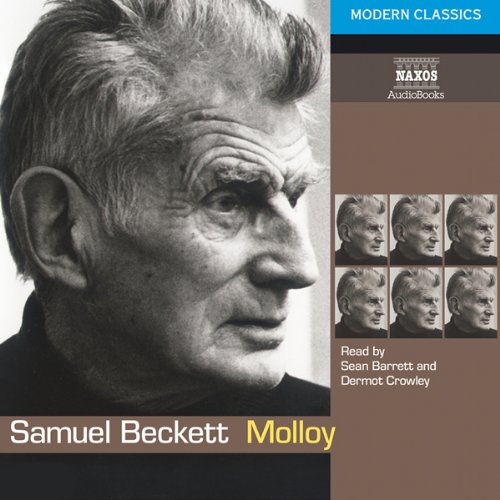
Molloy
Summary
Written initially in French, later translated by the author into English, Molloy is the first book in Dublin-born Samuel Beckett's trilogy. It was published shortly after WWII and marked a new, mature writing style, which was to dominate the remainder of his working life. Molloy is less a novel than a set of two monologues narrated by Molloy and his pursuer, Moran. In the first section, while consumed with the search of his mother, Molloy lost everything. Moran takes over in the second half, describing his hunt for Molloy. Within this simple outline, spoken in the first person, is a remarkable story, raising the questions of being and aloneness that marks so much of Beckett's work, but is richly comic as well. Beautifully written, it is one of the masterpieces of Irish literature.
©2003 NAXOS AudioBooks Ltd. (P)2003 NAXOS AudioBooks Ltd.

Malone Dies
Summary
Malone Dies is the first person monologue of Malone, an old man lying in bed and waiting to die. The tone is fiercely ironic, highly quotable, and because of its extravagance, also very comic. It catches the reality of old age in a way that is grimly convincing, cruel as humor so often is, and memorable because of Beckett's way with words. A master dramatist, Beckett's novels can be even more effective when heard, and especially when read by such a Beckett specialist as Sean Barrett.
©2004 NAXOS AudioBooks Ltd. (P)2004 NAXOS AudioBooks Ltd.

Murphy
Summary
'The sun shone, having no alternative, on the nothing new.' So opens Murphy, Samuel Beckett's first novel, published in 1938. Its work-shy eponymous hero, adrift in London, realises that desire can never be satisfied and withdraws from life, in search of stupor. Murphy's lovestruck fiancée, Celia, tries with tragic pathos to draw him back, but her attempts are doomed to failure. In Dublin, Murphy's friends and familiars are simulacra of him, fragmented and incomplete. They come to London in search of him. Under pressure from Celia to get a job, Murphy finds a post as a nurse in a mental institution, Magdalen Mental Mercyseat. Beckett's achievement in this early work lies in the brilliantly original language used to communicate his singular vision of isolation and misunderstanding. The combination of particularity and absurdity gives Murphy's world its painful definition, but the sheer comic energy of Beckett's prose releases characters and listeners alike into exuberance. It is read with verve and familiarity by Stephen Hogan.
©1938 Samuel Beckett (P)2016 Ukemi Productions Ltd

Watt
Summary
Written in Roussillon during World War Two, while Samuel Beckett was hiding from the Gestapo, Watt was first published in 1953. Beckett acknowledged that this comic novel unlike any other 'has its place in the series' - those masterpieces running from Murphy to the Trilogy, Waiting for Godot and beyond. It shares their sense of a world in crisis, their profound awareness of the paradoxes of being, and their distrust of the rational universe. Watt tells the tale of Mr Knott's servant and his attempts to get to know his master. Watt's mistake is to derive the essence of his master from the accidentals of his being, and his painstakingly logical attempts to 'know' ultimately consign him to the asylum. Itself a critique of error, Watt has previously appeared in editions that are littered with mistakes, both major and minor. The new Faber edition offers for the first time a corrected text based on a scholarly appraisal of the manuscripts and textual history. Watt is at times extremely funny, bizarre, allusive and richly poetic. Though 'early' Beckett, the novel shows the author to be a remarkable virtuoso, investing plot and pace with classical, intellectual and earthy content style. Dermot Crowley proves himself a towering Beckett performer, matching clarity with flair; and with its musical surprises (arranged and conducted by Roger Marsh), the recording shows that, once again, a key Becket novel comes to life unforgettably in the audiobook medium.
©2009 The Estate of Samuel Beckett (P)2016 Ukemi Productions Ltd

How It Is
Summary
How It Is, a landmark in 20th century literature, is one of the most challenging of Samuel Beckett's early novels. He published it first in French in 1961 and then in his own translation in 1964. He explained in a letter that it was the outpouring of a "'man' lying panting in the mud and dark murmuring his 'life' as he hears it obscurely uttered by a voice inside him.... The noise of his panting fills his ears and it is only when this abates that he can catch and murmur forth a fragment of what is being stated within...." It is written in short paragraphs without punctuation. Fragments of expression pour out, of memories, intentions, emotions. It is testing to read on the page, but in this extraordinary recording by Dermot Crowley, How It Is becomes more accessible and comprehensible than ever before. It is, from the start, mesmerizing, and as the character of the protagonist emerges through his words, moments of aggression, of tenderness, of loss and hopelessness become increasingly affecting. The novel is divided into three parts, as the opening paragraph indicates: 'How it was I quote before Pim with Pim after Pim how it is three parts I say it as I hear it [Paragraph] voice once without quaqua on all sides then in me when the panting stops tell me again finish telling me/invocation.'
©2009 The Estate of Samuel Beckett (P)2017 Ukemi Productions Ltd