Vladimir Ilich Lenin has 4 audiobooks on Listento.it, narrated by 4 narrators, with an average listener rating of 4.7★ across 16 ratings. The most-rated is State and Revolution.

State and Revolution
Summary
State and Revolution (1917) describes the role of the state in society, the necessity of proletarian revolution, and the theoretic inadequacies of social democracy in achieving revolution. It describes the inherent nature of the state as a tool for class oppression, a creation born of one social class' desire to control all other social classes. Whether a dictatorship or a democracy, the state remains in the control of the ruling class. Even in a democratic capitalist republic, the ruling class will never willingly relinquish political power, maintaining it via various strategies. Hence, according to this view, communist revolution is the sole remedy for the abolition of the state.
©2019 BN Publishing (P)2019 BN Publishing

The Wreckers
Summary
There was once a village off the coast of Cornwall, England, where people were so poor that they prayed for shipwrecks. They made their living by salvaging food and clothing from the wreckage. Some of them were evil and lit fires during a storm to lure ships onto the rocks. Then these "wreckers" made sure that no one survived the wrecks, so there would be no witnesses to their crimes. One stormy night in 1799, 14-year-old John Spencer was unfortunate enough to be on his father's ship when the wreckers did their worst. As John hid on the shore, he saw his shipmates murdered by these ruthless scavengers. Trapped in a strange land with no idea of whom to trust, he faced the most terrifying challenge of his life. The spell-binding excitement of a swashbuckling adventure, and the wrenching moral conflict of a Dickens novel delightfully converge in this critically-acclaimed debut novel. Ron Keith's exceptional narration ensures readers nonstop entertainment in the classic tradition. The Wreckers was chosen by Booklist as a Young Editors' Choice and by the New York Public Library as a title for reading and sharing.
©2006 Iain Lawrence (P)2006 Recorded Books LLC
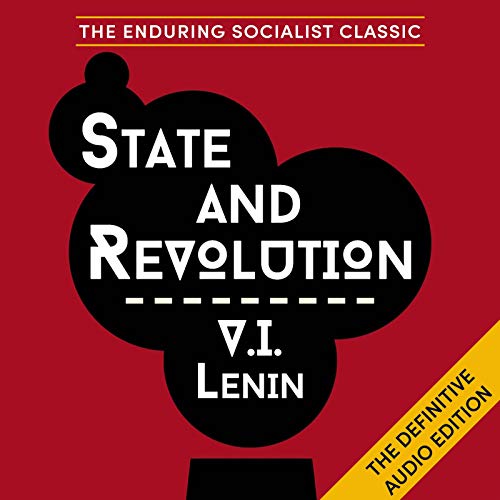
State and Revolution
Summary
Lenin's original work on class-based revolution. In 1917, in the midst of two revolutions, Vladimir Ilich Lenin fled Russia for fear of persecution by the government. While in exile, he began work on one of his most important works, State and Revolution, an attempt to resurrect the purity of Marx's and Engels' socialist teachings, which Lenin claimed were subsumed and weakened by reformists who reduced the "great revolutionaries" into "harmless icons". In State and Revolution, Lenin posits that the traditional role of the state in society is to maintain the control of the powerful, thus enabling the rich to exploit the poor. Because the ruling class will never willingly give up their political influence, social democracy - including parliamentary elections - is a false promise, and only results in a new crop of rich overlords lining up to "repress and crush the people". The sole way to bring true freedom and self-determination to all citizens, and throw off the "yoke of capitalism", is through Communist revolution - to "smash the state". As a result, the state would "wither away", and its bureaucrats would perform the will of the proletariat. This seminal work provides a practical application of socialist principles, and it has greatly influenced theories of global capitalist development. Italian philosopher Lucio Colletti called State and Revolution "Lenin's greatest contribution to political theory." This audio edition is deftly narrated by Peter Coates. To deepen your understanding of Lenin's arguments in State and Revolution, you may also wish to listen to his treatise on the relationship between capitalism and colonialism: Imperialism: The Highest Stage of Capitalism, skillfully read by Richard Webb, an Audible listener favorite.
©2020 Echo Point Books & Media, LLC (P)2020 Ech

Imperialism the Highest Stage of Capitalism
Summary
This 100-year-old book still explains our endless wars. As the extraordinary death and suffering of World War I unfolded, Vladimir Ilyich Lenin tried to explain why so many nations agreed to sacrifice so many people in such a brutal way. Expanding on the works of other political and economic theorists, including Karl Marx, Lenin provided an answer: Capitalism. As he saw it, WWI was solely about imperialism and colonialism. To maintain their unyielding drive for maximum profit, the major capitalist industries of rich nations-banks and manufacturing-had to seek riches outside of their country's borders. By sending money (capital), instead of goods, to poorer, less developed nations, they could exert their power and control new markets. But what happens when rival empires clash over these colonized lands? Warfare. In Imperialism: The Highest Stage of Capitalism, Lenin extends his scorn to the international socialist movement which - with the exception of the Russian faction-supported entering the war to fight against a perceived foreign enemy while ignoring domestic marauders. He also exposes the cynicism behind the Wilson doctrine, which posited the world could achieve peace through the continued exploitation of the poor by the rich. Lenin connects the ruling class's increased wealth with the corruption, through bribes, of politicians and the labor leaders who worked to suppress workers' strikes. Now a century in print, Lenin's influential analysis remains highly relevant in comprehending the historical context of the foreign and domestic policy in the United States and other major nations. This audio edition is skillfully narrated by Richard Webb. To deepen your understanding of Imperialism: the Highest Stage of Capitalism, you may also wish to listen to Lenin's pivotal work on political theory, State and Revolution, deftly read by Peter Coates.
Public Domain (P)2021 Echo Point Books & Media, LLC