Who HQ has 49 audiobooks on Listento.it, narrated by 41 narrators, with an average listener rating of 3.9★ across 392 ratings. The most-rated is The Odyssey.

What Is the Women's Rights Movement?
Summary
The story of Girl Power! Learn about the remarkable women who changed US history. From Susan B. Anthony and Elizabeth Cady Stanton to Gloria Steinem and Hillary Clinton, women throughout US history have fought for equality. In the 19th and early 20th centuries, women were demanding the right to vote. During the 1960s, equal rights and opportunities for women - both at home and in the workplace - were pushed even further. And in the more recent past, Women's Marches have taken place across the world. Celebrate how far women have come with this inspiring listen!
©2018 Deborah Hopkinson (P)2019 Listening Library
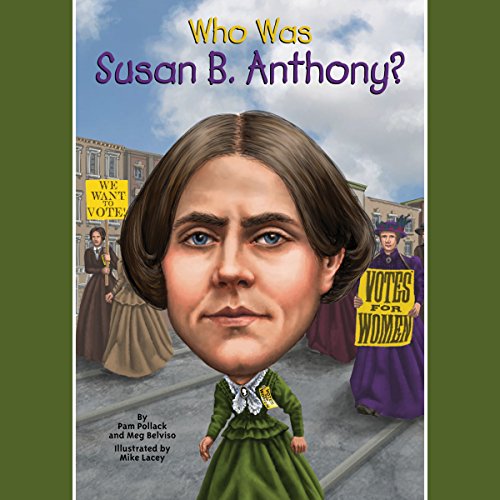
Who Was Susan B. Anthony?
Summary
Susan B. Anthony may be an international icon but her campaign for women's rights had personal roots. Working as a school teacher in New York, Anthony refused to settle for less pay than her male colleagues which ignited her lifelong devotion to women's equality. Anthony toured the United States and Europe giving speeches and publishing articles as one of the most important advocates of women's rights. Learn more about the woman behind the movement in Who Was Susan B. Anthony?
©2014 Pam Pollack, Meg Belviso and Who HQ (P)2018 Listening Library

Who Was Julius Caesar?
Summary
He came. He saw. He conquered. Julius Caesar was a force to be reckoned with as a savvy politician, an impressive orator, and a brave soldier. Born in Rome in 100 BC, he quickly climbed the ladder of Roman politics, making allies - and enemies - along the way. His victories in battle awarded him the support of the people, but flush from power, he named himself dictator for life. The good times, however, would not last much longer. On the Ides of March, Caesar was brutally assassinated by a group of senators determined to end his tyranny, bringing his reign to an end.
©2014 Nico Medina and Who HQ (P)2018 Listening Library

Who Was Mister Rogers?
Summary
Learn how Fred Rogers, a minister and musician from Pennsylvania, became one of America's most beloved television personalities and everyone's favorite neighbor. Even though he's best known for his successful PBS series Mister Rogers' Neighborhood, Fred Rogers never dreamed of working in television. In fact, he hated the very first program that he ever watched! Join author Diane Bailey as she takes listeners through the journey that brought Mister Rogers into our living rooms. From his childhood interest in puppet-making and music, to his courageous visit to Russia during the Cold War, this audiobook details Mister Rogers' quest for kindness and his gentle appeal to be more neighborly.
©2019 Diane Bailey, Who HQ (P)2019 Listening Library

Who Was Marie Antoinette?
Summary
From the palaces of Austria to the mirrored halls of Versailles, Marie Antoinette led a charmed life. She was born into royalty in 1755 and married the future king of France at age 15. By 21, she ascended to the throne and enjoyed a lavish lifestyle of masquerade balls, sky-high wigs, and extravagant food. But her taste for excess ruffled many feathers. The poor people of France blamed Marie Antoinette for their poverty. Her spending helped incite the French Revolution. And after much public outcry, in 1793 she quite literally lost her head because of it. Whether she was blameless or guilty is debatable, but Marie Antoinette remains woven into the fabric of history and popular culture.
©2015 Dana Meachen Rau and Who HQ (P)2018 Listening Library

Who Was Leif Erikson?
Summary
Hold on to your Viking helmets as you learn about the first known European to set foot on North America in this exciting addition to the Who Was? series! Leif Erikson was born to be an explorer. His father, Erik the Red, had established the first European settlement in present-day Greenland, and although he didn't yet know it, Leif was destined to embark on an adventure of his own. The wise and striking Viking landed in the area known as Vinland almost five centuries before Christopher Columbus even set sail! "Leif the Lucky" and the other fierce, sea-fearing pirates were accomplished navigators who raided foreign lands for resources, hunted for their food, and passed down Old Norse myths from one generation to the next. This audiobook gives listeners a detailed account of what life was like during the time of the Vikings.
©2018 Nico Medina and Who HQ (P)2018 Listening Library

Where Is the Bermuda Triangle?
Summary
Who doesn't love a great mystery? This book presents the eerie accidents and unexplained disappearances that have occurred in the region known as the Bermuda Triangle. Even before it was named, the Bermuda Triangle - roughly bounded by Miami, Bermuda, and Puerto Rico - had gained a mythic reputation. The Bermuda Triangle became famous for making boats and ships vanish and for snatching planes right out of the sky. But are these stories true? And if they are true, is there a more sensible reason that refutes the bad karma of the region? With so many mystifying events to learn about, readers will love disappearing into this story.
©2018 Megan Stine (P)2018 Listening Library

Who Was Coretta Scott King?
Summary
The wife of Martin Luther King, Jr., Coretta Scott King was a civil rights leader in her own right, playing a prominent role in the African American struggle for racial equality in the 1960s. Here's a gripping portrait of a smart, remarkable woman. Growing up in Alabama, Coretta Scott King graduated valedictorian from her high school before becoming one of the first African-American students at Antioch College in Ohio. It was there that she became politically active, joining the local chapter of the National Association for the Advancement of Colored People (NAACP). After her marriage to Martin Luther King, Jr., Coretta took part in the Civil Rights Movement. Following her husband's assassination in 1968, she assumed leadership of the movement. Later in life she was an advocate for the Women's Rights Movement, LGBT rights, and she worked to end apartheid in South Africa.
©2019 Gail Herman, Who HQ (P)2019 Listening Library

Who Was Catherine the Great?
Summary
Learn how a Prussian princess grew up to be Russia's longest-ruling female leader! Born in 1729, Princess Sophie of Anhalt-Zerbs was never supposed to come to power. But at age 16, she married the heir to the Russian throne. By 1762, Sophie, known now as Catherine, overthrew her immature and incompetent husband, Peter III, to lead the nation. Catherine became the sole ruler of Russia. This exciting Who Was? title explores how Catherine was able to turn Russia into one of the great powers of Europe by expanding its borders, helping improve its educational system, and advocating for the arts. Her three-decade reign is considered the Golden Age of Russia, and she is called Catherine the Great.
©2021 Pam Pollack, Meg Belviso, and Who HQ (P)2021 Listening Library

Who Was Celia Cruz?
Summary
How did a working-class girl from Cuba become a symbol of artistic freedom for Cuban Americans and the "Queen of Salsa"? Find out in this addition to the Who HQ library! Although her family and friends know her as Úrsula Hilaria Celia de la Caridad Cruz Alfonso, the world refers to her simply as Celia Cruz. Starting her career in 1950, Celia grew increasingly popular as the new lead singer of the Cuban band Sonora Matancera. Her exceptional vocal range and flashy costumes made fans fall in love with her. Celia's talent took her all around the world, including the United States. After Fidel Castro came to power in Cuba, she wasn't allowed to return to her native country. She and other Cubans who were exiled used their music to express their love for their homeland. Celia rose to the top of the charts in a genre that was dominated by men. She become an award-winning singer and the most popular Latin artist of the 20th century. Azucar! indeed!
©2020 Pam Pollack, Meg Belviso, and Who HQ (P)2020 Listening Library

Who Is Gloria Steinem?
Summary
As a field reporter in the 1960s, Gloria Steinem worked hard to dig up important stories. She went undercover to expose the grim realities of gender inequality in America. As her message continued to grow, she became the spokeswoman of the women’s liberation movement and created the feminist publication, Ms. magazine. Steinem continues to speak and write about women and women’s roles in media and politics.
©2014 Sarah Fabiny (P)2019 Listening Library

What Is Climate Change?
Summary
Learn more about what climate change means and how it's affecting our planet. The Earth is definitely getting warmer. There's no argument about that, but who, or what, is the cause? And why has climate change become a political issue? Are humans at fault? Is this just a natural development? While the vast majority of scientists who study the environment agree that humans play a large part in climate change, there is a counterargument. Author Gail Herman presents both sides of the debate in this fact-based, fair-minded, and well-researched book that looks at the subject from many perspectives, including scientific, social, and political.
©2018 Gail Herman and Who HQ (P)2018 Listening Library

Who Is Alexandria Ocasio-Cortez?
Summary
The inspiring story of the youngest woman ever elected to Congress, told in the new Who HQ Now format for trending topics. On June 26, 2018, 28-year-old Alexandria Ocasio-Cortez, a bartender from New York City, became the youngest woman ever elected to serve on Congress. Her win shocked the political world, and she became a celebrity overnight. Soon, everyone knew her by her initials: AOC. As soon as she was sworn into office, AOC became a vocal champion for health care for all and the fight against climate change. This exciting story details the defining moments of what led to her victory and all the monumental ones since that have shaped her into a smart politician willing to fight for others, the environment, and the future of America.
©2021 Kirsten Anderson, Who HQ (P)2021 Listening Library

What Is the Civil Rights Movement?
Summary
Relive the moments when African Americans fought for equal rights, and made history. Even though slavery had ended in the 1860s, African Americans were still suffering under the weight of segregation a hundred years later. They couldn't go to the same schools, eat at the same restaurants, or even use the same bathrooms as White people. But by the 1950s, Black people refused to remain second-class citizens and were willing to risk their lives to make a change. Author Sherri L. Smith brings to life momentous events through the words and stories of people who were on the frontlines of the civil rights movement of the 1950s and 1960s.
©2020 Sherri L. Smith (P)2020 Listening Library

Who Was Abigail Adams?
Summary
Abigail Adams was a strong woman far ahead of her time. She urged her husband, President John Adams, to "remember the ladies" and despite having no formal education herself, she later advocated for equal education in public schools for both boys and girls. She was also the first First Lady to live in the White House! This biography tells the story of Abigail Adams and her role in America's Revolutionary War period.
©2014 True Kelley and Who HQ (P)2018 Listening Library

Who Is RuPaul?
Summary
Learn how this Emmy-winning host, producer, and television personality became the world's most famous drag queen. RuPaul Andre Charles always knew he was meant to be a performer. Even as a young child, he loved to dress up and imitate the glamorous women he saw on television. When he turned 15, he began studying theater in a performing arts school in Atlanta and never looked back. Ru developed his drag-queen personality and launched his career in the 1980s. He now hosts and judges the widely popular and long-running show RuPaul's Drag Race, which has raised the profile of the art of drag, and drag queens around the world.
©2020 Nico Medina and Who HQ (P)2020 Listening Library

What is the Constitution?
Summary
We the people at Who HQ bring readers the full story - arguments and all - of how the US Constitution came into being. Signed on September 17, 1787 - four years after the American War for Independence - the Constitution laid out the supreme law of the United States of America. Today it's easy for us to take this blueprint of our government for granted. But the Framers - 55 men from almost all of the original 13 states - argued fiercely for many months over what ended up being only a four-page document. Here is a fascinating behind-the-scenes look at the hotly fought issues - those between Northern and Southern States; big states and little ones - and the key players such as James Madison, Alexander Hamilton, and George Washington, who suffered through countless revisions to make the Constitution happen.
©2018 Patricia Brennan Demuth and Who HQ (P)2018 Listening Library

Who Was Ruth Bader Ginsburg?
Summary
You've probably seen her on T-shirts, mugs, and even tattoos. Now that famous face graces the cover of our latest Who Was? book. Justice Ruth Bader Ginsburg was famous for her stylish collars (called jabots) and her commanding dissents. This opera-loving New Yorker always spoke her mind; as a young lawyer, RBG advocated for gender equality and women's rights when few others did. She gained attention for the cases she won when arguing in front of the Supreme Court, before taking her place on the bench in 1993. Author Patricia Brennan Demuth answers all the questions about what made RBG so irreplaceable and how the late Supreme Court justice left a legacy that will last forever.
©2019 Patricia Brennan Demuth, Who HQ (P)2019 Listening Library

Who Was Walt Whitman?
Summary
How did a New York printer become one of the most influential poets of all time? Find out in this addition to the Who HQ library! Walt Whitman was a printer, journalist, editor, and schoolteacher. But today, he's recognized as one of America's founding poets, a man who changed American literature forever. Throughout his life, Walt journeyed everywhere, from New York to New Orleans, Washington, DC, to Denver, taking in all that America had to offer. With the Civil War approaching, he saw a nation deeply divided, but he also understood the power of words to inspire unity. So in 1855, Walt published a short collection of poems, Leaves of Grass, a book about the America he saw and believed in. Though hated and misunderstood by many at the time, Walt's writing introduced an entirely new writing style: one that broke forms and celebrated the common man, human body, and the diversity of America. Generations later, people can still find themselves in Whitman's words and recognize the America he depicts. Who Was Walt Whitman? follows his remarkable journey from a young New York printer to one of America's most beloved literary figures.
©2021 Kirsten Anderson and Who HQ (P)2021 Listening Library

Who Was George Washington Carver?
Summary
Born in 1860s Missouri, nobody expected George Washington Carver to succeed. Slaves were not allowed to be educated. After the Civil War, Carver enrolled in classes and proved to be a star student. He became the first black student at Iowa State Agricultural College and later its first black professor. He went on to the Tuskegee Institute where he specialized in botany (the study of plants) and developed techniques to grow crops better. His work with vegetables, especially peanuts, made him famous and changed agriculture forever. He went on to develop nearly 100 household products and more than 100 recipes using peanuts.
©2015 Jim Gigliotti and Who HQ (P)2018 Listening Library