The History category has 4,114 audiobooks on Listento.it, with an average listener rating of 4.4★ across 16,411 ratings. The most-rated is A Short History of Nearly Everything.

A Short History of Nearly Everything
Summary
A Short History of Nearly Everything is Bill Bryson’s quest to find out everything that has happened from the Big Bang to the rise of civilization - how we got from there, being nothing at all, to here, being us. His challenge is to take subjects that normally bore the pants off most of us and see if there isn't some way to render them comprehensible to people who have never thought they could be interested in science. It's not so much about what we know, as about how we know what we know. How do we know what is in the centre of the Earth, or what a black hole is, or where the continents were 600 million years ago? How did anyone ever figure these things out? On his travels through time and space, Bill Bryson takes us with him on the ultimate eye-opening journey and reveals the world in a way most of us have never seen it before.
©2003 Bill Bryson (P)2003 Random House Audiobooks
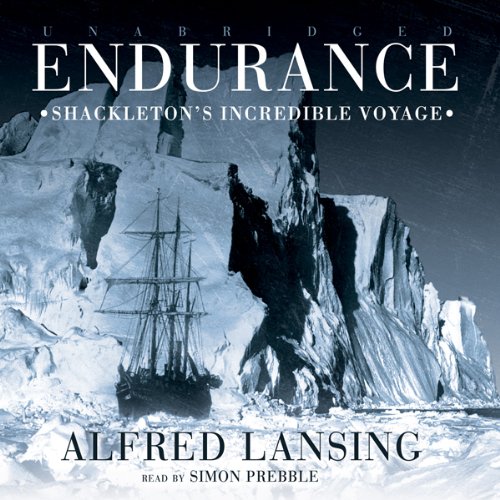
Endurance
Summary
This is a new reading of the thrilling account of one of the most astonishing feats of exploration and human courage ever recorded. In August of 1914, the British ship Endurance set sail for the South Atlantic. In October 1915, still half a continent away from its intended base, the ship was trapped, then crushed in the ice. For five months, Sir Ernest Shackleton and his men, drifting on ice packs, were castaways in one of the most savage regions of the world. Lansing describes how the men survived a 1,000-mile voyage in an open boat across the stormiest ocean on the globe and an overland trek through forbidding glaciers and mountains. The book recounts a harrowing adventure, but ultimately it is the nobility of these men and their indefatigable will that shines through.
©1959 Alfred Lansing (P)2007 Blackstone Audo, Inc.

The Rise and Fall of the Third Reich
Summary
Since its publication in 1960, William L. Shirer’s monumental study of Hitler’s German empire has been widely acclaimed as the definitive record of the 20th century’s blackest hours. The Rise and Fall of the Third Reich offers an unparalleled and thrillingly told examination of how Adolf Hitler nearly succeeded in conquering the world. With millions of copies in print around the globe, it has attained the status of a vital and enduring classic. Now, many years after the end of World War II, it may seem incredible that our most valued institutions and way of life were threatened by the menace that Hitler and the Third Reich represented. Shirer’s description of events and the cast of characters who played such pivotal roles in defining the course Europe was to take is unforgettable. Benefiting from his many years as a reporter, and thus a personal observer of the rise of Nazi Germany, and availing himself of some of the 485 tons of documents from the German Foreign Office, as well as countless other diaries, phone transcriptions, and other written records, meticulously kept at every level by the Germans, Shirer has put together a brutally objective account of how Hitler wrested political control of Germany, and planned and executed his six-year quest to dominate the world, only to see Germany go down in flames. This is a richly rewarding experience for anyone who wants to come to grips with the mysterious question of how this menace to civilization ever came into being, much less was sustained for as long as it was. The answer, unfortunately, is that most of Germany, for a whole host of reasons, embraced Nazism and the fanaticism that Hitler engendered.
©1990 William L. Shirer (P)2010 Blackstone Audio, Inc.

Forgiveness
Summary
When the Second World War broke out, Ralph MacLean chose to escape his troubled life on the Magdalen Islands in eastern Canada and volunteer to serve his country overseas. Meanwhile, in Vancouver, Mitsue Sakamoto saw her family and her stable community torn apart after the Japanese attack on Pearl Harbor. Like many young Canadian soldiers, Ralph was captured by the Japanese army. He would spend the war in prison camps, enduring pestilence, beatings and starvation as well as a journey by hell ship to Japan to perform slave labor, while around him his friends and countrymen perished. Back in Canada, Mitsue and her family were expelled from their home by the government and forced to spend years eking out an existence in rural Alberta, working other people's land for a dollar a day. By the end of the war, Ralph emerged broken but a survivor. Mitsue, worn down by years of backbreaking labour, had to start all over again in Medicine Hat, Alberta. A generation later, at a high school dance, Ralph's daughter and Mitsue's son fell in love. Although the war toyed with Ralph's and Mitsue's lives and threatened to erase their humanity, these two brave individuals somehow surmounted enormous transgressions and learned to forgive. Without this forgiveness, their grandson Mark Sakamoto would never have come to be.
©2014 Mark Sakamoto (P)2018 Audible, Inc.

Empire of the Summer Moon
Summary
Empire of the Summer Moon spans two astonishing stories. The first traces the rise and fall of the Comanches, the most powerful Indian tribe in American history. The second entails one of the most remarkable narratives ever to come out of the Old West: the epic saga of the pioneer woman Cynthia Ann Parker and her mixed-blood son, Quanah, who became the last and greatest chief of the Comanches. Although listeners may be more familiar with the names Apache and Sioux, it was in fact the legendary fighting ability of the Comanches that determined just how and when the American West opened up. They were so masterful at war and so skillful with their arrows and lances that they stopped the northern drive of colonial Spain from Mexico and halted the French expansion westward from Louisiana. White settlers arriving in Texas from the Eastern United States were surprised to find the frontier being rolled backward by Comanches incensed by the invasion of their tribal lands. So effective were the Comanches that they forced the creation of the Texas Rangers and account for the advent of the new weapon specifically designed to fight them: the six-gun. The war with the Comanches lasted four decades, in effect holding up the development of the new American nation. Gwynne's exhilarating account delivers a sweeping narrative that encompasses Spanish colonialism, the Civil War, the destruction of the buffalo herds, and the arrival of the railroads - a historical feast for anyone interested in how the United States came into being. PLEASE NOTE: When you purchase this title, the accompanying PDF will be available in your Audible Library along with the audio.
©2016 S. C. Gwynne (P)2016 Simon & Schuster

Clanlands
Summary
A road trip book with a difference. Stars of Outlander - Sam Heughan and Graham McTavish - explore Scotland, a land of raw beauty, poetry, feuding, music, history and warfare. Narrated by Sam Heughan and Graham McTavish, with a foreword written and read by Diana Gabaldon. From their faithful camper-van to boats, kayaks, bicycles and motorbikes, join stars of Outlander Sam and Graham on a road trip with a difference. Unlikely friends Sam and Graham begin their journey in the heart of Scotland at Glencoe and travel from there all the way to Inverness and Culloden battlefield, where along the way they experience adventure and a cast of highland characters. In this story of friendship, finding themselves and whisky, they discover the complexity, rich history and culture of their native country. PLEASE NOTE: When you purchase this title, the accompanying PDF will be available in your Audible Library along with the audio.
©2020 Diana Gabaldon, Graham McTavish, Sam Heughan (P)2020 Hodder & Stoughton Limited

Magicians of the Gods
Summary
New archaeological evidence for a pre-historic civilisation updated with two substantial new chapters brimming with recent reporting of fresh scientific advances. Graham Hancock's multi-million best seller Fingerprints of the Gods remains an astonishing, deeply controversial, wide-ranging investigation of the mysteries of our past and the evidence for Earth's lost civilisation. Twenty years on, Hancock returns with a book filled with completely new, scientific and archaeological evidence, which has only recently come to light.... The evidence revealed in this book shows beyond reasonable doubt that an advanced civilisation that flourished during the Ice Age was destroyed in the global cataclysms between 12,800 and 11,600 years ago. Near the end of the last Ice Age 12,800 years ago, a giant comet that had entered the solar system from deep space thousands of years earlier, broke into multiple fragments. Some of these struck the Earth causing a global cataclysm on a scale unseen since the extinction of the dinosaurs. At least eight of the fragments hit the North American ice cap, while further fragments hit the northern European ice cap. The impacts, from comet fragments a mile wide approaching at more than 60,000 miles an hour, generated huge amounts of heat which instantly liquidised millions of square kilometres of ice, destabilising the Earth's crust and causing the global Deluge that is remembered in myths all around the world. A second series of impacts, equally devastating, causing further cataclysmic flooding, occurred 11,600 years ago, the exact date that Plato gives for the destruction and submergence of Atlantis. But there were survivors - known to later cultures by names such as 'the Sages', 'the Magicians', 'the Shining Ones', and 'the Mystery Teachers of Heaven'. They travelled the world in their great ships doing all in their power to keep the spark of civilisation burning. They settled at key locations - Gobekli Tepe in Turkey, Baalbek in the Lebanon, Giza in Egypt, ancient Sumer, Mexico, Peru and across the Pacific where a huge pyramid has recently been discovered in Indonesia. Everywhere they went these 'Magicians of the Gods' brought with them the memory of a time when mankind had fallen out of harmony with the universe and paid a heavy price. A memory and a warning to the future.... For the comet that wrought such destruction between 12,800 and 11,600 years may not be done with us yet. Astronomers believe that a 20-mile wide 'dark' fragment of the original giant comet remains hidden within its debris stream and threatens the Earth. An astronomical message encoded at Gobekli Tepe and in the Sphinx and the pyramids of Egypt, warns that the 'Great Return' will occur in our time....
©2015 Graham Hancock (P)2015 Hodder & Stoughton

A Mind Spread Out on the Ground
Summary
Number One National Best Seller
Shortlisted for The 2019 Hilary Weston Writers' Trust Prize for Nonfiction
NAMED ONE OF THE BEST BOOKS OF 2019 BY THE GLOBE AND MAIL • CBC • CHATELAINE • QUILL & QUIRE • THE HILL TIMES • POP MATTERS
A bold and profound meditation on trauma, legacy, oppression, and racism in North America from award-winning Haudenosaunee writer Alicia Elliott.
In an urgent and visceral work that asks essential questions about the treatment of Native people in North America while drawing on intimate details of her own life and experience with intergenerational trauma, Alicia Elliott offers indispensable insight into the ongoing legacy of colonialism. She engages with such wide-ranging topics as race, parenthood, love, mental illness, poverty, sexual assault, gentrifcation, writing, and representation, and in the process makes connections both large and small between the past and present, the personal and political - from overcoming a years-long battle with head lice to the way Native writers are treated within the Canadian literary industry; her unplanned teenage pregnancy to the history of dark matter and how it relates to racism in the court system; her childhood diet of Kraft Dinner to how systemic oppression is directly linked to health problems in Native communities.
With deep consideration and searing prose, Elliott provides a candid look at our past, an illuminating portrait of our present and a powerful tool for a better future.
©2019 Alicia Elliott (P)2019 Doubleday Canada

The Other Side of History: Daily Life in the Ancient World
Summary
Look beyond the abstract dates and figures, kings and queens, and battles and wars that make up so many historical accounts. Over the course of 48 richly detailed lectures, Professor Garland covers the breadth and depth of human history from the perspective of the so-called ordinary people, from its earliest beginnings through the Middle Ages. The past truly comes alive as you take a series of imaginative leaps into the world of history's anonymous citizens, people such as a Greek soldier marching into battle in the front row of a phalanx; an Egyptian woman putting on makeup before attending an evening party with her husband; a Greek citizen relaxing at a drinking party with the likes of Socrates; a Roman slave captured in war and sent to work in the mines; and a Celtic monk scurrying away with the Book of Kells during a Viking invasion. Put yourself in the sandals of ordinary people and discover what it was like to be among history's 99%. What did these everyday people do for a living? What was their home like? What did they eat? What did they wear? What did they do to relax? What were their beliefs about marriage? Religion? The afterlife? This extraordinary journey takes you across space and time in an effort to be another person - someone with whom you might not think you have anything at all in common - and come away with an incredible sense of interconnectedness. You'll see the range of possibilities of what it means to be human, making this a journey very much worth taking. PLEASE NOTE: When you purchase this title, the accompanying reference material will be available in your Library section along with the audio.
©2012 The Teaching Company, LLC (P)2012 The Great Courses

The Room Where It Happened
Summary
John Bolton reads the epilogue! As President Trump’s national security advisor, John Bolton spent many of his 453 days in the room where it happened, and the facts speak for themselves. The result is a White House memoir that is the most comprehensive and substantial account of the Trump Administration and one of the few to date by a top-level official. With almost daily access to the president, John Bolton has produced a precise rendering of his days in and around the Oval Office. What Bolton saw astonished him: a president for whom getting reelected was the only thing that mattered, even if it meant endangering or weakening the nation. “I am hard-pressed to identify any significant Trump decision during my tenure that wasn’t driven by reelection calculations,” he writes. In fact, he argues that the House committed impeachment malpractice by keeping their prosecution focused narrowly on Ukraine when Trump’s Ukraine-like transgressions existed across the full range of his foreign policy - and Bolton documents exactly what those were and the attempts by him and others in the administration to raise alarms about them. He shows a president addicted to chaos, who embraced our enemies and spurned our friends, and was deeply suspicious of his own government. In Bolton’s telling, all this helped put Trump on the bizarre road to impeachment. “The differences between this presidency and previous ones I had served were stunning,” writes Bolton, who worked for Reagan, Bush 41, and Bush 43. He discovered a president who thought foreign policy is like closing a real estate deal - about personal relationships, made-for-TV showmanship, and advancing his own interests. As a result, the US lost an opportunity to confront its deepening threats, and in cases like China, Russia, Iran, and North Korea ended up in a more vulnerable place. Bolton’s account starts with his long march to the West Wing as Trump and others woo him for the national security job. The minute he lands, he has to deal with Syria’s chemical attack on the city of Douma and the crises after that never stop. As he writes early on, “If you don’t like turmoil, uncertainty, and risk - all the while being constantly overwhelmed with information, decisions to be made, and sheer amount of work - and enlivened by international and domestic personality and ego conflicts beyond description, try something else.” The turmoil, conflicts, and egos are all there - from the upheaval in Venezuela, to the erratic and manipulative moves of North Korea’s Kim Jong Un, to the showdowns at the G7 summits, the calculated warmongering by Iran, the crazy plan to bring the Taliban to Camp David, and the placating of an authoritarian China that ultimately exposed the world to its lethal lies. But this seasoned public servant also has a great eye for the Washington inside game, and his story is full of wit and wry humor about how he saw it played.
©2020 John Bolton (P)2020 Simon & Schuster Audio

The Year of Living Danishly
Summary
When she was suddenly given the opportunity of a new life in rural Jutland, journalist and archetypal Londoner Helen Russell discovered a startling statistic: the happiest place on earth isn't Disneyland but Denmark, a land often thought of by foreigners as consisting entirely of long, dark winters, cured herring, Lego and pastries. What is the secret to their success? Are happy Danes born or made? Helen decides there is only one way to find out: she will give herself a year, trying to uncover the formula for Danish happiness. From child care, education, food and interior design to SAD, taxes, sexism and an unfortunate predilection for burning witches, The Year of Living Danishly is a funny, poignant record of a journey that shows us where the Danes get it right, where they get it wrong, and how we might just benefit from living a little more Danishly ourselves. Helen Russell is a journalist and former editor of MarieClaire.co.uk. She now lives in rural Jutland and works as a Scandinavia correspondent for the Guardian as well as writing a column on Denmark for the Telegraph.
©2015 Helen Russell (P)2015 Audible, Ltd

The History of Ancient Egypt
Summary
Ancient Egyptian civilization is so grand our minds sometimes have difficulty adjusting to it. It lasted 3,000 years, longer than any other on the planet. Its Great Pyramid of Cheops was the tallest building in the world until well into the 19th century and remains the only Ancient Wonder still standing. And it was the most technologically advanced of the ancient civilizations, with the medical knowledge that made Egyptian physicians the most famous in the world. Yet even after deciphering its hieroglyphs, and marveling at its scarabs, mummies, obelisks, and sphinxes, Egyptian civilization remains one of history's most mysterious, as "other" as it is extraordinary. This chronological survey presents the complete history of ancient Egypt's three great Kingdoms: the Old Kingdom, when the pyramids were built and Egypt became a nation under the supreme rule of the pharaoh and the rules of Egyptian art were established; the Middle Kingdom, when Egypt was a nation fighting to restore its greatness; and the New Kingdom, when all the names we know today-Hatshepsut, Tutankhamen, Ramses the Great, Cleopatra, and others-first appeared. Professor Brier's 48 lectures glisten with the kind of vivid anecdotes and human glimpses that make this ancient world breathe again. "The fun of history is in the details," he notes. "Knowing that Ramses the Great was crippled by arthritis for the last decade of his long life makes us more sympathetic to the boastful monarch who fathered more than 100 children. If we understand what it was like to be a miner sent to the turquoise mines in the Sinai mountains in the summer, we will feel a kinship with our long-dead counterparts." PLEASE NOTE: When you purchase this title, the accompanying reference material will be available in your My Library section along with the audio.
©1999 The Teaching Company, LLC (P)1999 The Great Courses

The Splendid and the Vile
Summary
The number one New York Times best-selling author of The Devil in the White City and Dead Wake delivers a fresh and compelling portrait of Winston Churchill and London during the Blitz. NAMED ONE OF THE MOST ANTICIPATED BOOKS OF 2020 BY The Washington Post • HuffPost • The Seattle Times • Lit Hub • The Week • PopSugar On Winston Churchill’s first day as prime minister, Adolf Hitler invaded Holland and Belgium. Poland and Czechoslovakia had already fallen, and the Dunkirk evacuation was just two weeks away. For the next 12 months, Hitler would wage a relentless bombing campaign, killing 45,000 Britons. It was up to Churchill to hold his country together and persuade President Franklin Roosevelt that Britain was a worthy ally - and willing to fight to the end. In The Splendid and the Vile, Erik Larson shows, in cinematic detail, how Churchill taught the British people "the art of being fearless." It is a story of political brinkmanship, but it’s also an intimate domestic drama, set against the backdrop of Churchill’s prime-ministerial country home, Chequers; his wartime retreat, Ditchley, where he and his entourage go when the moon is brightest and the bombing threat is highest; and, of course, 10 Downing Street in London. Drawing on diaries, original archival documents, and once-secret intelligence reports - some released only recently - Larson provides a new lens on London’s darkest year through the day-to-day experience of Churchill and his family: his wife, Clementine; their youngest daughter, Mary, who chafes against her parents’ wartime protectiveness; their son, Randolph, and his beautiful, unhappy wife, Pamela; Pamela’s illicit lover, a dashing American emissary; and the advisers in Churchill’s "Secret Circle", to whom he turns in the hardest moments. The Splendid and the Vile takes listeners out of today’s political dysfunction and back to a time of true leadership, when, in the face of unrelenting horror, Churchill’s eloquence, courage, and perseverance bound a country, and a family, together. This audiobook includes a recording of Winston Churchill's 1941 Christmas Eve speech.
©2020 Erik Larson (P)2020 Random House Audio

The Crusades
Summary
The Crusades is an authoritative, accessible single-volume history of the brutal struggle for the Holy Land in the Middle Ages. Thomas Asbridge - a renowned historian who writes with "maximum vividness" (Joan Acocella, The New Yorker) - covers the years 1095 to 1291 in this big, ambitious, listenable account of one of the most fascinating periods in history. From Richard the Lionheart to the mighty Saladin, from the emperors of Byzantium to the Knights Templar, Asbridge's book is a magnificent epic of holy war between the Christian and Islamic worlds, full of adventure, intrigue, and sweeping grandeur.
©2010 Thomas Asbridged (P)2016 HarperCollins Publishers

The Story of World War II
Summary
Drawing on previously unpublished eyewitness accounts, prizewinning historian Donald L. Miller has written what critics are calling one of the most powerful accounts of warfare ever published. Here are the horror and heroism of World War II in the words of the men who fought it, the journalists who covered it, and the civilians who were caught in its fury. Miller gives us an up-close, deeply personal view of a war that was more savagely fought - and whose outcome was in greater doubt - than one might imagine. This is the war that Americans on the home front would have read about had they had access to the previously censored testimony of the soldiers on which Miller builds his gripping narrative. Miller covers the entire war - on land, at sea, and in the air - and provides new coverage of the brutal island fighting in the Pacific, the bomber war over Europe, the liberation of the death camps, and the contributions of African Americans and other minorities. He concludes with a suspenseful, never-before-told story of the atomic bombing of Nagasaki, based on interviews with the men who flew the mission that ended the war. Donald L. Miller is the John Henry MacCracken Professor of History at Lafayette College. He is a creator and associate producer of the HBO documentary He Has Seen War and has been chief consultant for numerous award-winning PBS productions. He is author of the prizewinning City of the Century: The Epic of Chicago and the Making of America.
©1945 Henry Steele Commager; renewed by Lou Reda Productions and Mary Steele Commager. Revisions; and introduction 2001 by Donald L. Miller (P)2012 Blackstone Audio, Inc.

SPQR
Summary
Ancient Rome matters. Its history of empire, conquest, cruelty and excess is something against which we still judge ourselves. Its myths and stories - from Romulus and Remus to the rape of Lucretia - still strike a chord with us. And its debates about citizenship, security and the rights of the individual still influence our own debates on civil liberty today. SPQR is a new look at Roman history from one of the world's foremost classicists. It explores not only how Rome grew from an insignificant village in central Italy to a power that controlled territory from Spain to Syria but also how the Romans thought about themselves and their achievements and why they are still important to us. Covering 1,000 years of history and casting fresh light on the basics of Roman culture, from slavery to running water, as well as exploring democracy, migration, religious controversy, social mobility and exploitation in the larger context of the empire, this is a definitive history of ancient Rome. SPQR is the Romans' own abbreviation for their state: Senatus Populusque Romanus, 'the Senate and People of Rome'.
©2015 Mary Beard (P)2015 Audible, Ltd

Homes
Summary
In 2010, the al Rabeeah family left their home in Iraq in hope of a safer life. They moved to Homs, in Syria - just before the Syrian civil war broke out. Abu Bakr, one of eight children, was 10 years old when the violence began on the streets around him: car bombings, attacks on his mosque and school, firebombs late at night. Homes tells of the strange juxtapositions of growing up in a war zone: horrific, unimaginable events punctuated by normalcy - soccer, cousins, video games, friends. Homes is the remarkable true story of how a young boy emerged from a war zone - and found safety in Canada - with a passion for sharing his story and telling the world what is truly happening in Syria. As told to her by Abu Bakr al Rabeeah, writer Winnie Yeung has crafted a heartbreaking, hopeful, and urgently necessary book that provides a window into understanding Syria.
©2018 Winnie Yeung (P)2019 Audible, Inc.

The Fall and Rise of China
Summary
How can we account for China’s momentous - and almost wholly unanticipated - global rise? And what does it mean, for us in the West and for humanity’s future? Speaking to these vital and fascinating questions, these 48 penetrating lectures by Professor Baum bring to vivid life the human struggles, the titanic political upheavals, and the spectacular speed of China’s modern rebirth. Offering multilevel insight into one of the most astounding real-life dramas of modern history, the lectures weave together the richly diverse developments and sociopolitical currents that created the China you now read about in the headlines. You’ll get a detailed understanding of all the core events in China’s century of stunning change, including the collapse of the Qing dynasty, the Republican era and civil wars, the "Great Leap Forward", the Cultural Revolution, and the post-Mao economic "miracle". Throughout, Professor Baum reveals highly unusual details that enrich the cinematic sweep of the story. For example, you’ll learn about the Christian warlord who baptized his troops with a fire hose, the strange kidnapping of Chiang K’ai-shek, and Professor Baum’s own smuggling of top-secret documents out of Taiwan. A core strength of these lectures is that they make sense of the dramatic events of the story by getting deeply at what underlay them, culturally, socially, and historically - leaving you with a nuanced knowledge of the forces moving China’s modern emergence. Bringing alive the passionate reinvention of China with deep discernment and humanity, they portray the confounding, majestic, heart-rending, and visionary story of a modern giant. PLEASE NOTE: When you purchase this title, the accompanying reference material will be available in your Library section along with the audio.
©2010 The Teaching Company, LLC (P)2010 The Great Courses

Band of Brothers
Summary
Easy Company, 506th Airborne Division, U.S. Army, was as good a rifle company as any in the world. From their rigorous training in Georgia in 1942 to D-Day and victory, Ambrose tells the story of this remarkable company, which kept getting the tough assignments. Easy Company was responsible for everything from parachuting into France early D-Day morning to the capture of Hitler's Eagle's Nest at Berchtesgaden. Band of Brothers is the account of the men of this remarkable unit who fought, went hungry, froze, and died, a company that took 150 percent casualities and considered the Purple Heart a badge of office. Drawing on hours of interviews with survivors as well as the soldiers' journals and letters, Stephen Ambrose tell the stories - often in the men's own words - of these American hereoes.
©1998 Stephen E. Ambrose (P)2012 Simon & Schuster

The Other America - A Speech from The Radical King (Free)
Summary
In a rousing speech on race, poverty, and economic justice - given less than a year before his assassination - Martin Luther King Jr. drives home the mission behind his Poor People's Campaign. It is a clear-eyed look at the disparity of wealth in America, what it means for people of all colors - and a message of inspiration dedicated to the power of the people. "And I say, if we will stand and work together, we will bring into being that day when justice will roll down like waters and righteousness like a mighty stream. We will bring into being that day when America will no longer be two nations but when it will be one nation, indivisible, with liberty and justice for all." Wanda Sykes' powerful performance delivers King's compassion, outrage, insight, and vulnerability like few others could - and reminds us all of the relevance his words still have today. "The Other America" is one of 23 speeches and essays from The Radical King, curated by Dr. Cornel West, including words never recorded in public - a revelation for his legacy. The Martin Luther King Estate has allowed, for the first time, a dramatic interpretation of King's words, by some of the most charismatic and activist actors working today: LeVar Burton, Mike Colter, Colman Domingo, Danny Glover, Gabourey Sidibe, Wanda Sykes, and Michael Kenneth Williams. "The Other America" excerpt from The Radical King is free of charge to all listeners until Monday, April 2, 2018. To preorder the full, revealing collection, visit www.audible.com/TheRadicalKing.
©2018 All material copyright Martin Luther King, Jr., and the Estate of Martin Luther King, Jr; all material copyright renewed Coretta Scott King and the Estate of Martin Luther King, Jr. Introductions 2015 Cornel West (P)2018 Audible, Inc.