The Architecture category has 52 audiobooks on Listento.it, with an average listener rating of 4.2★ across 44 ratings. The most-rated is The 99% Invisible City.

The Gardner Heist
Summary
Shortly after midnight on March 18, 1990, two men broke into the Isabella Stewart Gardner Museum in Boston and committed the largest art heist in history. They stole a dozen masterpieces, including one Vermeer, three Rembrandts, and five Degas. But after thousands of leads - and a $5 million reward - none of the paintings have been recovered. Worth as much as $500 million, the missing masterpieces have become one of the nation's most extraordinary unsolved mysteries. After the death of famed art detective Harold Smith, reporter Ulrich Boser decided to take up the case. Exploring Smith's unfinished leads, Boser travels deep into the art underworld and comes across a remarkable cast of characters, including a brilliant rock 'n' roll thief, a gangster who professes his innocence in rhyming verse, and the enigmatic late Boston heiress Isabella Stewart Gardner herself. Boser becomes increasingly obsessed with the case and eventually uncovers startling new evidence about the identities of the thieves. A tale of art and greed, of obsession and loss, The Gardner Heist is as compelling as the stolen masterpieces themselves. A Bustle Pick for Mystery Lovers Who Don't Want to Read about Murder.
©2018 Ulrich Boser (P)2018 Blackstone Audio, Inc.

The Flatiron
Summary
The marvelous story of the Flatiron: the instantly recognizable building that signaled the start of a new era in New York history. Critics hated it. The public feared it would topple over. Passersby were knocked down by the winds. But even before it was completed, the Flatiron Building had become an unforgettable part of New York City. The Flatiron Building was built by the Chicago-based Fuller Company - a group founded by George Fuller, "the father of the skyscraper" - to be their New York headquarters. The company's president, Harry Black, was never able to make the public call the Flatiron the Fuller Building, however. Black's was the country's largest real estate firm, constructing Macy's department store, and soon after the Plaza Hotel, the Savoy Hotel, and many other iconic buildings in New York as well as in other cities across the country. With an ostentatious lifestyle that drew constant media scrutiny, Black made a fortune only to meet a tragic, untimely end. In The Flatiron, Alice Sparberg Alexiou chronicles not just the story of the building but the heady times in New York at the dawn of the 20th century. It was a time when Madison Square Park shifted from a promenade for rich women to one for gay prostitutes; when photography became an art; motion pictures came into existence; the booming economy suffered increasing depressions; jazz came to the forefront of popular music - and all within steps of one of the city's best-known and best-loved buildings.
©2010 Alice Sparberg Alexiou (P)2013 Audible, Inc.

Nero and the Golden House (The wonders of Archaeology)
Summary
The story of Emperor Nero and the building of his Golden Palace. The reconstruction of the great fire of 64 AD, which destroyed the capital of the Empire, and the golden palace of Nero in a new production by Altair4 Multimedia & LA CASE Books: from the crumbling insulae of the Suburra to the sumptuous architecture of the Domus Aurea, from Nero's artificial lake to the Colosseum, from the Neronian porticoes on the Via Sacra to the glories of the Imperial Fora, from the imposing bulk of the Colossus of Nero to the architectural revolution of the Octagonal Hall.
©2017 La case USA (P)2017 La case USA

The Seven Lamps of Architecture
Summary
A great Ruskin book that is better listened to than read because of the complexity and detail of his writing. Hence he is much discussed but rarely read.
Public Domain (P)2020 Deaver Brown

Broadway
Summary
Broadway takes us on a mile-by-mile journey that traces the gradual evolution of the 17th century's Brede Wegh, a muddy cow path in a backwater Dutch settlement, to the 20th century's Great White Way. We learn why one side of the street was once considered more fashionable than the other; witness construction of the Ansonia Apartments, Trinity Church, and the Flatiron Building and the burning of P. T. Barnum's American Museum; and discover that Columbia University was built on the site of an insane asylum. Along the way we meet Alexander Hamilton, Edgar Allan Poe, John James Audubon, Emma Goldman, "Bill the Butcher" Poole, "Texas" Guinan, and the assorted real estate speculators, impresarios, and politicians who helped turn Broadway into a living paradigm of American progress, at its best and worst. Broadway tells the vivid story of what is arguably the world's most famous thoroughfare.
©2018 Fran Leadon (P)2018 HighBridge, a division of Recorded Books

Antiguo Egipto
Summary
Un viaje fantástico al esplendor del Reino de los Faraones: Alejandría, Guiza, Sakkara, Dendera, Karnak, Luxor, Deir el-Bahari, Deir el-Medina, Medinet-Habu, File, Abu Simbel, Elefantina, Asuán y La tumba de Nefertari.
©2017 ALTAIR4 MULTIMEDIA ROMA (P)2017 LA CASE Books & ALTAIR4 MULTIMEDIA ROMA

Bullocks Wilshire
Summary
This elegant book chronicles the efforts of the impressive team of international architects, designers, and businessmen who created Los Angeles’ famed Art Deco masterpiece. Bullocks Wilshire recounts the lives of the two immigrant entrepreneurs, John Gillespie Bullock and Percy Glen Winnett, who, with this magnificent department store, tested a new theory of retailing in the suburbs, and the architectural team, Parkinson and Parkinson, who executed that vision into one of Los Angeles’ most beloved landmarks. Narrated by Thomas Schiff, the Bullocks Wilshire audiobook evokes the dramatic events and historic periods of boom and bust that characterize the growth of Los Angeles in a way the written word might not.
©1996 Margaret Leslie Davis (P)2019 Balcony Media Inc

Sampuran Vaastu Shastra (Hindi Edition)
Summary
Sampoorn Vaastushaastra praacheen vaastukala ko lekar likhee gayee pahalee pustak hai, jismein bhavan-sthaapaty kala par vistrit chintan kiya gaya hai. Naye makaan ka pravesh dvaar kidhar ho? Dhaarvedh kise kahate hain, Kitne prakaar ke hote hain? Bhavan mein jal (watar-tank) sthaan kahaan, kidhar hona chaahiye? Paakshaala (Kitchen) mein agni sthaan (Fire-spot) kahaan ho? Shayan kaksh (bed-room) kis disha mein hona chaahiye taaki shayankartta ko bharpoor neend aa sake. Nivaas karne yogya bhookhand kee aakriti kaisee honee chaahiye. Bhoo-pareekshan ke kya-kya shaastreey vidhan hain? Sahee vaastu ke muhoort kaise dekhe jaate hain? In sabhee pahaluon par antarraashtreey khyaatipraapt vidvaan lekhak Dr. Bhojraaj Dwivedi ne vyaavahaarik chitron ke saath pustak ko bahut hee sundar dhang se sanvaara-sanjoya hai. Please note: This audiobook is in Hindi.
©1979 Diamond Pocket Books Pvt. Ltd. (P)2021 Audible, Inc.

Golden Gate
Summary
The Golden Gate Bridge is an icon of one of the most mythic of American cities, San Francisco. Standing between the Bay and the mighty Pacific like a guardian of the city, the Golden Gate retains its grip on the American imagination long after its 27-year record of being the longest suspension bridge in the world was superseded.
©2010 Kevin Starr (P)2012 Audible, Inc.

Ancient Egypt
Summary
A wonderful journey through the splendors of the Pharaoh's Kingdom: Alexandria, Giza, Saqqara, Dendera, Deir El-Bahari, Deir El-Medina, Medinet-Habu, Karnak - Luxor, Elephantine, Assuan, Phile, Abu-Simbel and The tomb of Nefertari.
©2017 ALTAIR4 MULTIMEDIA ROMA (P)2017 LA CASE Books & ALTAIR4 MULTIMEDIA ROMA

Castles
Summary
Beginning with their introduction in the 11th century, and ending with their widespread abandonment in the 17th, Marc Morris explores many of the country's most famous castles, as well as some spectacular lesser-known examples. At times this is an epic tale, driven by characters like William the Conqueror, King John, and Edward I, full of sieges and conquest on an awesome scale. But it is also by turns an intimate story of less eminent individuals, whose adventures, struggles, and ambitions were reflected in the fortified residences they constructed. Be it ever so grand or ever so humble, a castle was first and foremost a home. To understand castles - who built them, who lived in them, and why - is to understand the forces that shaped medieval Britain.
©2017 Marc Morris (P)2017 Tantor

Data Science: 2 Manuscripts in 1
Summary
Do you want to expand your skills from being a basic data scientist to becoming an expert data scientist ready to solve real-world data-centric issues? Exploring this audiobook could be a step in the right direction.
Discover two comprehensive manuscripts in one audiobook.
Part one of this audiobook will cover topics such as:
Introduction to data science
How to think about data
Importance of data in business
The art of data science
Data science as a change agent
How to use data science right
Data security - protect major enterprise assets data in the cloud
Data science modeling and featurization
Tips for data science
Difference between business intelligence and data science
Data science: tools and skills in data science
Part two of this audiobook will discuss the following topics:
How data can help mitigate risks in business
How to handle and manage big data in business
Data visualization
Machine learning for data science
Machine learning algorithms
Data science and big data analytics
The process of data analysis
Develop your own data analytics strategy and action plan
Predictive analytics techniques
©2019 Travis Goleman (P)2019 Travis Goleman

Asbestos: The Dark Arts
Summary
Asbestos management overview. A practical and informative no-nonsense guide to improving asbestos management, from a history overview to a more in-depth look at regulation and how to comply. This audiobook combines years of asbestos knowledge with it, all simplified and made easy to understand. There are various practical tasks to complete as well as amazing bonus material that the listener can really utilize to great effect. Ian stone and Neil Munro are two straight-talking asbestos consultants who have combined their skill and knowledge to cut through a lot of the overcomplicated elements in and surrounding asbestos management. Discover the quick and easy ways to asbestos management and also to finding your asbestos power team. You can master the dark art of asbestos management by following the guides and tasks in this audiobook. Seven-step guide to asbestos-management heaven Overview of everything you need to know Bullet-point chapter overviews Multiple tasks and templates And much, much more
©2018 Neil Munro & Ian Stone (P)2019 Neil Munro & Ian Stone

The Digital Battle
Summary
Playing a game... And don't know the cyber security rule. Networking in the form of Internet, extranet, intranet, and virtual private network (VPN) has opened many doors for businesses. No longer is commerce inhibited by time zones or geographic locations to conduct financial transactions. Cyberspace affords businesses enormous revenue opportunities with reduced associated costs. All that is necessary for customers to make Online purchases is Internet availability and connectivity, an Internet of things (IoT), digital media (i.e. laptop, desktop, tablet, smartphone, etc.), and a method of payment (i.e. bank account, credit card, debit card, etc.). The problem resonates from the protection of your personal identifiable information (PII) during authentication and validation processes. The Digital Battle: Cyber Security is an attempt to assist consumers by protecting their PII, trade secrets, and critical infrastructure from compromise. To prevent exploitation, consumers need vigilance paired with knowledge. Using strategies of cybersecurity outlined in the three domains within this audiobook, listeners can gain the tools they need to succeed. Be ready, cover your defenses, and take the offensive with cyber warfare tactics. Malida “Lida” Ihekwoaba is a native of St. Louis, Missouri, currently living in Augusta, Georgia. She is a veteran and retiree from the US Army as a Signal Corps officer. Lida has served the US Armed Forces for more than 24 years in areas of telecommunications, information technology, information security, and cybersecurity. Lida has held several leadership positions within information security and has a profound grasp of cybersecurity. She has more than 29 years of experience and education in information technology (IT), information security, and telecommunications, 16-plus years of experience in supervisory, administrative, and management of personnel and communication security equipment, and 13-plus years of experience and training in information assurance/cybersecurity. Malida holds six scholastic degrees (two associates of arts, two bachelors of science, a master of arts, and a master of divinity) and is currently pursuing a doctor of information assurance.
©2017 Lida (P)2018 Lida
Town Planning in Practice
Summary
Raymond Unwin was a prominent architect and engineer from the late 19th and early 20th century. He helped popularize the Arts and Crafts movement and was one of the first English voices in the town planning movement. Town Planning in Practice was published in 1909 and still resonates with planners and urban designers today. It reflects on discussions that are still happening to this day including the design of buildings, plots of land, and neighborhood streets.
©1909 Raymond Unwin (P)2020 The Overhead Wire Media

The Pentagon
Summary
The creation of the Pentagon in 17 whirlwind months during World War II is one of the great construction feats in American history, involving a tremendous mobilization of manpower, resources, and minds. In astonishingly short order, Brigadier General Brehon B. Somervell conceived and built an institution that ranks with the White House, the Vatican, and a handful of other structures as symbols recognized around the world. Now veteran military reporter Steve Vogel reveals for the first time the remarkable story of the Pentagon's construction, from its dramatic birth to its rebuilding after the September 11 attack. The Pentagon's post-World War II history is told through its critical moments, including the troubled birth of the Department of Defense during the Cold War, the tense days of the Cuban Missile Crisis, and the tumultuous 1967 protest against the Vietnam War. The pivotal attack on September 11 is related with chilling new detail, as is the race to rebuild the damaged Pentagon, a restoration that echoed the spirit of its creation. This study of a single enigmatic building tells a broader story of modern American history, from the eve of World War II to the new wars of the 21st century. Steve Vogel has crafted a dazzling work of military social history.
©2007 Steve Vogel (P)2020 Tantor
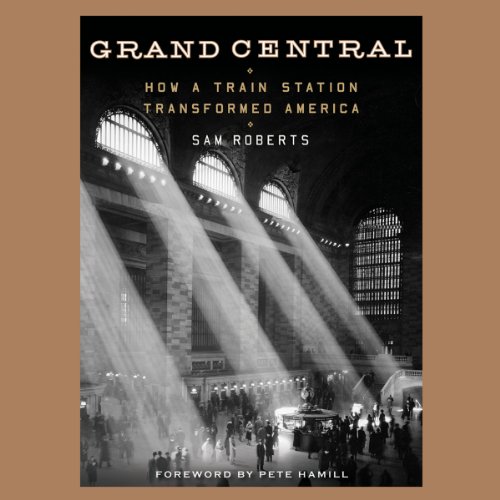
Grand Central
Summary
A rich, illustrated - and entertaining - history of the iconic Grand Central Terminal, from one of New York City's favorite writers, just in time to celebrate the train station's 100th fabulous anniversary. In the winter of 1913, Grand Central Station was officially opened and immediately became one of the most beautiful and recognizable Manhattan landmarks. In this celebration of the 100-year-old terminal, Sam Roberts of The New York Times looks back at Grand Central's conception, amazing history, and the far-reaching cultural effects of the station that continues to amaze tourists and shuttle busy commuters. Along the way, Roberts will explore how the Manhattan transit hub truly foreshadowed the evolution of suburban expansion in the country, and fostered the nation's westward expansion and growth via the railroad. Featuring quirky anecdotes and behind-the-scenes information, this book will allow listeners to peek into the secret and unseen areas of Grand Central - from the tunnels, to the command center, to the hidden passageways. With stories about everything from the famous movies that have used Grand Central as a location to the celestial ceiling in the main lobby (including its stunning mistake) to the homeless denizens who reside in the building's catacombs, this is a fascinating and, exciting look at a true American institution. PLEASE NOTE: When you purchase this title, the accompanying reference material will be available in your Library section along with the audio.
©2013 Sam Roberts (P)2013 Hachette Audio

Rosa's Castle
Summary
Samuel Taylor Suit was a dashing figure in West Virginian society - a man who made his fortune distilling whiskey. An investor in the growing railroad industry, he played host to US presidents. And when he fell in love, he fell hard. Rosa Pelham was almost two decades younger than Suit, who courted her unsuccessfully for five long years. Then, in 1883, he found the chink in Rosa’s romantic armor. She dreamed of living in a castle. Suit vowed to build her one if she accepted his proposal. He was as good as his word, and Berkeley Castle became part of West Virginian history. Some say the story of Rosa and her castle ended badly, with heartache, financial ruin, and insanity. Some darkly hint that vengeful ghosts now walk the halls of Berkeley Castle, tormented by secret misdeeds.Others tell a different tale - one of love and courage in the face of changing fortunes. Rosa’s Castle tells this tale - a dazzling “what if” based on one of America’s most striking love stories. As for ghosts...well, not all are vengeful shades. Some haunt out of love for those they left behind.
©2016 Deanna Edens (P)2019 Deanna Edens

The Ancient Egyptian Metaphysical Architecture
Summary
This book reveals the Ancient Egyptian knowledge of harmonic proportion, sacred geometry, and number mysticism, as manifested in their texts, temples, tombs, art, hieroglyphs, etc., throughout their known history. It shows how the Egyptians designed their buildings to generate cosmic energy, and the mystical application of numbers in Egyptian works. The book explains in detail the harmonic proportion of about 20 Ancient Egyptian buildings throughout their recorded history. This book is divided into three parts containing a total of 13 chapters Part I: Architectural Concepts - Function and From consists of five chapters - 1 through 5: Chapter 1: The Architectural Canon Chapter 2: The Metaphysical Structure of the Universe Chapter 3: Visitation Sites of the Lower Heavenly Court Chapter 4: The Sealed Pharaohs' Tombs Chapter 5: Egyptian Temples of The Divine Forces Part II: The Physical Manifestation of Metaphysical Concepts consists of five chapters - 6 through 11: Chapter 6: Architectural Constituent Forms of Metaphysical Functions will cover the various architectural forms as manifestation of their corresponding functions [both physically and metaphysically] for "false doors", recessed wall panels, columns and pillars, capitals of columns, porticoes, peristyles, colonnade formations at four different locations, obelisks, statuary images of various roof forms (flat, gable, corbelled, arch & vaulted), stylistic architectural details (architrave, cornice, and torus) and stylistic ornamentation and decoration such as starry ceilings, floral, geometric, figurative, a combination of two or all three, guilloche (misnamed as the Tuscan border), chevron, and scroll pattern. Chapter 7: The Primary Geometrical Shapes/Forms Chapter 8: The Generative Square Root Rectangles - "Irrational numbers" Chapter 9: The Arithmetic Generative Progression Chapter 10: Combined - Arithmetic and Graphic Harmonic Design of Egyptian Buildings Chapter 11: Harmonic Analysis of Ancient Egyptian Works will cover several examples in Ancient Egypt from all eras and throughout Egypt that show the Egyptian applications of the design elements discussed in this book. Examples include temples, tombs, pyramids, shrines, capitals of columns, stelae, pylons and doorways. Part III: The Spirited Communications has two chapters - 12 and 13: Chapter 12: The Animated Metaphysical Images on Walls will cover the metaphysical significance of walls' decoration as well as explanations of various depictions. Chapter 13: Human Activities will cover the roles of humans in activating, maintaining, participating in various rituals and festivities as well as deactivating the powers of the temple when temples and the whole Egypt is under siege.
©2016, 2018 Moustafa Gadalla (P)2019 Moustafa Gadalla

Lost Plantation
Summary
Along the fertile banks of the Mississippi River across from New Orleans, planter Camille Zeringue transformed a mediocre colonial plantation into a thriving gem of antebellum sugar production, complete with a columned mansion known as Seven Oaks. Under the moss-strewn oaks, the privileged master nurtured his own family but enslaved many others. Excelling at agriculture, business, an ambitious canal enterprise, and local politics, Zeringue ascended to the very pinnacle of Southern society. But his empire soon came crashing down. After the ravages of the Civil War and a nasty battle with a railroad company, the family eventually lost the great estate. Seven Oaks ultimately ended up in the hands of distant railroad executives whose only desire was to rid themselves of this heap of history. Lost Plantation: The Rise and Fall of Seven Oaks tells both of Zeringue's climb to the top and of his legacy's eventual ruin. Preservationists and community members abhorred the railroad's indifferent attitude, and the question of the plantation mansion's fate fueled years of fiery, political battles. These hard-fought confrontations ended in 1977, when the exasperated railroad executives sent bulldozers through the decaying house. By analyzing one failed effort, Lost Plantation provides insight into the complex workings of American historical preservation efforts as a whole while illustrating how Southerners deal with their multifaceted past. The rise and fall of Seven Oaks is much more than just a local tragedy - it is a glaring example of how any community can be robbed of its history. Now, as parishes around New Orleans recognize the great aesthetic and monetary value of restoring plantation homes and attracting tourism, Jefferson Parish mourns a manor lost.
©2005 Marc R. Matrana (P)2015 Redwood Audiobooks