The Economics category has 353 audiobooks on Listento.it, with an average listener rating of 4.4★ across 2,738 ratings. The most-rated is Stealing Fire.

The Silver Manifesto
Summary
There are factors that produce immense profits and these occur rarely. Investors stand at a unique point in monetary history where the death of paper currencies on a global scale is taking place before their eyes. Because most are frozen into inside-the-box thinking, few investors will ride the next move as silver (and gold) skyrocket in the years ahead. In fact the primary purpose of this book is to educate the listener as to why there is no way out of the financial morass created by the financial elite. We have reached the point where the savvy few understand what is happening and take action, while the rest are left watching, thinking the precious metals bull market is dead. The authors explore when to expect the next bull market to begin and why, how the 2008 financial crisis has been "papered over" and what to watch for going forward. The real supply and demand looking at both industrial and monetary demand. Money and banking - what fractional reserve banking means to currency and bullion. The best surest method to stay in the profit zone and not worry about the wild price swings. How to pick a mining company - this information is priceless. Most who are taught this methodology have a degree in finance, but we break it down for the average investor. The silver manipulation story - the facts, more facts, and the irrefutable facts. The biggest concern of all investors: The debt bomb!
©2015 christopher j marchese (P)2015 Christopher j marchese

Battle for the Soul of Capitalism
Summary
There is no one better qualified to tell us about the failures of the American financial system and the grotesque abuses that have taken place in recent years than John C. Bogle, founder and former chief executive of the Vanguard mutual-fund group. This legendary mutual-fund pioneer has witnessed firsthand the innermost workings of the financial industry for more than 50 years and has set the standards for sound investment strategies and stewardship. Bogle's prudent advocacy of the rights of individual investors began with his 1951 Princeton University thesis on the fund industry, and he continues to champion the restoration of integrity in industry practices today. An astute observer, he knows that a trustworthy business and financial complex is essential to America's continuing leadership in the world and to economic and social progress at home. This audiobook explains much more than what went wrong. More important, it tells us why we lost our way and how we can right our course. The specific reforms Bogle advances are practical and essential, and he includes recommendations for assuring that investors receive their fair share of financial-market returns.
©2005 John C. Bogle (P)2006 Audio Evolution, LLC

The Money Deception - What Banks & Governments Don't Want You to Know
Summary
In this startling new audiobook, Mr. Herold provides the most sophisticated insight and shocking details about the current monetary system. Never before has the massive manipulation of money caused so much despair and income inequality all over the world. This audiobook unveils more than 20 secret methods used by banks, governments, and corporations to legally steal 90 percent of your income. Brilliantly authored and astoundingly easy to understand, this audiobook is an eye-popping exposure of the most sophisticated fraud in the history of mankind. Why the current monetary system stands before the abyss The magic trick how banks create money out of thin air The myth of GDP growth and what really causes it The physiological methods by which advertisers and insurances get your money Will the government soon be forced to support universal basic income? Why Bitcoin is not a practical investment tool and will soon vanish Why cryptocurrencies could free us from central banks and government regulations Why a resource-based economy could be the solution and make money obsolete What you can do right now to shift from a money mind-set to wealth creation More than eight years in the making.... In spite of the frightening facts, it also provides remarkable and simple solutions to create abundance for all people. This is a must-listen if you want to survive the global monetary transformation that’s underway right now.
©2018 Thomas Herold (P)2018 Thomas Herold

Completing Capitalism
Summary
For the past 50 years, the business world has been dominated by the Milton Friedman financial capitalism economic model, which preaches that it is the "sole social responsibility of business to maximize profit for distribution to shareholders". This one-dimensional focus represents a grossly incomplete view of reality - there are many other factors businesses need to pay attention to if they are to thrive and endure - and has resulted in increasing global economic dysfunction, widening inequality, and environmental destruction. In this book, Roche and Jakub offer a new model that is built around detailed metrics to measure and track performance in all forms of capital, including social, human, and natural as well as financial. And this is not simply theory: The model has been extensively field-tested in live business pilots in Africa, Asia, and elsewhere. It is delivering superior measurable performance across the different forms of capital, including generating more profit than a profit maximization approach. Recent high-profile books like Capital in the Twenty-First Century have exposed the shortcomings of today's financial capitalism model, but this book goes far beyond by describing a well-developed, proven alternative.
©2017 Bruno Roche and Jay Jakub (P)2017 Bruno Roche and Jay Jakub

Birds of All Feathers
Summary
A book isn’t going to end racism or inequity. But it can be a start. Birds of All Feathers is a timely call to action for employers, HR professionals, managers, and employees to address diversity and inclusion - because it’s not just the right thing to do, but the smart thing to do. Michael Bach helps you develop a better understanding around the nuances of terms like diversity versus inclusion and equity versus equality, and he shows how diversity and inclusion can drive innovation and creativity - critical to any business’ survival in today’s fickle marketplace. You’ll learn how to craft a D&I policy that’s effective and how to start the work of dismantling systemic racism and inequity by creating safe work spaces where people can bring their whole selves, find advancement, and succeed. Whether you are in the arts, health care, nonprofit, or for-profit sectors, there is a business case for making your organization a space of true inclusion. In Birds of All Feathers, Michael Bach presents a feisty and honest case for the business advantage of diversity and inclusion in the workplace with practical steps to get there. This book shows you how to: Discover your organization’s “why” Learn how to implement and sustain beneficial changes Determine how to measure success for your business With more than 20 years of experience in the field, Michael Bach, founder of the Canadian Centre for Diversity and Inclusion (CCDI), brings clarity and candor to a daunting subject and shows you how to get diversity and inclusion right. No more excuses. No more delays. Change - and growth - starts right here.
©2020 Michael Bach (P)2020 Pesha Holdings Inc.

The Death of the Banker
Summary
With the same breadth of vision and narrative élan he brought to his monumental biographies of the great financiers, Ron Chernow examines the forces that made dynasties like the Morgans, the Warburgs, and the Rothschilds the financial arbiters of the early 20th century and then rendered them virtually obsolete by the century's end. As he traces the shifting balance of power among investors, borrowers, and bankers, Chernow evokes both the grand theater of capital and the personal dramas of its most fascinating protagonists. Here is Siegmund Warburg, who dropped a client in the heat of a takeover deal because the man wore monogrammed shirt cuffs, as well as the imperious J. P. Morgan, who, when faced with a federal antitrust suit, admonished Theodore Roosevelt to "send your man to my man and they can fix it up". And here are the men who usurped their power, from the go-getters of the 1920s to the masters of the universe of the 1980s. Glittering with perception and anecdote, The Death of the Banker is at once a panorama of 20th-century finance and a guide to the new era of giant mutual funds on Wall Street.
©1997 Ron Chernow (P)2017 HighBridge, a division of Recorded Books

The Age of Capital
Summary
The first and best major treatment of the crucial years 1848-1875 - a penetrating analysis of the rise of capitalism throughout the world. In the 1860s a new word entered the economic and political vocabulary of the world: 'capitalism'. The global triumph of capitalism is the major theme of history in the decades after 1848. It was the triumph of a society which believed that economic growth rests on competitive private enterprise, on success in buying everything in the cheapest market (including labour) and selling it in the dearest. An economy so based, and therefore nestling naturally on the sound foundations of a bourgeoisie composed of those whose energy, merit and intelligence had raised to their position and kept there, would - it was believed - create a world not only of suitably distributed material plenty but of ever-growing enlightenment, reason and human opportunity, an advance of the sciences and the arts: in brief, a world of continuous and accelerating material and moral progress.
©1975 Eric Hobsbawm (P)2020 Hachette Audio UK

Don't Compete, Dominate
Summary
Discover the secrets of true mastery and winning in life. Have you ever wondered why some people just seem to win all the time? Why some people get that promotion and you don't? Why some people always get picked for the team? Why are some more successful than you? Or why great people leave a mark and are immortalized as the greats of their chosen field? Well, so did I. I used to have the same thoughts and wondered exactly what it takes to win. I simply just woke up one morning hating my job and was tired of losing. In this book I share the seven rules, or habits, of dominance that resulted from my years of studying every success book and success story I could find. You will discover: How the famous and great successes of time applied the seven rules of domination Should you work smarter or harder? What do the great successes do? The rule that sets up all success The rule that will make you break away from your peers The rule that makes you indispensable and irreplaceable The conqueror's rule to crush your enemies in every area The rule that makes you stand out in a crowd The one rule you cannot afford not to know if you want to dominate The eighth rule of dominance (bonus) This book is not a magic recipe for success and doesn't promise to magically change your life after listening to it. But if you are ready to learn and apply what you will learn in this book, you will achieve whatever it is you desire and you will develop a mindset of winning that will help you dominate in all you do. Start dominating today.
©2016 Darnell Smith (P)2016 Darnell Smith

I.O.U.
Summary
The wildest story in the world these days is not fiction; it's what's really happening all around us as the world's global economy has gone into freefall. How did we get here? What does it all mean? How could so many smart people be so dumb and believe their own hype? Accessibly, cleverly, and with mordant humor, journalist John Lanchester trots the globe in search of the answers to these questions---to Iceland, the scene of catastrophic bank collapse; to Hong Kong, the city of his birth built at the altar of free-market capitalism; to the high-stakes leveraging of Wall Street; and to the tragedy of lost homes in small-town America. And in his capable hands, we see and understand what went wrong and why. Lanchester believes that the current crisis gives us an opportunity to bring about much-needed change and that a stronger and more compassionate system can emerge from the wreckage.
©2010 John Lanchester (P)2010 Tantor

Microeconomics Basics
Summary
To many people, economics is as confusing as physics. Just as we use physics every day even if we don’t know its technical aspects, we all use economics on a daily basis even if we don’t know its technical aspects. Yet, unlike physics, introductory economics is not as difficult as it might appear at first. However, it is true that economists speak a different “language”, in the sense that we often use terms that are not common in everyday conversation.
©2017 Can Akdeniz (P)2017 Can Akdeniz

Why Economies Rise or Fall
Summary
How can a nation create the conditions for economic growth and prosperity? And what, once these conditions are achieved, can it do to sustain this progress? Discover the answers (which may surprise you) in these 24 lectures that guide you through a stimulating and, above all, accessible examination of what economists know and don't know about the elusive search for economic prosperity. Here, you'll learn how countries as widely different as the United States and Vietnam have grown their economies; how countries like China and India were able to recover from economic reverses; and, most important, why the critical test of any economic policy is its ability to productively alter human behavior for everyone's ultimate benefit. By looking at economic growth as the result of incentivizing such productive behavior - "making productivity more profitable than all the alternatives" - Professor Rodriguez clears up an often-shrouded economic landscape. The result is a lecture series that brings the economic strategies chosen by nations down to street level by adding a newfound clarity to key issues: Why economies succeed or fail; how economic bubbles are created, why they burst, and how nations recover from them; the challenges posed by globalization; and more. By the end of the last lecture, you'll understand as never before both the benefits granted and the costs extracted by the "instant economy" that technology and globalization have brought us. You'll grasp what China's expected economic dominance may soon mean. And you'll have a new appreciation of the juggling act policymakers perform as they try to heed history's latest lesson in achieving national growth and maximum human happiness. PLEASE NOTE: When you purchase this title, the accompanying reference material will be available in your Library section along with the audio.
©2010 The Teaching Company, LLC (P)2010 The Great Courses

Human Action
Summary
Human Action is the most important book on political economy you will ever own. It was (and remains) the most comprehensive, systematic, forthright, and powerful defense of the economics of liberty ever written. This is the Scholar's Edition: accept no substitute. You will treasure this volume. The Scholar's Edition is the original, unaltered treatise (originally published in 1949) that shaped a generation of Austrians and made possible the intellectual movement that is leading the global charge for free markets. Mises himself wrote the following by way of explanation of why he wrote the book: "Economics does not allow any breaking up into special branches. It invariably deals with the interconnectedness of all phenomena of acting and economizing. All economic facts mutually condition one another. Each of the various economic problems must be dealt with in the frame of a comprehensive system assigning its due place and weight to every aspect of human wants and desires. All monographs remain fragmentary if not integrated into a systematic treatment of the whole body of social and economic relations. "To provide such a comprehensive analysis is the task of my book Human Action, a Treatise on Economics. It is the consummation of lifelong studies and investigations, the precipitate of half a century of experience. I saw the forces operating which could not but annihilate the high civilization and prosperity of Europe. In writing my book, I was hoping to contribute to the endeavors of our most eminent contemporaries to prevent this country from following the path which leads to the abyss." The Scholar's Edition of Human Action is the definitive edition of this great work and foundation of every library of freedom.
©1949 Ludwig von Mises (P)2010 Ludwig von Mises Institute

A Macat Analysis of Charles P. Kindleberger's Manias, Panics, and Crashes: A History of Financial Crises
Summary
When Charles P. Kindleberger's Manias, Panics, and Crashes: A History of Financial Crises was first published in 1978, the world was entering a new period of global economic turbulence. Established economists based their analyses on the assumption that investors act rationally, and these economists often communicated their ideas with dry, technical language. Kindleberger rebelled against convention. Using a more literary and descriptive style, he came up with a new view. He argued that markets are unstable precisely because investors act irrationally when they get swept along on a tide of optimism or despair. This makes the financial markets susceptible to crises, and at times they are in need of radical intervention. Kindleberger's historical examples of financial crashes worldwide show a distinct pattern, leading him to the conclusion that the world needs a single, central body to stabilize global markets at their most fragile moments. The fact that Kindleberger's book is now in its seventh edition shows just how popular his ideas have become, and how they are still relevant today. Manias, Panics, and Crashes is essential listening for anyone who wants to understand the market cycle of boom and bust.
©2016 Macat Inc (P)2016 Macat Inc

Coined
Summary
We are all aware of the power of money - how it influences our moods, compels us to take risks, and serves as the yardstick of success. Yet, because we take the daily reality of money so completely for granted, we seldom question how and why it has come to play such a central role in our lives. In Coined, author Kabir Sehgal casts aside our workaday assumptions about money and takes the listener on a global quest to understand the relationship between money and humankind. Coined is not only a profoundly informative discussion of the concept of money, but it is also an endlessly fascinating take on the nature of humanity and the inner workings of the mind.
©2015 Kabir Sehgal (P)2015 Hachette Audio

Abolish Silicon Valley
Summary
Former insider turned critic Wendy Liu busts the myths of the tech industry, and offers a galvanizing argument for why and how we must reclaim technology's potential for the public good. Innovation. Meritocracy. The possibility of overnight success. What's not to love about Silicon Valley? These days, it's hard to be unambiguously optimistic about the growth-at-all-costs ethos of the tech industry. Public opinion is souring in the wake of revelations about Cambridge Analytica, Theranos, and the workplace conditions of Amazon workers or Uber drivers. It's becoming clear that the tech industry's promised "innovation" is neither sustainable nor always desirable. Abolish Silicon Valley is both a heartfelt personal story about the wasteful inequality of Silicon Valley and a rallying call to engage in the radical politics needed to upend the status quo. Going beyond the idiosyncrasies of the individual founders and companies that characterize the industry today, Wendy Liu delves into the structural factors of the economy that gave rise to Silicon Valley as we know it. Ultimately, she proposes a more radical way of developing technology, where innovation is conducted for the benefit of society at large, and not just to enrich a select few.
©2020 Wendy Liu (P)2020 Repeater Books

The Green Line: Buy the Bottom of Any Stock Market Correction
Summary
"This is buy low, sell high on steroids!" Learn how to find the bottom of any stock market correction! Tim Morris is back with another one! On average, the stock market experiences one 14 percent correction each year. What if there was an indicator that showed you where the bottom of this correction was? An indicator you could use to make 5-20 percent profit or more in just a few weeks from these regular market corrections? Tim Morris has found this indicator, and he has coined it The Green Line! In this audiobook, Tim Morris shares with you a strategy that gets you in at the very bottom of market corrections. This strategy uses a simple indicator available on Yahoo Finance, Stockcharts, and many other free websites; no advanced algorithms needed! Tim guides you through the whole process determining when a correction is taking place and setting up your chart. He then goes over clear entry and exit points allowing you to make the most amount of money in the shortest period of time. Now each time the market goes through a correction, you have a money making strategy you can use to add some extra income to your wallet! If you want to learn a high probability trading strategy which allows you to earn a nice chunk of extra income each year, get this audiobook now!
©2019 Tim Morris (P)2019 Tim Morris

EuroTragedy
Summary
Blending economic analysis with political drama, EuroTragedy is a groundbreaking account of the euro's history and tragic consequences. In this vivid and compelling chronicle, Ashoka Mody describes how the euro improbably emerged through a narrow historical window as a flawed compromise wrapped in a false pro-European rhetoric of peace and unity. Drawing on his frontline experience as an official with the IMF, Mody situates the tragedy in a fast-paced global context and guides the listener through the forced - and unforced - errors Eurozone authorities committed during their long financial crisis. The decision to switch from national currencies to the euro unfolded as both economic and political tragedy. It weakened the growth potential of member states, which made financially vulnerable Europeans more anxious. It deepened perceptions of unfairness and widened the division between nations. Now, the burden falls on younger Europeans, a generation with a discouragingly bleak future. A compassionate view of European possibilities, EuroTragedy makes clear that the euro's structural flaws will continue to haunt the continent. Instead of centralizing authority to prop up an ossified pro-Europeanist model, it is time to loosen ties that bind too tightly so that a liberal order can once more flourish.
©2018 Oxford University Press (P)2019 Tantor
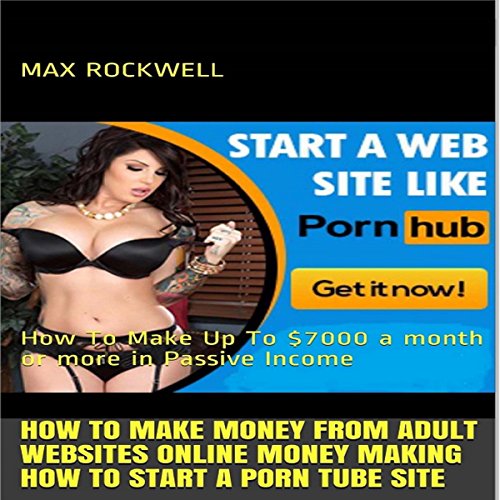
How to Start a Porn Tube Site: Make Money from Adult Websites Online Now!
Summary
Startups, Home Based Business, Work from Home, You have it all here! Did you know that online porn has grown into a $20 BILLION dollar industry? Did you also know that it's bigger than the NFL, the NBA and Major League Baseball COMBINED! Companies like General Motors, AOL Time Warner and Marriott earn revenue by streaming adult movies into homes and hotels across the USA. But you won't see it mentioned in their annual reports. This step by step guide will reveal how you can start making money within 24 hours in the porn industry startup. This new edition is a great addition to the likes of authors Eve Hanson, For Adults Only:How To Make Money with Adult Sites, Avery Breyer Steve Blank, The Startup Owner's Manual: The Step-by-Step Guide for Building a Great Company, and Peter Thiel. More importantly, you will learn how to do it quickly and effectively, Get ready, what you are about to discover will blow your mind! In this audiobook, the author shares not only how to do what he did, step-by-step and in clear language. He also shares tips, advice and stories from the porn industry trenches to help you avoid taking the dead-end paths that beginners find so tempting. Startups and Web based business are the way to financial freedom now. You will save countless hours of trial and error, and have the information you need to start your own business making money from online porn (without producing or appearing in porn yourself). He will help you choose the best fit for you and your skill set—even if you have no technical knowledge whatsoever—among many different possibilities, and will explain to you the advantages and disadvantages of each. Make up to $7000 per month or more all Passive Income Love to watch tube porn? Why Not Make Money in the Process Learn effective techniques to drive incredible traffic to your site and much more. . .
©2018 Max Rockwell (P)2018 Max Rockwell

In Fed We Trust
Summary
"Whatever it takes." That was Federal Reserve Chairman Ben Bernanke's vow as the worst financial panic in more than 50 years gripped the world and he struggled to avoid the once unthinkable: a repeat of the Great Depression. Brilliant but temperamentally cautious, Bernanke researched and wrote about the causes of the Depression during his career as an academic. Then, when thrust into a role as one of the most important people in the world, he was compelled to boldness by circumstances he never anticipated. The president of the United States can respond instantly to a missile attack with America's military might, but he cannot respond to a financial crisis with real money unless Congress acts. The Fed chairman can. Bernanke did. Under his leadership the Fed spearheaded the biggest government intervention in more than half a century and effectively became the fourth branch of government, with no direct accountability to the nation's voters. Believing that the economic catastrophe of the 1930s was largely the fault of a sluggish and wrongheaded Federal Reserve, Bernanke was determined not to repeat that epic mistake. In this penetrating look inside the most powerful economic institution in the world, David Wessel illuminates its opaque and undemocratic inner workings, while revealing how the Bernanke Fed led the desperate effort to prevent the world's financial engine from grinding to a halt.
©2009 David Wessel (P)2009 Random House

On the Wealth of Nations
Summary
As one of the first titles in Atlantic Monthly Press' "Books That Changed the World" series, America's most provocative satirist, P.J. O'Rourke, reads from Adam Smith's revolutionary The Wealth of Nations - so you don't have to. Recognized almost instantly on its publication in 1776 as the fundamental work of economics, The Wealth of Nations was also recognized as really long. The original edition totaled over 900 pages in two volumes, including the blockbuster 67-page "digression concerning the variations in the value of silver during the course of the last four centuries", which, O'Rourke says, "to those uninterested in the historiography of currency supply, is like reading Modern Maturity in Urdu". Although daunting, Smith's tome is still essential to understanding such currently hot topics as outsourcing, trade imbalances, and Angelina Jolie. In this hilarious, approachable, and insightful examination of Smith and his groundbreaking work, P.J. puts his trademark wit to good use and shows us why Smith is still relevant, why what seems obvious now was once revolutionary, and why the pursuit of self-interest is so important.
©2006 P.J. O'Rourke (P)2007 Tantor Media Inc.