Jeff Riggenbach has narrated 38 audiobooks on Listento.it by 34 authors, with an average listener rating of 4.6★ across 213 ratings. The most-rated is Amusing Ourselves to Death.

Amusing Ourselves to Death
Summary
In this eloquent and persuasive book, Neil Postman examines the deep and broad effects of television culture on the manner in which we conduct our public affairs, and how "entertainment values" have corrupted the very way we think. As politics, news, religion, education, and commerce are given less and less expression in the form of the printed word, they are rapidly being reshaped to suit the requirements of television. And because television is a visual medium, whose images are most pleasurably apprehended when they are fast-moving and dynamic, discourse on television has little tolerance for argument, hypothesis, or explanation. Postman argues that public discourse, the advancing of arguments in logical order for the public good, once a hallmark of American culture, is being converted from exposition and explanation to entertainment.
©1985 Neil Postman (P)1994 Blackstone Audio Inc.

Economics in One Lesson
Summary
Called by H.L. Mencken, "one of the few economists in history who could really write," Henry Hazlitt achieved lasting fame for his brilliant but concise work. In it, he explains basic truths about economics and the economic fallacies responsible for unemployment, inflation, high taxes, and recession. Covering considerable ground, Hazlitt illustrates the destructive effects of taxes, rent and price controls, inflation, trade restrictions, and minimum wage laws. And, he writes about key classical liberal thinkers like John Locke, Adam Smith, Thomas Jefferson, John Stuart Mill, Alexis de Tocqueville, and Herbert Spencer.
©1962, 1979 by Henry Hazlitt (P)1996 by Blackstone Audiobooks

Economic Facts and Fallacies
Summary
Economic Facts and Fallacies is designed for people who want to understand economic issues without getting bogged down in economic jargon, graphs, or political rhetoric. Writing in a lively manner that does not require any prior knowledge of economics, Thomas Sowell exposes some of the most popular fallacies about economic issues, including many that are widely disseminated in the media and by politicians: fallacies about urban problems, income differences, male-female economic differences, academia, race, and Third World countries. While all of these fallacies have a certain plausibility that gives them their staying power, this makes it even more important to carefully examine their flaws. Sowell holds these beliefs under the microscope and draws conclusions that are sure to inspire rigorous debate.
©2008 Blackstone Audio, Inc. (P)2008 Blackstone Audio, Inc.

The Machiavellians
Summary
This classic work of political theory and practice offers an account of the modern Machiavellians, a remarkable group who have been influential in Europe and practically unknown in the United States. The book devotes a long section to Machiavelli himself as well as to such modern Machiavellians as Gaetano Mosca, Georges Sorel, Robert Michels and Vilfredo Pareto. Burnham contends that the writings of these men hold the key both to the truth about politics and to the preservation of political liberty.
©1943 James Burnham (P)1998 Blackstone Audio, Inc.

Happiness Is a Serious Problem
Summary
When you ask people about their most cherished values in life, "happiness" is always at the top of the list. But surprisingly, few people claim real happiness. We seem to be completely satisfied with nothing, and indeed, there is little correlation between the circumstances of people's lives and how happy they are. In this book, lecturer, theologian, philosopher, and Los Angeles radio personality Dennis Prager ruminates on what makes happiness such a serious problem to solve. He discusses the difference between happiness and success, and between happiness and fun, and how to adjust our expectations of life. Prager maintains that insatiable human nature makes lasting happiness profoundly difficult to achieve, but that nevertheless, it can be a reality. When happiness is treated with the same level of seriousness that people bring to life’s other tasks, it becomes immediately more tangible and thus achievable.
©1998 Dennis Prager (P)1998 Blackstone Audio, Inc.

The Politically Incorrect Guide to Islam (and the Crusades)
Summary
You think you know about Islam. But, did you know that Islam teaches that Muslims must wage war to impose Islamic law on non-Muslim states, or that American Muslim groups are engaged in a huge cover-up of Islamic doctrine? These and other "politically incorrect" facts are revealed by Robert Spencer in The Politically Incorrect Guide to Islam (and the Crusades). Spencer traces the history of Islam, the teachings of the Qur'an, and the Crusades, and reveals the myths and realities related to Islamic law, the treatment of women, and the continuing jihad. This is a fast-paced, politically incorrect tour that you will not hear about in school or on the evening news, but will give you all the information you need to understand the true nature of the global conflict America faces today.
©2005 Robert Spencer (P)2005 Blackstone Audio Inc.

A Personal Odyssey
Summary
Here is the gritty, powerful story of Thomas Sowell's life-long education in the school of hard knocks, a journey that took him from Harlem to the Marines, the Ivy League, and a career as a controversial writer, teacher, and economist in government and private industry. It is also the story of the dramatically changing times in which this personal odyssey took place. The vignettes of the people and places that made impressions on Sowell at various stages of his life range from the poor and powerless to the mighty and the wealthy, from a home for homeless boys to the White House. More than an account of Sowell's life, this is also the story of the people who gave him their help, their support, and their loyalty, as well as those who demonized him and knifed him in the back. It is a study not just of one life, but also of life itself, with all its exhilaration, pain, constant striving, and deserved success.
©2000 Thomas Sowell (P)2001 Blackstone Audio Inc.

What's So Great About Christianity
Summary
Is Christianity obsolete? Can an intelligent, educated person really believe the Bible? Or do the atheists have it right? In his new book, best-selling author Dinesh D'Souza ( What's So Great about America) investigates both Christianity and atheism and their influences on culture to show why there is, indeed, something great about Christianity. Challenging the assumptions of both believers and doubters, D'Souza demonstrates: how Christianity created the framework for modern science and is compatible with the theory of evolution; how Christianity explains consciousness and free will, which atheists have to deny; and why, against all expectations, Christianity is the fastest-growing religion in the world, while secularism and atheism are on the decline. He argues that, ultimately, you can't have Western civilization without the Christianity that gave it birth.
©2007 Dinesh D'Souza (P)2007 Blackstone Audio Inc.

For a New Liberty
Summary
In For a New Liberty: The Libertarian Manifesto, Rothbard proposes a once-and-for-all escape from the two major political parties, the ideologies they embrace, and their central plans for using state power against people. Libertarianism is Rothbard's radical alternative that says state power is unworkable and immoral, and ought to be curbed and finally overthrown. To make his case, Rothbard deploys his entire system of thought: natural law, natural rights, Austrian economics, American history, the theory of the state, and more. Society without the nation-state? Rothbard shows that this is the way for peace, prosperity, security, and freedom for all. In the entire history of libertarian ideas, no book has more successfully combined ideological rigor, theoretical exposition, political rhetoric, historical illustration, and strategic acumen. Rothbard poured a lifetime of research and all his intellectual energy into this project, and he succeeded in writing a classic. He shows that the state creates social and economic problems and then further intervenes to make these problems worse than ever - while increasing its power at the expense of everyone else. He is particularly good at highlighting who really benefits from government regulation: usually it is the largest corporations who are attempting to rig the game in their favor. The book is still regarded as "dangerous" percisely because, once the exposure to Rothbardianism takes place, no other book on politics, economics, history, or sociology can be read the same way again.
©2006 Ludwig von Mises Institute (P)2006 Ludwig von Mises Institute

Technopoly
Summary
In this witty, often terrifying work of cultural criticism, Postman chronicles our transformation into a Technopoly: a society that no longer merely uses technology as a support system but instead is shaped by it. According to Postman, technology is rapidly gaining sovereignty over social institutions and national life to become self-justifying, self-perpetuating, and omnipresent. He warns that this will have radical consequences for the meanings of politics, art, religion, family, education, privacy, intelligence, and truth, as they are redefined to fit the requirements of the technological thought-world.
©1992 Neil Postman (P)2000 Blackstone Audio, Inc.

Man, Economy, and State with Power and Market - Scholar's Edition
Summary
New Edition, with new introduction! Murray N. Rothbard's great treatise Man, Economy, and State and its complementary text, Power and Market, are here combined into a single audiobook edition as they were written to be. It provides a sweeping presentation of Austrian economic theory, a reconstruction of many aspects of that theory, a rigorous criticism of alternative schools, and an inspiring look at a science of liberty that concerns nearly everything and should concern everyone. The Mises Institute's new edition of Man Economy, and State, united with its formerly sundered companion volume, Power and Market, is a landmark in the history of the institute. It takes this book out of the category of underground classic and raises it up to its proper status as one of the great economic treatises of all time, a book that is essential for anyone seeking a robust economic education. The captivating new introduction by Professor Joseph Salerno frames up the Rothbardian contribution in a completely new way and reassesses the place of this book in the history of economic thought. In Salerno's view, Rothbard was not attempting to write a distinctively "Austrian" book but rather a comprehensive treatise on economics that eschewed the Keynesian and positivist corruptions. This is what accounts for its extraordinarily logical structure and depth. That it would later be called Austrian is only due to the long-lasting nature of the corruptions of economics that Rothbard tried to correct. For years the Mises Institute has kept it in print and sold thousands of copies in a nice paperback version. Then we decided to take a big step and put out an edition worthy of this great treatise. It is the Scholar's Edition of Man, Economy, and State - an edition that immediately became definitive and used throughout the world. The index is huge and comprehensive.
©Man, Economy, and State with Power and Market: Copyright 2004 by Ludwig von Mises Institute, Scholar's Edition Copyright 2009 by Ludwig von Mises Institute, Scholar's Edition, second edition Man, Economy, and State: Copyright 1962 by William Volker Fund and D. Van Nostrand Copyright 1970 by Murray N. Rothbard Copyright 1993 by Murray N. Rothbard, revised edition Copyright 2001 by Ludwig von Mises Institute Power and Market: Copyright 1970 by Institute for Humane Studies Copyright 1977 by Institute for Humane Studies, second edition Ludwig von Mises Institute (P)2011 Ludwig von Mises Institute

What Has Government Done to Our Money?
Summary
The Mises Institute is pleased to present this audio edition of Rothbard's most famous monetary essay - the one that has influenced two generations of economists, investors, and business professionals. The Mises Institute has united this book with its natural complement: a detailed reform proposal for a 100 percent gold dollar. "The Case for a 100 Percent Gold Dollar" was written a decade before the last vestiges of the gold standard were abolished. Rothbard's unique plan for making the dollar sound again still holds up. Some people have said that Rothbard tells us what is wrong with money but not what to do about it. Well, with the addition of this essay, the problem and the answer are united in a comprehensive whole. After presenting the basics of money and banking theory, Rothbard traces the decline of the dollar from the 18th century to the present and provides lucid critiques of central banking, New Deal monetary policy, Nixonian fiat money, and fixed exchange rates. He also provides a blueprint for a return to a 100 percent reserve gold standard. The book made huge theoretical advances. Rothbard was the first to prove that the government, and only the government, can destroy money on a mass scale, and he showed exactly how they go about this dirty deed. But just as importantly, it is beautifully written. He tells a thrilling story because he loves the subject so much.The passion that Murray Rothbard feels for the topic comes through in the prose and transfers to the reader. Readers become excited about the subject and tell others. Students tell professors. Some, like the great Ron Paul of Texas, have even run for political office after having read it.
©2005 Ludwig von Mises Institute (P)2005 Ludwig von Mises Institute

The Dark Side of Genius
Summary
The story of the man who changed people’s relationships with their showers forever, thanks to Psycho, this is the classic, Edgar Award-winning biography of the enigmatic and intensely private Alfred Hitchcock. One of America’s greatest film directors, his suspenseful subject matter ranged from the dark drama of a man possibly trying to kill his wife, to the humorous problem of disposing of a body, to the ecological underpinnings of an attack by fowl fiends in a sleepy harbor town. Acclaimed biographer Donald Spoto explores the roots of Hitchcock’s obsessions - with food, murder, and idealized love, among others - and traces the origins of his incomparable, bizarre genius, from his childhood and education to the golden years of his career. Based on interviews with his writers, actors, and longtime associates, and on exhaustive research, The Dark Side of Genius is the definitive biography of Alfred Hitchcock. Donald Spoto is the author of more than 20 books, including best-selling biographies of Alfred Hitchcock, Tennessee Williams, Laurence Olivier, Marlene Dietrich, Ingrid Bergman, and Audrey Hepburn. He lives with his husband, Danish artist and school administrator Ole Flemming Larsen, near Copenhagen, Denmark.
©1983 Donald Spoto (P)1998 Blackstone Audio, Inc.
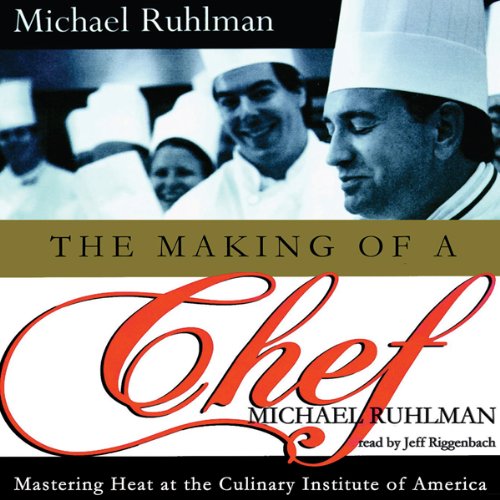
The Making of a Chef
Summary
In the ultimate food-lover's fantasy, journalist Michael Ruhlman dons chef's jacket and houndstooth-check pants to join the students in Skills One at the Culinary Institute of America, the most influential cooking school in the country. His goal is to document the training of America's chefs from the first classroom to the Culinary's final kitchen, the American Bounty Restaurant. The result becomes more than a rote reportage of a school for cooks. Ruhlman learns to cook as though his future depends upon it, and this complete immersion enables him to create the most vivid and energetic memoir of a culinary education on record.
©1997 by Michael Ruhlman (P)1998 by Blackstone Audiobooks

Who Killed Homer?
Summary
For over two millennia in the West, familiarity with the literature, philosophy, and values of the Classical World has been synonymous with education itself. The traditions of the Greeks explain why Western Culture’s unique tenets of democracy, capitalism, civil liberty, and constitutional government are now sweeping the globe. Yet the general public in America knows less about its cultural origins than ever before, as Classical education rapidly disappears from our high school and university curricula. Acclaimed classicists Hanson and Heath raise an impassioned call to arms: if we lose our knowledge of the Greeks, we lose our understanding of who we are. With straightforward advice and informative reading lists, the authors present a highly useful primer for anyone who wants more knowledge of Classics, and thus of the beauty and perils of our own culture.
©1998 Victor Davis Hanson and John Heath (P)2000 Blackstone Audio, Inc.

Radical Son
Summary
David Horowitz was one of the founders of the New Left and an editor of Ramparts, the magazine that set the intellectual and revolutionary tone for the movement. From his vantage point at the center of the action, he provides vivid portraits of people who made the radical decade: world-famous philosopher Bertrand Russell, who in his 90s became America's scourge, organizing a War Crimes Tribunal over the war in Vietnam; Tom Hayden, the radical Everyman who promoted guerrilla warfare in America's cities in the 60s and became a Democratic state senator when his revolutions failed; and Huey Newton, a street hustler and murderer who founded the most celebrated radical group of the 60s, the Black Panthers. A brutal murder committed by the Panthers prompted Horowitz's profound "second thoughts" that eventually transformed him into an intellectual leader of conservatism and its most prominent activist in Hollywood.
©1997 David Horowitz (P)1998 Blackstone Audio, Inc.

Defending the Undefendable
Summary
Professor Block's book is among the most famous of the great defenses of victimless crimes and controversial economic practices, from profiteering and gouging to bribery and blackmail. However, beneath the surface, this book is also an outstanding work of microeconomic theory that explains the workings of economic forces in everyday events and affairs. Murray Rothbard explains why: "Defending the Undefendable performs the service of highlighting, in the fullest and starkest terms, the essential nature of the productive services performed by all people in the free market. By taking the most extreme examples and showing how the Smithian principles work even in these cases, the book does far more to demonstrate the workability and morality of the free market than a dozen sober tomes on more respectable industries and activities. By testing and proving the extreme cases, he all the more illustrates and vindicates the theory. "F.A. Hayek agreed, writing the author as follows: "Looking through Defending the Undefendable made me feel that I was once more exposed to the shock therapy by which, more than fifty years ago, the late Ludwig von Mises converted me to a consistent free market position. Even now I am occasionally at first incredulous and feel that 'this is going too far,' but usually find in the end that you are right. Some may find it too strong a medicine, but it will still do them good even if they hate it. A real understanding of economics demands that one disabuses oneself of many dear prejudices and illusions. Popular fallacies in economics frequently express themselves in unfounded prejudices against other occupations, and in showing the falsity of these stereotypes you are doing a real service, although you will not make yourself more popular with the majority."
©2008 Ludwig von Mises Institute (P)2008 Ludwig von Mises Institute

Human Action
Summary
Human Action is the most important book on political economy you will ever own. It was (and remains) the most comprehensive, systematic, forthright, and powerful defense of the economics of liberty ever written. This is the Scholar's Edition: accept no substitute. You will treasure this volume. The Scholar's Edition is the original, unaltered treatise (originally published in 1949) that shaped a generation of Austrians and made possible the intellectual movement that is leading the global charge for free markets. Mises himself wrote the following by way of explanation of why he wrote the book: "Economics does not allow any breaking up into special branches. It invariably deals with the interconnectedness of all phenomena of acting and economizing. All economic facts mutually condition one another. Each of the various economic problems must be dealt with in the frame of a comprehensive system assigning its due place and weight to every aspect of human wants and desires. All monographs remain fragmentary if not integrated into a systematic treatment of the whole body of social and economic relations. "To provide such a comprehensive analysis is the task of my book Human Action, a Treatise on Economics. It is the consummation of lifelong studies and investigations, the precipitate of half a century of experience. I saw the forces operating which could not but annihilate the high civilization and prosperity of Europe. In writing my book, I was hoping to contribute to the endeavors of our most eminent contemporaries to prevent this country from following the path which leads to the abyss." The Scholar's Edition of Human Action is the definitive edition of this great work and foundation of every library of freedom.
©1949 Ludwig von Mises (P)2010 Ludwig von Mises Institute

Reading Between the Lines
Summary
This is a guidebook for those who want to learn how to recognize books that are spiritually and aesthetically good - to cultivate good literary taste. Gene Edward Veith presents basic information to help book lovers understand what they read, from the classics to best sellers. He explains how the major genres of literature communicate. He explores ways comedy, tragedy, realism, and fantasy can portray the Christian worldview. These discussions lead to a host of related topics: the value of fairy tales for children, the tragic and the comic sense of life, the interplay between Greek and Biblical concepts in the imagination, and the new "post-modernism" (a subject of vital importance to Christians).
©1994 Gene Edward Veith, Jr. (P)1994 by Blackstone Audiobooks

The Glory and the Dream
Summary
This great time capsule of a book captures the abundant popular history of the United States from 1932 to 1972. It encompasses politics, military history, economics, the lively arts, science, fashion, fads, social change, sexual mores, communications, graffiti...everything and anything indigenous that can be captured in print. The Glory and the Dream chronicles the progress of life in the United States, from the time William Manchester and his generation reached the beginning of awareness in the desperate summer of '32 to President Nixon's Second Inaugural Address and the opening scenes of Watergate. Masterfully compressing four crowded decades of our history, Manchester relives the epic, significant, or just memorable events that befell the generation of Americans whose lives pivoted between the America before and the America after the Second World War.
©1974 William Manchester (P)1994 Blackstone Audio, Inc.