The Military category has 1,612 audiobooks on Listento.it, with an average listener rating of 4.6★ across 5,283 ratings. The most-rated is The Rise and Fall of the Third Reich.
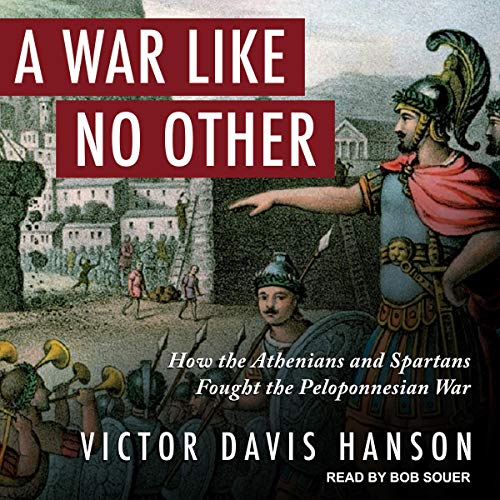
A War Like No Other
Summary
Victor Davis Hanson has given us painstakingly researched and pathbreaking accounts of wars ranging from classical antiquity to the 21st century. Now he juxtaposes an ancient conflict with our most urgent modern concerns to create his most engrossing work to date, A War Like No Other. Hanson compellingly portrays the ways Athens and Sparta fought on land and sea, in city and countryside, and details their employment of the full scope of conventional and non-conventional tactics, from sieges to targeted assassinations, torture, and terrorism. He also assesses the crucial roles played by warriors such as Pericles and Lysander, artists, among them Aristophanes, and thinkers including Sophocles and Plato. Hanson's perceptive analysis of events and personalities raises many thought-provoking questions: Were Athens and Sparta like America and Russia, two superpowers battling to the death? Is the Peloponnesian War echoed in the endless, frustrating conflicts of Vietnam, Northern Ireland, and the current Middle East? Or was it more like America's own Civil War, a brutal rift that rent the fabric of a glorious society, or even this century's schism between liberals and conservatives? Hanson daringly brings the facts to life and unearths the often surprising ways in which the past informs the present.
©2005 Victor Davis Hanson (P)2019 Tantor

War, Peace, and Power: Diplomatic History of Europe, 1500-2000
Summary
For much of the past five centuries, the history of the European continent has been a history of chaos, its civilization thrown into turmoil by ferocious wars or bitter religious conflicts - sometimes in combination - that have made and remade borders, created and eliminated entire nations, and left a legacy that is still influencing our world. This 36-lecture series from an award-winning teacher and honored scholar pursues an explanation for this chaos that goes beyond the obvious ones of political ambition, religious intolerance, the pursuit of state power, or the fear of another state's aspirations. In pursuing that explanation, Professor Liulevicius offers everyone interested in the "why" of history a remarkable look into the evolution of the European continent and the modern state system. His provocative lectures allow us to peer through the revealing lens of statecraft to show us its impact on war, peace, and power and how that impact may well be felt in the future. As you learn to examine key points on history's diplomatic timeline in the context of attempting to establish - successfully and not - a lasting idea of order in the European world, you'll begin to grasp the key Professor Liulevicius offers to understanding the dynamics of international politics. And you'll see how such key concepts as the balance of power, power itself, sovereignty, and "reason of state" - the raison d'état first enunciated by France's powerful Cardinal Richelieu - fit into those dynamics. PLEASE NOTE: When you purchase this title, the accompanying reference material will be available in your Library section along with the audio.
©2007 The Teaching Company, LLC (P)2007 The Great Courses

Jutland
Summary
More than a century later, historians still argue about this controversial and misunderstood World War I naval battle off the coast of Denmark. It was the 20th century's first engagement of dreadnoughts - and while it left Britain in control of the North Sea, both sides claimed victory and decades of disputes followed, revolving around senior commanders Admiral Sir John Jellicoe and Vice Admiral Sir David Beatty. This book not only retells the story of the battle from both a British and German perspective based on the latest research, but also helps clarify the context of Germany's inevitable naval clash and the aftermath after the smoke had cleared.
©2016 Nicholas Jellicoe (P)2020 Tantor

World History of Warfare
Summary
World History of Warfare covers worldwide military history from ancient times to the present and is designed for college courses. Its principal theme is an exploration of change and continuity, revolution and tradition, in three thousand years of warfare. It teaches students and general listeners how warfare evolved and how that evolution affected human society, with emphasis on major turning points in the conduct of warfare rather than a superficial general history of wars. Although the volume addresses traditional subjects such as generals and tactics, each chapter also includes discussion of the idea of war, the role of the common soldier, and the changing interpretations of the military’s place in society and politics. Of special value is the authors’ treatment of non-Western societies and the role military forces have played in shaping societies worldwide.
©2002 University of Nebraska Press (P)2018 Redwood Audiobooks

MiG Alley
Summary
Of the many myths that emerged following the end of the Korean War, the prevailing one in the West was that of the absolute supremacy of US Air Force pilots and aircraft over their Soviet-supplied opponents. The claims of the 10:1 victory-loss ratio achieved by the US Air Force fighter pilots flying the North American F-86 Sabre against their communist adversaries, amongst other such fabrications, went unchallenged until the end of the Cold War, when Soviet records of the conflict were finally opened. From that point onwards, a very different story began to emerge. Far from decisive American victories over an unsophisticated opponent, the aerial battles of the Korean War were, at least in the early years, evenly matched affairs, fought to an approximate 1:1 victory-loss ratio. Though the Soviet victories declined over the following years, this had more to do with home politics than American tactics. In addition to the aerial combat over MiG Alley, this title covers the full range of US Air Force activities over Korea, including the failed strategic bombing campaign and the escalating nuclear threat. Incorporating first-hand accounts from those involved, both US and Soviet, this new history of the US Air Force in Korea reveals the full story of this bitter struggle in the Eastern skies.
©2019 Thomas McKelvey Cleaver (P)2019 Tantor

Dragon's Jaw
Summary
A riveting Vietnam War story - and one of the most dramatic in aviation history - told by a New York Times best-selling author and a prominent aviation historian Every war has its "bridge" - Old North Bridge at Concord, Burnside's Bridge at Antietam, the railway bridge over Burma's River Kwai, the bridge over Germany's Rhine River at Remagen, and the bridges over Korea's Toko Ri. In Vietnam it was the bridge at Thanh Hoa, called Dragon's Jaw. For seven long years hundreds of young US airmen flew sortie after sortie against North Vietnam's formidable and strategically important bridge, dodging a heavy concentration of anti-aircraft fire and enemy MiG planes. Many American airmen were shot down, killed, or captured and taken to the infamous "Hanoi Hilton" POW camp. But after each air attack, when the smoke cleared and the debris settled, the bridge stubbornly remained standing. For the North Vietnamese it became a symbol of their invincibility; for US war planners an obsession; for US airmen a testament to American mettle and valor. Using after-action reports, official records, and interviews with surviving pilots, as well as untapped Vietnamese sources, Dragon's Jaw chronicles American efforts to destroy the bridge, strike by bloody strike, putting listeners into the cockpits, under fire. The story of the Dragon's Jaw is a story rich in bravery, courage, audacity, and sometimes luck, sometimes tragedy. The "bridge" story of Vietnam is an epic tale of war against a determined foe. PLEASE NOTE: When you purchase this title, the accompanying PDF will be available in your Audible Library along with the audio.
©2019 Stephen Coonts and Barrett Tillman (P)2019 Hachette Audio

Rocket Men
Summary
A richly detailed and dramatic account of one of the greatest achievements of humankind. At 9:32 A.M. on July 16, 1969, the Apollo 11 rocket launched in the presence of more than a million spectators who had gathered to witness a truly historic event. It carried Neil Armstrong, Buzz Aldrin, and Mike Collins to the last frontier of human imagination: the moon. Rocket Men is the thrilling story of the moon mission, and it restores the mystery and majesty to an event that may have become too familiar for most people to realize what a stunning achievement it represented in planning, technology, and execution. Through interviews, 23,000 pages of NASA oral histories, and declassified CIA documents on the space race, Craig Nelson re-creates a vivid and detailed account of the Apollo 11 mission. From the quotidian to the scientific to the magical, readers are taken right into the cockpit with Aldrin and Armstrong and behind the scenes at Mission Control. Rocket Men is the story of a 20th-century pilgrimage, a voyage into the unknown motivated by politics, faith, science, and wonder that changed the course of history.
©2009 Craig Nelson (P)2009 Penguin

One Thousand Miles to Freedom
Summary
The thrilling true story of a British Army soldier who was determined to break free from Japanese captivity in World War II. Corporal Roy Pagani staged a daring escape from the Burma-Thailand Railway of Death, after already escaping twice from captivity, and set out to walk 1,000 miles to freedom in India through some of the most challenging landscape in the world. Along to way he endures great hardships, joins a guerrilla force, launches daring raids against the Japanese and faces betrayal and torture at every step. Can he make it to freedom where none have yet succeeded?
©2019 Mandalay Books (P)2019 Mandalay Books

Six Months in 1945
Summary
From the author of the best-selling One Minute to Midnight, a riveting account of the pivotal six-month period spanning the end of World War II, the dawn of the nuclear age, and the beginning of the Cold War. When Roosevelt, Stalin, and Churchill met in Yalta in February 1945, Hitler's armies were on the run and victory was imminent. The Big Three wanted to draft a blueprint for a lasting peace - but instead set the stage for a 44-year division of Europe into Soviet and western spheres of influence. After fighting side by side for nearly four years, their political alliance was rapidly fracturing. By the time the leaders met again in Potsdam in July 1945, Russians and Americans were squabbling over the future of Germany and Churchill was warning about an "iron curtain" being drawn down over the Continent. These six months witnessed some of the most dramatic moments of the 20th century: the cataclysmic battle for Berlin, the death of Franklin Roosevelt, the discovery of the Nazi concentration camps, Churchill's electoral defeat, and the dropping of atomic bombs on Japan. While their armies linked up in the heart of Europe, the political leaders maneuvered for leverage: Stalin using his nation's wartime sacrifices to claim spoils, Churchill doing his best to halt Britain's waning influence, FDR trying to charm Stalin, Truman determined to stand up to an increasingly assertive Soviet superpower. Six Months in 1945 brilliantly captures this momentous historical turning point, chronicling the geopolitical twists behind the descent of the iron curtain, while illuminating the aims and personalities of larger-than-life political giants. It is a vividly rendered story of individual and national interests in fierce competition at a seminal moment in history.
©2012 Random House Audio (P)2012 Michael Dobbs

The American Civil War
Summary
For the past half century, John Keegan, the greatest military historian of our time, has been returning to the scenes of America's most bloody and wrenching war to ponder its lingering conundrums: the continuation of fighting for four years between such vastly mismatched sides; the dogged persistence of ill-trained, ill-equipped, and often malnourished combatants; the effective absence of decisive battles among some two to three hundred known to us by name. Now Keegan examines these and other puzzles with a peerless understanding of warfare, uncovering dimensions of the conflict that have eluded earlier historiography. While offering original and perceptive insights into psychology, ideology, demographics, and economics, Keegan reveals the war's hidden shape - a consequence of leadership, the evolution of strategic logic, and, above all, geography, the Rosetta Stone of his legendary decipherments of all great battles. The American topography, Keegan argues, presented a battle space of complexity and challenges virtually unmatched before or since. Out of a succession of mythic but chaotic engagements, he weaves an irresistible narrative illuminated with comparisons to the Napoleonic Wars, the First World War, and other conflicts. The American Civil War is sure to be hailed as a definitive account of its eternally fascinating subject.
©2009 John Keegan (P)2009 Random House

40 Thieves on Saipan
Summary
Before there were Navy SEALs, before there were Green Berets, there were the 40 Thieves: the elite Scout Sniper Platoon of the Sixth Marine Regiment during World War II. Behind enemy lines on the island of Saipan - where firing a gun could mean instant discovery and death - the 40 Thieves killed in silence during the grueling battle for Saipan, the D-Day of the Pacific. Now, Joseph Tachovsky - whose father, Frank, was the commanding officer of the 40 Thieves, also called Tachovsky's Terrors - joins with award-winning author Cynthia Kraack to transport listeners back to the brutal Battle of Saipan. Built on hours of personal interviews with WWII veterans, their personal papers, letters, and documentation from the National Archives, 40 Thieves on Saipan is an astonishing portrayal of elite World War II combat. It's also a rare glimpse into the lives of World War II Marines. The poorest equipped branch of the services at that time, Marines were notorious thieves. To improve their odds for victory against the Japanese, they found it necessary to improve their supply chains through "Marine Methods" - stealing. Being the elite of the Sixth Regiment, the Scout-Sniper Platoon excelled at the craft - earning them the nickname of the "40 Thieves" from their envious peers. Upon returning from a 1943 trip to the Pacific theater, Eleanor Roosevelt observed, "The Marines I have met around the world have the cleanest bodies, the filthiest minds, the highest morale and the lowest morals of any group of animals I have ever seen. Thank God for the United States Marines."
©2020 Joseph Tachovsky (P)2020 Dreamscape Media, LLC

Quadruple Duty: All or Nothing
Summary
Three years after answering a wickedly outrageous ad and falling in love with four gorgeous Army Ranger specialists, Sammara Madsen's life is beyond picture-perfect. Business is booming, her libido is off the charts, and her strong, powerful boyfriends attend to her every want, need, and desire. In the turquoise blue waters of paradise, a shocking moment leads to the most incredible surprise of a lifetime. But when two soldiers from Jason's mercenary company suddenly go missing overseas? A sequence of rapidly cascading events could cause that perfect life to mercilessly unravel. A mysterious enemy in the desert. An ex-Marine with a hideous vendetta. As Sammara's lovers are siphoned off one by one, she's forced to take desperate action - including forging an unlikely alliance with a dangerous enemy - to win back the lives of the men she loves most. Follow along with Sammara and her four incredible alpha mercenaries as they brave the traitorous forces aligning against them. From the crystal blue waters of Fiji to the blazing vastness of the Western desert, only the strong survive in this turbo-charged, blisteringly hot reverse-harem thrill ride. Contains mature themes.
©2018 Krista Wolf (P)2019 Tantor

Finland's War of Choice
Summary
This book describes the odd coalition between Germany and Finland in World War II, and their joint military operations from 1941 to 1945. This is a topic often missing in English, though in stark contrast to the numerous books on the shorter and less bloody Winter War. That conflict represented a gallant fight of a democratic “David” against a totalitarian “Goliath” that caught the imagination of the world. The story of Finland fighting alongside a “Goliath” of its own has not brought pride to that nation and was a period many Finns would rather forget. The prologue of this book brings the listener up to speed by briefly examining the difficult history of Finland, from its separation from the Soviet Union in 1917 to its isolation after being bludgeoned in 1939-40. It then examines both Finnish and German motives for forming a coalition against the USSR, and how - as logical as a common enemy would seem - the lack of true planning and preparation would doom the alliance. This book posits that it was mind-boggling how the highly professional German General Staff allowed itself to accept the militarily unsound and shaky coalition that resulted. The war aims were not discussed or harmonized, there were no campaign plans with tasks and missions spelled out past the initial assault, no effective main effort established, inadequate force levels, and an unsound command structure with various headquarters. Practically every rule in the book was broken. The objective of linking up with the Finns in the Leningrad area was an important factor in Hitler opting for three main drives into the Soviet Union rather than an earlier OKH plan that called for only two. After describing the operations during and after Barbarossa, this book describes how the Finnish theater became a blind ally for the Germans. Their strongest and best army was trapped both operationally and geographically in central and northern Finland, making virtually no contribution to the war effort. The Germans could not bring to bear enough forces to accomplish their objectives without substantial Finnish assistance, and that was not forthcoming. The final chapters deal with the Soviet counteroffensive against the Finns in 1944. The Finns lost all their gains and quickly concluded a separate armistice. This left the German forces in Finland to simply vacate the territory, fighting between the Finns and Soviets alike as they tried to return to the main war. Jointly suffering 291,000 casualties, the only consolation was that the coalition had inflicted some 830,000 on the Soviets. In this book, Henrik Lunde, a former US Special Operations colonel, and the renowned author of Hitler’s Pre-emptive War: The Battle for Norway, 1940, once again fills a profound gap in our understanding of World War II.
©2011 Henrik O. Lunde (P)2013 Audible, Inc.

Carrier Pilot
Summary
In 1942, Norman Hanson learned to fly the Royal Navy's newest fighter: the US-built Chance Vought Corsair. Fast, rugged, and demanding to fly, it was an intimidating machine. But in the hands of its young Fleet Air Arm pilots, it also proved to be a lethal weapon. Posted to the South Pacific aboard HMS Illustrious, Hanson and his squadron took the fight to the Japanese. Facing a desperate and determined enemy, Kamikaze attacks, and the ever-present dangers of flying off a pitching carrier deck, death was never far away. Brought to life in vivid, visceral detail, Carrier Pilot is one of the finest aviators' memoirs of the war; an awe-inspiring, thrilling, sometimes terrifying, account of war in the air.
©2016 Norman Hanson (P)2017 Tantor

A Warrior Dynasty
Summary
This audiobook examines the meteoric rise of Sweden as the pre-eminent military power in Europe during the Thirty Years War during the 1600s, and then follows its line of warrior kings into the next century until the Swedes finally meet their demise, in an overreach into the vastness of Russia. A small Scandinavian nation, with at most one and a half million people and scant internal resources of its own, there was small logic to how Sweden could become the dominant power on the Continent. That Sweden achieved this was due to its leadership - a case-study in history when pure military skill, and that alone, could override the demographic and economic factors which have in modern times been termed so pre-eminent. Once Protestantism emerged, via Martin Luther, the most devastating war in European history ensued, as the Holy Roman Empire sought to reassert its authority by force. Into this bloody maelstrom stepped Gustav Adolf of Sweden, a brilliant tactician and strategist, who with his finely honed Swedish legions proceeded to establish a new authority in northern Europe. Gustav, as brave as he was brilliant, was finally killed while leading a cavalry charge at the Battle of Ltzen. He had innovated, however, tactics and weaponry that put his successors in good stead, as Sweden remained a great power, rivaled only by France and Spain in terms of territory in Europe. And then one of his successors, Karl XII, turned out to be just as great a military genius as Gustav himself, and as the year 1700 arrived, Swedish armies once more burst out in all directions. Karl, like Gustav, assumed the throne while still a teenager, but immediately displayed so much acumen, daring and skill that chroniclers could only compare him, like Gustav, to Alexander the Great. This book examines thoroughly, yet in highly readable fashion, the century during which Swedish military power set an example for all Europe.
©2014 Henrik O. Lunde (P)2014 Audible Inc.

The Last Battle
Summary
May 1945. Hitler is dead, and the Third Reich is little more than smoking rubble. No GI wants to be the last man killed in action against the Nazis. But for cigar-chewing, rough-talking, hard-drinking, hard-charging Captain Jack Lee and his men, there is one more mission: rescue 14 prominent French prisoners held in an SS-guarded castle high in the Austrian Alps. It's a dangerous mission, but Lee has help from a decorated German Wehrmacht officer and his men, who voluntarily join the fight. Based on personal memoirs, author interviews, and official American, German, and French histories, The Last Battle is the nearly unbelievable story of the most improbable battle of World War II - a tale of unlikely allies, bravery, cowardice, and desperate combat between implacable enemies.
©2013 Stephen Harding (P)2013 Blackstone Audio, Inc.

Fire and Movement
Summary
The dramatic opening weeks of the Great War passed into legend long before the conflict ended. The British Expeditionary Force fought a mesmerizing campaign, outnumbered and outflanked but courageous and skillful, holding the line against impossible odds, sacrificing themselves to stop the last great German offensive of 1914. A remarkable story of high hopes and crushing disappointment, the campaign contains moments of sheer horror and nerve-shattering excitement, pathos and comic relief, occasional cowardice and much selfless courage - all culminating in the climax of the First Battle of Ypres. And yet, as Peter Hart shows in this gripping and revisionary look at the war's first year, for too long the British part in the 1914 campaigns has been veiled in layers of self-congratulatory myth: a tale of poor unprepared Britain, reliant on the peerless class of her regular soldiers to bolster the rabble of the unreliable French Army and defeat the teeming hordes of German troops. But the reality of those early months is in fact far more complex - and ultimately, Hart argues, far more powerful than the standard triumphalist narrative. Fire and Movement places the British role in 1914 into a proper historical context, incorporating the personal experiences of the men who were present on the front lines. The British regulars were indeed skillful soldiers, but as Hart reveals, they also lacked practice in many of the required disciplines of modern warfare, and the inexperience of officers led to severe mistakes. Hart also provides a more accurate portrait of the German Army they faced - not the caricature of hordes of automatons, but the reality of a well-trained and superlatively equipped force that outfought the BEF in the early battles - and allows listeners to come to a full appreciation of the role of the French Army, without whom the Marne never would have been won.
©2015 Peter Hart (P)2014 Audible Inc.

World War One: History in an Hour
Summary
History for busy people. Listen to a concise history of World War One in just one hour. World War One brought with it the world’s first experience of Total War, involving all of the world’s great powers, polarized between the Triple Entente, led by Britain, France and Russia, and the Central Powers, dominated by Germany, Italy and Austria-Hungary. Around nine million men lost their lives in a conflict that introduced the horrors of trench warfare, machine guns, and toxic gas attacks. World War One: History In an Hour gives you a clear overview of the road to war, the major turning points and battles, and the key leaders involved, as well as the lasting impact the Great War had on almost every country in the world. World War One: History In an Hour is essential listening for all history lovers.
©2012 Rupert Colley (P)2012 HarperCollins Publishers Limited

The Finest Hours
Summary
In the winter of 1952, New England was battered by the most brutal nor’easter in years. As the weather wreaked havoc on land, the freezing Atlantic became a wind-whipped zone of peril, setting the stage for one of the most heroic rescue stories ever lived. On February 18, while the storm raged, two oil tankers, the Pendleton and the Fort Mercer, were in the same horrifying predicament. Built with “dirty steel,” and not prepared to withstand such ferocious seas, both tankers split in two, leaving the dozens of men on board utterly at the Atlantic’s mercy. The Finest Hours is the gripping, true story of the valiant attempt to rescue the souls huddling inside the broken halves of the two ships. The spellbinding tale is overflowing with breathtaking scenes, as boats capsize, bows and sterns crash into one another, and men hurl themselves into the raging sea in a terrifying battle for survival. Not all of the 84 men caught at sea in the midst of that brutal storm survived, but considering the odds, it’s a miracle - and a testament to their bravery - that any at all came home to tell their tales.
©2009 Casey Sherman and Michael Tougias (P)2012 Blackstone Audio, Inc.

The Republic for Which It Stands
Summary
The Oxford History of the United States is the most respected multivolume history of the American nation. In the newest volume in the series, The Republic for Which It Stands, acclaimed historian Richard White offers a fresh and integrated interpretation of Reconstruction and the Gilded Age as the seedbed of modern America. At the end of the Civil War the leaders and citizens of the victorious North envisioned the country's future as a free-labor republic, with a homogenous citizenry, both Black and White. The South and West were to be reconstructed in the image of the North. Thirty years later Americans occupied an unimagined world. The unity that the Civil War supposedly secured had proved ephemeral. The country was larger, richer, and more extensive but also more diverse. Life spans were shorter, and physical well-being had diminished, due to disease and hazardous working conditions. Independent producers had become wage earners. The country was Catholic and Jewish as well as Protestant and increasingly urban and industrial. The "dangerous" classes of the very rich and poor expanded, and deep differences - ethnic, racial, religious, economic, and political - divided society. The corruption that gave the Gilded Age its name was pervasive. These challenges also brought vigorous efforts to secure economic, moral, and cultural reforms. Real change - technological, cultural, and political - proliferated from below more than emerging from political leadership. Americans, mining their own traditions and borrowing ideas, produced creative possibilities for overcoming the crises that threatened their country. In a work as dramatic and colorful as the era it covers, White narrates the conflicts and paradoxes of these decades of disorienting change and mounting unrest, out of which emerged a modern nation whose characteristics resonate with the present day.
©2017 Richard White (P)2018 Audible, Inc.