The Military category has 1,612 audiobooks on Listento.it, with an average listener rating of 4.6★ across 5,283 ratings. The most-rated is The Rise and Fall of the Third Reich.

Judd's Vow
Summary
His heart has been grounded for so long. But she's about to give it wings. Captain Judd Harlow is happiest in the air. It's only when he's flying that he can leave his childhood memories behind. But when he and his brothers find themselves the guardians of their 12-year-old half-sister, he knows moving back to the small Montana town where he grew up is the right thing. When Savannah Casteele learns that a local pilot has agreed to fly her and her little boy to Chicago for a long-awaited surgery, she's overcome with gratitude. A young, single mother, her first priority has always been raising her son the best way she knows how. But when she sees Judd for the first time, she's unprepared for the affect he has on her heart: he's stoic, guarded, and a little out of reach, reminding her that she's not the only one who's trying to put aside a broken past. As they begin falling for one another, brought together by the children in their lives, they start seeing family not just as something you're given but something you create. And that the heart, no matter how scarred, is always capable of a tender, new beginning. But are they both willing to take a leap of faith to get there?
©2019 Kaylie Newell (P)2019 Blackstone Audio, Inc.

Intrepid Aviators
Summary
On the morning of October 24, 1944, in the Sibuyan Sea amidst the Philippine Islands, VT-18, a close-knit squadron of six young American torpedo bomber pilots, departed the aircraft carrier USS Intrepid on a search and destroy mission. Their target: the super-battleship Musashi, the pride of the Imperial Japanese Navy. The pilots were tasked with preventing the immense enemy warship and the huge naval armada of which she was a part from inflicting unspeakable damage on the transports and supply ships that were supporting the American amphibious landings within nearby Leyte Gulf. Little did these young men know that they had embarked on the opening rounds of history’s greatest - and last - epic naval battle. Two bomber crews launched in the first wave of attackers were shot out of the sky. Only pilot Will Fletcher survived the crash landing. Adrift at sea, Will made his way to land and escaped into the jungles of the Philippines, where he eluded capture by the Japanese with the help of Filipino guerrillas and joined their ranks against their common enemy. Intrepid Aviators is the thrilling true story of the brave bomber pilots, their daring duel with the Musashi, and Will Fletcher’s struggle to survive as a guerrilla soldier. The sinking of Musashi inflicted a crucial blow in the Battle of Leyte Gulf, and would mark the first time in history that aviators had sunk a Japanese battleship on the high seas.
©2012 Gregory G. Fletcher (P)2012 Gildan Media LLC

New Georgia: The Second Battle for the Solomons
Summary
In 1942, the Solomon Islands formed the stepping stones toward Rabaul, the main base of Japanese operations in the South Pacific, and the Allies primary objective. The stunning defeat of Japanese forces at the Naval Battle of Guadalcanal in November marked the turning point in the war against Japan and the start of an offensive in the Central Solomons aimed at New Georgia. New Georgia: The Second Battle for the Solomons tells the story of the land, sea, and air battles fought there from March through October 1943. Making careful and copious use of both Japanese and Allied sources, Ronnie Day masterfully weaves the intricate threads of these battles into a well-crafted narrative of this pivotal period in the war. As Day makes clear, combat in the Solomons exemplified the war in the Pacific, especially the importance of air power, something the Japanese failed to understand until it was too late, and the strategy of island hopping, bypassing Japanese strongholds (including Rabaul) in favor of weaker or more strategically advantageous targets. This multifaceted account gives the fighting for New Georgia its proper place in the history of the drive to break the Japanese defensive perimeter and bring the homeland within range of Allied bombers. The book is published by Indiana University Press.
©2016 Ronnie Day (P)2016 Redwood Audiobooks

We March Against England
Summary
In May 1940, Nazi Germany was master of continental Europe. The only European power still standing was Great Britain - and the all-conquering German armed forces stood poised to cross the Channel. Following the destruction of the RAF fighter forces, the sweeping of the Channel of mines, and the wearing down of the Royal Naval defenders, two German army groups were set to storm the beaches of southern England. Despite near-constant British fears from August to October, the invasion never took place after first being postponed to spring 1941 before finally being abandoned entirely. Robert Forczyk, author of Where the Iron Crosses Grow, looks beyond the traditional British account of Operation Sea Lion, complete with plucky Home Guards and courageous Spitfire pilots, at the real scale of German ambition, plans, and capabilities. He examines, in depth, how Operation Sea Lion fitted in with German air-sea actions around the British Isles as he shows exactly what stopped Hitler from invading Britain.
©2016 Robert Forczyk (P)2016 Tantor

Operation Pastorius
Summary
World War II stood apart in many ways from every earlier war, not least in the way that it reached to every corner of the planet and involved a noticeable segment of humanity's collective resources. Battles erupted not only on land and the sea's surface as they had for centuries, but also in the ocean depths and the windswept heights of the sky. One of the war's most crucial struggles happened in the realm of the unseen, inside the human mind, and amid the invisible flow of radio waves. Every war is a battle of wits as intelligence-gathering, tactics, and strategies clash, from the level of individual action up to the grand, overarching schemes of generals and statesmen. Intelligence took on a freshly urgent aspect in World War II, however, as the fate of offensives, armies, and nations came to hang on the struggle to decrypt vital enemy radio traffic and military communications. By the end of 1941, it seemed as if nothing could stop Germany. German forces had swept deep into Russia, killing or capturing hundreds of thousands of prisoners and were closing in on Moscow. In North Africa, German and Italian forces under the command of General Erwin Rommel were poised to take British-controlled Egypt. In the Atlantic, German U-boats were sinking such large numbers of British merchant ships that it seemed as if Britain might be starved into submission. The Japanese attack on Pearl Harbor presented President Franklin D. Roosevelt with a strategic problem that went beyond how to deal with Japanese aggression. Although the war in Europe had been raging for more than two years, many Americans felt it was not their concern, especially with the ultimate defeat of the British seeming all but certain. Four days after the attack on Pearl Harbor, Hitler declared war on America, almost casually and without seeming to consider the consequences. There was no diplomatic necessity for him to have done this and no obvious strategic reason. Germany’s military successes were so complete at that point that Hitler seemed to believe declaring war on one more country was a trifling matter. In some ways, he was right, because in December 1941, the US Army was tiny and poorly equipped. In September 1939, the German army invading Poland comprised 100 infantry divisions and six panzer divisions. At that time, the whole US Army was comprised of just five divisions. Even two years later, the US Army was relatively small and ill-equipped. It was clear that, in strictly military terms, the United States was no threat to Nazi Germany when Hitler declared war in late 1941. However, American industry had the capacity and power ahead of virtually any other country in the world, so if America posed a threat to Germany, it would be through its capacity to produce weapons, tanks, aircraft, and ships in vast numbers. At the same time, America was simply too far from any German-controlled airbases to make strategic bombing a possibility. Thus, if a direct attack on American industry was not feasible, the best alternative was to mount a campaign of subterfuge and sabotage. The responsibility for mounting an attack on American industry was given to the German military secret intelligence service, the Abwehr, which devised a plan to land saboteurs in America to attack factories, railroads, and perhaps conduct a random bombing campaign against American civilians. The Nazi plan was given the codename of Operation Pastorius, and it was launched in June 1942, just six months after Germany had declared war on America. What followed was one of World War II’s most bizarre spy stories.
©2020 Charles River Editors (P)2020 Charles River Editors

Unconditional: The Japanese Surrender in World War II
Summary
Signed on September 2, 1945 by Japanese and Allied leaders, the instrument of surrender that formally ended the war in the Pacific brought to a close one of the most cataclysmic engagements in history. The surrender fulfilled the commitment that Franklin Roosevelt had made in 1943 at the Casablanca conference that it be "unconditional". Though readily accepted as policy at the time, after Roosevelt's death in April 1945, support for unconditional surrender wavered, particularly among Republicans in Congress, when the bloody campaigns on Iwo Jima and Okinawa made clear the cost of military victory against Japan. Though this was the last time American forces would impose surrender unconditionally, questions surrounding it continued through the 1950s and 1960s - with the Korean and Vietnam Wars - when liberal and conservative views reversed, including over the definition of "peace with honor". The subject was revived during the ceremonies surrounding the 50th anniversary in 1995, and the Gulf and Iraq Wars, when the subjects of exit strategies and "accomplished missions" were debated. Marc Gallicchio reveals how and why the surrender in Tokyo Bay unfolded as it did and the principle figures behind it. Most importantly, Gallicchio reveals how the policy of unconditional surrender has shaped our memory and our understanding of World War II.
©2020 Marc Gallicchio (P)2020 Tantor

Greek Fire, Poison Arrows, & Scorpion Bombs
Summary
Flamethrowers, poison gases, incendiary bombs, the large-scale spreading of disease...are these terrifying agents and implements of warfare modern inventions? Not by a long shot. Weapons of biological and chemical warfare have been in use for thousands of years, and Greek Fire, Poison Arrows & Scorpion Bombs, Adrienne Mayor's fascinating exploration of the origins of biological and unethical warfare, draws extraordinary connections between the mythical worlds of Hercules and the Trojan War, the accounts of Herodotus and Thucydides, and modern methods of war and terrorism. PLEASE NOTE: When you purchase this title, the accompanying reference material will be available in your Library section along with the audio.
©2008 Adrienne Mayor (P)2010 Audible, Inc.

Battle of the Atlantic
Summary
Battle of the Atlantic - World War II Imagine a battlefield of 3000 square miles, with an enemy that was often invisible when it struck. Imagine a convoy of ships carrying vital supplies from North America to Great Britain, at the mercy of the deadly marauders under the water, waiting to attack them. The Battle of the Atlantic, the longest campaign of World War II, took place upon the Atlantic Ocean as the Allies traveled back and forth from North America to Great Britain with desperately needed oil, provisions, weapons, and supplies for the embattled forces fighting against Nazi Germany. The U-boats, the terror of the undersea, made those convoy journeys particularly precarious, especially after Germany’s Admiral Karl Dönitz developed his dreaded wolf pack strategy. You will hear about: The Threat of the German U-Boats Battleships and the Bismarck The Lend-Lease Program The Downfall of the U-boats The Codebreakers who Cracked the Enigma Code And much more! From the start of the war in September 1939 until its end in 1945, the Battle of the Atlantic was fought to keep the Germans from blockading the Atlantic Ocean. The efforts of those valiant seafarers would eventually make D-Day possible, but there were times when even Winston Churchill feared that the prowess of the U-boats would imperil the Allies in their battle against the Nazi menace that had conquered Western Europe. The bravery of the Allied naval crews, and the brilliance of the Bletchley Park codebreakers, prevented the Atlantic Ocean from becoming yet another victim of Nazi dominance.
©2019 Hourly History (P)2019 Hourly History
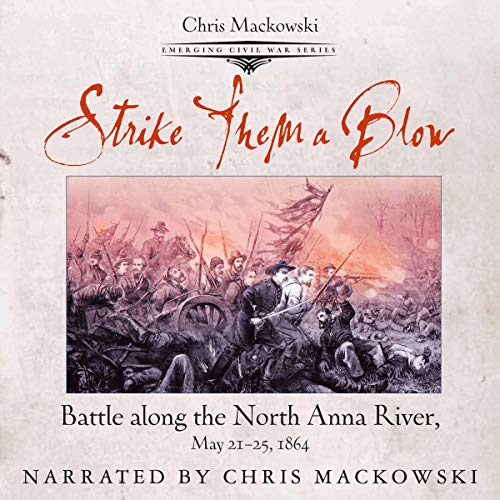
Strike Them a Blow: Battle Along the North Anna River, May 21-25, 1864
Summary
For 16 days the armies had grappled — a grueling horror-show of nonstop battle, march, and maneuver that stretched through May of 1864. Federal commander Ulysses S. Grant had resolved to destroy his Confederate adversaries through attrition if by no other means. He would just keep at them until I used them up. Meanwhile, Grant's Confederate counterpart, Robert E. Lee, looked for an opportunity to regain the offensive initiative. "We must strike them a blow," he told his lieutenants. The toll on both armies was staggering. But Grant's war of attrition began to take its toll in a more insidious way. Both army commanders — operating on the dark edge of exhaustion, fighting off illness, pressure-cooked by stress — began to feel the effects of that continuous, merciless grind in very personal ways. Punch-drunk tired, they began to second-guess themselves, began missing opportunities, began making mistakes. As a result, along the banks of the North Anna River, commanders on both sides brought their armies to the brink of destruction without even knowing it. Picking up the story started in the Emerging Civil War Series book A Season of Slaughter: The Battle of Spotsylvania Courthouse, historian Chris Mackowski follows the road south to the North Anna River. Strike Them a Blow: Battle Along the North Anna River offers a concise, engaging account of the mistakes and missed opportunities of the third — and least understood — phase of the Overland Campaign.
©2015 Savas Beatie (P)2020 Savas Beatie

The Battle for Hell's Island
Summary
From the author of Pacific Payback comes the gripping true story of the Cactus Air Force and how this rugged crew of dive bombers helped save Guadalcanal and won the war. November 1942: Japanese and American forces have been fighting for control of Guadalcanal, a small but pivotal island in Japan's expansion through the South Pacific. Both sides have endured months of grueling battle under the worst circumstances: hellish jungles, meager rations, and tropical diseases, which have taken a severe mental and physical toll on the combatants. The Japanese call Guadalcanal Jigoku no Jima - Hell's Island. Amid a seeming stalemate, a small group of US Navy dive bombers are called upon to help determine the island's fate. The men have until recently been serving in their respective squadrons aboard the USS Lexington and the USS Yorktown, fighting in the thick of the Pacific War's aerial battles. Their skills have been honed to a fine edge, even as injury and death inexorably have depleted their ranks. When their carriers are lost, many of the men end up on the USS Enterprise. Battle damage to that carrier then forces them from their home at sea to operating from Henderson Field, a small dirt-and-gravel airstrip on Guadalcanal. With some Marine and Army Air Force planes, they help form the Cactus Air Force, a motley assemblage of fliers tasked with holding the line while making dangerous flights from their jungle airfield. Pounded by daily Japanese air assaults, nightly warship bombardments, and sniper attacks from the jungle, pilots and gunners rarely last more than a few weeks before succumbing to tropical ailments, injury, exhaustion, and death. But when the Japanese launch a final offensive to take the island once and for all, these dive bomber jocks answer the call of duty - and try to perform miracles in turning back an enemy warship armada, a host of fighter planes, and a convoy of troop transports. A remarkable story of grit, guts, and heroism, The Battle for Hell's Island reveals how command of the South Pacific, and the outcome of the Pacific War, depended on control of a single dirt airstrip-and the small group of battle-weary aviators sent to protect it with their lives.
©2015 Stephen L. Moore (P)2015 Recorded Books

Never Call Retreat
Summary
The final work in this series begins in December of 1862. Four months before, the Union Army tasted long-awaited victory at the bloody battle of Antietam. Grant continued on towards Vicksburg, Mississippi. The grim battles that lay ahead would be costly: the Vicksburg campaign, Chattanooga, the Battle of the Wilderness, the Battle of Atlanta and the March to the Sea, the siege of Petersburg. There would be two and a half more years of war before Lee’s surrender at Appomattox, followed by Lincoln’s death just six days later.
©1965 Bruce Catton (P)1990 Recorded Books, LLC

The Calculus of Violence
Summary
At least three-quarters of a million lives were lost during the American Civil War. Given its seemingly indiscriminate mass destruction, this conflict is often thought of as the first "total war." But Aaron Sheehan-Dean argues for another interpretation. The Calculus of Violence demonstrates that this notoriously bloody war could have been much worse. Military forces on both sides sought to contain casualties inflicted on soldiers and civilians. In Congress, in church pews, and in letters home, Americans debated the conditions under which lethal violence was legitimate, and their arguments differentiated carefully among victims - women and men, black and white, enslaved and free. Sometimes, as Sheehan-Dean shows, these well-meaning restraints led to more carnage by implicitly justifying the killing of people who were not protected by the laws of war. As the Civil War raged on, the Union's confrontations with guerrillas and the Confederacy's confrontations with black soldiers forced a new reckoning with traditional categories of lawful combatants and raised legal disputes that still hang over military operations around the world today.
©2018 the President and Fellows of Harvard College (P)2019 Tantor

Four Years in the Stonewall Brigade
Summary
Every memoir of the American Civil War provides us with another view of the catastrophe that changed the country forever. But this is one of the clearest and most informative ever put into audio. As a commander in Stonewall Jackson's brigade, John Casler experienced all the horrors and comedy of the American Civil War. His time was not so different from his countrymen on the other side, with the exception of point of view. "I was no secessionist and hoped the trouble would be settled without recourse to arms; but when the war came, I shouldered my musket on behalf of my native state and defended her to the last." Drawn from his diary at the time, Casler recounts his experiences in the ranks, from marches and looting to nail-biting escapades and the monotony of life as a prisoner of war. Four Years in the Stonewall Brigade is a remarkable account of men in war, graphically bringing to light the challenges they faced on a daily basis.
©2016 John O. Casler (P)2016 Blackstone Audio, Inc.

Holding the Line
Summary
Naval and air power was crucial to the United Nations' success in the Korean War as it sought to negate the overwhelming Chinese advantage in manpower. In what became known as the "long hard slog", naval aviators sought to slow and cut off Communist forces and support troops on the ground. USS Leyte (CV-32) operated off Korea in the Sea of Japan for a record 93 continuous days to support the Marines in their epic retreat out of North Korea and was crucial in the battles of the spring and summer of 1951 in which the UN forces again battled to the 38th Parallel. All of this was accomplished with a force that was in the midst of change, as jet aircraft altered the entire nature of naval aviation. Holding the Line chronicles the carrier war in Korea from the first day of the war to the last, focusing on frontline combat while also describing the technical development of aircraft and shipboard operations and how these all affected the broader strategic situation on the Korean Peninsula.
©2019 Thomas McKelvey Cleaver (P)2019 Tantor

SEALs of Chance Creek
Summary
Cora Seton presents the first three books in the SEALs of Chance Creek series.
©2015, 2016 Cora Seton (P)2021 Tantor

Those Who Hold Bastogne
Summary
Hitler's last gamble, the Battle of the Bulge, was intended to push the Allied invaders of Normandy all the way back to the beaches. The plan nearly succeeded, and almost certainly would have, were it not for one small Belgian town and its tenacious American defenders who held back a tenfold larger German force while awaiting the arrival of General George Patton's mighty Third Army. In this dramatic account of the 1944-45 winter of war in Bastogne, historian Peter Schrijvers offers the first full story of the German assault on the strategically located town. From the December stampede of American and Panzer divisions racing to reach Bastogne first, through the bloody eight-day siege from land and air, and through three more weeks of unrelenting fighting even after the siege was broken, events at Bastogne hastened the long-awaited end of WWII. Schrijvers draws on diaries, memoirs, and other fresh sources to illuminate the experiences not only of Bastogne's 3,000 citizens and their American defenders, but also of German soldiers and commanders desperate for victory.
©2014 Peter Schrijvers (P)2015 Tantor

A Legion of Devils
Summary
The war crimes committed by General William T. Sherman and his men against Southern civilians and their means of sustaining life are a huge stain on the American national character. Sherman's crimes are routinely denied or minimized (by those who don't actually celebrate them), although they are as heavily documented, from Northern as well as Southern sources, as any event in history. Sherman's campaign through Georgia and South Carolina is even cited as a brilliant military feat. In fact, it was not a military feat at all. There was very little fighting. It was a massive campaign of terrorism against civilians. It violated international law and hypocritically deviated widely from officially-declared US policy. A Legion of Devils: Sherman in South Carolina adds more very interesting original sources to the published record of US war crimes. The audiobook also features a timeline documenting most of the significant incidents of January through March 1865, when South Carolina's home front became a war front for thousands of civilians. Charlestonian Karen Stokes enjoys unsurpassed knowledge of the first-hand sources that document South Carolina during the war between the states. She has been prolific in sharing her knowledge both as historian and novelist. Her works of both kinds give a rich picture of the "faith, valour, and devotion" of the South Carolinians who, in time of ruthless invasion, steadfastly endured the greatest sacrifice and suffering that any large group of Americans have ever experienced. Stokes’s previous books (history and fiction) include Faith, Valor, and Devotion; A Confederate Englishman; Honor in the Dust; The Immortals: A Story of Love and War; Days of Destruction; South Carolina Civilians in Sherman’s Path; The Immortal 600; The Soldier’s Ghost: A Tale of Charleston; Belles: A Carolina Love Story; and Confederate South.
©2017 Karen Stokes (P)2018 Shotwell Publishing LLC

Henry Knox's Noble Train
Summary
The inspiring story of a little-known hero's pivotal role in the American Revolutionary War During the brutal winter of 1775-1776, an untested Boston bookseller named Henry Knox commandeered an oxen train hauling 60 tons of cannons and other artillery from Fort Ticonderoga near the Canadian border. He and his men journeyed some 300 miles south and east over frozen, often treacherous terrain to supply George Washington for his attack of British troops occupying Boston. The result was the British surrender of Boston and the first major victory for the Colonial Army. This is one of the great stories of the American Revolution, still little known by comparison with the more famous battles of Concord, Lexington, and Bunker Hill. Told with a novelist's feel for narrative, character, and vivid description, The Noble Train brings to life the events and people at a time when the ragtag American rebels were in a desperate situation. Washington's army was withering away from desertion and expiring enlistments. Typhoid fever, typhus, and dysentery were taking a terrible toll. There was little hope of dislodging British General Howe and his 20,000 British troops in Boston - until Henry Knox arrived with his supply convoy of heavy armaments. Firing down on the city from the surrounding Dorchester Heights, these weapons created a decisive turning point. An act of near desperation fueled by courage, daring, and sheer tenacity led to a tremendous victory for the cause of independence. This exciting tale of daunting odds and undaunted determination highlights a pivotal episode that changed history.
©2020 William Hazelgrove (P)2020 Rowman & Littlefield

The Few
Summary
It was the summer of 1940, and World War II had been raging for nearly a year. Buoyed by his successes on the Continent, Hitler was now planning an invasion of England to seal Europe's fate. Though the United States was still a neutral country, a few Americans decided they couldn't remain on the sidelines. They joined Britain's Royal Air Force to defend the country - with the future of civilization hanging in the balance. The Few tells the dramatic and unforgettable story of these Americans who defied their own country's neutrality laws and risked their very citizenship to fight side-by-side with England's finest pilots. Flying the lethal and elegant Spitfire, they became "knights of the air" who, with minimal training but plenty of guts, dueled the skilled and fearsome aces of Germany's Luftwaffe. By October 1940, they had helped England win the greatest air battle in the history of aviation. Some five years later, at war's end, just one of them would be alive. Winston Churchill once said famously of all those who fought in the Battle of Britain, "Never in the field of human conflict was so much owed by so many to so few." These daring Americans were the few among the "few."
©2006 Alex Kershaw and published by Da Capo Press, a member of the Perseus Books Group (P)2006 Brilliance Audio, Inc.

Renegade
Summary
When you fall in love with the most unexpected person, at the most unexpected time.... Ryan “Renegade” Kepler I’m the type of man who knows what I want. I make up my mind and stay in my lane, never veering off the course I set for myself. Going into the military? Did it. Youngest member of the Moonshine Task Force? That’s me. Get my best friend’s older sister in bed? It was my pleasure. Age means nothing to me. I’ve seen and done things men twice my age never will. What I want more than anything is someone to share my life with, and that person is my best friend's older sister, Whitney. Whitney Trumbolt Ryan is 10 years my junior, but damn, being a cougar never felt as good as it did the night we spent together. Now I’m struggling with wanting things to either go back to the way they were or spend every night in his arms. Make my wedding planning company the best in the south? Did it. Ignore the way my body trembles when I see Ryan? Epic fail. Freak out when I see a positive pregnancy test staring back at me? Complete with mascara running down my face and clutching my pearls. Looks like things won’t go back to the way they were. There’s a man in my life who won't take no for an answer. He’s the one who makes my blood run hot, cheeks turn red, and heart beat wildly within my chest. His name is Renegade.
©2018, 2019, 2020 Laramie Briscoe (P)2021 Laramie Briscoe