The Outdoors & Nature category has 284 audiobooks on Listento.it, with an average listener rating of 4.4★ across 2,023 ratings. The most-rated is American Buffalo.

American Buffalo
Summary
From the host of the Travel Channel’s The Wild Within. A hunt for the American buffalo - an adventurous, fascinating examination of an animal that has haunted the American imagination. In 2005, Steven Rinella won a lottery permit to hunt for a wild buffalo, or American bison, in the Alaskan wilderness. Despite the odds - there’s only a two percent chance of drawing the permit, and fewer than 20 percent of those hunters are successful - Rinella managed to kill a buffalo on a snow-covered mountainside and then raft the meat back to civilization while being trailed by grizzly bears and suffering from hypothermia. Throughout these adventures, Rinella found himself contemplating his own place among the 14,000 years’ worth of buffalo hunters in North America, as well as the buffalo’s place in the American experience. At the time of the Revolutionary War, North America was home to approximately 40 million buffalo, the largest herd of big mammals on the planet, but by the mid-1890s only a few hundred remained. Now that the buffalo is on the verge of a dramatic ecological recovery across the West, Americans are faced with the challenge of how, and if, we can dare to share our land with a beast that is the embodiment of the American wilderness. American Buffalo is a narrative tale of Rinella’s hunt. But beyond that, it is the story of the many ways in which the buffalo has shaped our national identity. Rinella takes us across the continent in search of the buffalo’s past, present, and future: to the Bering Land Bridge, where scientists search for buffalo bones amid artifacts of the New World’s earliest human inhabitants; to buffalo jumps where Native Americans once ran buffalo over cliffs by the thousands; to the Detroit Carbon works, a “bone charcoal” plant that made fortunes in the late 1800s by turning millions of tons of buffalo bones into bone meal, black dye, and fine china; and even to an abattoir turned fashion mecca in Manhattan’s Meatpacking District, where a depressed buffalo named Black Diamond met his fate after serving as the model for the American nickel. Rinella’s erudition and exuberance, combined with his gift for storytelling, make him the perfect guide for a book that combines outdoor adventure with a quirky blend of facts and observations about history, biology, and the natural world. Both a captivating narrative and a book of environmental and historical significance, American Buffalo tells us as much about ourselves as Americans as it does about the creature who perhaps best of all embodies the American ethos.
©2008, 2009 Steven Rinella (P)2019 Random House Audio

Into Thin Air
Summary
One of the inspirations for the major motion picture Everest, starring Jake Gyllenhaal and Keira Knightley. This is the true story of a 24-hour period on Everest when members of three separate expeditions were caught in a storm and faced a battle against hurricane-force winds, exposure, and the effects of altitude, which ended the worst single-season death toll in the peak's history. In March 1996, Outside magazine sent veteran journalist and seasoned climber Jon Krakauer on an expedition led by celebrated Everest guide Rob Hall. Despite the expertise of Hall and the other leaders, by the end of summit day eight people were dead. Krakauer's audiobook is at once the story of the ill-fated adventure and an analysis of the factors leading up to its tragic end. Written within months of the events it chronicles, Into Thin Air clearly evokes the majestic Everest landscape. As the journey up the mountain progresses, Krakauer puts it in context by recalling the triumphs and perils of other Everest trips throughout history. The author's own anguish over what happened on the mountain is palpable as he leads his listeners to ponder timeless questions.
©2011 Jon Krakauer (P)2016 Audible, Ltd

A Walk in the Woods
Summary
The Appalachian Trail covers 14 states, and over 2,000 miles. It stretches along the East Coast of the United States, from Maine in the north to Georgia in the south. It is famous for being the longest continuous footpath in the world. (Compare this with the Pennine Way, which is a mere 250 miles long.) It snakes through some of the wildest and most spectacular landscapes in America, as well as through some of its most poverty-stricken and primitive backwoods areas - 'redneck' country - Moonshine, Lil’ Abner, 'There’s bears in them thar hills.' Remember the film Deliverance? God only knows what possessed Bill Bryson, a reluctant adventurer if ever there was one, to undertake this gruelling hike. Perhaps it was just a long-held ambition to lose weight: he has lost two stone so far. As he recently wrote from the trail to his publisher: ‘Speaking of vigorous exercise, boy have I just had some. Maine was a bitch. I want you to come back and walk it with me so that when you die if you go to hell you will be able to say: “Call this hell? Try walking across Maine in August.'" Reared in the tradition of Mark Twain, James Thurber, and S.J. Perelman, Bryson used his many years in Britain to soak up a peculiarly English sense of irony and humour and to hone a laugh-out-loud style that is uniquely, hilariously, his own.
©2004 Bill Bryson (P)2004 Random House Audiobooks

The Push
Summary
A New York Times Bestseller A dramatic, inspiring memoir by legendary rock climber Tommy Caldwell, the first person to free climb the Dawn Wall of Yosemite’s El Capitan “The rarest of adventure reads: It thrills with colorful details of courage and perseverance, but it enriches readers with an absolutely captivating glimpse into how a simple yet unwavering resolve can turn adversity into reward.” (The Denver Post) A finalist for the Boardman Tasker Award for Mountain Literature On January 14, 2015, Tommy Caldwell, along with his partner, Kevin Jorgeson, summited what is widely regarded as the hardest climb in history - Yosemite’s nearly vertical 3,000-foot Dawn Wall, after 19 days on the route. Caldwell’s odds-defying feat - the subject of the documentary film The Dawn Wall to be released nationwide in September - was the culmination of an entire lifetime of pushing himself to his limits as an athlete. This engrossing memoir chronicles the journey of a boy with a fanatical mountain-guide father who was determined to instill toughness in his son to a teen whose obsessive nature drove him to the top of the sport-climbing circuit. Caldwell’s affinity for adventure then led him to the vertigo-inducing and little understood world of big wall free climbing. But his evolution as a climber was not without challenges; in his early 20s, he was held hostage by militants in a harrowing ordeal in the mountains of Kyrgyzstan. Soon after, he lost his left index finger in an accident. Later his wife, and main climbing partner, left him. Caldwell emerged from these hardships with a renewed sense of purpose and determination. He set his sights on free climbing El Capitan’s biggest, steepest, blankest face - the Dawn Wall. This epic assault took more than seven years, during which time Caldwell redefined the sport, found love again, and became a father. The Push is an arresting story of focus, drive, motivation, endurance, and transformation, a book that will appeal to anyone seeking to overcome fear and doubt, cultivate perseverance, turn failure into growth, and find connection with family and with the natural world.
©2017 Tommy Caldwell (P)2017 Penguin Audio

438 Days
Summary
438 Days is the miraculous account of the man who survived alone and adrift at sea longer than anyone in recorded history - as told to journalist Jonathan Franklin in dozens of exclusive interviews.
On November 17, 2012, Salvador Alvarenga left the coast of Mexico for a two-day fishing trip. A vicious storm killed his engine, and the current dragged his boat out to sea. The storm picked up and blasted him west. When he washed ashore on January 29, 2014, he had arrived in the Marshall Islands, 9,000 miles away - equivalent to traveling from New York to Moscow round trip.
For 14 months, Alvarenga survived constant shark attacks. He learned to catch fish with his bare hands. He built a fish net from a pair of empty plastic bottles. Taking apart the outboard motor, he fashioned a huge fishhook. Using fish vertebrae as needles, he stitched together his own clothes.
He considered suicide on multiple occasions - including offering himself up to a pack of sharks. But Alvarenga never failed to invent an alternative reality. He imagined a method of survival that kept his body and mind intact long enough for the Pacific Ocean to toss him up on a remote, palm-studded island, where he was saved by a local couple living alone in their own Pacific Island paradise.
Based on dozens of hours of interviews with Alvarenga and interviews with his colleagues, search and rescue officials, the medical team that saved his life, and the remote islanders who nursed him back to health, this is an epic tale of survival, an all-true version of the fictional Life of Pi. 438 Days is a study of the resilience, will, ingenuity, and determination required for one man to survive 14 months lost at sea.
©2015 Jonathan Franklin (P)2015 Simon & Schuster

Into Thin Air
Summary
When Jon Krakauer reached the summit of Mt. Everest in the early afternoon of May 10, 1996, he hadn't slept in 57 hours and was reeling from the brain-altering effects of oxygen depletion. As he turned to begin his long, dangerous descent from 29,028 feet, 20 other climbers were still pushing doggedly toward the top. No one had noticed that the sky had begun to fill with clouds. Six hours later and 3,000 feet lower, in 70-knot winds and blinding snow, Krakauer collapsed in his tent, freezing, hallucinating from exhaustion and hypoxia, but safe. The following morning, he learned that six of his fellow climbers hadn't made it back to their camp and were desperately struggling for their lives. When the storm finally passed, five of them would be dead, and the sixth so horribly frostbitten that his right hand would have to be amputated. Into Thin Air is the definitive account of the deadliest season in the history of Everest by the acclaimed journalist and author of the best seller Into the Wild. On assignment for Outside Magazine to report on the growing commercialization of the mountain, Krakauer, an accomplished climber, went to the Himalayas as a client of Rob Hall, the most respected high-altitude guide in the world. A rangy, 35-year-old New Zealander, Hall had summited Everest four times between 1990 and 1995 and had led 39 climbers to the top. Ascending the mountain in close proximity to Hall's team was a guided expedition led by Scott Fischer, a 40-year-old American with legendary strength and drive who had climbed the peak without supplemental oxygen in 1994. But neither Hall nor Fischer survived the rogue storm that struck in May 1996. Krakauer examines what it is about Everest that has compelled so many people - including himself - to throw caution to the wind, ignore the concerns of loved ones, and willingly subject themselves to such risk, hardship, and expense. Written with emotional clarity and supported by his unimpeachable reporting, Krakauer's eyewitness account of what happened on the roof of the world is a singular achievement. Into the Wild is available on audio, read by actor Campbell Scott.
©1997 Jon Krakauer (P)1997 Bantam Doubleday Dell Audio Publishing, Bantam Doubleday Dell Audio Publishing, A Division of Random House Inc.

Meat Eater
Summary
“Revelatory.... With every chapter, you get a history lesson, a hunting lesson, a nature lesson and a cooking lesson.... Meat Eater offers an overabundance to savor.” (The New York Times Book Review) Steven Rinella grew up in Twin Lake, Michigan, the son of a hunter who taught his three sons to love the natural world the way he did. As a child, Rinella devoured stories of the American wilderness, especially the exploits of his hero, Daniel Boone. He began fishing at the age of three and shot his first squirrel at eight and his first deer at 13. He chose the colleges he went to by their proximity to good hunting ground, and he experimented with living solely off wild meat. As an adult, he feeds his family from the food he hunts. Meat Eater chronicles Rinella’s lifelong relationship with nature and hunting through the lens of 10 hunts, beginning when he was an aspiring mountain man at age 10 and ending as a 37-year-old Brooklyn father who hunts in the remotest corners of North America. He tells of having a struggling career as a fur trapper just as fur prices were falling; of a dalliance with catch-and-release steelhead fishing; of canoeing in the Missouri Breaks in search of mule deer just as the Missouri River was freezing up one November; and of hunting the elusive Dall sheep in the glaciated mountains of Alaska. Through each story, Rinella grapples with themes such as the role of the hunter in shaping America, the vanishing frontier, the ethics of killing, the allure of hunting trophies, the responsibilities that human predators have to their prey, and the disappearance of the hunter himself as Americans lose their connection with the way their food finds its way to their tables. Hunting, he argues, is intimately connected with our humanity; assuming responsibility for acquiring the meat that we eat, rather than entrusting it to proxy executioners, processors, packagers, and distributors, is one of the most respectful and exhilarating things a meat eater can do. A thrilling storyteller with boundless interesting facts and historical information about the land, the natural world, and the history of hunting, Rinella also includes after each chapter a section of “Tasting Notes” that draws from his 30-plus years of eating and cooking wild game, both at home and over a campfire. In Meat Eater, he paints a loving portrait of a way of life that is part of who we are as humans and as Americans. “Full of empathy and intelligence.... In some sections of the book, the author’s prose is so engrossing, so riveting, that it matches, punch for punch, the best sports writing.” (The Wall Street Journal) “Rinella’s writing is unerringly smart, direct, and sharply detailed.” (The Boston Globe) “A unique and valuable alternate view of where our food comes from.” (Anthony Bourdain)
©2012 Steven Rinella (P)2020 Random House Audio

The Twenty-Ninth Day
Summary
A 600-mile canoe trip in the Canadian wilderness is a 17-year-old's dream adventure, but after he is mauled by a grizzly bear, it's all about staying alive. This true-life wilderness survival epic recounts 17-year-old Alex Messenger's near-lethal encounter with a grizzly bear during a canoe trip in the Canadian tundra. The story follows Alex and his five companions as they paddle north through harrowing rapids and stunning terrain. Twenty-nine days into the trip, while out hiking alone, Alex is attacked by a barren-ground grizzly. Left for dead, he wakes to find that his summer adventure has become a struggle to stay alive. Over the next hours and days, Alex and his companions tend his wounds and use their resilience, ingenuity, and dogged perseverance to reach help at a remote village a thousand miles north of the US-Canadian border. The Twenty-Ninth Day is a coming-of-age story like no other, filled with inspiring subarctic landscapes, thrilling riverine paddling, and a trial by fire of the human spirit.
©2019 Alex Messenger (P)2019 Blackstone Publishing

Into Thin Air
Summary
When Jon Krakauer reached the summit of Mt. Everest in the early afternoon of May 10, 1996, he hadn't slept in 57 hours and was reeling from the brain-altering effects of oxygen depletion. As he turned to begin his long, dangerous descent from 29,028 feet, 20 other climbers were still pushing doggedly toward the top. No one had noticed that the sky had begun to fill with clouds. Six hours later and 3,000 feet lower, in 70-knot winds and blinding snow, Krakauer collapsed in his tent, freezing, hallucinating from exhaustion and hypoxia, but safe. The following morning, he learned that six of his fellow climbers hadn't made it back to their camp and were desperately struggling for their lives. When the storm finally passed, five of them would be dead, and the sixth so horribly frostbitten that his right hand would have to be amputated. Into Thin Air is the definitive account of the deadliest season in the history of Everest by the acclaimed journalist and author of the best seller Into the Wild. On assignment for Outside magazine to report on the growing commercialization of the mountain, Krakauer, an accomplished climber, went to the Himalayas as a client of Rob Hall, the most respected high-altitude guide in the world. A rangy, 35-year-old New Zealander, Hall had summited Everest four times between 1990 and 1995 and had led 39 climbers to the top. Ascending the mountain in close proximity to Hall's team was a guided expedition led by Scott Fischer, a 40-year-old American with legendary strength and drive who had climbed the peak without supplemental oxygen in 1994. But neither Hall nor Fischer survived the rogue storm that struck in May 1996. Krakauer examines what it is about Everest that has compelled so many people - including himself - to throw caution to the wind, ignore the concerns of loved ones, and willingly subject themselves to such risk, hardship, and expense. Written with emotional clarity and supported by his unimpeachable reporting, Krakauer's eyewitness account of what happened on the roof of the world is a singular achievement.
©1997 Jon Krakauer (P)1997 Bantam Doubleday Dell Audio Publishing, Bantam Doubleday Dell Audio Publishing, A Division of Random House Inc.

Buried in the Sky
Summary
When Edmund Hillary first conquered Mt. Everest, Sherpa Tenzing Norgay was at his side. Indeed, for as long as Westerners have been climbing the Himalaya, Sherpas have been the unsung heroes in the background. In August 2008, when eleven climbers lost their lives on K2, the world’s most dangerous peak, two Sherpas survived. They had emerged from poverty and political turmoil to become two of the most skillful mountaineers on earth. Based on unprecedented access and interviews, Buried in the Sky reveals their astonishing story for the first time. Peter Zuckerman and Amanda Padoan explore the intersecting lives of Chhiring Dorje Sherpa and Pasang Lama, following them from their villages high in the Himalaya to the slums of Kathmandu, across the glaciers of Pakistan to K2 Base Camp. When disaster strikes in the Death Zone, Chhiring finds Pasang stranded on an ice wall, without an axe, waiting to die. The rescue that follows has become the stuff of mountaineering legend. At once a gripping, white-knuckled adventure and a rich exploration of Sherpa customs and culture, Buried in the Sky re-creates one of the most dramatic catastrophes in alpine history from a fascinating new perspective.
©2012 Peter Zuckerman and Amanda Padoan (P)2013 Audible, Inc.

Bliss(ters)
Summary
Just before her 40th birthday, Gail Francis quit her perfectly good job and set out to hike one of the great trails of the world. Carrying everything she needed on her back, Francis spent five months walking from Mexico to Canada along the Pacific Crest Trail. Along the way, she lost her pack scrambling over scree in the desert, struggled to navigate high mountain passes, and wore the soles off her boots trekking across lava fields - all within some of the most pristine wilderness in the nation. Though she set out alone, her story includes an eclectic cast of characters. From the man walking the entire 2,700 miles in a series of 26 wedding dresses, to the woman making the journey in the company of her pet mouse, Francis learned to count on her fellow hikers for entertainment as well as a few important life lessons.
©2017 Gail M. Francis (P)2019 Tantor

The Calling
Summary
With heart-pounding descriptions of avalanches and treacherous ascents, Barry Blanchard chronicles his transformation from a poor Native American/white kid from the wrong side of the tracks to one of the most respected alpinists in the world. At 13 he learned to rappel when he joined the 1292 Lord Strathcone's Horse Army Cadets. Soon kicked out for insubordination, he was already hooked on climbing and saw alpinism as a way to make his single mother proud and end his family's cycle of poverty. He describes early climbs attempted with nothing to guide him but written trail descriptions and the cajones of youth. He slowly acquired the skills, equipment and partners necessary to tackle more and more difficult climbs, farther and farther afield: throughout the Canadian Rockies, into Alaska and the French Alps and on to Everest, Peru, and the challenging mountains in Pakistan. From each he learned lessons that only nature and extreme endeavor can teach. This is the story of the culture of climbing in the days of punk rock, spurred on by the rhythm of adrenaline and the arrogance of youth. It is also a portrait of the power of the mountains to lift us.
©2014 Barry Blanchard (P)2017 Random House Audio

Alone on the Wall
Summary
Only a few years ago, Alex Honnold was little known beyond a small circle of hardcore climbers. Today, at the age of 30, he is probably the most famous adventure athlete in the world. In that short time, he has proven his expertise in many styles of climbing and has shattered speed records, pioneered routes, and won awards within each discipline. More spectacularly still, he has pushed the most extreme and dangerous form of climbing far beyond the limits of what anyone thought was possible. Free soloing, Honnold's specialty, is a type of climbing performed without a rope, a partner, or hardware - such as pitons, nuts, or cams - for aid or protection. The results of climbing this way are breathtaking, but the stakes are ultimate: If you fall, you die. In Alone on the Wall, Honnold recounts the seven most astonishing climbing achievements so far in his still-evolving career. He narrates the drama of each climb along with reflective passages that illuminate the inner workings of his highly perceptive and discerning mind. We share in the jitters and excitements he feels waking in his van (where he lives full time) before a climb; we see him self-criticize in his climbing journal (a veritable Bible for students of the sport); and we learn his secrets to managing fear. Veteran climber and award-winning author David Roberts writes part of each chapter in his own voice, and he calls on other climbers and the sport's storied past to put Alex's tremendous accomplishments in perspective. Whenever Honnold speaks in public, he is asked the same two questions: "Aren't you afraid you're going to die?" and "why do you do this?" Alone on the Wall takes us around the world and through the highs and lows in the life of a climbing superstar to answer those fascinating questions.
©2016 Alex Honnold and David Roberts (P)2015 Blackstone Audio, Inc.

Alive
Summary
On October 12, 1972, a plane carrying a team of young rugby players crashed into the remote, snow-peaked Andes. Out of the 45 original passengers and crew, only 16 made it off the mountain alive. For 10 excruciating weeks, they suffered deprivations beyond imagining, confronting nature head-on at its most furious and inhospitable. And to survive, these men and women not only had to keep their faith; they had to make an impossible decision: Should they eat the flesh of their dead friends? A remarkable story of endurance and determination, Alive is the dramatic best-selling account of one of the most harrowing quests for survival in modern times.
©2002 Piers Paul Read (P)2017 Dreamscape Media, LLC

The Genius of Birds
Summary
Birds are astonishingly intelligent creatures. In fact, according to revolutionary new research, some birds rival primates and even humans in their remarkable forms of intelligence. Like humans, many birds have enormous brains relative to their size. Although small, bird brains are packed with neurons that allow them to punch well above their weight.
©2016 Jennifer Ackerman. (P)2016 HighBridge, a division of Recorded Books

No Shortcuts to the Top
Summary
This gripping and triumphant memoir follows a living legend of extreme mountaineering as he makes his assault on history, one 8,000-meter summit at a time. For 18 years, Ed Viesturs pursued climbing's holy grail: to stand atop the world's 14 8,000-meter peaks, without the aid of bottled oxygen. But No Shortcuts to the Top is as much about the man who would become the first American to achieve that goal as it is about his stunning quest. As Viesturs recounts the stories of his most harrowing climbs, he reveals a man torn between the flat, safe world he and his loved ones share and the majestic and deadly places where only he can go. A preternaturally cautious climber who once turned back 300 feet from the top of Everest but who would not shrink from a peak (Annapurna) known to claim the life of one climber for every two who reached its summit, Viesturs lives by an unyielding motto: "Reaching the summit is optional. Getting down is mandatory." It is with this philosophy that he vividly describes fatal errors in judgment made by his fellow climbers, as well as a few of his own close calls and gallant rescues. And, for the first time, he details his own pivotal and heroic role in the 1996 Everest disaster made famous in Jon Krakauer's Into Thin Air. No Shortcuts to the Top is more than the first full account of one of the staggering accomplishments of our time; it is a portrait of a brave and devoted family man and the beliefs that shaped this most perilous and magnificent pursuit.
©2006 Ed Viesturs and David Roberts (P)2006 Books on Tape

Touching the Void
Summary
Joe Simpson, with just his partner, Simon Yates, tackled the unclimbed West Face of the remote 21,000-foot Siula Grande in the Peruvian Andes in June of 1995. But before they reached the summit, disaster struck. A few days later, Simon staggered into Base Camp, exhausted and frostbitten, to tell their non-climbing companion that Joe was dead. For three days he wrestled with guilt as they prepared to return home. Then a cry in the night took them out with torches, where they found Joe, badly injured, crawling through the snowstorm in a delirium. Far from causing Joe's death, Simon had paradoxically saved his friend's life. What happened, and how they dealt with the psychological traumas that resulted when Simon was forced into the appalling decision to cut the rope, makes not only an epic of survival but a compelling testament of friendship.
©1988 Joe Simpson (P)2012 Random House Audiobooks

The Impossible Climb
Summary
Instant National Best Seller New York Times Monthly Best Seller One of the 10 Best Books of March - Paste Magazine A deeply reported insider perspective of Alex Honnold’s historic achievement and the culture and history of climbing. “One of the most compelling accounts of a climb and the climbing ethos that I've ever read.” (Sebastian Junger) In Mark Synnott’s unique window on the ethos of climbing, his friend Alex Honnold’s astonishing “free solo” ascent of El Capitan’s 3,000 feet of sheer granite is the central act. When Honnold topped out at 9:28 a.m. on June 3, 2017, having spent fewer than four hours on his historic ascent, the world gave a collective gasp. The New York Times described it as “one of the great athletic feats of any kind, ever.” Synnott’s personal history of his own obsession with climbing since he was a teenager - through professional climbing triumphs and defeats and the dilemmas they render - makes this a deeply reported, enchanting revelation about living life to the fullest. What are we doing if not an impossible climb? Synnott delves into a raggedy culture that emerged decades earlier during Yosemite’s Golden Age, when pioneering climbers like Royal Robbins and Warren Harding invented the sport that Honnold would turn on its ear. Painting an authentic, wry portrait of climbing history and profiling Yosemite heroes and the harlequin tribes of climbers known as the Stonemasters and the Stone Monkeys, Synnott weaves in his own experiences with poignant insight and wit: Tensions burst on the mile-high northwest face of Pakistan’s Great Trango Tower; fellow climber Jimmy Chin miraculously persuades an official in the Borneo jungle to allow Honnold’s first foreign expedition, led by Synnott, to continue; armed bandits accost the same trio at the foot of a tower in the Chad desert.... The Impossible Climb is an emotional drama driven by people exploring the limits of human potential and seeking a perfect, choreographed dance with nature. Honnold dared far beyond the ordinary, beyond any climber in history. But this story of sublime heights is really about all of us. Who doesn’t need to face down fear and make the most of the time we have?
©2019 Mark Synnott (P)2019 Penguin Audio

Lost in the Wild
Summary
In the wilderness, one false step can make the difference between a delightful respite and a brush with death. On a beautiful summer afternoon in 1998, Dan Stephens, a 22-year-old canoeist, was leading a trip deep into Ontario's Quetico Provincial Park. He stepped into a gap among cedar trees to look for the next portage - and did not return. More than four hours later, Dan awakened from a fall with a lump on his head and stumbled deeper into the woods, confused. Three years later, Jason Rasmussen, a third-year medical student who loved the forest's solitude, walked alone into the Boundary Waters Canoe Area Wilderness on a crisp fall day. After a two-day trek into a remote area of the woods, he stepped away from his campsite and made a series of seemingly trivial mistakes that left him separated from his supplies, wet, and lost, as cold darkness fell. Enduring days without food or shelter, these men faced the full harsh force of wilderness, the place that they had sought out for tranquil refuge from city life. Lost in the Wild takes listeners with them as they enter realms of pain, fear, and courage, as they suffer dizzying confusion and unending frustration, and as they overcome seemingly insurmountable hurdles in a race to survive.
©2006 Cary J. Griffith (P)2018 Tantor
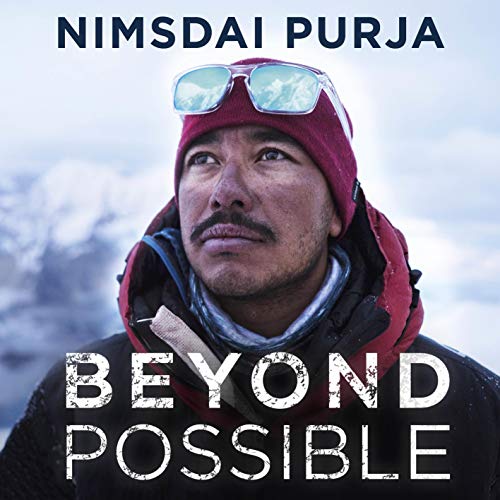
Beyond Possible
Summary
An SBS Gurkha soldier's account of how his tough Nepali upbringing and the lessons learned in his army life enabled his record-breaking conquest of all 14 of the world's 8,000m peaks in under seven months. What happens when ambition meets limitless imagination? Enter Project Possible: a seemingly unreachable goal to climb all 14 'death zone' mountains in record time. The previous record was seven years, 10 months and six days. I did it in six months. This is the inside story of my incredible adventure. As a kid in Nepal, barefoot in the mountains, I developed the resilience I needed to later join the Gurkhas, one of the most fearless forces in the British Army. Then in the Special Boat Service I served in some of the world's most dangerous warzones. But my next challenge was even more of a test. In Beyond Possible I reveal how I conquered the world's most dangerous peaks, breaking several world records in the process. With my elite training, I was able to adapt quickly to the lethal conditions, rarely phased by the lung-burning temperatures or brutal winds. Fear became irrelevant because I had belief. In the death zone, I came alive. But even after facing countless challenges, right at the peak of my achievements, my world fell apart when my mother was hospitalised. But I survived and ultimately conquered the most deadly and hostile mountains on the planet. Beyond Possible is my story.
©2020 Nimsdai Purja (P)2020 Hodder & Stoughton Limited