The Philosophy category has 1,858 audiobooks on Listento.it, with an average listener rating of 4.5★ across 25,891 ratings. The most-rated is 12 Rules for Life.

The Complete Book of Five Rings
Summary
The Complete Book of Five Rings is an authoritative version of Musashi's classic The Book of Five Rings, translated and annotated by a modern martial arts master, Kenji Tokitsu. Tokitsu has spent most of his life researching the legendary samurai swordsman and his works, and in this book he illuminates this seminal text, along with several other works by Musashi. These include "The Mirror of the Way of Strategy", which Musashi wrote when he was in his 20s; "Thirty-five Instructions on Strategy", and "Forty-two Instructions on Strategy", which were precursors to The Book of Five Rings; and "The Way to Be Followed Alone", which Musashi wrote just days before his death. Heard together, these five texts give listeners an unusually detailed, nuanced view of Musashi's ideas on swordsmanship, strategy, and self-cultivation. Tokitsu puts all these writings into historical and philosophical context and makes them accessible and relevant to today's listeners and martial arts students. Tokitsu understands Musashi's writings - and Musashi as a martial artist - unusually well and is able to provide a rare insight into the man and his historical contribution.
©2000 Kenji Tokitsu, English Translation 2004, 2010 by Shambhala Publications, Inc. (P)2014 Audible Inc.

Sci-Phi: Science Fiction as Philosophy
Summary
The science fiction genre has become increasingly influential in mainstream popular culture, evolving into one of the most engaging storytelling tools we use to think about technology and consider the shape of the future. Along the way, it has also become one of the major lenses we use to explore important philosophical questions. The origins of science fiction are most often thought to trace to Mary Shelley's novel Frankenstein, a story born from a night of spooky tale-telling by the fireside that explores scientific, moral, and ethical questions that were of great concern in the 19th century - and that continue to resonate today. And, although novels and short stories built the foundations of science fiction, film and television have emerged as equally powerful, experimental, and enjoyable ways to experience the genre. Even as far back as the silent era, films like Fritz Lang's Metropolis have used science fiction to tell stories that explore many facets of human experience. In Sci-Phi: Science Fiction as Philosophy, Professor of Philosophy David Kyle Johnson, of King's College, takes you on a 24-lecture exploration of the final frontiers of philosophy across several decades of science fiction in film and television. From big-budget blockbusters to television series featuring aliens in rubber masks, Professor Johnson finds food for philosophical thought in a wide range of stories. By looking at serious questions through astonishing tales and astounding technologies, you will see how science fiction allows us to consider immense, vital - and sometimes controversial - ideas with a rare combination of engagement and critical distance. PLEASE NOTE: When you purchase this title, the accompanying reference material will be available in your Library section along with the audio.
©2018 The Great Courses (P)2018 The Teaching Company, LLC

Ikigai
Summary
Bring meaning and joy to all your days with this internationally best-selling guide to the Japanese concept of ikigai - the happiness of always being busy - as revealed by the daily habits of the world's longest-living people. "Only staying active will make you want to live a hundred years." (Japanese proverb) According to the Japanese, everyone has an ikigai - a reason for living. And according to the residents of the Japanese village with the world's longest-living people, finding it is the key to a happier and longer life. Having a strong sense of ikigai - the place where passion, mission, vocation, and profession intersect - means that each day is infused with meaning. It's the reason we get up in the morning. It's also the reason many Japanese never really retire (in fact there's no word in Japanese that means retire in the sense it does in English): They remain active and work at what they enjoy, because they've found a real purpose in life - the happiness of always being busy. In researching this book, the authors interviewed the residents of the Japanese village with the highest percentage of 100-year-olds - one of the world's Blue Zones. Ikigai reveals the secrets to their longevity and happiness: how they eat, how they move, how they work, how they foster collaboration and community, and - their best-kept secret - how they find the ikigai that brings satisfaction to their lives. And it provides practical tools to help you discover your own ikigai. Because who doesn't want to find happiness in every day?
©2017 Héctor García and Francesc Miralles (P)2017 Gildan Media LLC
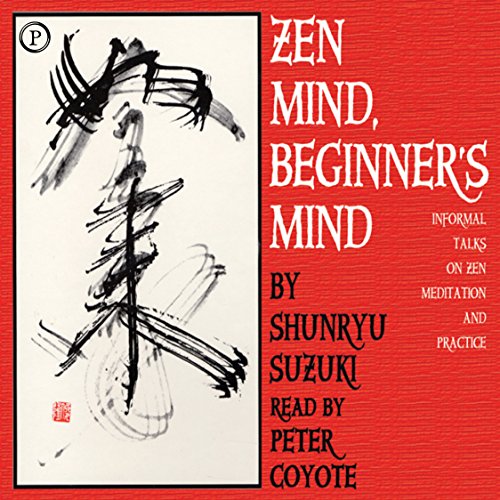
Zen Mind, Beginner's Mind
Summary
In the beginner's mind there are many possibilities, but in the expert's there are few. So begins this most beloved of all American Zen works. Seldom has such a small handful of words provided a teaching as rich as this famous opening line of Shunryu Suzuki's classic. In a single stroke, the simple sentence cuts through the pervasive tendency students have of getting so close to Zen as to completely miss what it's all about. An instant teaching in the first minutes. And that's just the beginning. In the 30 years since its original publication, Zen Mind, Beginner's Mind has become one of the great modern Zen classics. Suzuki Roshi presents the basics in a way that is remarkably clear and resonates with the joy of insight. Listeners will refer to this audio time and time again as an inspiration to practice.
©1970 Shunryu Suzuki (P)1988, 2015 Audio Literature, Phoenix Books

Just So
Summary
"If you were God," asked Alan Watts, "what kind of universe would you create? A perfect one free of suffering and drama? Or one filled with surprise and delight?" With Just So, the celebrated philosopher and self-described "spiritual entertainer" invites us to explore the hidden dimensions that shape both the cosmos and our personal experience of it. From the 1950s to the 1970s, Eastern spiritual philosophies ignited in the West profound new ways of perceiving ourselves and the mysteries of life. And from the beginning, Alan Watts was at the forefront - sparking insight after insight at live gatherings and radio broadcasts. Today Alan Watts' books and recordings bring perennial delight to new listeners of all ages and beliefs. Here the luminary author and speaker explores three often overlooked yet essential universal dynamics: connection, play, and pleasure. This exceptional collection of sessions includes three complementary seminars: The Cosmic Network - a journey into the interconnected web of the personal and the infinite Ecological Awareness - reflections on how humanity and nature evolve through discovery and "purposeless" play The Pursuit of Pleasure - how a true materialism connects us fully through our senses with others and to the natural flow of the cosmos. Along the way you'll explore many other themes, at turns humorous, prophetic, and more relevant today than ever. What unfolds is a liberating view of life that arises from possibility and the unpredictable - perfect and "just so" not in spite of its messy imperfections but because of them.
©2017 Alan Watts (P)2017 Sounds True
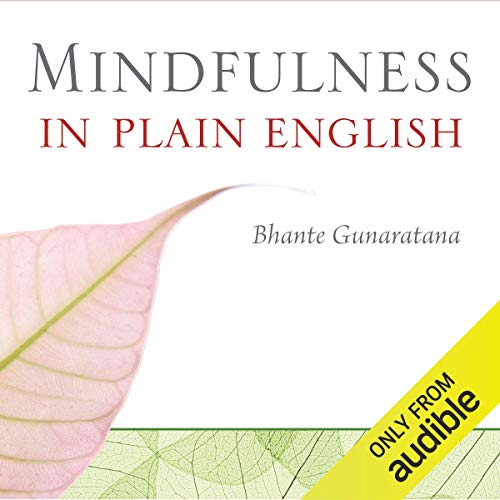
Mindfulness in Plain English
Summary
With over a quarter of a million copies sold, Mindfulness in Plain English is one of the most influential books in the burgeoning field of mindfulness and a timeless classic introduction to meditation. This is a book that people listen to, love, and share - a book that people talk about, write about, reflect on, and return to over and over again. Bhante Gunaratana is also the author of Eight Mindful Steps to Happiness, Beyond Mindfulness in Plain English, The Four Foundations of Mindfulness in Plain English, and his memoir, Journey to Mindfulness.
©2011 Bhante Henepola Gunaratana (P)2016 Audible, Inc.

Outgrowing God
Summary
Should we believe in God? In this brisk introduction to modern atheism, one of the world’s greatest science writers tells us why we shouldn’t. Richard Dawkins was 15 when he stopped believing in God. Deeply impressed by the beauty and complexity of living things, he’d felt certain they must have had a designer. Learning about evolution changed his mind. Now one of the world’s best and best-selling science communicators, Dawkins has given listeners, young and old, the same opportunity to rethink the big questions. In 12 fiercely funny, mind-expanding chapters, Dawkins explains how the natural world arose without a designer - the improbability and beauty of the "bottom-up programming" that engineers an embryo or a flock of starlings - and challenges head-on some of the most basic assumptions made by the world’s religions: Do you believe in God? Which one? Is the Bible a "Good Book"? Is adhering to a religion necessary, or even likely, to make people good to one another? Dissecting everything from Abraham’s abuse of Isaac to the construction of a snowflake, Outgrowing God is a concise, provocative guide to thinking for yourself. Includes a bonus PDF of photographs and charts. Advance praise for Outgrowing God "My son came home from his first day in the sixth grade with arms outstretched plaintively demanding to know: 'Have you ever heard of Jesus?' We burst out laughing. Maybe not our finest parenting moment, given that he was genuinely distraught. He felt that he had woken up one day to a world in which his peers were expressing beliefs he found frighteningly unreasonable. He began devouring books like The God Delusion, books that helped him formulate his own arguments and helped him stand his ground. Dawkins’s new book is special in the terrain of atheists’ pleas for humanism and rationalism precisely since it speaks to those most vulnerable to the coercive tactics of religion. As Dawkins himself says in the dedication, this book is for ‘all young people when they’re old enough to decide for themselves.’ It is also, I must add, for their parents." (Janna Levin, author of Black Hole Blues) "When someone is considering atheism I tell them to read the Bible first and then Dawkins. Outgrowing God - second only to the Bible!" (Penn Jillette, author of God, No!) PLEASE NOTE: When you purchase this title, the accompanying PDF will be available in your Audible Library along with the audio.
©2019 Richard Dawkins (P)2019 Random House Audio

Cynical Theories
Summary
Wall Street Journal, USA Today, and Publishers Weekly best seller! Have you heard that language is violence and that science is sexist? Have you read that certain people shouldn't practice yoga or cook Chinese food? Or been told that being obese is healthy, that there is no such thing as biological sex, or that only White people can be racist? Are you confused by these ideas, and do you wonder how they have managed so quickly to challenge the very logic of Western society? In this probing and intrepid volume, Helen Pluckrose and James Lindsay document the evolution of the dogma that informs these ideas, from its coarse origins in French postmodernism to its refinement within activist academic fields. Today this dogma is recognizable as much by its effects, such as cancel culture and social-media dogpiles, as by its tenets, which are all too often embraced as axiomatic in mainstream media: knowledge is a social construct; science and reason are tools of oppression; all human interactions are sites of oppressive power play; and language is dangerous. As Pluckrose and Lindsay warn, the unchecked proliferation of these anti-Enlightenment beliefs present a threat not only to liberal democracy but also to modernity itself. While acknowledging the need to challenge the complacency of those who think a just society has been fully achieved, Pluckrose and Lindsay break down how this often radical activist scholarship does far more harm than good, not least to those marginalized communities it claims to champion. They also detail its alarmingly inconsistent and illiberal ethics. Only through a proper understanding of the evolution of these ideas, they conclude, can those who value science, reason, and consistently liberal ethics successfully challenge this harmful and authoritarian orthodoxy - in the academy, in culture, and beyond.
©2020 Helen Pluckrose and James Lindsay (P)2020 Pitchstone Publishing

The Convoluted Universe: Book One
Summary
The Convoluted Universe: Book One is the sequel to The Custodians. This book contains some of the more complicated concepts in metaphysics that Dolores Cannon discovered through 20 years of using deep hypnosis to explore the subconscious mind. Some of the topics explored in this book include: The origin, knowledge, and destruction of Atlantis The explanations of Earth's mysteries, including the Pyramids, Easter Island, the Bermuda Triangle, the Ark of the Covenant, Loch Ness Monster, Nazca Lines Characteristics of other planets Parallel universes Parallel lifetimes and realities Other dimensions And much more... This audiobook is intended for those listeners who want their minds expanded by the more complicated metaphysical ideas that border on quantum physics.
©2010 Dolores Cannon (P)2019 Dolores Cannon
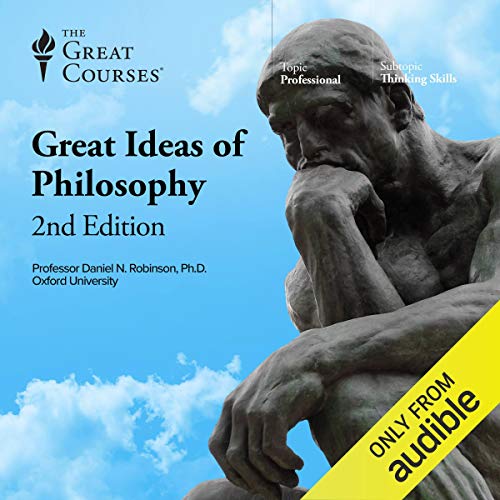
The Great Ideas of Philosophy, 2nd Edition
Summary
Grasp the important ideas that have served as the backbone of philosophy across the ages with this extraordinary 60-lecture series. This is your opportunity to explore the enormous range of philosophical perspectives and ponder the most important and enduring of human questions - without spending your life poring over dense philosophical texts. Professor Robinson guides you through more than 2,000 years of philosophical thinking and gives you a coherent, comprehensive, and beautifully articulated introduction to the great conversation of philosophy. Every lecture contains substance that can change your view of the world and its history. You'll journey from the early philosophical ideas of Socrates, Plato, and Aristotle; chart the origins of Christian philosophy and investigate the Islamic scholars who preserved and extended Greek thought during the Middle Ages; and venture through Enlightenment contributions to philosophy, from Francis Bacon to Locke, Hume, Kant, Mill, and Adam Smith. Then shift your attention to the modern era, where you see groundbreaking ideas like psychoanalysis, pragmatism, and nihilism, as well as the collision between the inherently social understanding of meaning created by Wittgenstein, the vastly different estimation of human thought developed by the code-breaking genius Alan Turing, and the subtle response to him made by the American philosopher John Searle. While the lectures cover an enormous range of key thinkers and ideas, they always focus on the most important ideas. The result is a course that gives you everything you need to finally grasp humanity's exciting philosophical history - without years of intense academic study and piles of dense reading. PLEASE NOTE: When you purchase this title, the accompanying reference material will be available in your Library section along with the audio.
©2004 The Teaching Company, LLC (P)2004 The Great Courses
The Heart of the Buddha's Teaching
Summary
In The Heart of the Buddha's Teaching, Thich Nhat Hanh introduces us to the core teachings of Buddhism and shows us that the Buddha's teachings are accessible and applicable to our daily lives. With poetry and clarity, Nhat Hanh imparts comforting wisdom about the nature of suffering and its role in creating compassion, love, and joy - all qualities of enlightenment. Covering such significant teachings as the Four Noble Truths, the Noble Eightfold Path, the Three Doors of Liberation, the Three Dharma Seals, and the Seven Factors of Awakening, The Heart of the Buddha's Teaching is a radiant beacon on Buddhist thought for the initiated and uninitiated alike.
©2014 Thich Nhat Hanh (P)2014 Random House Audio

The Mindful Athlete
Summary
Michael Jordan credits George Mumford with transforming his on-court leadership of the Bulls, helping Jordan lead the team to six NBA championships. Mumford also helped Kobe Bryant, Andrew Bynum, and Lamar Odom and countless other NBA players turn around their games. A widely respected public speaker and coach, Mumford is sharing his own story and the strategies that have made these athletes into stars in The Mindful Athlete: The Secret to Pure Performance. His proven, gentle but groundbreaking mindfulness techniques can transform the performance of anyone with a goal, be they an Olympian, weekend warrior, executive, hacker, or artist. Mumford's deeply moving personal story is unforgettable. A basketball player at the University of Massachusetts (where he roomed with Dr. J, Julius Erving), injuries forced Mumford out of the game he loved. The meds that relieved the pain of his injuries also numbed him to the emptiness he felt without the game and eventually led him to heroin. After years as a functioning addict, Mumford enrolled in Dr. Jon Kabat-Zinn's Mindfulness Based Stress Reduction program, and made meditation, on and off the cushion, the center of his life. He kicked drugs, earned a master's degree in counseling psychology and began teaching meditation to inmates and others. When Michael Jordan left the Chicago Bulls to play baseball in 1993, the team was in crisis. Coach Phil Jackson, a long-time mindfulness practitioner, contacted Dr. Kabat-Zinn to find someone who could teach mindfulness techniques to the struggling team - someone who would have credibility and could speak the language of his players. Kabat-Zinn led Jackson to Mumford and their partnership began. Mumford has worked with Jackson and each of the eleven teams he coached to become NBA champions. His roster of champion clients has since blossomed way beyond basketball to include corporate executives, Olympians, and athletes.
©2016 George Mumford (P)2015 Brilliance Audio, all rights reserved.

The Voice of Knowledge
Summary
In The Voice of Knowledge, don Miguel Ruiz reminds us of a profound and simple truth: The only way to end our emotional suffering and restore our joy in living is to stop believing in lies, mainly about ourselves. Before we learn to speak, our true nature is to love and be happy, to explore and enjoy life. As little children, we are completely authentic. Our actions are guided by instinct and emotions, we listen to the silent "voice of our integrity". Once we learn to speak, the people around us hook our attention and program us with knowledge. The "voice of knowledge" comes alive inside our head, and what is that voice telling us? Mostly lies. That voice never stops talking, judging, gossiping, and abusing us. It constantly sabotages our happiness and keeps us from enjoying a reality of truth and love. Ruiz shows us how to recover the silent voice of our integrity and find inner peace. When the voice of knowledge no longer controls us, our life becomes an expression of our authentic self, just as it was before we learned to speak. Then we return to the truth, we return to love, and we live in happiness again.
©2004 Migeul Angel Ruiz and Janet Mills (P)2005 Amber-Allen Publishing

The Will to Power: The Philosophy of Friedrich Nietzsche
Summary
Who was Friedrich Nietzsche? This lonely and chronically ill, yet passionate, daring, and complex man is perhaps the most mysterious and least understood of all contemporary philosophers. Why are his brilliant insights so relevant for today? How did he become the most misinterpreted and unfairly maligned intellectual figure of the last two centuries? To provide shape to Nietzsche's thought, each of these 24 lectures focuses on specific ideas that preoccupied Nietzsche while tracing the profound themes that give meaning to his work. You'll get a chance to put Nietzsche's life and work in a larger historical and philosophical context. You'll explore the controversial philosopher's subtle, complex critique of both religious belief and Greek rationalism. You'll also spend a wealth of time focusing on Nietzsche's famous writing style, which deftly combines the majesty of the prophet, the force of the Homeric warrior, and the lyricism of the poet - but which nonetheless is rife with inconsistencies, exaggerations, and personal attacks. And you'll get a better understanding of Nietzsche's complaints and criticisms of the intellectual currents of his time: Christian moralism, evolution, socialism, democracy, and nationalism. As you make your way through these lectures, you'll discover that Nietzsche, even at his most polemical and offensive, exudes an unmistakable enthusiasm and love of life. In fact, you'll see that his exhortation to learn to love and accept one's own life, to make it better by becoming who one really is, forms the project that is the true core of his work. PLEASE NOTE: When you purchase this title, the accompanying reference material will be available in your Library section along with the audio.
©1999 The Teaching Company, LLC (P)1999 The Great Courses

Other Minds
Summary
Although mammals and birds are widely regarded as the smartest creatures on earth, it has lately become clear that a very distant branch of the tree of life has also sprouted higher intelligence: the cephalopods, consisting of the squid, the cuttlefish, and above all the octopus. In captivity, octopuses have been known to identify individual human keepers, raid neighboring tanks for food, turn off lightbulbs by spouting jets of water, plug drains, and make daring escapes. How is it that a creature with such gifts evolved through an evolutionary lineage so radically distant from our own? What does it mean that evolution built minds not once but at least twice? The octopus is the closest we will come to meeting an intelligent alien. What can we learn from the encounter? In Other Minds, Peter Godfrey-Smith, a distinguished philosopher of science and a skilled scuba diver, tells a bold new story of how subjective experience crept into being - how nature became aware of itself. As Godfrey-Smith stresses, it is a story that largely occurs in the ocean, where animals first appeared. Tracking the mind's fitful development, Godfrey-Smith shows how unruly clumps of seaborne cells began living together and became capable of sensing, acting, and signaling. As these primitive organisms became more entangled with others, they grew more complicated. The first nervous systems evolved, probably in ancient relatives of jellyfish; later on the cephalopods, which began as inconspicuous mollusks, abandoned their shells and rose above the ocean floor, searching for prey and acquiring the greater intelligence needed to do so. Taking an independent route, mammals and birds later began their own evolutionary journeys. But what kind of intelligence do cephalopods possess? Drawing on the latest scientific research and his own scuba-diving adventures, Godfrey-Smith probes the many mysteries that surround the lineage. How did the octopus, a solitary creature with little social life, become so smart? What is it like to have eight tentacles that are so packed with neurons that they virtually think for themselves? What happens when some octopuses abandon their hermit-like ways and congregate, as they do in a unique location off the coast of Australia? By tracing the question of inner life back to its roots and comparing human beings with our most remarkable animal relatives, Godfrey-Smith casts crucial new light on the octopus mind - and on our own.
©2016 Peter Godfrey-Smith (P)2016 Harper Collins

Beyond Good and Evil
Summary
Continuing where Thus Spoke Zarathustra left off, Nietzsche's controversial work Beyond Good and Evil is one of the most influential philosophical texts of the 19th century and one of the most controversial works of ideology ever written. Attacking the notion of morality as nothing more than institutionalised weakness, Nietzsche criticises past philosophers for their unquestioning acceptance of moral precepts. Nietzsche tried to formulate what he called "the philosophy of the future". Alex Jennings reads this new translation by Ian Johnston. PLEASE NOTE: When you purchase this title, the accompanying reference material will be available in your Library section along with the audio.
©2008 Naxos Audiobooks (P)2008 Naxos Audiobooks

The Tao of Seneca
Summary
The Tao of Seneca (volumes 1-3) is an introduction to Stoic philosophy through the words of Seneca. If you study Seneca, you'll be in good company. He was popular with the educated elite of the Greco-Roman Empire, but Thomas Jefferson also had Seneca on his bedside table. Thought leaders in Silicon Valley tout the benefits of Stoicism, and NFL management, coaches, and players alike - from teams such as the Patriots and Seahawks - have embraced it because the principles make them better competitors. Stoicism is a no-nonsense philosophical system designed to produce dramatic real-world effects. Think of it as an ideal operating system for thriving in high-stress environments. This is your guide.
Public Domain (P)2015 Seneca and Marcus, LLC
Redefining Reality
Summary
No subject is bigger than reality itself, and nothing is more challenging to understand, since what counts as reality is undergoing continual revision and has been for centuries. For example, the matter that comprises all stars, planets, and living things turns out to be just a fraction of what actually exists. Moreover, we think that we control our actions, but data analytics can predict, with astonishing accuracy, when we will wake up, what we will buy, and even whom we will marry. The quest to pin down what's real and what's illusory is both philosophical and scientific, a metaphysical search for ultimate reality that goes back to the ancient Greeks. For the last 400 years, this search has been increasingly guided by scientists, who create theories and test them in order to define and redefine reality. And we have developed the power to alter our own reality in major ways - to defeat diseases, compensate for disabilities, and augment our intellect with computers. Where is that trend going? Experience the thrill of this exciting quest in 36 wide-ranging lectures that touch on many aspects of the ceaseless search for reality. From the birth of the universe to brain science, discover that separating the real from the illusory is an exhilarating intellectual adventure. Scientists and philosophers are not alone in grappling, at an intellectual level, with reality. Some of the most accessible interpretations are by painters, novelists, filmmakers, and other artists whose works not only draw on the latest discoveries but also sometimes inspire them. Explore examples such as Alice in Wonderland, pointillism, cubism, surrealism, and reality TV. And since dealing with reality is an experience we all share, this course is designed for people of all backgrounds. PLEASE NOTE: When you purchase this title, the accompanying reference material will be available in your Library section along with the audio.
©2015 The Teaching Company, LLC (P)2015 The Great Courses

More than Two
Summary
Can you love more than one person? Can you have multiple romantic partners without jealousy or cheating? Absolutely! Polyamorous people have been paving the way through trial and painful error. Now the new book More Than Two can help you find your own way. With completely new material and a fresh approach, Franklin Veaux and Eve Rickert wrote More Than Two to expand on and update the themes and ideas in the wildly popular polyamory website morethantwo.com. From ancient Greece through the many dynasties of China and to current practices of nonmonogamy, people have openly engaged in multiple intimate relationships. Not until the late 20th century, however, was a word coined that encapsulated the practice, philosophies, edicts, and ethics: polyamory (poly = many + amore = love). For Franklin Veaux, who has been polyamorous for his entire adult life, the emerging framework and subsequent vocabulary for his lifestyle was a light in the dark. Candidly sharing his experiences and thoughts online catapulted his website, morethantwo.com, among the first dedicated to the poly lifestyle, to one of the top-ranking on the subject. In recent years, as more people have discovered polyamory as a legitimate and desirable option for how they conduct their relationships, Franklin and one of his partners, Eve Rickert, saw that there was a growing need for a comprehensive guide to the lifestyle. More Than Two is that guide.
©2014 Franklin Veaux and Eve Rickert (P)2015 Franklin Veaux and Eve Rickert

You Are Not So Smart
Summary
An entertaining illumination of the stupid beliefs that make us feel wise. You believe you are a rational, logical being who sees the world as it really is, but journalist David McRaney is here to tell you that you're as deluded as the rest of us. But that's OK - delusions keep us sane. You Are Not So Smart is a celebration of self-delusion. It's like a psychology class, with all the boring parts taken out, and with no homework.Based on the popular blog of the same name, You Are Not So Smart collects more than 46 of the lies we tell ourselves everyday, including: Dunbar's Number - Humans evolved to live in bands of roughly 150 individuals, the brain cannot handle more than that number. If you have more than 150 Facebook friends, they are surely not all real friends. Hindsight bias - When we learn something new, we reassure ourselves that we knew it all along. Confirmation bias - Our brains resist new ideas, instead paying attention only to findings that reinforce our preconceived notions. Brand loyalty - We reach for the same brand not because we trust its quality but because we want to reassure ourselves that we made a smart choice the last time we bought it.
©2011 David McRaney (P)2011 Gildan Media Corp