The Politics & Government category has 4,793 audiobooks on Listento.it, with an average listener rating of 4.5★ across 40,708 ratings. The most-rated is A Promised Land.

Operation Nemesis
Summary
A masterful account of the conspiracy of assassins that hunted down the perpetrators of a genocide. In 1921 a small group of self-appointed patriots set out to avenge the deaths of almost one million victims of the Armenian Genocide. They named their operation Nemesis after the Greek goddess of retribution. Over several years the men tracked down and assassinated former Turkish leaders. The story of this secret operation has never been fully told until now. Eric Bogosian goes beyond simply telling the story of this cadre of Armenian assassins to set the killings in context by providing a summation of Ottoman and Armenian history as well as the history of the genocide itself. Casting fresh light on one of the great crimes of the 20th century and one of history's most remarkable acts of political retribution, and drawing upon years of new research across multiple continents, Nemesis is both a riveting listen and a profound examination of evil, revenge, and the costs of violence.
©2015 Eric Bogosian (P)2015 Hachette Audio

Losing the Long Game
Summary
The definitive account of how regime change in the Middle East has proven so tempting to American policymakers for decades - despite never achieving the far-reaching aims of its proponents - and how it's finally time to forge a new path forward. Since the end of World War II, the United States has set out to oust governments in the Middle East on an average of once per decade - in places as diverse as Iran, Iraq, Afghanistan (twice), Egypt, Libya, and Syria. The reasons for these interventions have also been extremely diverse, and the methods by which the United States pursued regime change have also been highly varied, ranging from diplomatic pressure alone to outright military invasion and occupation. What is common to all the operations, however, is that they failed to achieve their ultimate goals, produced a range of unintended and even catastrophic consequences, carried heavy financial and human costs, and in many cases left the countries in question worse off than they were before. Losing the Long Game is a thorough and riveting look at the US experience with regime change over the past 70 years and an insider's view on US policymaking in the region at the highest levels. It is the story of repeated US interventions in the region that always started out with high hopes and often the best of intentions, but never turned out well. No future discussion of US policy in the Middle East will be complete without taking into account the lessons of the past, especially at a time of intense domestic polarization and reckoning with America's standing in world.
©2020 Philip H. Gordon (P)2020 Random House Audio

Hitler's American Friends
Summary
Hitler's American Friends, by Bradley W. Hart, is an audiobook examining the strange terrain of Nazi sympathizers, nonintervention campaigners, and other voices in America who advocated on behalf of Nazi Germany in the years before World War II. Americans who remember World War II reminisce about how it brought the country together. The less-popular truth behind this warm nostalgia: Until the attack on Pearl Harbor, America was deeply, dangerously divided. Bradley W. Hart's Hitler's American Friends exposes the homegrown antagonists who sought to protect and promote Hitler, leave Europeans (and especially European Jews) to fend for themselves, and elevate the Nazi regime. Some of these friends were Americans of German heritage who joined the Bund, whose leadership dreamed of installing a stateside Führer. Some were as bizarre and hair-raising as the Silver Shirt Legion, run by an eccentric who claimed Hitler fulfilled a religious prophesy. Some were Midwestern Catholics like Father Charles Coughlin, an early right-wing radio star who broadcast anti-Semitic tirades. They were even members of Congress who used their franking privilege - sending mail at cost to American taxpayers - to distribute German propaganda. And celebrity pilot Charles Lindbergh ended up speaking for them all at the America First Committee. We try to tell ourselves it couldn't happen here, but Americans are not immune to the lure of fascism. Hitler's American Friends is a powerful look at how the forces of evil manipulate ordinary people, how we stepped back from the ledge, and the disturbing ease with which we could return to it.
©2018 Bradley W. Hart (P)2018 Macmillan Audio

An Impeccable Spy
Summary
Bloomsbury presents An Impeccable Spy by Owen Matthews, read by Mike Grady. Richard Sorge was a man with two homelands. Born of a German father and a Russian mother in Baku in 1895, he moved in a world of shifting alliances and infinite possibility. A member of the angry and deluded generation who found new, radical faiths after their experiences on the battlefields of the First World War, Sorge became a fanatical communist - and the Soviet Union’s most formidable spy. Like many great spies, Sorge was an effortless seducer, combining charm with ruthless manipulation. He did not have to go undercover to find out closely guarded state secrets - his victims willingly shared them. As a foreign correspondent, he infiltrated and influenced the highest echelons of German, Chinese and Japanese society in the years leading up to and including the Second World War. His intelligence regarding Operation Barbarossa and Japanese intentions not to invade Siberia in 1941 proved pivotal to the Soviet counteroffensive in the Battle of Moscow, which in turn determined the outcome of the war. Never before has Sorge’s story been told from the Russian side as well as the German and Japanese. Owen Matthews takes a sweeping historical perspective and draws on a wealth of declassified Soviet archives - along with testimonies from those who knew and worked with Sorge - to rescue the riveting story of the man described by Ian Fleming as 'the most formidable spy in history'.
©2019 Owen Matthews (P)2019 Bloomsbury Publishing Plc

The Good American
Summary
From the New York Times best-selling author of The Revenge of Geography comes a sweeping yet intimate story of the most influential humanitarian you’ve never heard of - Bob Gersony, who spent four decades in crisis zones around the world. “This graceful study of a courageous and humble man reminds us that history can be made, and lives can be saved, by diplomats who know how to reconcile the good with the possible.” (Timothy Snyder, author of The Road to Unfreedom and On Tyranny) In his long career as an acclaimed journalist covering the “hot” moments of the Cold War and its aftermath, best-selling author Robert D. Kaplan often found himself crossing paths with Bob Gersony, a consultant for the US State Department whose quiet dedication and consequential work made a deep impression on Kaplan. Gersony, a high school dropout later awarded a Bronze Star for his service in Vietnam, conducted on-the-ground research for the US government in virtually every war and natural-disaster zone in the world. In Thailand, Central and South America, Sudan, Chad, Mozambique, Rwanda, Gaza, Bosnia, North Korea, Iraq, and beyond, Gersony never flinched from entering dangerous areas that diplomats could not reach, sometimes risking his own life. Gersony’s behind-the scenes fact-finding, which included interviews with hundreds of refugees and displaced persons from each war zone and natural-disaster area, often challenged the assumptions and received wisdom of the powers that be, on both the left and the right. In nearly every case, his advice and recommendations made American policy at once smarter and more humane - often dramatically so. In Gersony, Kaplan saw a powerful example of how American diplomacy should be conducted. In a work that exhibits Kaplan’s signature talent for combining travel and geography with sharp political analysis, The Good American tells Gersony’s powerful life story. Set during the State Department’s golden age, this is a story about the loneliness, sweat, and tears and the genuine courage that characterized Gersony’s work in far-flung places. It is also a celebration of ground-level reporting: a pause-resisting demonstration, by one of our finest geopolitical thinkers, of how getting an up-close, worm’s-eye view of crises and applying sound reason can elicit world-changing results.
©2020 Robert D. Kaplan (P)2020 Random House Audio

No More Lies
Summary
In 1972, during the Black Power Movement, iconoclast Dick Gregory challenged one of the foundations of America itself - its history, which had been written almost exclusively from the white male perspective. In No More Lies, this true trailblazer gave voice to African Americans, speaking their truth about the past and race relations in the United States. No More Lies offers this incomparable satirist’s intellectual, conspiratorial, and humorous spin on the facts. No subject is off limits from his critical eye - Gregory examines numerous aspects of culture and history, from the slave trade, police brutality, the wretchedness of working-class life and labor unions to the 1968 Civil Rights Act, the Founding Fathers, “happy slaves”, and entrepreneurs. Although this absorbing book is more than 40 years old, its provocative truths continue to reverberate in our lives today. With No More Lies, Gregory inspire a new generation to connect what is happening today with what has happened in the past.
©1971 Richard Claxton Gregory (P)2020 Audible, Inc.

Economic Dignity
Summary
"A timely and important new book... It should be our North Star for the recovery and beyond." (Hillary Clinton) From one of our wisest and most influential economic thinkers, the only person to serve as Director of the National Economic Council under two presidents, a profound big-picture vision of why the promotion of dignity should be the singular end goal by which we chart America's economic future When Gene Sperling was in charge of coordinating the shaping and execution of the US government's economic policy in the Obama White House, he found himself surprised and dismayed when serious people in Washington worried out loud to him that the Obama focus on health care was a distraction because it was "not focused on the economy." How, he asked, was millions of Americans' fear that they were a single pink slip or a loved one's serious illness away from financial ruin somehow not considered an economic issue? To him, it was just one more example of a more profound truth he witnessed in his many years in our national economic debate: that when it comes to America's economic policy, there is too little focus on what the end goal should be. Too often, he found that our economic debate confused ends and means; that we measured economic success by metrics like GDP instead of whether the economy was succeeding in lifting up the sense of meaning, purpose, fulfillment, and security of people. Too often, he found debates framed by old divisions or pro-market ideology that increasingly failed to capture whether economic policy was fostering exploitation, economic insecurity, and disillusionment that were too often invisible within our current framework. Now more than ever, at a moment when the very capacity of modern capitalism to avoid accelerating inequality, a hollowed-out middle class, and structural poverty is being questioned, we need to step back and reflect on our ultimate goals. Economic Dignity is Sperling's effort to do just that - to frame our thinking about the way forward in a time of wrenching economic change. His argument combines moral and intellectual seriousness with actual high-level policy experience. Economic dignity, Sperling maintains, can be seen as resting on three pillars. The first: the capacity to care for family without economic deprivation denying people the capacity to experience its greatest joys - the birth of one's children, the companionship of a loving partner, the love of family and friends, the fulfillment that comes from providing. The second: the right to the pursuit of potential and purpose, including the right to first and second chances - the right to a life of active striving. The third: economic participation with respect and without domination and humiliation. All three pillars are rooted in the highest and most noble values of the American project. But getting there is the rub, and in Economic Dignity, Sperling offers paths that policymakers and citizens can follow for years to come. As he puts it, if you live in times when major steps forward are needed, it is important to be clear on your destination - or at least to know the North Star that is guiding you. His answer, in two words, is economic dignity.
©2020 Gene Sperling (P)2020 Penguin Audio

The Accidental Guerrilla
Summary
David Kilcullen is one of the world's most influential experts on counterinsurgency and modern warfare. A senior counterinsurgency advisor to General David Petraeus in Iraq, his vision of war dramatically influenced America's decision to rethink its military strategy in Iraq and implement "the surge". Now, in The Accidental Guerrilla, Kilcullen provides a remarkably fresh perspective on the War on Terror. Kilcullen takes us "on the ground" to uncover the face of modern warfare, illuminating both the big global war (the "War on Terrorism") and its relation to the associated "small wars" across the globe: Iraq, Afghanistan, the Philippines, Indonesia, Thailand, Chechnya, Pakistan, and North Africa. Kilcullen sees today's conflicts as a complex pairing of contrasting trends: local social networks and worldwide movements; traditional and postmodern culture; local insurgencies seeking autonomy and a broader pan-Islamic campaign. He warns that America's actions in the war on terrorism have tended to conflate these trends, blurring the distinction between local and global struggles and thus enormously complicating our challenges. Indeed, the US had done a poor job of applying different tactics to these very different situations, continually misidentifying insurgents with limited aims and legitimate grievances (whom he calls "accidental guerrillas") as part of a coordinated worldwide terror network. We must learn how to disentangle these strands, develop strategies that deal with global threats, avoid local conflicts where possible, and win them where necessary. Colored with gripping battlefield experiences that range from the jungles and highlands of Southeast Asia to the mountains of the Afghanistan-Pakistan border to the dusty towns of the Middle East, The Accidental Guerrilla will, quite simply, change the way we think about war. This much anticipated book will be a must listen for everyone concerned about the war on terror.
©2009 David Kilcullen (P)2009 Audible, Inc.

Abraham Lincoln
Summary
An essential book for any student of Lincoln and American history, Abraham Lincoln: The Man Behind the Myths is acclaimed Lincoln biographer Stephen B. Oates’ unique exploration of America’s 16th president in reality and memory. In this multifaceted portrait, Oates, “the most popular historical interpreter of Lincoln” (Gabor S. Boritt, New York Times Book Review), exposes the human side of the great and tragic president - including his depression, his difficulties with love, and his troubled and troubling attitudes about slavery - while also confronting the many legends that have arisen around “Honest Abe”. Oates throughout raises timely questions about what the Lincoln mythos reveals about the American people.
©1984 Stephen B. Oates (P)2021 Blackstone Publishing

Life After the State
Summary
Have you ever had the nagging feeling that the problems the country faces are spiraling out of control, that the government has lost its way and that, despite its promises, nothing ever changes? Well, you're right. In every instance where government gets involved in people's lives with a desire to do good, it can always be relied on to make the situation much, much worse. Yet despite overwhelming evidence to the contrary, we imagine that a world without the state would be a wild and terrifying place. With wit and devastating clarity of argument, Frisby shows in this book that human nature proves the opposite to be true. Welcome to Life After the State.
©2013 Unbound (P)2013 Unbound

Five Miles Away, a World Apart
Summary
How is it that, half a century after Brown v. Board of Education, educational opportunities remain so unequal for black and white students, not to mention poor and wealthy ones? In his important new book, Five Miles Away, a World Apart, James E. Ryan answers this question by tracing the fortunes of two schools in Richmond, Virginia - one in the city and the other in the suburbs. Ryan shows how court rulings in the 1970s, limiting the scope of desegregation, laid the groundwork for the sharp disparities between urban and suburban public schools that persist to this day. The Supreme Court, in accord with the wishes of the Nixon administration, allowed the suburbs to lock nonresidents out of their school systems. City schools, whose student bodies were becoming increasingly poor and black, simply received more funding, a measure that has proven largely ineffective, while the independence (and superiority) of suburban schools remained sacrosanct. Weaving together court opinions, social science research, and compelling interviews with students, teachers, and principals, Ryan explains why all the major education reforms since the 1970s have failed to bridge the gap between urban and suburban schools and have unintentionally entrenched segregation by race and class.
©2010 Oxford University Press, Inc. (P)2019 HighBridge, a division of Recorded Books

All the Ways We Kill and Die
Summary
The search for a friend's killer is a riveting lesson in the way war has changed. The EOD - explosive ordnance disposal - community is tight-knit, and when one of their own is hurt, an alarm goes out. When Brian Castner, an Iraq War vet, learns that his friend and EOD brother Matt has been killed by an IED in Afghanistan, he goes to console Matt's widow, but he also begins a personal investigation. Is the bomb maker who killed Matt the same man American forces have been hunting since Iraq, known as the Engineer? In this nonfiction thriller, Castner takes us inside the manhunt for this elusive figure, meeting maimed survivors, interviewing the forensics teams who gather post-blast evidence, the wonks who collect intelligence, the drone pilots and contractors tasked to kill. His investigation reveals how warfare has changed since Iraq, becoming individualized even as it has become hi-tech, with our drones, bomb disposal robots, and CSI-like techniques. As we use technology to identify, locate, and take out the planners and bomb makers, the chilling lesson is that the hunters are also being hunted, and the other side - from Al-Qaeda to ISIS - has been selecting its own high-value targets.
©2016 Brian Castner (P)2016 Audible, Inc.

Dissent and the Supreme Court
Summary
From the admired judicial authority, author of Louis D. Brandeis ("Remarkable" - Anthony Lewis, The New York Review of Books; "Monumental" - Alan M. Dershowitz, The New York Times Book Review), Division and Discord, and Supreme Decisions - Melvin Urofsky's major new audiobook looks at the role of dissent in the Supreme Court and the meaning of the Constitution through the greatest and longest lasting public-policy debate in the country's history, among members of the Supreme Court, between the Court and the other branches of government, and between the Court and the people of the United States. Urofsky writes of the necessity of constitutional dialogue as one of the ways in which we as a people reinvent and reinvigorate our democratic society. In Dissent and the Supreme Court, he explores the great dissents throughout the Court's 225-year history. He discusses in detail the role the Supreme Court has played in helping to define what the Constitution means, how the Court's majority opinions have not always been right, and how the dissenters, by positing alternative interpretations, have initiated a critical dialogue about what a particular decision should mean. This dialogue is sometimes resolved quickly; other times it may take decades before the Court adjusts its position. Louis Brandeis' dissenting opinion about wiretapping became the position of the Court four decades after it was written. The Court took six decades to adopt the dissenting opinion of the first Justice John Harlan in Plessy v. Ferguson - that segregation on the basis of race violated the Constitution - in Brown v. Board of Education. Urofsky shows that the practice of dissent grew slowly but steadily and that in the 19th century dissents became more frequent. In the (in)famous case of Dred Scott v. Sanford, Chief Justice Roger Taney's opinion upheld slavery, declaring that blacks could never be citizens.
©2015 Melvin I. Urofsky (P)2015 Random House Audio

Mafia Summit
Summary
Here is the true story of how a small-town lawman in upstate New York busted a Cosa Nostra conference in 1957, exposing the Mafia to America. In a small village in upstate New York, mob bosses from all over the country—including Vito Genovese, Carlo Gambino, Joe Bonanno, Joe Profaci, Cuba boss Santo Trafficante, Jr., and future Gambino boss Paul Castellano—were nabbed by Sergeant Edgar D. Croswell as they gathered to sort out a bloody war of succession. For years FBI director J. Edgar Hoover had adamantly denied the existence of the Mafia, but young Robert Kennedy immediately recognized the shattering importance of the Apalachin summit. Appointed attorney general after his brother John became president, Bobby embarked on a campaign to break the spine of the mob, engaging in a furious turf battle with the powerful Hoover. Detailing mob killings, the early days of the heroin trade, and the crusade to loosen the hold of organized crime, this momentous story will caputre fans of Gus Russo and Luc Sante. Reavill scintillatingly recounts the beginning of the end for the Mafia in America and how it all began with a good man in the right place at the right time. Gil Reavill is an author, screenwriter, and playwright whose work has been widely featured in magazines. He is the author of Aftermath, Inc. and coauthor of Beyond All Reason and the screenplay that became the 2006 film Dirty, starring Cuba Gooding, Jr.
©2012 Gil Reavill (P)2013 Blackstone Audio, Inc
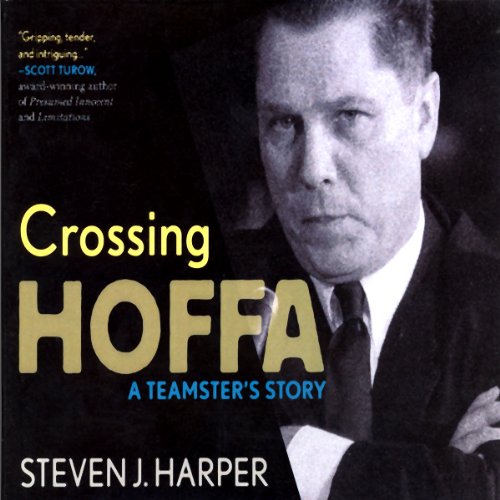
Crossing Hoffa
Summary
From 1959 to 1961, over-the-road trucker Jim Harper clashed with Jimmy Hoffa, the most powerful labor leader of his time. Throughout the ordeal, Harper endured death threats and survived murder attempts. When he died 40 years later, his son discovered the true story behind his father's doomed crusade - a story that even his father had never known.
©2008 Steven Harper (P)2008 Spoken Books Publishing

How Safe Are We?
Summary
Former secretary of the Department of Homeland Security Janet Napolitano offers an insightful analysis of American security at home and a prescription for the future. Created in the wake of the greatest tragedy to occur on US soil, the Department of Homeland Security was handed a sweeping mandate: make America safer. It would encompass intelligence and law-enforcement agencies, oversee natural disasters, commercial aviation, border security and ICE, cybersecurity, and terrorism, among others. From 2009-2013, Janet Napolitano ran DHS and oversaw 22 federal agencies with 230,000 employees. In How Safe Are We?, Napolitano pulls no punches, reckoning with the critics who call it Frankenstein's Monster of government run amok and taking a hard look at the challenges we'll be facing in the future. But ultimately, she argues that the huge, multifaceted department is vital to our nation's security. An agency that's part terrorism prevention, part intelligence agency, part law enforcement, public safety, and disaster recovery makes for an odd combination for the protocol-driven, tradition-bound Washington, DC, culture. But, she says, it has made us more safe, secure, and resilient. Napolitano not only answers the titular question but grapples with how these security efforts have changed our country and society. Where are the failures that leave us vulnerable, and what has our trillion-dollar investment yielded over the last 15 years? And why haven't we had another massive terrorist attack in the US since September 11, 2001? In our current political climate, where Donald Trump has politicized nearly every aspect of the department, Napolitano's clarifying, bold vision is needed now more than ever.
©2019 Janet Napolitano (P)2019 Hachette Audio

Midnight in Vehicle City
Summary
In a time of great inequality and a gutted middle class, the dramatic story of “the strike heard around the world” is a testament to what workers can gain when they stand up for their rights. The tumultuous Flint sit-down strike of 1936-1937 was the birth of the United Auto Workers, which set the standard for wages in every industry. Midnight in Vehicle City tells the gripping story of how workers defeated General Motors, the largest industrial corporation in the world. Their victory ushered in the golden age of the American middle class and created a new kind of America, one in which every worker had a right to a share of the company's wealth. The causes for which the strikers sat down - collective bargaining, secure retirement, better wages - enjoyed a half century of success. But now, the middle class is disappearing, and economic inequality is at its highest since the New Deal. Journalist and historian Edward McClelland brings the action-packed events of the strike back to life - through the voices of those who lived it. In vivid play-by-plays, McClelland narrates the dramatic scenes including of the takeovers of GM plants; violent showdowns between picketers and the police; Michigan Governor Frank Murphy’s activation of the National Guard; the actions of the militaristic Women’s Emergency Brigade who carried billy clubs and vowed to protect strikers from police; and tense negotiations between labor leader John L. Lewis, GM Chairman Alfred P. Sloan, and Labor Secretary Frances Perkins. The epic tale of the strike and its lasting legacy shows why the middle class is one of the greatest inventions of the 20th century and will guide our understanding of what we will lose if we don’t revive it.
©2021 Edward McClelland (P)2021 Random House Audio

Regulating the Poor
Summary
Piven and Cloward have updated their classic work on the history and function of welfare to cover the American welfare state's massive erosion during the Reagan, Bush, and Clinton years. The authors present a boldly comprehensive, brilliant new theory to explain the comparative underdevelopment of the US welfare state among advanced industrial nations. Their conceptual framework promises to shape the debate within current and future administrations as they attempt to rethink the welfare system and its role in American society. "Uncompromising and provocative.... By mixing history, political interpretation and sociological analysis, Piven and Cloward provide the best explanation to date of our present situation...no future discussion of welfare can afford to ignore them." (Peter Steinfels, The New York Times Book Review)
©1971, 1993 Frances Fox Piven and Richard A. Cloward (P)2020 Audible, Inc.

Freefall
Summary
The current global financial crisis carries a "made in America" label. In this forthright and incisive book, Nobel Laureate Joseph E. Stiglitz explains how America exported bad economics, bad policies, and bad behavior to the rest of the world, only to cobble together a haphazard and ineffective response when the markets finally seized up. Drawing on his academic expertise, his years spent shaping policy in the Clinton administration and at the World Bank, and his more recent role as head of a UN commission charged with reforming the global financial system, Stiglitz outlines a way forward, building on ideas that he has championed his entire career: restoring the balance between markets and government, addressing the inequalities of the global financial system, and demanding more good ideas (and less ideology) from economists. Freefall is an instant classic, combining an enthralling whodunit account of the current crisis with a bracing discussion of the broader economic issues at stake.
©2010 Joseph E. Stiglitz (P)2010 Tantor

Time for Change
Summary
Der ehemalige griechische Finanzminister Yanis Varoufakis hat ein Buch geschrieben, in dem er seiner Tochter die Welt der Wirtschaft erklärt. Ähnlich wie in "Sofies Welt" die Philosophie erklärt wird, gibt Varoufakis hier einen leichtverständlichen und kurzweiligen Einblick in die Welt der Wirtschaft. Autorenporträt: Yanis Varoufakis, geboren 1961, ist ein griechisch-australischer Wirtschaftswissenschaftler und Autor zahlreicher Buch- und Zeitschriftenpublikationen. Er war Professor für ökonomische Theorie an der Universität von Athen und an der Lyndon B. Johnson School of Public Affairs der Universität in Austin, Texas. Von Januar bis Juli 2015 war er Finanzminister der Regierung unter Alexis Tsipras. Frank Stöckle, geb. 1964 in Stuttgart, ist Sprecher, Saitenkünstler und Schauspieler. In Funk und Fernsehen gehört er zu den gefragtesten Sprechern.
©2015 Hanser Verlag (P)2015 Herder