The Politics & Government category has 4,793 audiobooks on Listento.it, with an average listener rating of 4.5★ across 40,708 ratings. The most-rated is A Promised Land.

A Debt Against the Living
Summary
Thomas Jefferson famously wrote that the earth belongs to the living. His letter to James Madison is often quoted for the proposition that we should not be bound to the "dead hand of the past", suggesting that the constitution should, instead, be interpreted as a living, breathing document. Less well-known is Madison's response, in which he said the improvements made by the dead - including the US Constitution - form a debt against the living who benefit from them. In this illuminating book, Ilan Wurman introduces Madison's concept of originalism to a new generation and shows how it has shaped the US Supreme Court in ways that are expected to continue, following the death of Justice Antonin Scalia, one of the theory's leading proponents. This audiobook should be listened to by anyone seeking a better understanding of originalism and its ongoing influence on the constitutional jurisprudence of the Supreme Court.
©2017 Ilan Wurman (P)2019 Ilan Wurman
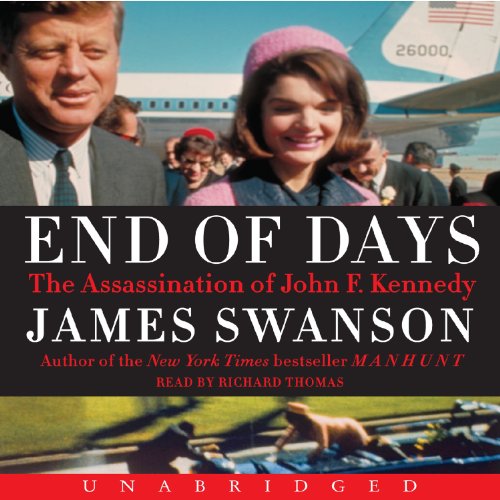
End of Days
Summary
Here, for the first time in decades, is a gripping, minute-by-minute account of the day President John F. Kennedy was shot. In End of Days, James Swanson reveals Lee Harvey Oswald's bizarre history of violence and follows John and Jacqueline Kennedy on their fateful Dallas motorcade ride. Swanson takes us to the sixth-floor Texas Book Depository window to look through Oswald's rifle sights, re-creates the last hours of the doomed assassin, and the day of national mourning for the president that followed, culminating in a funeral that united the country. Combining extensive research with his unparalleled storytelling abilities, Swanson turns the events of one of the darkest days of the twentieth century into a pulse-pounding thriller that will remain the definitive account of the assassination for years to come.
©2013 James L. Swanson (P)2013 HarperCollinsPublishers

The Fed and Lehman Brothers
Summary
The bankruptcy of the investment bank Lehman Brothers was the pivotal event of the 2008 financial crisis and the Great Recession that followed. Ever since the bankruptcy, there has been heated debate about why the Federal Reserve did not rescue Lehman in the same way it rescued other financial institutions, such as Bear Stearns and AIG. The Fed's leaders from that time, especially former Chairman Ben Bernanke, have strongly asserted that they lacked the legal authority to save Lehman because it did not have adequate collateral for the loan it needed to survive. Based on a meticulous four-year study of the Lehman case, The Fed and Lehman Brothers debunks the official narrative of the crisis. It shows that in reality, the Fed could have rescued Lehman but officials chose not to because of political pressures and because they underestimated the damage that the bankruptcy would do to the economy. The compelling story of the Lehman collapse will interest anyone who cares about what caused the financial crisis, whether the leaders of the Federal Reserve have given accurate accounts of their actions, and how the Fed can prevent future financial disasters.
©2018 Cambridge University Press (P)2020 Tantor

American Warlords
Summary
American Warlords is the story of the greatest "team of rivals" since the days of Lincoln. In a lifetime shaped by politics, President Franklin D. Roosevelt proved himself a master manipulator of Congress, the press, and the public. But when war in Europe and Asia threatened America's shores, FDR found himself in a world turned upside down, where his friends became his foes, his enemies his allies. To help wage democracy's first "total war", he turned to one of history's most remarkable triumvirates. Henry Stimson, an old-money Republican from Long Island, rallied to FDR's banner to lead the Army as Secretary of War and championed innovative weapons that helped shape our world today. General George C. Marshall argued with Roosevelt over grand strategy, but he built the world's greatest war machine and willingly sacrificed his dream of leading the invasion of Europe that made his protégé, Dwight Eisenhower, a legend. Admiral Ernest J. King, a hard-drinking, irascible fighter who "destroyed" Pearl Harbor in a prewar naval exercise, understood how to fight Japan, but he also battled the army, the air force, Douglas MacArthur, and his British allies as they moved armies and fleets across the globe. These commanders threw off sparks whenever they clashed: generals against politicians, army versus navy. But those sparks lit the fire of victory. During four years of bitter warfare, FDR's lieutenants learned to set aside deep personal, political, and professional differences and pull a nation through the 20th century's darkest days. Encircling Roosevelt's warlords - and sometimes bitterly at odds with them - was a colorful cast of the Second World War's giants: Winston Churchill, MacArthur, Josef Stalin, Eisenhower, Eleanor Roosevelt, and Charles de Gaulle. These and other larger-than-life figures enrich a sweeping story of an era brimming with steel, fire, and blood.
©2015 Jonathan W. Jordan (P)2015 Blackstone Audio, Inc.

The Lies They Tell
Summary
Welcome to the real America, a place you call home but don't yet know! The USA is the world's empire and its actions will influence us all for generations to come. But who are the Americans, the people who make up America? Tuvia Tenenbom travels through America to find out. His wanderings take him across regional frontiers, partisan lines, and socioeconomic boundaries in a fearless quest for the flesh-and-blood American. He visits black ghettos and white gated communities, megachurches and Indian reservations. He schmoozes with robbers who teach him the true meaning of love and meets Jews who dedicate day and night to hatred of their brethren. He finagles his way into a prison where skinheads pray, goes to the Senate - where no senator seems to be working - experiments with drugs on American streets, and ponders the deeper meaning of life with rednecks. He mingles with soldiers who teach him how to invade foreign countries and intellectuals who teach him the beautiful nature of Mother Earth, the goodness of man, and the sadism of the Israeli. The characters he encounters, the adventures he eagerly embraces, and the findings of his journey are always unique and often unexpected.
©2017 Tuvia Tenenbom (P)2017 Tuvia Tenenbom

Building the Future
Summary
Niccolò Machiavelli famously wrote, "There is nothing more difficult to take in hand, more perilous to conduct, or more uncertain in its success than to take the lead in the introduction of a new order of things." That's what this book is about - innovation far more audacious than a new way to find a restaurant or a smartphone you can wear on your wrist. Harvard professor Amy Edmondson and journalist Susan Salter Reynolds explore how to bring into being systems that transform human experience and make the world more livable and sustainable. This demands "big teaming": intense collaboration across professions and industries that may have completely different mind-sets and even be antagonistic to each other. To do this successfully requires practicing new forms of leadership that combine an expansive vision with incremental action - not an easy balance. To reveal how pioneers build the future, Edmondson and Reynolds tell the story of Living PlanIT, an award-winning "smart city" start-up with a breathtakingly ambitious goal: building a showcase high-tech city from scratch to pilot its software. This meant a joint effort spanning a truly disparate group of software entrepreneurs, real estate developers, city government officials, architects, construction companies, and technology corporations. We get to know Living PlanIT's leaders and follow them and their partners through cycles of hope, exhaustion, disillusionment, pragmatism, and renewal. There are powerful lessons here for anyone, in any industry, seeking to transform the world.
©2016 Amy C. Edmondson and Susan Salter Reynolds (P)2016 Amy C. Edmondson and Susan Salter Reynolds

The Impeachment Report
Summary
The official report from the House Intelligence Committee on Donald Trump’s secret pressure campaign against Ukraine, featuring an exclusive introduction by Pulitzer Prize-winning author and biographer Jon Meacham For only the fourth time in American history, the House of Representatives has conducted an impeachment inquiry into a sitting United States president. This landmark document details the findings of the House Intelligence Committee’s historic investigation of whether President Donald J. Trump committed impeachable offenses when he sought to have Ukraine announce investigations of former vice president Joe Biden and his son Hunter. Penetrating a dense web of connected activity by the president, his ambassador Gordon Sondland, his personal attorney Rudolph Giuliani, and many others, this program offers a damning, blow-by-blow account of the president’s attempts to “use the powers of his office to solicit foreign interference on his behalf in the 2020 election” and his subsequent attempts to obstruct the House investigation into his actions. Published here with an introduction offering critical context from best-selling presidential historian Jon Meacham, The Impeachment Report is necessary listening for every American concerned about the fate of our democracy.
©2019 The House Intelligence Committee and Jon Meacham (P)2019 Random House Audio

Just Desserts
Summary
In partnership with Texas Monthly, Katy Vine's "Just Desserts" is now available as an audio download, where the length and timeliness of a podcast meets the high-quality production of a full-length audio program. Mr. and Mrs. Jenkins led a perfectly adequate middle class life in Corsicana, Texas. Mr. Jenkins, Sandy, worked as an accountant at Collin Street Bakery, world-famous for their fruitcakes. Kay, Mrs. Jenkins, was the more outgoing of the two, the one that friends and neighbors actually noticed and didn't mind talking to. Feelings of adequacy and invisibility weighed on Sandy, and were only compounded by his admiration of boss bakery owner, Bob McNutt, a man who reminded him daily that others were respected and were living more luxurious lives than he. One day, Sandy decided to seize a bit of that respect and finer life he admired so much in McNutt for himself. With just a bit of manipulation of the bakery's accounts, Sandy wrote the first of many checks in the company's name to pay for the life of luxury he envisioned was his right. Combining a quintessential tale of living outside one's means with the addiction of committing a crime time and again without getting caught, Katy Vine delivers the hard-to-imagine story of the Jenkinses and their mysterious rise through Corsicana society.
©2016 Katy Vine (P)2018 Random House Audio

A Trial by Jury
Summary
Jury duty happens to everyone. When the call came to Graham Burnett, a young historian, he had a shock in store. A Trial by Jury is his startling account of how performing this familiar civic duty challenged him in ways he never thought possible and turned into one of the most consuming experiences of his life. Burnett begins with the story of the trial: a body with multiple stab wounds found in a New York apartment, intimations of cross-dressing, male prostitution, mistaken identity. And then, the unexpected drama: Burnett finds himself appointed the foreman, with the responsibility of leading the increasingly frenetic deliberations within the black box of the jury room. Soon he is sequestered - which is to say marooned - with 11 others, a group of people who view their task, and often one another, with palpable distaste. Among his colleagues: a vacuum-cleaner repairman cum urban missionary, a young actress, and a man apparently floundering in a borderland between real life and daytime television. As Burnett steers the contentious politics of their temporary no-exit society toward the verdict, he undergoes an unexpected awakening. Having been plucked from his cozy nest in the world of books and ideas and then plunged into the netherworld of lurid crime, he learns the limits of what intellect alone can accomplish in the real world. Above all, Burnett discovers firsthand the terrifying ultimate power of the state and the agonies of being asked to do justice within the rigid dictates of the law. Part true crime, part political treatise, part contemplation of right, wrong, and the power of words, A Trial by Jury is a mesmerizing narrative of one man's encounter with crime and punishment, American style. It profoundly affects one's sense of the privileges - and the perils - of citizenship.
©2001 D. Graham Burnett (P)2001 Random House Inc., Random House AudioBooks, a Division of Random House Inc.

Liberty's First Crisis
Summary
When the United States government passed the Bill of Rights in 1791, its uncompromising protection of speech and of the press were unlike anything the world had ever seen before. But by 1798, the once-dazzling young republic of the United States was on the verge of collapse: partisanship gripped the weak federal government, British seizures threatened American goods and men on the high seas, and war with France seemed imminent as its own democratic revolution deteriorated into terror. Suddenly, the First Amendment, which protected harsh commentary of the weak government, no longer seemed as practical. So that July, President John Adams and the Federalists in control of Congress passed an extreme piece of legislation that made criticism of the government and its leaders a crime punishable by heavy fines and jail time. In Liberty's First Crisis, writer Charles Slack tells the story of the 1798 Sedition Act, the crucial moment when high ideals met real-world politics and the country's future hung in the balance. From a loudmouth in a bar to a firebrand politician to Benjamin Franklin's own grandson, those victimized by the Sedition Act were as varied as the country's citizenry. But Americans refused to let their freedoms be so easily dismissed: they penned fiery editorials, signed petitions, and raised "liberty poles," while Vice President Thomas Jefferson and James Madison drew up the infamous Kentucky and Virginia Resolutions, arguing that the Federalist government had gone one step too far. Liberty's First Crisis vividly unfolds these pivotal events in the early life of the republic, as the Founding Fathers struggled to define America off the page and preserve the freedoms they had fought so hard to create.
©2015 Charles Slack. Recorded by arrangement with Grove Atlantic, Inc. (P)2015 Audible Inc.

Universal Basic Income
Summary
Who benefits from Universal Basic Income - and who pays for it? Learn everything you need to know about UBI in this short book! Buy this Universal Basic Income guide now to learn: What is UBI? Why is UBI so controversial? Who benefits from Universal Basic Income, and who pays for it? The history of UBI What UBI means for capitalism and a free market economy What UBI means for developing economies The outcome of UBI experiments in the USA, Kenya, India, Finland, and the Netherlands Positive and negative impacts of UBI and arguments for and against What UBI means for America in the 2020 Presidential Election Don't be left out of political discussions about UBI; get the facts fast in this book now. Scroll up and click "Buy" to learn everything you need to know about Universal Basic Income!
©2020 Mark Gates (P)2020 Mark Gates

Cool War
Summary
A bold and thought-provoking look at the future of U.S.-China relations, and how their coming power struggle will reshape the competitive playing field for nations around the world The Cold War seemingly ended in a decisive victory for the West. But now, Noah Feldman argues, we are entering an era of renewed global struggle: the era of Cool War. Just as the Cold War matched the planet’s reigning superpowers in a contest for geopolitical supremacy, so this new age will pit the United States against a rising China in a contest for dominance, alliances, and resources. Already visible in Asia, the conflict will extend to the Middle East (U.S.-backed Israel versus Chinese-backed Iran), Africa, and beyond. Yet this Cool War differs fundamentally from the zero-sum showdowns of the past: The world’s major power and its leading challenger are economically interdependent to an unprecedented degree. Exports to the U.S. account for nearly a quarter of Chinese trade, while the Chinese government holds 8 percent of America’s outstanding debt. This positive-sum interdependence has profound implications for nations, corporations, and international institutions. It makes what looked to be a classic contest between two great powers into something much more complex, contradictory, and badly in need of the shrewd and carefully reasoned analysis that Feldman provides. To understand the looming competition with China, we must understand the incentives that drive Chinese policy. Feldman offers an arresting take on that country’s secretive hierarchy, proposing that the hereditary & “princelings” who reap the benefits of the complicated Chinese political system are actually in partnership with the meritocrats who keep the system full of fresh talent and the reformers who are trying to root out corruption and foster government accountability. He provides a clear-eyed analysis of the years ahead, showing how China’ss rise presents opportunities as well as risks. Robust competition could make the U.S. leaner, smarter, and more pragmatic, and could drive China to greater respect for human rights. Alternatively, disputes over trade, territory, or human rights could jeopardize the global economic equilibrium – or provoke a catastrophic “hot war” that neither country wants. The U.S. and China may be divided by political culture and belief, but they are also bound together by mutual self-interest. Cool War makes the case for competitive cooperation as the only way forward that can preserve the peace and make winners out of both sides.
©2013 Noah Feldman (P)2013 Random House

QAnon
Summary
Have you ever heard about conspiracy theories? Do you want to learn more about them? If yes, then keep reading! Some of the popular conspiracy theories include the fake walking on the moon, and assassination and deaths of politicians, famous TV personalities, and famous musicians. There are groups of people who develop these kinds of theories and are backed with facts and data. One of the largest and currently getting an audience and attention is QAnon. QAnon is a conspiracy theory about what they call the Deep State. They are an anonymous, organized community of believers who embrace unsubstantiated beliefs. They are waiting for two significant events: the Storm and the Great Awakening. They post about conspiracy theories regarding world news and issues. The first post about QAnon came from an unidentified person who the believers call “Q". Many believe that Q is a high-ranking official in the government of the United States. It is also believed that Q is acquainted with President Donald Trump. It is also thought that the main antagonist of QAnon is Barack Obama, who is a democrat. Throughout human history, a recurring theme has emerged repeatedly; when human beings lack an explanation, they will make one up. Hundreds of myths exist to explain scientific phenomena, from why there are stars in the sky to why the human body gets sick. This audiobook covers the following topics: What is the story of QAnon? The antagonist of QAnon The QAnon conspiracy theory When did the QAnon conspiracy theory begin? What are the basic tenets of the QAnon conspiracy theory? And much more! This audiobook contains everything you need to know generally about conspiracy theories and specifically about the now extremely popular QAnon movement. Ready to get started? Click “Buy Now”!
©2020 Donald Jones (P)2020 Donald Jones

Walter Ralegh
Summary
From a Bancroft Prize-winning historian, a biography of the famed poet, courtier, and colonizer, showing how he laid the foundations of the English Empire Sir Walter Ralegh was a favorite of Queen Elizabeth. She showered him with estates and political appointments. He envisioned her becoming empress of a universal empire. She gave him the opportunity to lead the way. In Walter Ralegh, Alan Gallay shows that, while Ralegh may be best known for founding the failed Roanoke colony, his historical importance vastly exceeds that enterprise. Inspired by the mystical religious philosophy of hermeticism, Ralegh led English attempts to colonize in North America, South America, and Ireland. He believed that the answer to English fears of national decline resided overseas - and that colonialism could be achieved without conquest. Gallay reveals how Ralegh launched the English Empire and an era of colonization that shaped Western history for centuries after his death. PLEASE NOTE: When you purchase this title, the accompanying PDF will be available in your Audible Library along with the audio.
©2019 Alan Gallay (P)2019 Basic Books

Zombie Banks
Summary
An in-depth look at the essential issues surrounding zombie institutions and their effect on the global economy. Zombie banking has become standard operating procedure for big debtor nations. They prop up failing institutions, print money, and avoid financial corrections. But in an attempt to prolong the inevitable, bigger problems are created. The approach used now has not, and will not, work. This timely book reveals why. Zombie Banks tells the story of how debtor nations and failing institutions are damaging the long-term prospects of the global economy. Author Yalman Onaran, a veteran Bloomberg News reporter and financial banking-sector expert, examines exactly what a zombie bank is and why they are kept alive. He also discusses how they hurt economic recovery and what needs to be done in order to restore stability. Along the way, Onaran takes an honest look at how we arrived at this point and details the harsh realities that must be faced, and the serious steps that must be taken, in order to get things headed in the right direction. Puts insolvent banks and debtor nations in the spotlight and examines how they are crippling the global economy On the record sources include Paul Volcker, Joseph Stiglitz, Sheila Bair, and many more bank executives, regulators, politicians, and policymakers in the United States and abroad Takes the complexity of the current situation and translates it in a way that makes it understandable While the short-term measures taken to stave off depression and rejuvenate economic growth may offer hope, they are unsustainable over the long term. Get a better look at what really lies ahead, and what it will take to improve our economic situation, with this book. PLEASE NOTE: When you purchase this title, the accompanying PDF will be available in your Audible Library along with the audio.
©2011 Yalman Onaran (P)2011 Gildan Media

Robert Berdella: The True Story of a Man Who Turned His Darkest Fantasies into a Reality
Summary
One man's Robert Berdella is another's Kansas City Butcher. We may not always see what truly hides within the minds and hearts of certain people, and where we believe is a good, pure individual, lays a terrible murderer capable of the most horrible acts. Robert Berdella was one such man, a helpful and friendly individual who - in a spree separated by a few years - managed to capture and horrifically torture seven young men, murdering six along the way. Control and dominance were his tools, pain was his method. The Kansas City Butcher had no mercy, and his victims soon learned that he had no limits in terms of defiling or humiliating their bodies, minds, and spirits once they were bound and gagged. Robert Berdella: The True Story of a Man Who Turned His Darkest Fantasies into a Reality is an audiobook that recounts the tale of the Kansas City Butcher, a man capable of committing the most truly degrading acts on his victims, a monster who will never be forgotten by the families of those young men whose lives he destroyed. Be warned listener, you aren't just about to listen to an audiobook about Bob Berdella and his acts. You are about to walk into his very mind.
©2017 Ryan Becker (P)2017 Ryan Becker

Making Globalization Work
Summary
Four years after he outlined the challenges our increasingly interdependent world was facing in Globalization and Its Discontents, Joseph E. Stiglitz offered his agenda for reform. Now in audiobook, Making Globalization Work offers inventive solutions to a host of problems, including the indebtedness of developing countries, international fiscal instability, and worldwide pollution. Stiglitz also argues for the reform of global financial institutions, trade agreements, and intellectual property laws, to make them better able to respond to the growing disparity between the richest and poorest countries. Now more than ever before, globalization has gathered the peoples of the world into one community, bringing with it a need to think and act globally. This trenchant, intellectually powerful book is an invaluable step in that process.
©2007, 2006 Joseph E. Stiglitz (P)2013 Audible, Inc.

The King Years
Summary
The essential moments of the civil rights movement are introduced and set in historical context by the author of the magisterial America in the King Years trilogy: Parting the Waters, Pillar of Fire, and At Canaan's Edge. Taylor Branch's three-volume history endures as a masterpiece of storytelling on American race, violence, and democracy. With this brief volume, which brings to life the pivotal scenes, he relates the dramatic story of how the movement evolved from a bus strike to a political revolution, and brings this historic achievement to a wider audience.
©2013 Taylor Branch (P)2013 Simon & Schuster

Perilous Bounty
Summary
Bloomsbury presents Perilous Bounty by Tom Philpott, read by Eric Meyers. An unsettling journey into the United States' disaster-bound food system, and an exploration of possible solutions, from leading food politics commentator and farmer-turned-journalist Tom Philpott. More than a decade after Michael Pollan's game-changing The Omnivore's Dilemma transformed the conversation about what we eat, a combination of global diet trends and corporate interests have put American agriculture into a state of 'quiet emergency', from dangerous drought in California - which grows more than 50 percent of the fruits and vegetables we eat - to catastrophic topsoil loss in the 'breadbasket' heartland of the United States. Whether or not we take heed, these urgent crises of industrial agriculture will define our future. In Perilous Bounty, veteran journalist and former farmer Tom Philpott explores and exposes the small handful of seed and pesticide corporations, investment funds and magnates who benefit from the trends that imperil us, with on-the-ground dispatches featuring the scientists documenting the damage and the farmers and activists who are valiantly and inventively pushing back. Resource scarcity looms on the horizon, but rather than pointing us towards an inevitable doomsday, Philpott shows how the entire wayward ship of American agriculture could be routed away from its path to disaster. He profiles the farmers and communities in the nation's two key growing regions developing resilient, soil-building, water-smart farming practices and readying for the climate shocks that are already upon us; and he explains how we can help move these methods from the margins to the mainstream.
©2020 Tom Philpott (P)2020 Bloomsbury Publishing Plc

The Heart of a Great Nation
Summary
With a foreword from Senator Marco Rubio, a stirring collection of Ronald Reagan's most inspiring speeches, offering his timeless wisdom and guidance for our day. In his 1989 farewell address, Ronald Reagan said, "I wasn't a great communicator, but I communicated great things, and they didn't spring full bloom from my brow, they came from the heart of a great nation - from our experience, our wisdom, and our belief in principles that have guided us for two centuries". The Heart of a Great Nation brings together Reagan's most powerful speeches, as relevant to our chaotic world as they were when he first gave them. In a period of our country's history consumed by economic stagnation, national instability, and the looming threat of communism, Reagan spoke directly to the hearts of everyday Americans. His wisdom on matters of family, freedom, and nationhood helped guide the country back to its founding principles and ushered in an era of prosperity and national pride. Today, as we find our country treading similar ground, Reagan's wisdom speaks to us once again, offering guidance to everyone looking to navigate the present and remember of the legacy of this great nation - which can one day be reclaimed.
©2020 Estate of Ronald Reagan (P)2020 Penguin Audio