Malcolm Hillgartner has narrated 146 audiobooks on Listento.it by 153 authors, with an average listener rating of 4.5★ across 1,567 ratings. The most-rated is The Revisionaries.

American Gangster and Other Tales of New York
Summary
In the 1970s, Frank Lucas was the king of the Harlem drug trade, bringing in over a million dollars a day. He lived a glamorous life, hobnobbing with athletes, musicians, and politicians, but Lucas was a ruthless gangster. He was notorious for using the coffins of dead GIs to smuggle heroin into the United States, and, before being sentenced to 70 years in prison, he played a major role in the near death of New York City. In American Gangster, Mark Jacobson's captivating account of the life of Frank Lucas joins other tales of New York City from the past 30 years. The collection features a number of Jacobson's most famous essays, as well as previously unpublished works and more recent articles. Together, they create a vibrant, many-layered portrait of the most fascinating city in the world, by one of the most acclaimed journalists of our time.
©2007 Mark Jacobson (P)2007 Blackstone Audio Inc.

The Last Warrior
Summary
Andrew Marshall is a Pentagon legend. For more than four decades he has served as Director of the Office of Net Assessment, the Pentagon's internal think tank, under 12 defense secretaries and eight administrations. Yet Marshall has been on the cutting edge of strategic thinking even longer than that. At the Rand Corporation during its golden age in the 1950s and early 1960s, Marshall helped formulate bedrock concepts of US nuclear strategy that endure to this day; later, at the Pentagon, he pioneered the development of "net assessment" - a new analytic framework for understanding the long-term military competition between the United States and the Soviet Union. Following the Cold War, Marshall successfully used net assessment to anticipate emerging disruptive shifts in military affairs, including the revolution in precision warfare and the rise of China as a major strategic rival of the United States. In The Last Warrior, Andrew Krepinevich and Barry Watts - both former members of Marshall's staff - trace Marshall's intellectual development from his upbringing in Detroit during the Great Depression to his decades in Washington as an influential behind-the-scenes advisor on American defense strategy. The result is a unique insider's perspective on the changes in US strategy from the dawn of the Cold War to the present day. Covering some of the most pivotal episodes of the last half century and peopled with some of the era's most influential figures, The Last Warrior tells Marshall's story for the first time, in the process providing an unparalleled history of the evolution of the American defense establishment.
©2015 Andrew F. Krepinevich, Barry D. Watts (P)2015 Blackstone Audio, Inc.

Dancing in the Dark
Summary
Hailed as one of the best books of 2009 by the New York Times and the Los Angeles Times, this vibrant portrait of 1930s culture masterfully explores the anxiety and hope, the despair and surprising optimism of distressed Americans during the Great Depression. Morris Dickstein, whom Norman Mailer called “one of our best and most distinguished critics of American literature,” has brought together a staggering range of material, from epic Dust Bowl migrations to zany screwball comedies, elegant dance musicals, wildly popular swing bands, and streamlined art deco designs. Exploding the myth that Depression culture was merely escapist, Dickstein concentrates on the dynamic energy of the arts and the resulting lift they gave to the nation's morale. A fresh and exhilarating analysis of one of America's most remarkable artistic periods, with Dancing in the Dark Dickstein delivers a monumental critique.
©2009 Morris Dickstein (P)2010 Blackstone Audio, Inc.

The (Other) You
Summary
A powerful reckoning over the people we might have been if we’d chosen a different path, from a master of the short story In this stirring, reflective collection of short stories, Joyce Carol Oates ponders alternate destinies: the other lives we might have led if we’d made different choices. An accomplished writer returns to her childhood home of Yewville, but the homecoming stirs troubled thoughts about the person she might have been if she’d never left. A man in prison contemplates the gravity of his irreversible act. A student’s affair with a professor results in a pregnancy that alters the course of her life forever. Even the experience of reading is investigated as one that can create a profound transformation: “You could enter another time, the time of the book." The (Other) You is an arresting and incisive vision into these alternative realities, a collection that ponders the constraints we all face given the circumstances of our birth and our temperaments, and that examines the competing pressures and expectations on women in particular. Finely attuned to the nuances of our social and psychic selves, Joyce Carol Oates demonstrates here why she remains one of our most celebrated and relevant literary figures.
©2021 Joyce Carol Oates (P)2021 HarperCollins Publishers

Earthquake Storms
Summary
The lives of millions will be changed after it breaks, and yet so few people understand it, or even realize it runs through their backyard. Dvorak reveals the San Andreas Fault's fascinating history - and its volatile future. It is a prominent geological feature that is almost impossible to see unless you know where to look. Hundreds of thousands of people drive across it every day. The San Andreas Fault is everywhere - and primed for a colossal quake. For decades scientists have warned that such a sudden shifting of the Earth's crust is inevitable. In fact, it is a geologicn ecessity. The San Andreas Fault runs almost the entire length of California, from the redwood forest to the east edge of the Salton Sea. Along the way, it passes through two of the largest urban areas of the country - San Francisco and Los Angeles. Dozens of major highways and interstates cross it. Scores of housing developments have been planted over it. The words San Andreas are so familiar today that they have become synonymous with earthquake. Yet few people understand the San Andreas or the network of subsidiary faults it has spawned. Some run through Hollywood, others through Beverly Hills and Santa Monica. The Hayward Fault slices the football stadium at the University of California in half. Even among scientists, few appreciate that the San Andreas Fault is a transient, evolving system that, as seen today, is younger than the Grand Canyon and key to our understanding of earthquakes worldwide.
©2014 John Dvorak (P)2014 Blackstone Audio

One Brief Shining Moment
Summary
William Manchester was friends with John F. Kennedy for two decades before the President's assassination. In this work, the best-selling author of Portrait of a President and The Death of a President puts aside the tragedy of JFK's death to celebrate the brightness of his life. Manchester recalls in intimate detail everything from family gatherings at Hyannis Port, to grueling campaign trips, and quiet evenings alone with the president in the White House family quarters. The resulting portrait provides listeners with myriad anecdotes and insights into a life of a man that bristled with vigor, competitiveness, and an unflagging drive for excellence, and shone with elegance, intelligence, and compassion. The book was important when it was first published, but now fills a new role as an antidote to the wave of political disillusionment in America.
©2016 William Manchester (P)2016 Blackstone Audio, Inc.

Native Blood
Summary
The ritual killing of a young Apache girl on a reservation in rural Arizona takes the listener through many complex layers of relationships between Apache and Anglo cultures. The myth and spiritual fabric of the Apache community pulls Zeb Hanks, a small town sheriff, through a personal journey, making the murder not just a crime to solve but a cathartic passage. The dead never leave us but they do whisper ghost stories that bring the past back to life. Jake Dablo is a drunken, washed up lawman because of his inability to solve the murder of his only granddaughter. Seven years after her death the granddaughter of his lifelong friend, Medicine Man Jimmy Song Bird, is murdered in exactly the same ritualistic fashion. The pair join forces with the current sheriff's team to solve the murders. The closer to the truth they get the more each man grapples with his own conscience. Ultimately the intersection of two cultures and four men who are community pillars opens larger questions about the collision of the old and new west. When the dead are buried and the ghosts finally die, each character is not the same. For they have lived each day of their life knowing that a murderer and his mark opens as many doors as it closes.
©2012 Mark Reps (P)2018 Tantor

The Reagan I Knew
Summary
In The Reagan I Knew, the late William F. Buckley Jr. offers a reminiscence of 30 years of friendship with the man who brought the American conservative movement out of the political wilderness and into the White House. Reagan and Buckley were political allies and close friends throughout Reagan's political career. They went on vacations together and shared inside jokes. For all the words that have been written about him, Ronald Reagan remains an enigma. His former speechwriter Peggy Noonan called him "paradox all the way down," and even his son despaired of ever truly knowing him. But Reagan was not an enigma to William F. Buckley Jr. They understood and taught each other for decades, and together they changed history.
©2008 The Estate of William F. Buckley Jr. (P)2008 Blackstone Audio, Inc.

21st Century Dead
Summary
The Stoker Award-winning editor of the acclaimed, eclectic anthology The New Dead returns with 21st Century Dead and an all-new lineup of authors from every corner of the fiction world, shining a dark light on our fascination with tales of death and resurrection - and with zombies! The stellar stories in this volume include a tale set in the world of Daniel H. Wilson’s Robopocalypse, the first published fiction by Sons of Anarchy creator Kurt Sutter, and a tale of love, family, and resurrection from the legendary Orson Scott Card. This new volume also includes stories from other award-winning and New York Times best-selling authors, such as Simon R. Green, Chelsea Cain, Jonathan Maberry, Duane Swiercyznski, Caitlin Kittredge, Brian Keene, Amber Benson, John Skipp, S. G. Browne, Thomas E. Sniegoski, Hollywood screenwriter Stephen Susco, National Book Award nominee Dan Chaon, and others. The complete list of narrators includes Scott Brick, Cassandra Campbell, Bernadette Dunne, Paul Michael Garcia, Kirby Heyborne, Malcolm Hillgartner, Chris Patton, John Pruden, Renée Raudman, Stefan Rudnicki, Sean Runnette, Simon Vance, and Tom Weiner. "Zombies Are Good for You: An Introduction" © 2012 by Christopher Golden. "Biters" © 2012 by Mark Morris. "Why Mothers Let Their Babies Watch Television: A Just-So Horror Story" © 2012 by Verite, Inc. "Carousel" © 2012 by Orson Scott Card. "Reality Bites" © 2012 by S. G. Browne. "The Drop" © 2012 by Stephen Susco. "Antiparallelogram" © 2012 by Amber Benson. "How We Escaped Our Certain Fate" © 2012 by Dan Chaon. "A Mother’s Love" © 2012 by John M. McIlveen. "Down and Out in Dead Town" © 2012 by Simon R. Green. "Devil Dust" © 2012 by Caitlin Kittredge. "The Dead of Dromore" © 2012 by Ken Bruen. "All the Comforts of Home: A Beacon Story" © 2012 by John Skipp and Cody Goodfellow. "Ghost Dog & Pup: Stay" © 2012 by Thomas E. Sniegoski. "Tic Boom: A Slice of Love" © 2012 by Mad/Doll, Inc. "Jack and Jill" © 2012 by Jonathan Maberry. "Tender as Teeth" © 2012 by Stephanie Crawford and Duane Swierczynski. "Couch Potato" © 2012 by Brian Keene. "The Happy Bird and Other Tales" © 2012 by Rio Youers. "Parasite" © 2012 by Daniel H. Wilson.
©2012 Christopher Golden (P)2012 Blackstone Audio, Inc.

It All Adds Up
Summary
In this collection of more than 30 essays, published in the New York Times, Esquire, and the New Republic, the vast range of Saul Bellow’s nonfiction is made abundantly clear. In Bellow’s capable hands, a single essay can range fluidly across topics as various as the talents of President Roosevelt, the economic narrative of Jay Gatsby, and childhood adventures in Chicago. This rich mix of literary, political, and personal musings allows Bellow to explore subjects as enormous as the writer’s search for truth, and as minute as the discomforts of a French doctors’ office. Traveling from Washington to Spain to the Sinai Peninsula, and profiling friends and characters such as John Cheever and John Berryman, Bellow is keenly focused and perceptive. This collection, spanning a lifetime of thought and debate, presents provocative arguments and erudite literary criticism, all with the wry humor of a great storyteller. In It All Adds Up, Bellow turns his view away from the sparkling characters of his novels, and toward the conditions and qualities of his own experience of writing and living.
©1948, 1955, 1956, 1957, 1960, 1961, 1962, 1970, 1973, 1974, 1975, 1979, 1983, 1990, 1991, 1992, 1993, 1994 by Saul Bellow. © renewed 1976, 1983, 1984, 1985, 1988, 1989, 1990 Saul Bellow (P)2019 Blackstone Publishing

Shadows at Dawn
Summary
A masterful reconstruction of one of the worst Indian massacres in American history. In April 1871, a group of Americans, Mexicans, and Tohono O'odham Indians surrounded an Apache village at dawn and murdered nearly 150 men, women, and children in their sleep. In the past century, the attack, which came to be known as the Camp Grant Massacre, has largely faded from memory. Now, drawing on oral histories, contemporary newspaper reports, and the participants' own accounts, prizewinning author Karl Jacoby brings this perplexing incident and tumultuous era to life to paint a sweeping panorama of the American Southwest - a world far more complex, diverse, and morally ambiguous than the traditional portrayals of the Old West.
©2019 Karl Jacoby (P)2019 Blackstone Audio, Inc.

Unintended Consequences
Summary
In the aftermath of the financial crisis, many commonly held beliefs have emerged to explain its cause. Conventional wisdom blames Wall Street and the mortgage industry for using low down payments, teaser rates, and other predatory tactics to seduce unsuspecting home owners into assuming mortgages they couldn’t afford. It blames average Americans for borrowing recklessly and spending too much. And it blames the tax policies and deregulatory environment of the Reagan and Bush administrations for encouraging reckless risk taking by wealthy individuals and financial institutions. But according to Unintended Consequences, the conventional wisdom masks the real causes of our economic disruption and puts us at risk of a slew of unintended—and potentially dangerous—consequences. Unintended Consequences is not a book that takes a couple of insights and expands them into 300 pages; rather, it covers the entire scope of the economy. It’s a fascinating and contrarian case for how the economy really works, what went wrong over the past decade, and what steps we can take to start growing again. Whether you agree with the book’s provocative and counterintuitive conclusions or not, Unintended Consequences will reward you with a sophisticated understanding of the contemporary economy—one no other book has yet provided. Edward Conard was a partner at Bain Capital from 1993 to 2007. He served as the head of Bain’s New York office and led the firm’s acquisitions of large industrial companies. Prior to that he worked for Wasserstein Perella, an investment bank that specialized in mergers and acquisitions. He lives in New York City.
©2012 Edward Conard (P)2012 Blackstone Audio, Inc.
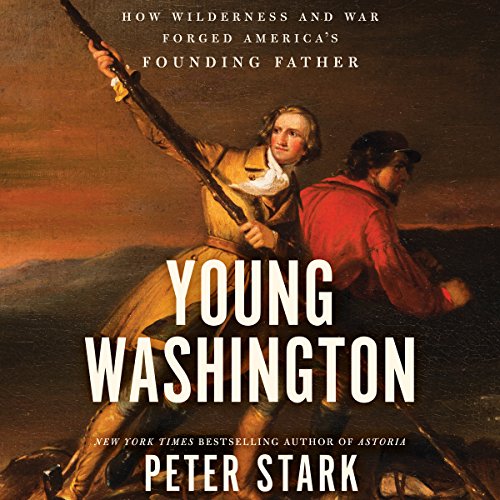
Young Washington
Summary
A vivid and groundbreaking portrait of a young, struggling George Washington that casts a new light on his character and the history of American independence, from the best-selling author of Astoria Two decades before he led America to independence, George Washington was a flailing young soldier serving the British Empire in the vast wilderness of the Ohio Valley. Naive and self-absorbed, the 22-year-old officer accidentally ignited the French and Indian War - a conflict that opened colonists to the possibility of an American Revolution. With powerful narrative drive and vivid writing, Young Washington recounts the wilderness trials, controversial battles, and emotional entanglements that transformed Washington from a temperamental striver into a mature leader. Enduring terrifying summer storms and subzero winters imparted resilience and self-reliance, helping prepare him for what he would one day face at Valley Forge. Leading the Virginia troops into battle taught him to set aside his own relentless ambitions and stand in solidarity with those who looked to him for leadership. Negotiating military strategy with British and colonial allies honed his diplomatic skills. And thwarted in his obsessive, youthful love for one woman, he grew to cultivate deeper, enduring relationships. By weaving together Washington’s harrowing wilderness adventures and a broader historical context, Young Washington offers new insights into the dramatic years that shaped the man who shaped a nation.
©2018 Peter Stark (P)2018 HarperCollins Publishers

Good Hunting
Summary
A master class in spycraft from one of its greatest practitioners.
Jack Devine ran Charlie Wilson's War in Afghanistan. It was the largest covert action of the Cold War, and it was Devine who put the brand-new Stinger missile into the hands of the mujahideen during their war with the Soviets, paving the way to a decisive victory against the Russians. He also pushed the CIA's effort to run down the narcotics trafficker Pablo Escobarin Colombia. He tried to warn the director of central intelligence, George Tenet, that there was a bullet coming from Iraq with his name on it. He was in Chile when Allende fell, and he had too much to do with Iran-Contra for his own taste, though he tried to stop it. He also tangled with Rick Ames, the KGB spy inside the CIA, and hunted Robert Hanssen, the mole in the FBI.
Good Hunting: An American Spymaster's Story is the spellbinding memoir of Devine's time in the CIA, where he served for more than 30 years, rising to become the acting deputy director of operations, responsible for all of the agency's spying operations. This is a story of intrigue and high-stakes maneuvering - all the more gripping when the fate of our geopolitical order hangs in the balance. But this audiobook also sounds a warning to our nation's decision makers: covert operations, not costly and devastating full-scale interventions, are the best safeguard of America's interests worldwide.
Part memoir, part historical redress, Good Hunting debunks some of the myths surrounding the agency and cautions against its misuses. Beneath the exotic allure - living abroad, running operations in seven countries, serving successive presidents from Nixon to Clinton - this is a realist's gimlet-eyed account of the CIA. As Devine sees it, the agency is now trapped within a larger bureaucracy, losing swaths of turf to the military, and most ominous of all, becoming overly weighted toward paramilitary operations after a decade of war.
©2014 Jack Devine (P)2014 Blackstone Audio, Inc.

If You Are Lonely and You Know It
Summary
He tends to his garden and bees. He keeps quiet. He avoids drama. Until one transgression causes an emotional adventure in this heartfelt short story by Yiyun Li, a PEN/Hemingway Award-winning author. Lonely, thanklessly courteous, and without the benefit of status, Gordon Schulmeister is only tolerated in his younger, hip, and gentrified Oakland neighborhood. Now, amid the tensions of a pandemic, the cantankerousness of his landlord, and dog sitting an intimidating pit bull, Gordon has never felt the target on his back so acutely. To keep his neighbors off his heels, with some hope and a sigh, Gordon might have to finally speak up. Yiyun Li’s If You Are Lonely and You Know It is part of Currency, a compounding collection of stories about wealth, class, competition, and collapse. If time is money, deposit here with interest. Read or listen in a single sitting.
©2021 Yiyun Li (P)2020 Brilliance Publishing, Inc., all rights reserved.

American Hannibal
Summary
On January 17, 1781, a remarkable battle took place in the backwoods of South Carolina. British Lt. Colonel Banastre Tarleton, handpicked by General Charles Cornwallis for command due to his dash and record of accomplishment, was opposed by Brigadier General Daniel Morgan, a rough-and-tumble son of the American frontier. Morgan employed a scheme so brilliantly conceived and masterfully executed that within an hour, the British found themselves overwhelmed, enveloped, and routed from the field. In response to this stunning American victory, Cornwallis embarked on a reckless, desperate trek north in pursuit of Morgan - a strategy that ultimately led to his own defeat at Yorktown. In his compelling account of the Battle of Cowpens, Jim Stempel makes the case that Morgan's victory closely mirrors Hannibal's extraordinary triumph at Cannae, regarded by many as one of the greatest military accomplishments of all time. With a narrative style that plunges listeners into the center of the events, American Hannibal will enthrall students of American history and newcomers to the subject alike.
©2017 James Stempel (P)2021 Tantor

Lincoln's Boys
Summary
A timely and intimate look into Abraham Lincoln's White House through the lives of his two closest aides and confidants. Lincoln's official secretaries, John Hay and John Nicolay, enjoyed more access, witnessed more history, and knew Lincoln better than anyone outside of the president's immediate family. Hay and Nicolay were the gatekeepers of the Lincoln legacy. They read poetry and attendeded the theater with the president, commiserated with him over Union army setbacks, and plotted electoral strategy. They were present at every seminal event, from the signing of the Emancipation Proclamation to Lincoln's delivery of the Gettysburg Address - and they wrote about it after his death. In their biography of Lincoln, Hay and Nicolay fought to establish Lincoln's heroic legacy and to preserve a narrative that saw slavery - not states' rights - as the sole cause of the Civil War. As Joshua Zeitz shows, the image of a humble man with uncommon intellect who rose from obscurity to become a storied wartime leader and emancipator is very much their creation. Drawing on letters, diaries, and memoirs, Lincoln's Boys is part political drama and part coming-of-age tale - a fascinating story of friendship, politics, war, and the contest over history and remembrance.
©2014 Joshua Zeitz (P)2014 Penguin Audiobook

Innocent Bystander
Summary
A midway murder sends a terrified eyewitness running for her life - from a cop, a con, and her own secrets - in this mystery by the author of the John J. Malone series. The best carnival barker in the business couldn’t have drawn a crowd like the one now gathered around the Ferris wheel on the pier. In one of the cabs, still rocking with the ocean breeze, is a dead man - a bloody knife protruding from his back. Why the notorious gambling boss Jerry McGurn was killed is no mystery. Who did it is. And there’s only one probable witness to the crime. As bystanders go, Ellen Haven comes across as innocent: pretty enough, plus her blue eyes well up with tears at the mere mention of something as awful as murder. Homicide detective Art Smith wants to believe she didn’t see a thing. Why would she lie? Then again, why else would she suddenly vanish? And Smith isn’t the only one looking for her; so is a brutal ex-con, fresh out of San Quentin, with a score to settle. Smith knows he’d better find her first, but Ellen is leading both men into a hall of mirrors where illusions of guilt and innocence can shatter with a single gunshot. A former crime reporter, Craig Rice was “the first writer of detective fiction to make the cover of Time magazine. Her hardcover sales figures matched those of her bestselling contemporaries Rex Stout, Ellery Queen, Erle Stanley Gardner, and Raymond Chandler. She’s worth remembering” (Jon L. Breen, Edgar Award-winning author).
©1949 Craig Rice (P)2021 Blackstone Publishing

American Warlords
Summary
American Warlords is the story of the greatest "team of rivals" since the days of Lincoln. In a lifetime shaped by politics, President Franklin D. Roosevelt proved himself a master manipulator of Congress, the press, and the public. But when war in Europe and Asia threatened America's shores, FDR found himself in a world turned upside down, where his friends became his foes, his enemies his allies. To help wage democracy's first "total war", he turned to one of history's most remarkable triumvirates. Henry Stimson, an old-money Republican from Long Island, rallied to FDR's banner to lead the Army as Secretary of War and championed innovative weapons that helped shape our world today. General George C. Marshall argued with Roosevelt over grand strategy, but he built the world's greatest war machine and willingly sacrificed his dream of leading the invasion of Europe that made his protégé, Dwight Eisenhower, a legend. Admiral Ernest J. King, a hard-drinking, irascible fighter who "destroyed" Pearl Harbor in a prewar naval exercise, understood how to fight Japan, but he also battled the army, the air force, Douglas MacArthur, and his British allies as they moved armies and fleets across the globe. These commanders threw off sparks whenever they clashed: generals against politicians, army versus navy. But those sparks lit the fire of victory. During four years of bitter warfare, FDR's lieutenants learned to set aside deep personal, political, and professional differences and pull a nation through the 20th century's darkest days. Encircling Roosevelt's warlords - and sometimes bitterly at odds with them - was a colorful cast of the Second World War's giants: Winston Churchill, MacArthur, Josef Stalin, Eisenhower, Eleanor Roosevelt, and Charles de Gaulle. These and other larger-than-life figures enrich a sweeping story of an era brimming with steel, fire, and blood.
©2015 Jonathan W. Jordan (P)2015 Blackstone Audio, Inc.

The Order of the Day
Summary
Winner of the 2017 Prix Goncourt, this eye-opening account of the muddled forces at work behind the Anschluss brilliantly dismantles the myth of a glorious and inevitable Nazi victory. February 20, 1933: on an unremarkable day during a harsh Berlin winter, a meeting of twenty-four German captains of industry and senior Nazi dignitaries is being held in secret in the plush lounges of the Reichstag. They are there to "stump up" funding for the accession to power of the National Socialist Party and its fearsome Chancellor. This inaugural scene sets the tone of consent which will lead to the worst possible repercussions. March 12, 1938: the annexation of Austria is on the agenda and a grotesque day ensues that is intended to make history: the newsreels capture for eternity a motorized army, a terrible, inexorable power. But behind Goebbels's splendid propaganda, it is an ersatz Blitzkrieg which unfolds, the Panzers breaking down en mass on the roads of Austria. The true behind-the-scenes story of the Anschluss - a patchwork of minor shows of strength and fine words, a string of fevered telephone calls and vulgar threats - reveals a starkly different picture: it is no longer strength of character or the determination of a people that wins the day, but rather a combination of intimidation and bluff. With this vivid, compelling history, Éric Vuillard warns against the perils of willfully blind acquiescence, and offers a crucial reminder that, ultimately, the worst is not inescapable.
©2018 Actes Sud. (P)2018 Brilliance Publishing, Inc., all rights reserved. Translation © 2018 by Mark Polizzotti.