Rob Shapiro has narrated 102 audiobooks on Listento.it by 105 authors, with an average listener rating of 4.5★ across 2,600 ratings. The most-rated is The Rooster Bar.

The Game
Summary
Victor the assassin is living a solitary, peaceful life in Iceland when he's drawn into a job for an unidentified Swiss broker. Having passed the test, he's introduced to a group of mercenaries and killers who are tasked to perform the ultimate assassination.In this group, Victor meets someone from his past, someone who recruited him to the life he now knows-someone he thought was dead. And when he wants out, it's too late-his former mentor has other plans for him...
©2013 Tom Hinshelwood (P)2013 Tantor

A Time to Die
Summary
It's not how long you'll live.... Now that professional assassin Victor is indentured to British Intelligence, he is tasked with eliminating the worst of the worst. One such man is Milan Rados, a former Serbian paramilitary commander wanted for war crimes and now head of an organized criminal network in Belgrade. He has escaped justice once already, so it's Victor's job to take the justice to him. It's how soon they'll die. Victor might be the best in the business, but with powerful friends and an entire crew to protect him, Rados is a hard man to corner and even harder to kill. To get close to his target, Victor will need more than his deadly skills. An unlikely ally can provide him with the edge he seeks, but there's a price on Victor's head - and a killer who won't quit knows just how to find him....
©2016 Tom Hinshelwood (P)2016 Tantor

No Tomorrow
Summary
When Victor is called to meet with an old friend who ultimately betrayed him, what he thought was an ambush is in fact a plea for help. As a Russian gangster, Norimov is accustomed to death threats, but now an unknown enemy wants more than his life. They intend to kill everyone he cares about, including his missing daughter Gisele. This time, Victor's job is not to kill but to protect. Unfortunately, locating Gisele is his first mistake - because someone is watching his every move. Before she went into hiding, Gisele had uncovered a secret worth killing for - and now Victor has brought the enemy right to her doorstep. The least he can do is help her escape. But the ruthless network they're up against has the police, MI-5, and every major news outlet joining in the manhunt across London.
©2014 Tom Hinshelwood (P)2014 Tantor

Making Faces
Summary
Ambrose Young was beautiful. He was tall and muscular, with hair that touched his shoulders and eyes that burned right through you. The kind of beautiful that graced the covers of romance novels, and Fern Taylor would know. She'd been reading them since she was 13. But maybe because he was so beautiful he was never someone Fern thought she could have...until he wasn't beautiful anymore. Making Faces is the story of a small town where five young men go off to war, and only one comes back. It is the story of loss. Collective loss, individual loss, loss of beauty, loss of life, loss of identity. It is the tale of one girl's love for a broken boy and a wounded warrior's love for an unremarkable girl. This is a story of friendship that overcomes heartache, heroism that defies the common definitions, and a modern tale of Beauty and the Beast, where we discover that there is a little beauty and a little beast in all of us.
©2013 Amy Harmon (P)2014 Tantor

King
Summary
Homeless. Hungry. Desperate. Doe has no memories of who she is or where she comes from. A notorious career criminal just released from prison, King is someone you don't want to cross unless you're prepared to pay him back in blood, sweat, sex, or a combination of all three. King's future hangs in the balance. Doe's is written in her past. When they come crashing together, they will have to learn that sometimes in order to hold on, you have to first let go.
©2015 T. M. Frazier (P)2015 Tantor

Arguing with Zombies
Summary
An accessible, compelling introduction to today’s major policy issues from the New York Times columnist, best-selling author, and Nobel prize-winning economist Paul Krugman. There is no better guide than Paul Krugman to basic economics, the ideas that animate much of our public policy. Likewise, there is no stronger foe of zombie economics, the misunderstandings that just won’t die. In Arguing with Zombies, Krugman tackles many of these misunderstandings, taking stock of where the United States has come from and where it’s headed in a series of concise, digestible chapters. Drawn mainly from his popular New York Times column, they cover a wide range of issues, organized thematically and framed in the context of a wider debate. Explaining the complexities of health care, housing bubbles, tax reform, Social Security, and so much more with unrivaled clarity and precision, Arguing with Zombies is Krugman at the height of his powers. Arguing with Zombies puts Krugman at the front of the debate in the 2020 election year and is an indispensable guide to two decades’ worth of political and economic discourse in the United States and around the globe. Krugman turns his listeners into intelligent consumers of the daily news and hands them the keys to unlock the concepts behind the greatest economic policy issues of our time. In doing so, he delivers an instant classic that can serve as a reference point for this and future generations. This audiobook includes a bonus PDF of diagrams from the book. PLEASE NOTE: When you purchase this title, the accompanying PDF will be available in your Audible Library along with the audio.
©2020 Paul Krugman (P)2020 Random House Audio

Tyrant
Summary
I remember everything, only now I wish I didn't. When the fog is sucked away from my mind like smoke through a vacuum, the truth that has been beyond my reach for months finally reveals itself. But the relief I thought I would feel never comes, and I'm more afraid now than I was the morning I woke up handcuffed in King's bed. Because with the truth comes dark secrets I was never meant to know. I don't know if I'm strong enough to resist the magnetic pull toward King that grows stronger every day. He's already saved me in more ways than one. Now it's my turn to do whatever it takes to save him, even if that means marrying someone else.
©2015 T. M. Frazier (P)2015 Tantor

The Outpost
Summary
At 6:00 a.m. on the morning of October 3, 2009, Combat Outpost Keating was viciously attacked by Taliban insurgents. The 53 U.S. troops, having been stationed at the bottom of three steep mountains, were severely outmanned by nearly 400 Taliban fighters. Though the Americans ultimately prevailed, their casualties made it one of the war's deadliest battles for U.S. forces. And after more than three years in that dangerous and vulnerable valley a mere 14 miles from the Pakistan border, the U.S. abandoned and bombed the camp. A Pentagon investigation later concluded that there was no reason for Outpost Keating to have been there in the first place. The Outpost is a tour de force of investigative journalism. Jake Tapper exposes the origins of this tragic and confounding story, exploring the history of the camp and detailing the stories of soldiers heroic and doomed, shadowed by the recklessness of their commanders in Washington, D.C., and a war built on constantly shifting sands.
©2012 Jake Tapper (P)2012 Simon & Schuster Audio

Palaces for the People
Summary
“A comprehensive, entertaining, and compelling argument for how rebuilding social infrastructure can help heal divisions in our society and move us forward.” (Jon Stewart) Named one of the best books of the year by NPR. “Engaging.” (Mayor Pete Buttigieg, The New York Times Book Review, editors’ choice) We are living in a time of deep divisions. Americans are sorting themselves along racial, religious, and cultural lines, leading to a level of polarization that the country hasn’t seen since the Civil War. Pundits and politicians are calling for us to come together and find common purpose. But how, exactly, can this be done? In Palaces for the People, Eric Klinenberg suggests a way forward. He believes that the future of democratic societies rests not simply on shared values but on shared spaces: the libraries, childcare centers, churches, and parks where crucial connections are formed. Interweaving his own research with examples from around the globe, Klinenberg shows how “social infrastructure” is helping to solve some of our most pressing societal challenges. Richly reported and ultimately uplifting, Palaces for the People offers a blueprint for bridging our seemingly unbridgeable divides. Longlisted for the Andrew Carnegie Medal for Excellence in Nonfiction. “Just brilliant!” (Roman Mars, 99% Invisible) “The aim of this sweeping work is to popularize the notion of ‘social infrastructure' - the ‘physical places and organizations that shape the way people interact'.... Here, drawing on research in urban planning, behavioral economics, and environmental psychology, as well as on his own fieldwork from around the world, [Eric Klinenberg] posits that a community’s resilience correlates strongly with the robustness of its social infrastructure. The numerous case studies add up to a plea for more investment in the spaces and institutions (parks, libraries, childcare centers) that foster mutual support in civic life.” (The New Yorker) “Palaces for the People - the title is taken from the Scottish-American industrialist and philanthropist Andrew Carnegie’s description of the hundreds of libraries he funded - is essentially a calm, lucid exposition of a centuries-old idea, which is really a furious call to action.” (New Statesman) “Clear-eyed...fascinating.” (Psychology Today)
©2018 Eric Klinenberg (P)2018 Random House Audio

Possible Minds
Summary
Science-world luminary John Brockman assembles 25 of the most important scientific minds, people who have been thinking about the field of artificial intelligence for most of their careers, for an unparalleled roundtable examination about mind, thinking, intelligence, and what it means to be human. "Artificial intelligence is today's story - the story behind all other stories. It is the Second Coming and the Apocalypse at the same time: Good AI versus evil AI." (John Brockman) More than 60 years ago, mathematician-philosopher Norbert Wiener published a book on the place of machines in society that ended with a warning: "We shall never receive the right answers to our questions unless we ask the right questions.... The hour is very late, and the choice of good and evil knocks at our door." In the wake of advances in unsupervised, self-improving machine learning, a small but influential community of thinkers is considering Wiener's words again. In Possible Minds, John Brockman gathers their disparate visions of where AI might be taking us. The fruit of the long history of Brockman's profound engagement with the most important scientific minds who have been thinking about AI - from Alison Gopnik and David Deutsch to Frank Wilczek and Stephen Wolfram - Possible Minds is an ideal introduction to the landscape of crucial issues AI presents. The collision between opposing perspectives is salutary and exhilarating; some of these figures, such as computer scientist Stuart Russell, Skype cofounder Jaan Tallinn, and physicist Max Tegmark, are deeply concerned with the threat of AI, including the existential one, while others, notably robotics entrepreneur Rodney Brooks, philosopher Daniel Dennett, and best-selling author Steven Pinker, have a very different view. Serious, searching, and authoritative, Possible Minds lays out the intellectual landscape of one of the most important topics of our time. Read by Jason Culp, Rob Shapiro, Vikas Adam, Will Damron, and Kathleen McInerney.
©2019 John Brockman (P)2019 Penguin Audio

One Doctor
Summary
An epic story told by a unique voice in American medicine, One Doctor describes life-changing experiences in the career of a distinguished physician. In riveting first-person prose, Dr. Brendan Reilly takes us to the front lines of medicine today. Whipsawed by daily crises and frustrations, Reilly must deal with several daunting challenges simultaneously: the extraordinary patients under his care on the teeming wards of a renowned teaching hospital; the life-threatening illnesses of both of his ninety-year-old parents; and the tragic memory of a cold case from long ago that haunts him still. As Reilly's patients and their families survive close calls, struggle with heartrending decisions, and confront the limits of medicine's power to cure, One Doctor lays bare a fragmented, depersonalized, business-driven health-care system where real caring is hard to find. Every day, Reilly sees patients who fall through the cracks and suffer harm because they lack one doctor who knows them well and relentlessly advocates for their best interests. Filled with fascinating characters in New York City and rural New England-people with dark secrets, mysterious illnesses, impossible dreams, and many kinds of courage - One Doctor tells their stories with sensitivity and empathy, reminding us of professional values once held dear by all physicians. But medicine has changed enormously during Reilly's career, for both better and worse, and One Doctor is a cautionary tale about those changes. It is also a hopeful, inspiring account of medicine's potential to improve people's lives, Reilly's quest to understand the "truth" about doctoring, and a moving testament to the difference one doctor can make.
©2013 Brendan Reilly, M.D. (P)2014 Tantor

Insane Clown President
Summary
Dispatches from the 2016 election that provide an eerily prescient take on our democracy's uncertain future, by the country's most perceptive and fearless political journalist. The 2016 presidential contest as told by Matt Taibbi, from its tragicomic beginnings to its apocalyptic conclusion, is in fact the story of Western civilization's very own train wreck. Years before the clown car of candidates was fully loaded, Taibbi grasped the essential themes of the story: the power of spectacle over substance or even truth; the absence of a shared reality; the nihilistic rebellion of the white working class; the death of the political establishment; and the emergence of a new explicit form of white nationalism that would destroy what was left of the Kingian dream of a successful pluralistic society. Taibbi captures, with dead-on, real-time analysis, the failures of the right and the left, from the thwarted Bernie Sanders insurgency to the flawed and aimless Hillary Clinton campaign; the rise of the "dangerously bright" alt-right with its wall-loving identity politics and its rapturous view of the racial "holy war" to come; and the giant fail of a flailing, reactive political media that fed a ravenous news cycle not with reporting on political ideology but with undigested propaganda served straight from the campaign bubble. At the center of it all stands Donald J. Trump, leading a historic revolt against his own party, "bloviating and farting his way" through the campaign, "saying outrageous things, acting like Hitler one minute and Andrew Dice Clay the next." For Taibbi, the stunning rise of Trump marks the apotheosis of the new postfactual movement. Taibbi frames the reporting with original essays that explore the seismic shift in how we perceive our national institutions, the democratic process, and the future of the country. Insane Clown President is not just a postmortem on the collapse and failure of American democracy. It offers the riveting, surreal, unique, and essential experience of seeing the future in hindsight.
©2017 Matt Taibbi (P)2017 Random House Audio

Warriors of God
Summary
Hezbollah is the most powerful Islamist group operating in the Middle East today, and no other Western journalist has penetrated as deeply inside this secretive organization as Nicholas Blanford. Now Blanford has written the first comprehensive inside account of Hezbollah and its enduring struggle against Israel. Based on more than a decade and a half of reporting in Lebanon and conversations with Hezbollah’s determined fighters, Blanford reveals their ideology, motivations, and training, as well as new information on military tactics, weapons, and sophisticated electronic warfare and communications systems. Using exclusive sources and his own dogged investigative skills, Blanford traces Hezbollah’s extraordinary evolution - from a zealous group of raw fighters motivated by Iran’s 1979 Islamic revolution into the most formidable non-state military organization in the world, whose charismatic leader vows to hasten Israel’s destruction. With dramatic eyewitness accounts, including Blanford’s own experiences of the battles, massacres, triumphs, and tragedies that have marked the conflict, the story follows the increasingly successful campaign of resistance that led to Israel’s historic withdrawal from Lebanon in 2000. Warriors of God shows how Hezbollah won hearts and minds with exhaustive social welfare programs and sophisticated propaganda skills. Blanford traces the group’s secret military build-up since 2000 and reveals the stunning scope of its underground network of tunnels and bunkers, becoming the only journalist to independently discover and explore them. With the Middle East fearful of another, even more destructive war between Lebanon and Israel, Blanford tenaciously pursues Hezbollah’s post-2006 battle plans in the Lebanese mountains, earning him newspaper scoops as well as a terrifying interrogation and a night in jail.
©2011 Nicholas Blanford (P)2011 Random House Audio

Liftoff
Summary
The dramatic inside story of the first four historic flights that launched SpaceX - and Elon Musk - from a shaky startup into the world's leading-edge rocket company. In 2006, SpaceX - a brand-new venture with fewer than 200 employees - rolled its first, single-engine rocket onto a launch pad at Kwajalein Atoll. After a groundbreaking launch from the middle of the Pacific Ocean, the Falcon 1 rocket designed by Elon Musk’s engineers rose in the air for approximately 30 seconds. Then, its engine flamed out, and the rocket crashed back into the ocean. In 2007, SpaceX undertook a second launch. This time, the rocket rose far into space, but just before reaching orbit it spun out of control. Confident of success in 2008, Musk and his team launched their third rocket with several paying customers. The first stage executed perfectly, but instead of falling away, it thudded into the second stage. Another failure. Elon Musk had only budgeted for three attempts when he founded SpaceX. Out of money and with a single Falcon 1 rocket left in its factory, SpaceX decided to try one last, dramatic launch. Over eight weeks, engineers worked furiously to prepare this final rocket. The fate of Musk’s venture mirrored the trajectory of this slender, single-engine rocket aimed toward the skies. If it crashed and burned, so would SpaceX. In September 2008, SpaceX’s last chance for success lifted off...and accelerated like a dream, soaring into orbit flawlessly. That success would launch a miraculous decade for the company, in which SpaceX grew from building a single-engine rocket to one with a staggering 27 engines; created two different spacecraft, and mastered reusable-rocket descents using mobile drone ships on the open seas. It marked a level of production and achievement that has not been seen since the space race of the 1960s. But these achievements would not have been possible without SpaceX’s first four flight tests. Drawing on unparalleled access and exclusive interviews with dozens of former and current employees - engineers, designers, mechanics, and executives, including Elon Musk - Eric Berger tells the complete story of this foundational generation that transformed SpaceX into the world’s leading space company. Supplemental enhancement PDF accompanies the audiobook. PLEASE NOTE: When you purchase this title, the accompanying PDF will be available in your Audible Library along with the audio.
©2021 Eric Berger (P)2021 HarperCollins Publishers

Frank
Summary
Best-selling author James Kaplan redefines Frank Sinatra in a triumphant new biography that includes many rarely seen photographs. Frank Sinatra was the best-known entertainer of the 20th century - infinitely charismatic, lionized, and notorious in equal measure. But despite his mammoth fame, Sinatra the man has remained an enigma. As Bob Spitz did with the Beatles, Tina Brown for Diana, and Peter Guralnick for Elvis, James Kaplan goes behind the legend and hype to bring alive a force that changed popular culture in fundamental ways. Sinatra endowed the songs he sang with the explosive conflict of his own personality. He also made the very act of listening to pop music a more personal experience than it had ever been. In Frank: The Voice, Kaplan reveals how he did it, bringing deeper insight than ever before to the complex psyche and turbulent life behind that incomparable vocal instrument. We relive the years 1915 to 1954 in glistening detail, experiencing as if for the first time Sinatra’s journey from the streets of Hoboken, his fall from the apex of celebrity, and his Oscar-winning return in From Here to Eternity. Here at last is the biographer who makes the reader feel what it was really like to be Frank Sinatra - as man, as musician, as tortured genius.
©2010 James Kaplan (P)2010 Random House Audio

Beirut Rules
Summary
From the New York Times best-selling coauthors of Under Fire - the riveting story of the kidnapping and murder of CIA Station Chief William Buckley. After a deadly terrorist bombing at the American embassy in Lebanon in 1983, only one man inside the CIA possessed the courage and skills to rebuild the networks destroyed in the blast: William Buckley. But the new Beirut station chief quickly became the target of a young terrorist named Imad Mughniyeh. Beirut Rules is the pulse-by-pulse account of Buckley's abduction, torture, and murder at the hands of Hezbollah terrorists. Drawing on never-before-seen government documents as well as interviews with Buckley's co-workers, friends and family, Burton and Katz reveal how the relentless search for Buckley in the wake of his kidnapping ignited a war against terror that continues to shape the Middle East to this day.
©2018 Fred Burton and Samuel M. Katz (P)2018 Penguin Audio

Lawless
Summary
Bear is leather and lawless. Thia is prim and proper. It will never work between them. It's a lie they almost believe.
©2015 T. M. Frazier (P)2016 Tantor
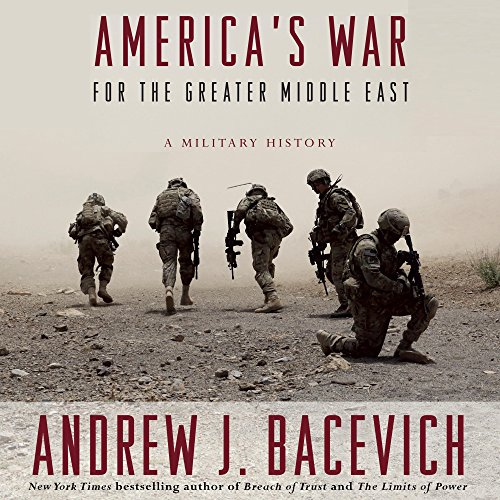
America's War for the Greater Middle East
Summary
Retired army colonel and New York Times best-selling author Andrew J. Bacevich provides a searing reassessment of US military policy in the Middle East over the past four decades.
From the end of World War II until 1980, virtually no American soldiers were killed in action while serving in the Greater Middle East. Since 1990, virtually no American soldiers have been killed in action anywhere else. What caused this shift? Andrew J. Bacevich, one of the country's most respected voices on foreign affairs, offers an incisive critical history of this ongoing military enterprise - now more than 30 years old and with no end in sight.
During the 1980s, Bacevich argues, a great transition occurred. As the Cold War wound down, the United States initiated a new conflict - a war for the Greater Middle East - that continues to the present day. The long twilight struggle with the Soviet Union had involved only occasional and sporadic fighting. But as this new war unfolded, hostilities became persistent. From the Balkans and East Africa to the Persian Gulf and Central Asia, US forces embarked upon a seemingly endless series of campaigns across the Islamic world. Few achieved anything remotely like conclusive success. Instead, actions undertaken with expectations of promoting peace and stability produced just the opposite. As a consequence, phrases like permanent war and open-ended war have become part of everyday discourse.
Connecting the dots in a way no other historian has done before, Bacevich weaves a compelling narrative out of episodes as varied as the Beirut bombing of 1983, the Mogadishu firefight of 1993, the invasion of Iraq in 2003, and the rise of ISIS in the present decade. Understanding what America's costly military exertions have wrought requires seeing these seemingly discrete events as parts of a single war. It also requires identifying the errors of judgment made by political leaders in both parties and by senior military officers who share responsibility for what has become a monumental march to folly. This Bacevich unflinchingly does.
A 20-year army veteran who served in Vietnam, Andrew J. Bacevich brings the full weight of his expertise to this vitally important subject. America's War for the Greater Middle East is a bracing after-action report from the front lines of history. It will fundamentally change the way we view America's engagement in the world's most volatile region.
Read by Rob Shapiro, with a Prologue and Note read by the author.
©2016 Andrew J. Bacevich (P)2016 Random House Audio

The Oil Kings
Summary
Struggling with a recession... European nations at risk of defaulting on their loans... A possible global financial crisis. It happened before, in the 1970s. The Oil Kings is the story of how oil came to dominate U.S. domestic and international affairs. As Richard Nixon fought off Watergate inquiries in 1973, the U.S. economy reacted to an oil shortage initiated by Arab nations in retaliation for American support of Israel in the Arab-Israeli war. The price of oil skyrocketed, causing serious inflation. One man the U.S. could rely on in the Middle East was the Shah of Iran, a loyal ally whose grand ambitions had made him a leading customer for American weapons. Iran sold the U.S. oil; the U.S. sold Iran missiles and fighter jets. But the Shah's economy depended almost entirely on oil, and the U.S. economy could not tolerate annual double-digit increases in the price of this essential commodity. European economies were hit even harder by the soaring oil prices, and several NATO allies were at risk of default on their debt. In 1976, with the U.S. economy in peril, President Gerald Ford, locked in a tight election race, decided he had to find a country that would sell oil to the U.S. more cheaply and break the OPEC monopoly, which the Shah refused to do. On the advice of Treasury Secretary William Simon and against the advice of Secretary of State Henry Kissinger, Ford made a deal to sell advanced weaponry to the Saudis in exchange for a modest price hike on oil. Ford lost the election, but the deal had lasting consequences. The Shah's economy was destabilized, and disaffected elements in Iran mobilized to overthrow him. The U.S. had embarked on a long relationship with the autocratic Saudi kingdom that continues to this day. Andrew Scott Cooper draws on newly declassified documents and interviews with some key figures of the time to show how Nixon, Ford, Kissinger, the CIA, and the State and Treasury departments - as well as the Shah and the Saudi royal family maneuvered to control events in the Middle East. He details the secret U.S.-Saudi plan to circumvent OPEC that destabilized the Shah. He reveals how close the U.S. came to sending troops into the Persian Gulf to break the Arab oil embargo. The Oil Kings provides solid evidence that U.S. officials ignored warning signs of a potential hostage crisis in Iran. It discloses that U.S. officials offered to sell nuclear power and nuclear fuel to the Shah. And it shows how the Ford Administration barely averted a European debt crisis that could have triggered a financial catastrophe in the U.S. Brilliantly reported and filled with astonishing details about some of the key figures of the time, The Oil Kings is the history of an era that we thought we knew, an era whose momentous reverberations still influence events at home and abroad today.
©2011 Andrew Scott Cooper (P)2011 Random House

Soulless
Summary
T. M. Frazier presents the finale to Bear and Thia's epic love story. Contains mature themes.
©2016 T. M. Frazier (P)2016 Tantor