The Computers & Technology category has 840 audiobooks on Listento.it, with an average listener rating of 3.9★ across 1,046 ratings. The most-rated is Life 3.0.

Life 3.0
Summary
How will artificial intelligence affect crime, war, justice, jobs, society, and our very sense of being human? The rise of AI has the potential to transform our future more than any other technology - and there's nobody better qualified or situated to explore that future than Max Tegmark, an MIT professor who's helped mainstream research on how to keep AI beneficial. How can we grow our prosperity through automation without leaving people lacking income or purpose? What career advice should we give today's kids? How can we make future AI systems more robust so that they do what we want without crashing, malfunctioning, or getting hacked? Should we fear an arms race in lethal autonomous weapons? Will machines eventually outsmart us at all tasks, replacing humans on the job market and perhaps altogether? Will AI help life flourish like never before or give us more power than we can handle? What sort of future do you want? This book empowers you to join what may be the most important conversation of our time. It doesn't shy away from the full range of viewpoints or from the most controversial issues - from superintelligence to meaning, consciousness, and the ultimate physical limits on life in the cosmos.
©2017 Max Tegmark (P)2017 Random House Audio
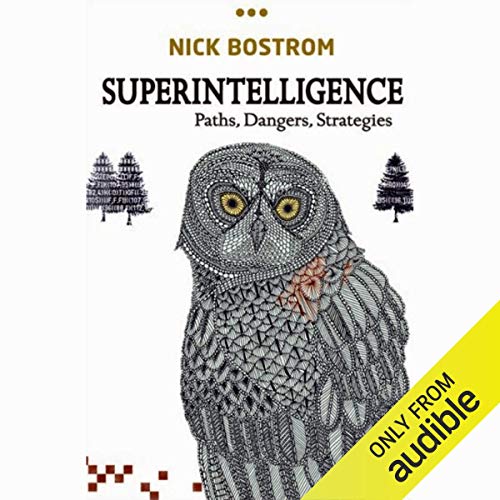
Superintelligence
Summary
Superintelligence asks the questions: What happens when machines surpass humans in general intelligence? Will artificial agents save or destroy us? Nick Bostrom lays the foundation for understanding the future of humanity and intelligent life. The human brain has some capabilities that the brains of other animals lack. It is to these distinctive capabilities that our species owes its dominant position. If machine brains surpassed human brains in general intelligence, then this new superintelligence could become extremely powerful - possibly beyond our control. As the fate of the gorillas now depends more on humans than on the species itself, so would the fate of humankind depend on the actions of the machine superintelligence. But we have one advantage: We get to make the first move. Will it be possible to construct a seed Artificial Intelligence, to engineer initial conditions so as to make an intelligence explosion survivable? How could one achieve a controlled detonation? This profoundly ambitious and original book breaks down a vast track of difficult intellectual terrain. After an utterly engrossing journey that takes us to the frontiers of thinking about the human condition and the future of intelligent life, we find in Nick Bostrom's work nothing less than a reconceptualization of the essential task of our time. PLEASE NOTE: When you purchase this title, the accompanying reference material will be available in your Library section along with the audio.
©2014 Nick Bostrom (P)2014 Audible Inc.

The Art of Invisibility
Summary
Kevin Mitnick, the world's most famous hacker, teaches you easy cloaking and countermeasures for citizens and consumers in the age of Big Brother and Big Data. Like it or not, your every move is being watched and analyzed. Consumers' identities are being stolen, and a person's every step is being tracked and stored. What once might have been dismissed as paranoia is now a hard truth, and privacy is a luxury few can afford or understand. In this explosive yet practical book, Kevin Mitnick illustrates what is happening without your knowledge - and he teaches you "the art of invisibility". Mitnick is the world's most famous - and formerly the most wanted - computer hacker. He has hacked in to some of the country's most powerful and seemingly impenetrable agencies and companies, and at one point he was on a three-year run from the FBI. Now, though, Mitnick is reformed and is widely regarded as the expert on the subject of computer security. He knows exactly how vulnerabilities can be exploited and just what to do to prevent that from happening. In The Art of Invisibility Mitnick provides both online and real-life tactics and inexpensive methods to protect you and your family, in easy step-by-step instructions. He even talks about more advanced "elite" techniques, which, if used properly, can maximize your privacy. Invisibility isn't just for superheroes - privacy is a power you deserve and need in this modern age.
©2017 Kevin Mitnick (P)2017 Hachette Audio

The Pragmatic Programmer: 20th Anniversary Edition, 2nd Edition
Summary
The Pragmatic Programmer is one of those rare tech audiobooks you’ll listen, re-listen, and listen to again over the years. Whether you’re new to the field or an experienced practitioner, you’ll come away with fresh insights each and every time. Dave Thomas and Andy Hunt wrote the first edition of this influential book in 1999 to help their clients create better software and rediscover the joy of coding. These lessons have helped a generation of programmers examine the very essence of software development, independent of any particular language, framework, or methodology, and the Pragmatic philosophy has spawned hundreds of books, screencasts, and audio books, as well as thousands of careers and success stories. Now, 20 years later, this new edition re-examines what it means to be a modern programmer. Topics range from personal responsibility and career development to architectural techniques for keeping your code flexible and easy to adapt and reuse. All the old favorite topics are there, updated for this new world. And there's a bunch of new content, reflecting what we've learned in the intervening years. Whether you’re a new coder, an experienced programmer, or a manager responsible for software projects, use these lessons daily, and you’ll quickly see improvements in personal productivity, accuracy, and job satisfaction. You’ll learn skills and develop habits and attitudes that form the foundation for long-term success in your career. You’ll become a pragmatic programmer. This audiobook is organized as a series of sections, each containing a series of topics. It is read by Anna Katarina; Dave and Andy (and a few other folks) jump in every now and then to give their take on things.
©2019 Pearson Education, Inc (P)2020 David Thomas and Andrew Hunt
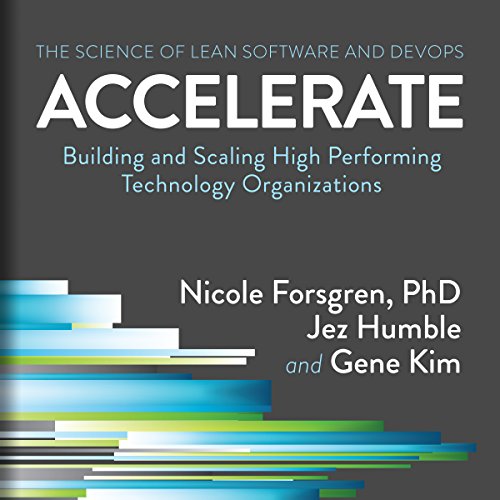
Accelerate: Building and Scaling High Performing Technology Organizations
Summary
Accelerate your organization to win in the marketplace. How can we apply technology to drive business value? For years we've been told that the performance of software delivery teams doesn't matter - that it can't provide a competitive advantage to our companies. Through four years of groundbreaking research to include data collected from the State of DevOps reports conducted with Puppet, Dr. Nicole Forsgren, Jez Humble, and Gene Kim set out to find a way to measure software delivery performance - and what drives it - using rigorous statistical methods. This book presents both the findings and the science behind that research, making the information accessible for listeners to apply in their own organizations. Listeners will discover how to measure the performance of their teams and what capabilities they should invest in to drive higher performance. This book is ideal for management at every level.
©2018 Nicole Forsgren, Jez Humble, and Gene Kim (P)2018 Nicole Forsgren, Jez Humble, and Gene Kim

Creative Selection
Summary
An insider's account of Apple's creative process during the golden years of Steve Jobs. Hundreds of millions of people use Apple products every day; several thousand work on Apple's campus in Cupertino, California; but only a handful sit at the drawing board. Creative Selection recounts the life of one of the few who worked behind the scenes, a highly respected software engineer who worked in the final years of the Steve Jobs era - the Golden Age of Apple. Ken Kocienda offers an inside look at Apple’s creative process. For 15 years, he was on the ground floor of the company as a specialist, directly responsible for experimenting with novel user interface concepts and writing powerful, easy-to-use software for products including the iPhone, the iPad, and the Safari web browser. His stories explain the symbiotic relationship between software and product development for those who have never dreamed of programming a computer and reveal what it was like to work on the cutting edge of technology at one of the world's most admired companies. Kocienda shares moments of struggle and success, crisis and collaboration, illuminating each with lessons learned over his Apple career. He introduces the essential elements of innovation - inspiration, collaboration, craft, diligence, decisiveness, taste, and empathy - and uses these as a lens through which to understand productive work culture. An insider's tale of creativity and innovation at Apple, Creative Selection shows listeners how a small group of people developed an evolutionary design model and how they used this methodology to make groundbreaking and intuitive software that countless millions use every day. PLEASE NOTE: When you purchase this title, the accompanying PDF will be available in your Audible Library along with the audio.
©2018 Ken Kocienda (P)2018 Macmillan Audio

Hello World
Summary
Shortlisted for the 2018 Royal Society Investment Science Book Prize A look inside the algorithms that are shaping our lives and the dilemmas they bring with them. If you were accused of a crime, who would you rather decide your sentence - a mathematically consistent algorithm incapable of empathy or a compassionate human judge prone to bias and error? What if you want to buy a driverless car and must choose between one programmed to save as many lives as possible and another that prioritizes the lives of its own passengers? And would you agree to share your family’s full medical history if you were told that it would help researchers find a cure for cancer? These are just some of the dilemmas that we are beginning to face as we approach the age of the algorithm, when it feels as if the machines reign supreme. Already, these lines of code are telling us what to watch, where to go, whom to date, and even whom to send to jail. But as we rely on algorithms to automate big, important decisions - in crime, justice, healthcare, transportation, and money - they raise questions about what we want our world to look like. What matters most: Helping doctors with diagnosis or preserving privacy? Protecting victims of crime or preventing innocent people being falsely accused? Hello World takes us on a tour through the good, the bad, and the downright ugly of the algorithms that surround us on a daily basis. Mathematician Hannah Fry reveals their inner workings, showing us how algorithms are written and implemented, and demonstrates the ways in which human bias can literally be written into the code. By weaving in relatable, real world stories with accessible explanations of the underlying mathematics that power algorithms, Hello World helps us to determine their power, expose their limitations, and examine whether they really are improvement on the human systems they replace.
©2018 Hannah Fry (P)2018 Audible, Inc.

The Internet of Money
Summary
The Internet of Money by Andreas M. Antonopoulos contains 11 of his most inspiring and thought-provoking talks, including: Introduction to Bitcoin; Blockchain vs Bullshit; Fake News, Fake Money; Currency Wars; Bubble Boy and the Sewer Rat; Rocket Science and Ethereum's Killer App; and many more!
©2017 Merkle Bloom LLC (P)2017 Merkle Bloom LLC

The Big Nine
Summary
A call-to-arms about the broken nature of artificial intelligence, and the powerful corporations that are turning the human-machine relationship on its head. We like to think that we are in control of the future of "artificial" intelligence. The reality, though, is that we - the everyday people whose data powers AI - aren't actually in control of anything. When, for example, we speak with Alexa, we contribute that data to a system we can't see and have no input into - one largely free from regulation or oversight. The big nine corporations - Amazon, Google, Facebook, Tencent, Baidu, Alibaba, Microsoft, IBM and Apple - are the new gods of AI and are short-changing our futures to reap immediate financial gain. In this book, Amy Webb reveals the pervasive, invisible ways in which the foundations of AI - the people working on the system, their motivations, the technology itself - is broken. Within our lifetimes, AI will, by design, begin to behave unpredictably, thinking and acting in ways which defy human logic. The big nine corporations may be inadvertently building and enabling vast arrays of intelligent systems that don't share our motivations, desires, or hopes for the future of humanity. Much more than a passionate, human-centered call-to-arms, this book delivers a strategy for changing course, and provides a path for liberating us from algorithmic decision-makers and powerful corporations.
©2019 Amy Webb (P)2019 Hachette Audio

The History of the Future
Summary
The dramatic, larger-than-life true story behind the founding of Oculus and its quest for virtual reality, by the best-selling author of Console Wars. From iconic books like Neuromancer to blockbuster films like The Matrix, virtual reality has long been hailed as the ultimate technology. But outside of a few research labs and military training facilities, this tantalizing vision of the future was nothing but science fiction. Until 2012, when Oculus founder Palmer Luckey - then just a rebellious teenage dreamer living alone in a camper trailer - invents a device that has the potential to change everything. With the help of a video game legend, a serial entrepreneur, and many other colorful characters, Luckey’s scrappy start-up kick-starts a revolution and sets out to bring VR to the masses. As with most underdog stories, things don’t quite go according to plan. But what happens next turns out to be the ultimate entrepreneurial journey: a tale of battles won and lost, lessons learned, and never-ending twists and turns - including an unlikely multibillion-dollar acquisition by Facebook’s Mark Zuckerberg that shakes up the landscape in Silicon Valley and gives Oculus the chance to forever change our reality. Drawing on more than 100 interviews with the key players driving this revolution, The History of the Future weaves together a rich, cinematic narrative that captures the breakthroughs, breakdowns, and human drama of trying to change the world. The result is a super accessible and supremely entertaining look at the birth of a game-changing new industry. PLEASE NOTE: When you purchase this title, the accompanying PDF will be available in your Audible Library along with the audio.
©2019 Blake J. Harris (P)2019 HarperCollins Publishers
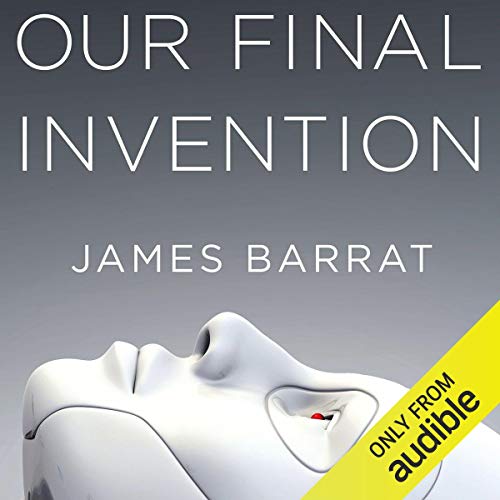
Our Final Invention
Summary
A Huffington Post Definitive Tech Book of 2013 Artificial Intelligence helps choose what books you buy, what movies you see, and even who you date. It puts the "smart" in your smartphone and soon it will drive your car. It makes most of the trades on Wall Street, and controls vital energy, water, and transportation infrastructure. But Artificial Intelligence can also threaten our existence. In as little as a decade, AI could match and then surpass human intelligence. Corporations and government agencies are pouring billions into achieving AI’s Holy Grail - human-level intelligence. Once AI has attained it, scientists argue, it will have survival drives much like our own. We may be forced to compete with a rival more cunning, more powerful, and more alien than we can imagine. Through profiles of tech visionaries, industry watchdogs, and groundbreaking AI systems, Our Final Invention explores the perils of the heedless pursuit of advanced AI. Until now, human intelligence has had no rival. Can we coexist with beings whose intelligence dwarfs our own? And will they allow us to?
©2013 James Barrat (P)2014 Audible Inc.

Deep Thinking
Summary
Garry Kasparov's 1997 chess match against the IBM supercomputer Deep Blue was a watershed moment in the history of technology. It was the dawn of a new era in artificial intelligence: a machine capable of beating the reigning human champion at this most cerebral game. That moment was more than a century in the making, and in this breakthrough book, Kasparov reveals his astonishing side of the story for the first time. He describes how it felt to strategize against an implacable, untiring opponent with the whole world watching, and recounts the history of machine intelligence through the microcosm of chess, considered by generations of scientific pioneers to be a key to unlocking the secrets of human and machine cognition. Kasparov uses his unrivaled experience to look into the future of intelligent machines and sees it bright with possibility. As many critics decry artificial intelligence as a menace, particularly to human jobs, Kasparov shows how humanity can rise to new heights with the help of our most extraordinary creations, rather than fear them. Deep Thinking is a tightly argued case for technological progress, from the man who stood at its precipice with his own career at stake.
©2017 Garry Kasparov (P)2017 Hachette Audio

The Simulation Hypothesis: An MIT Computer Scientist Shows Why AI, Quantum Physics, and Eastern Mystics All Agree We Are in a Video Game
Summary
The Simulation Hypothesis, by best-selling author, renowned MIT computer scientist, and Silicon Valley video game designer Rizwan Virk, explains one of the most daring and consequential theories of our time. Drawing from research and concepts from computer science, artificial intelligence, video games, quantum physics, and referencing both speculative fiction and ancient eastern spiritual texts, Virk shows how all of these traditions come together to point to the idea that we may be inside a simulated reality like the Matrix. The Simulation Hypothesis is the idea that our physical reality, far from being a solid physical universe, is part of an increasingly sophisticated video game-like simulation, where we all have multiple lives, consisting of pixels with its own internal clock run by some giant Artificial Intelligence. Simulation theory explains some of the biggest mysteries of quantum and relativistic physics, such as quantum indeterminacy, parallel universes, and the integral nature of the speed of light. “There’s a one in a billion chance we are not living in a simulation.” (Elon Musk) “I find it hard to argue we are not in a simulation.” (Neil deGrasse Tyson) “We are living in computer generated reality.” (Philip K. Dick) Video game designer Riz Virk shows how the history and evolution of our video games, including virtual reality, augmented reality, artificial intelligence, and quantum computing could lead us to the point of being able to develop all encompassing virtual worlds like the Oasis in Ready Player One, or the simulated reality in The Matrix. While the idea sounds like science fiction, many scientists, engineers, and professors have given the simulation hypothesis serious consideration. But the simulation hypothesis is not just a modern idea. Philosophers and mystics of all traditions have long contended that we are living in some kind of “illusion“ and that there are other realities which we can access with our minds. Whether you are a computer scientist, a fan of science fiction like The Matrix movies, a video game enthusiast, or a spiritual seeker, The Simulation Hypothesis touches on all these areas, and you will never look at the world the same way again!
©2019 Rizwan Virk (P)2019 Rizwan Virk

How to Invent Everything
Summary
An NPR Best Book of 2018 "How to Invent Everything is such a cool book. It's essential reading for anyone who needs to duplicate an industrial civilization quickly." (Randall Munroe, xkcd creator and New York Times best-selling author of What If?) The only book you need if you're going back in time What would you do if a time machine hurled you thousands of years into the past...and then broke? How would you survive? Could you improve on humanity's original timeline? And how hard would it be to domesticate a giant wombat? With this book as your guide, you'll survive - and thrive - in any period in Earth's history. Best-selling author and time-travel enthusiast Ryan North tells you how to invent all the modern conveniences we take for granted - from first principles. This manual contains all the science, engineering, art, philosophy, facts, and figures required for even the most clueless time traveler to build a civilization from the ground up. Deeply researched, irreverent, and significantly more fun than being eaten by a saber-toothed tiger, How to Invent Everything will make you smarter, more competent, and completely prepared to become the most important and influential person ever. You're about to make history....better.
©2018 Ryan North (P)2018 Penguin Audio

Cult of the Dead Cow
Summary
The shocking untold story of the elite secret society of hackers fighting to protect our privacy, our freedom - even democracy itself... Cult of the Dead Cow is the tale of the oldest, most respected, and most famous American hacking group of all time. Though until now it has remained mostly anonymous, its members invented the concept of hacktivism, released the top tool for testing password security, and created what was for years the best technique for controlling computers from afar, forcing giant companies to work harder to protect customers. They contributed to the development of Tor, the most important privacy tool on the net, and helped build cyberweapons that advanced US security without injuring anyone. With its origins in the earliest days of the Internet, the cDc is full of oddball characters - activists, artists, even future politicians. Many of these hackers have become top executives and advisors walking the corridors of power in Washington and Silicon Valley. The most famous is former Texas Congressman and current presidential candidate Beto O'Rourke, whose time in the cDc set him up to found a tech business, launch an alternative publication in El Paso, and make long-shot bets on unconventional campaigns. Today, the group and its followers are battling electoral misinformation, making personal data safer, and battling to keep technology a force for good instead of for surveillance and oppression. Cult of the Dead Cow shows how governments, corporations, and criminals came to hold immense power over individuals and how we can fight back against them.
©2019 Joseph Menn (P)2019 PublicAffairs

Human Compatible
Summary
"The most important book on AI this year." (The Guardian) "Mr. Russell's exciting book goes deep, while sparkling with dry witticisms." (The Wall Street Journal) "The most important book I have read in quite some time" (Daniel Kahneman) "A must-read" (Max Tegmark) "The book we've all been waiting for" (Sam Harris) A leading artificial intelligence researcher lays out a new approach to AI that will enable us to coexist successfully with increasingly intelligent machines. In the popular imagination, superhuman artificial intelligence is an approaching tidal wave that threatens not just jobs and human relationships, but civilization itself. Conflict between humans and machines is seen as inevitable and its outcome all too predictable. In this groundbreaking audiobook, distinguished AI researcher Stuart Russell argues that this scenario can be avoided, but only if we rethink AI from the ground up. Russell begins by exploring the idea of intelligence in humans and in machines. He describes the near-term benefits we can expect, from intelligent personal assistants to vastly accelerated scientific research, and outlines the AI breakthroughs that still have to happen before we reach superhuman AI. He also spells out the ways humans are already finding to misuse AI, from lethal autonomous weapons to viral sabotage. If the predicted breakthroughs occur and superhuman AI emerges, we will have created entities far more powerful than ourselves. How can we ensure they never, ever, have power over us? Russell suggests that we can rebuild AI on a new foundation, according to which machines are designed to be inherently uncertain about the human preferences they are required to satisfy. Such machines would be humble, altruistic, and committed to pursue our objectives, not theirs. This new foundation would allow us to create machines that are provably deferential and provably beneficial.
©2019 Stuart Russell (P)2019 Penguin Audio

You Look Like a Thing and I Love You
Summary
As heard on NPR's Science Friday, discover the book recommended by Malcolm Gladwell, Susan Cain, Daniel Pink, and Adam Grant: an "accessible, informative, and hilarious" introduction to the weird and wonderful world of artificial intelligence (Ryan North). "You look like a thing and I love you" is one of the best pickup lines ever...according to an artificial intelligence trained by scientist Janelle Shane, creator of the popular blog AI Weirdness. She creates silly AIs that learn how to name paint colors, create the best recipes, and even flirt (badly) with humans — all to understand the technology that governs so much of our daily lives. We rely on AI every day for recommendations, for translations, and to put cat ears on our selfie videos. We also trust AI with matters of life and death, on the road and in our hospitals. But how smart is AI really...and how does it solve problems, understand humans, and even drive self-driving cars? Shane delivers the answers to every AI question you've ever asked, and some you definitely haven't. Like, how can a computer design the perfect sandwich? What does robot-generated Harry Potter fan-fiction look like? And is the world's best Halloween costume really "Vampire Hog Bride"? In this smart, often hilarious introduction to the most interesting science of our time, Shane shows how these programs learn, fail, and adapt — and how they reflect the best and worst of humanity. You Look Like a Thing and I Love You is the perfect book for anyone curious about what the robots in our lives are thinking. "I can't think of a better way to learn about artificial intelligence, and I've never had so much fun along the way." (Adam Grant, New York Times best-selling author of Originals) PLEASE NOTE: When you purchase this title, the accompanying PDF will be available in your Audible Library along with the audio.
©2019 Janelle Shane (P)2019 Little, Brown & Company

On the Future
Summary
A provocative and inspiring look at the future of humanity and science from world-renowned scientist and best-selling author Martin Rees Humanity has reached a critical moment. Our world is unsettled and rapidly changing, and we face existential risks over the next century. Various outcomes - good and bad - are possible. Yet our approach to the future is characterized by short-term thinking, polarizing debates, alarmist rhetoric, and pessimism. In this short, exhilarating book, renowned scientist and best-selling author Martin Rees argues that humanity’s prospects depend on our taking a very different approach to planning for tomorrow. The future of humanity is bound to the future of science and hinges on how successfully we harness technological advances to address our challenges. If we are to use science to solve our problems while avoiding its dystopian risks, we must think rationally, globally, collectively, and optimistically about the long term. Advances in biotechnology, cybertechnology, robotics, and artificial intelligence - if pursued and applied wisely - could empower us to boost the developing and developed world and overcome the threats humanity faces on Earth, from climate change to nuclear war. At the same time, further advances in space science will allow humans to explore the solar system and beyond with robots and AI. But there is no “Plan B” for Earth - no viable alternative within reach if we do not care for our home planet. Rich with fascinating insights into cutting-edge science and technology, this accessible book will captivate anyone who wants to understand the critical issues that will define the future of humanity on Earth and beyond.
©2018 Martin Rees (P)2018 Princeton University Press

Possible Minds
Summary
Science-world luminary John Brockman assembles 25 of the most important scientific minds, people who have been thinking about the field of artificial intelligence for most of their careers, for an unparalleled roundtable examination about mind, thinking, intelligence, and what it means to be human. "Artificial intelligence is today's story - the story behind all other stories. It is the Second Coming and the Apocalypse at the same time: Good AI versus evil AI." (John Brockman) More than 60 years ago, mathematician-philosopher Norbert Wiener published a book on the place of machines in society that ended with a warning: "We shall never receive the right answers to our questions unless we ask the right questions.... The hour is very late, and the choice of good and evil knocks at our door." In the wake of advances in unsupervised, self-improving machine learning, a small but influential community of thinkers is considering Wiener's words again. In Possible Minds, John Brockman gathers their disparate visions of where AI might be taking us. The fruit of the long history of Brockman's profound engagement with the most important scientific minds who have been thinking about AI - from Alison Gopnik and David Deutsch to Frank Wilczek and Stephen Wolfram - Possible Minds is an ideal introduction to the landscape of crucial issues AI presents. The collision between opposing perspectives is salutary and exhilarating; some of these figures, such as computer scientist Stuart Russell, Skype cofounder Jaan Tallinn, and physicist Max Tegmark, are deeply concerned with the threat of AI, including the existential one, while others, notably robotics entrepreneur Rodney Brooks, philosopher Daniel Dennett, and best-selling author Steven Pinker, have a very different view. Serious, searching, and authoritative, Possible Minds lays out the intellectual landscape of one of the most important topics of our time. Read by Jason Culp, Rob Shapiro, Vikas Adam, Will Damron, and Kathleen McInerney.
©2019 John Brockman (P)2019 Penguin Audio

Digital Transformation
Summary
From visionary Silicon Valley entrepreneur Tom Siebel comes a penetrating examination of the new technologies that are disrupting business and government - and how organizations can harness them to transform into digital enterprises. The confluence of four technologies - elastic cloud computing, big data, artificial intelligence, and the internet of things - writes Siebel, is fundamentally changing how business and government will operate in the 21st century. Siebel masterfully guides listeners through a fascinating discussion of the game-changing technologies driving digital transformation and provides a roadmap to seize them as a strategic opportunity. He shows how leading enterprises such as Enel, 3M, Royal Dutch Shell, the US Department of Defense, and others are applying AI and IoT with stunning results. Digital Transformation is the guidebook every business and government leader needs to survive and thrive in the new digital age. Image credited to Regan McCamey PLEASE NOTE: When you purchase this title, the accompanying PDF will be available in your Audible Library along with the audio.
©2019 Thomas M. Siebel (P)2019 Audible, Inc.