Sean Runnette has narrated 293 audiobooks on Listento.it by 254 authors, with an average listener rating of 4.6★ across 9,426 ratings. The most-rated is Rich Dad Poor Dad.

The Predictioneer's Game
Summary
Bruce Bueno de Mesquita is a master of game theory, which is a fancy label for a simple idea: People compete, and they always do what they think is in their own best interest. Bueno de Mesquita uses game theory and its insights into human behavior to predict and even engineer political, financial, and personal events. His forecasts, which have been employed by everyone from the CIA to major business firms, have an amazing 90-percent accuracy rate, and in this dazzling and revelatory book he shares his startling methods and lets you play along in a range of high-stakes negotiations and conflicts. Revealing the origins of game theory and the advances made by John Nash, the Nobel Prize-winning scientist perhaps best known from A Beautiful Mind, Bueno de Mesquita details the controversial and cold-eyed system of calculation that he has since created, one that allows individuals to think strategically about what their opponents want, how much they want it, and how they might react to every move. From there, Bueno de Mesquita games such events as the North Korean disarmament talks and the Middle East peace process and recalls, among other cases, how he correctly predicted which corporate clients of the Arthur Andersen accounting firm were most likely engaged in fraudulent activity (hint: one of them started with an E). Looking as ever to the future, Bueno de Mesquita also demonstrates how game theory can provide successful strategies to combat both global warming and terror. But as Bueno de Mesquita shows, game theory isn't just for saving the world. It can help you in your own life, whether you want to succeed in a lawsuit, elect the CEO of your company, or even buy a car. Savvy, provocative, and shockingly effective, The Predictioneer's Game will change how you understand the world and manage your future. Life's a game, and how you play is whether you win or lose.
©2009 Bruce Bueno De Mesquita (P)2009 Random House

The Essential Guide to Healing
Summary
Two premier renewal leaders help inspire and equip believers to receive and minister healing, stressing that God's miraculous healing is part of the Good News.
©2016 eChristian (P)2016 eChristian

Secrets of the Savanna
Summary
"Vividly written... Their story is thrilling - the kind of tale that wild-animal lovers won't easily forget." (People)
In this riveting real-life adventure, Mark and Delia Owens tell the dramatic story of their last years in Africa, fighting to save elephants, villagers, and - in the end - themselves. The award-winning zoologists and pioneering conservationists describe their work in the remote and ruggedly beautiful Luangwa Valley, in northeastern Zambia. There they studied the mysteries of the elephant population’s recovery after poaching, discovering remarkable similarities between humans and elephants. A young elephant named Gift provided the clue to help them crack the animals’ secret of survival. A stirring portrait of life in Africa, Secrets of the Savanna is a remarkable record of the Owenses's unique passions.
©2006 Mark Owens and Delia Owens (P)2019 Brilliance Publishing, Inc., all rights reserved

The Things of Earth
Summary
Helping listeners walk the line between idolatry and ingratitude, this audiobook emphasizes our responsibility to glorify God by joyfully embracing his good gifts without letting them become worldly distractions that steal our affection.
©2015 eChristian (P)2015 eChristian

Alive in a Dead World
Summary
"What now, sister?" Tomas asked. "We kill Michael Talbot, his family, and his friends and then we rule the world," she said absently as she fingered the locket around her neck. In the latest installment of Mark Tufo's zombie fallout series, Mike Talbot and his family continue their fight for survival as Eliza plots their demise.
©2012 Mark Tufo (P)2020 Audible, Inc.
The Powers of the Earth
Summary
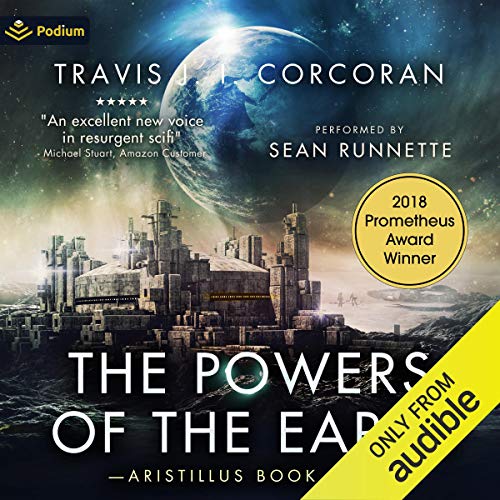
Winner of the 2018 Promethus Award for Best Novel Earth in 2064 is politically corrupt and in economic decline. The Long Depression has dragged on for 56 years, and the Bureau of Sustainable Research is hard at work making sure no new technologies disrupt the planned economy. Ten years ago, a band of malcontents, dreamers, and libertarian radicals bolted privately developed antigravity drives onto rusty seagoing cargo ships, loaded them to the gills with 20th-century tunnel-boring machines and earthmoving equipment, and set sail - for the moon. There, they built their retreat. A lunar underground border town fit to rival Ayn Rand's "Galt's Gulch", with American capitalists, Mexican hydroponic farmers, and Vietnamese space-suit mechanics - this is the city of Aristillus. There's a problem, though: The economic decline of Earth under a command-and-control economy is causing trouble for the political powers-that-be in Washington, DC, and elsewhere. To shore up their positions, they need to slap down the lunar expats and seize the gold they've been mining. The conflicts start small but rapidly escalate. The Powers of the Earth includes zero-gravity gun fights in rusted oceangoing ships flying through space, containers full of bulldozers hurtling through the vacuum, nuclear explosions, armies of tele-operated combat UAVs, guerrilla fighting in urban environments, an astoundingly visual climax...and really, really big guns.
©2017 Travis J. I. Corcoran (P)2018 Podium Publishing

I Invented the Modern Age
Summary
Every century or so, our republic has been remade by a new technology: 170 years ago the railroad changed Americans' conception of space and time; in our era, the microprocessor revolutionized how humans communicate. But in the early 20th century the agent of creative destruction was the gasoline engine, as put to work by an unknown and relentlessly industrious young man named Henry Ford. Born the same year as the battle of Gettysburg, Ford died two years after the atomic bombs fell, and his life personified the tremendous technological changes achieved in that span. Growing up as a Michigan farm boy with a bone-deep loathing of farming, Ford intuitively saw the advantages of internal combustion. Resourceful and fearless, he built his first gasoline engine out of scavenged industrial scraps. It was the size of a sewing machine. From there, scene by scene, Richard Snow vividly shows Ford using his innate mechanical abilities, hard work, and radical imagination as he transformed American industry. In many ways, of course, Ford's story is well known; in many more ways, it is not. Richard Snow masterfully weaves together a fascinating narrative of Ford's rise to fame through his greatest invention, the Model T. When Ford first unveiled this car, it took 12 and a half hours to build one. A little more than a decade later, it took exactly one minute. In making his car so quickly and so cheaply that his own workers could easily afford it, Ford created the cycle of consumerism that we still inhabit. Our country changed in a mere decade, and Ford became a national hero. But then he soured, and the benevolent side of his character went into an ever-deepening eclipse, even as the America he had remade evolved beyond all imagining into a global power capable of producing on a vast scale not only cars, but airplanes, ships, machinery, and an infinity of household devices. A highly pleasurable listen, filled with scenes and incidents from Ford's life, particularly during the intense phase of his secretive competition with other early car manufacturers, I Invented the Modern Age shows Richard Snow at the height of his powers as a popular historian and reclaims from history Henry Ford, the remarkable man who, indeed, invented the modern world as we know it.
©2013 Richard Snow (P)2013 Tantor

Fire Season
Summary
In the tradition of Desert Solitaire and Shop Class as Soulcraft, this is a remarkable debut from a major new voice in American nonfiction—a meditation on nature and life, witnessed from the heights of one of the last fire-lookout towers in America. For nearly a decade, Philip Connors has spent half of each year in a seven-by-seven foot fire-lookout tower, ten thousand feet above sea level in one of the most remote territories of New Mexico. One of the least developed parts of the country, the first region designated as an official wilderness area in the world, the section he tends is also one of the most fire-prone, suffering more than thirty thousand lightning strikes each year. Written with gusto, charm, and a sense of history, Fire Season captures the wonder and grandeur of this most unusual job and place: the eerie pleasure of solitude, the strange dance of communion and mistrust with its animal inhabitants, and the majesty, might, and beauty of untamed fire at its wildest. Connors’ time up on the peak is filled with drama—there are fires large and small; spectacular midnight lightning storms and silent mornings awakening above the clouds; surprise encounters with long-distance hikers, smokejumpers, bobcats, black bears, and an abandoned, dying fawn. Filled with Connors’ heartfelt reflections on our place in the wild, on other writers who have worked as lookouts—Jack Kerouac, Edward Abbey, Norman Maclean, Gary Snyder—and on the ongoing debate over whether fires should be suppressed or left to burn, Fire Season is a remarkable homage to the beauty of nature, the blessings of solitude, and the freedom of the independent spirit. As Connors writes, “I’ve seen lunar eclipses and desert sandstorms and lightning that made my hair stand on end…I’ve watched deer and elk frolic in the meadow below me and pine trees explode in a blue ball of smoke. If there’s a better job anywhere on the planet, I’d like to know what it is.”
©2011 Philip Connors (P)2011 Blackstone Audio, Inc.

Culture Making
Summary
Andy Crouch unleashes a stirring manifesto calling Christians to be culture makers. For too long, Christians have had an insufficient view of culture and have waged misguided "culture wars." But we must reclaim the cultural mandate to be the creative cultivators that God designed us to be. Culture is what we make of the world, both in creating cultural artifacts as well as in making sense of the world around us. By making chairs and omelets, languages and laws, we participate in the good work of culture making. Crouch unpacks the complexities of how culture works and gives us tools for cultivating and creating culture. He navigates the dynamics of cultural change and probes the role and efficacy of our various cultural gestures and postures. Keen biblical exposition demonstrates that creating culture is central to the whole scriptural narrative, the ministry of Jesus and the call to the church. He guards against naive assumptions about "changing the world," but points us to hopeful examples from church history and contemporary society of how culture is made and shaped. Ultimately, our culture making is done in partnership with God's own making and transforming of culture.
©2008 Andy Crouch (P)2010 christianaudio.com

Chesty
Summary
The Marine Corps is known for its heroes, and Lieutenant General Lewis B. Puller has long been considered the greatest of them all. His assignments and activities covered an extraordinary spectrum of warfare. Puller mastered small unit guerrilla warfare as a lieutenant in Haiti in the 1920s, and at the end of his career commanded a division in Korea. In between, he chased Sandino in Nicaragua and fought at Guadalcanal, Cape Gloucester, and Peleliu. With his bulldog face, barrel chest (which earned him the nickname Chesty), gruff voice, and common touch, Puller became - and has remained - the epitome of the marine combat officer. At times Puller's actions have been called into question - at Peleliu, for instance, where, against a heavily fortified position, he lost more than half of his regiment. And then there is the saga of his son, who followed in Chesty's footsteps as a marine officer only to suffer horrible wounds in Vietnam (his book, Fortunate Son, won the Pulitzer Prize). Jon Hoffman has been given special access to Puller's personal papers as well as his personnel record. The result will unquestionably stand as the last word about Chesty Puller.
©2001 Jon T. Hoffman (P)2018 Tantor

Dr. Hugh Mann
Summary
Before there were zombies, there was the virus....
©2011 Mark Tufo (P)2019 Audible, Inc.

No Immediate Danger
Summary
In his nonfiction, William T. Vollmann has won acclaim as a singular voice tackling some of the most important issues of our age. Now, Vollmann turns to a topic that will define the generations to come - the factors and human actions that have led to global warming. Vollmann begins No Immediate Danger, the first volume of Carbon Ideologies, by examining and quantifying the many causes of climate change, from industrial manufacturing and agricultural practices to fossil fuel extraction, economic demand for electric power, and the justifiable yearning of people all over the world to live in comfort. Turning to nuclear power first, Vollmann then recounts multiple visits that he made at significant personal risk over the course of seven years to the contaminated no-go zones and sad ghost towns of Fukushima, Japan, beginning shortly after the tsunami and reactor meltdowns of 2011. Equipped first only with a dosimeter and then with a scintillation counter, he measured radiation and interviewed tsunami victims, nuclear evacuees, anti-nuclear organizers, and pro-nuclear utility workers. Featuring Vollmann's signature wide learning, sardonic wit, and encyclopedic research, No Immediate Danger builds up a powerful, sobering picture of the ongoing nightmare of Fukushima. PLEASE NOTE: When you purchase this title, the accompanying reference material will be available in your Library section along with the audio.
©2018 William T. Vollmann (P)2018 Tantor

Judgment of Paris
Summary
The Smithsonian's National Museum of American History houses, amid its illustrious artifacts, two bottles of wine: a 1973 Stag's Leap Wine Cellars Cabernet Sauvignon and a 1973 Chateau Montelena Chardonnay. These are the wines that won at the now-famous Paris Tasting in 1976, where a panel of top French wine experts compared some of France's most famous wines with a new generation of California wines. Little did they know the wine industry would be completely transformed as a result, sparking a golden age for viticulture that extends beyond France's hallowed borders to Australia, Chile, South Africa, New Zealand, and across the globe. Then Paris correspondent for Time magazine, George M. Taber recounts this seminal contest and its far-reaching effects, focusing on the three gifted unknowns behind the winning wines: a college lecturer, a real estate lawyer, and a Yugoslavian immigrant. At a time when California was best known for cheap jug wine, these pioneers used radical new techniques alongside time-honored winemaking traditions to craft premium American wines that could stand up to France's finest. With unique access to the main players and a contagious passion for his subject, Taber renders this historic event and its tremendous aftershocks in captivating prose, bringing to life an eclectic cast and magnificent settings. For lovers of wine and anyone who enjoys a story of the entrepreneurial spirit of the new world conquering the old, this is an illuminating and deeply satisfying tale.
©2005 George M. Taber (P)2011 Tantor

The Search for the "Manchurian Candidate"
Summary
A "Manchurian Candidate" is an unwitting assassin brainwashed and programmed to kill. In this book, former State Department officer John Marks tells the explosive story of the CIA's highly secret program of experiments in mind control. His curiosity first aroused by information on a puzzling suicide, Marks worked from thousands of pages of newly released documents as well as interviews and behavioral science studies, producing a book that "accomplished what two Senate committees could not" (Senator Edward Kennedy).
©1979 John Marks (P)2020 Tantor

The Perfect Theory
Summary
How did one elegant theory incite a scientific revolution? Physicists have been exploring, debating, and questioning the general theory of relativity ever since Albert Einstein first presented it in 1915. Their work has uncovered a number of the universe's more surprising secrets, and many believe further wonders remain hidden within the theory's tangle of equations, waiting to be exposed. In this sweeping narrative of science and culture, astrophysicist Pedro Ferreira brings general relativity to life through the story of the brilliant physicists, mathematicians, and astronomers who have taken up its challenge. For these scientists, the theory has been both a treasure trove and an enigma, fueling a century of intellectual struggle and triumph. Einstein's theory, which explains the relationships among gravity, space, and time, is possibly the most perfect intellectual achievement of modern physics, yet studying it has always been a controversial endeavor. Relativists were the target of persecution in Hitler's Germany, hounded in Stalin's Russia, and disdained in 1950s America. Even today, doctorate students are warned that specializing in general relativity will make them unemployable. Despite these pitfalls, general relativity has flourished, delivering key insights into our understanding of the origin of time and the evolution of all the stars and galaxies in the cosmos. Its adherents have revealed what lies at the farthest reaches of the universe, shed light on the smallest scales of existence, and explained how the fabric of reality emerges. Dark matter, dark energy, black holes, and string theory are all progeny of Einstein's theory. We are in the midst of a momentous transformation in modern physics. As scientists look farther and more clearly into space than ever before, The Perfect Theory reveals the greater relevance of general relativity, showing us where it started, where it has led, and where it can still take us.
©2014 Pedro G. Ferreira (P)2014 Blackstone Audio, Inc.
Wait
Summary
A passionate polemic in favor of pausing to think, not blink. What do these scenarios have in common: a professional tennis player returning a serve, a woman evaluating a first date across the table, a naval officer assessing a threat to his ship, and a comedian about to reveal a punch line? In this counterintuitive and insightful work, author Frank Partnoy weaves together findings from hundreds of scientific studies and interviews with wide-ranging experts to craft a picture of effective decision making that runs contrary to our brutally fast-paced world. Thought technology is exerting new pressures to speed up our lives, it turns out that the choices we make––unconsciously and consciously, in time frames varying from milliseconds to years—benefit profoundly from delay. Taking control of time and slowing down our responses yields better results in almost every arena of life—even when time seems to be of the essence. The procrastinator in all of us will delight in Partnoy’s accounts of celebrity “delay specialists,” from Warren Buffett to Chris Evert to Steve Kroft, underscoring the myriad ways in which delaying our reactions to everyday choices—large and small—can improve the quality of our lives. Frank Partnoy is the George E. Barrett Professor of Law and Finance and is codirector of the Center on Corporate and Securities Law at the University of San Diego. He is one of the world’s leading experts on the complexities of modern finance and financial market regulation. He is also the author of several works of nonfiction.
©2012 Frank Partnoy (P)2012 Blackstone Audio, Inc.

Leadership 101
Summary
Drawing from John Maxwell's best sellers Developing the Leader Within You, The 21 Irrefutable Laws of Leadership, The 21 Indispensable Qualities of a Leader, and Becoming a Person of Influence, Leadership 101 explores the timeless principles that have become Dr. Maxwell's trademark style. In a concise, straightforward style, Maxwell focuses on essential and time-tested qualities necessary for true leadership - influence, integrity, attitude, vision, problem solving, and self-discipline - and guides listeners through practical steps to develop true leadership in their lives and the lives of others.
©2002 John C. Maxwell (P)2015 Thomas Nelson Publishers

The Craftsman
Summary
The Craftsman explores the relation between the hand and the head. Richard Sennett argues that working with physical things stimulates people to think. Craftsmanship, says Sennett, names the basic human impulse to do a job well for its own sake, and good craftsmanship involves developing skills and focusing on the work rather than ourselves. The computer programmer, the doctor, the artist, and even the parent and citizen all engage in a craftsman's work. In this thought-provoking book, Sennett explores the work of craftsmen past and present, identifies deep connections between material consciousness and ethical values, and challenges received ideas about what constitutes good work in today's world. The Craftsman engages the many dimensions of skill - from the technical demands to the obsessive energy required to do good work. Craftsmanship leads Sennett across time and space, from ancient Roman brickmakers to Renaissance goldsmiths to the printing presses of Enlightenment Paris and the factories of industrial London; in the modern world he explores what experiences of good work are shared by computer programmers, nurses and doctors, musicians, glassblowers, and cooks. Unique in the scope of his thinking, Sennett expands previous notions of crafts and craftsmen and apprises us of the surprising extent to which we can learn about ourselves through the labor of making physical things.
©2008 Richard Sennett (P)2018 Tantor

The Case for Mars
Summary
Since the beginning of human history Mars has been an alluring dream - the stuff of legends, gods, and mystery. The planet most like ours, it has still been thought impossible to reach, let alone explore and inhabit. Now with the advent of a revolutionary new plan, all this has changed. Leading space exploration authority Robert Zubrin has crafted a daring new blueprint, Mars Direct, presented here with engaging anecdotes. The Case for Mars is not a vision for the far future or one that will cost us impossible billions. It explains step-by-step how we can use present-day technology to send humans to Mars within 10 years; actually produce fuel and oxygen on the planet's surface with Martian natural resources; how we can build bases and settlements; and how we can one day "terraform" Mars - a process that can alter the atmosphere of planets and pave the way for sustainable life.
©2011 Robert Zubrin (P)2018 Tantor

Sanctum
Summary
Will any Sanctuary stand? With both the Naked Horde and the Survivor Army destroyed, Zed and Murphy make their preparations and head to College Station to do their small part in salvaging humanity's future. But the post-virus world isn't kind to humans or their plans, and nothing they find on their journey is what they expected. Slow Burn Zombie Apocalypse Series: Book 1 - Zero Day Book 2 - Infected Book 3 - Destroyer Book 4 - Dead Fire Book 5 - Torrent Book 6 - Bleed Book 7 - City of Stin Book 8 - Grind Book 9 - Sanctum
©2016 Beezle Media, LLC (P)2016 Beezle Media, LLC