Chris DeRose has 5 audiobooks on Listento.it, narrated by 5 narrators, with an average listener rating of 4.5★ across 3 ratings. The most-rated is The Fighting Bunch.

The Fighting Bunch
Summary
The incredible, untold story of the WWII vets who overthrew their corrupt hometown government - the only successful armed rebellion on US soil since the War of Independence. Corrupt politician Paul Cantrell was in complete control of McMinn County, Tennessee, his whims enforced by the violent Sheriff Pat Mansfield and his deputies. On Election Day, Cantrell and the sheriff seized the ballot boxes and brought them to the jail "to be counted" in secret. Soldiers came home from World War II to find their community in the grips of this corrupt political machine. These veteran soldiers, who became known as "The Fighting Bunch", armed themselves and lay siege to the jail as the National Guard closed in. After six hours of gunfire and dynamite blasts, Boss Cantrell and Sheriff Mansfield fled the state. The deputies surrendered. The ballot boxes were opened and counted. The GI slate was elected, and the story buried. This episode in US history has never been more relevant but has never been fully told. After years of research, including exclusive interviews with the remaining witnesses, archival radio broadcast and interview tapes, scrapbooks, letters, and diaries, author Chris DeRose has reconstructed one of the seminal - yet untold - events in American election history.
©2020 Chris DeRose (P)2020 Tantor
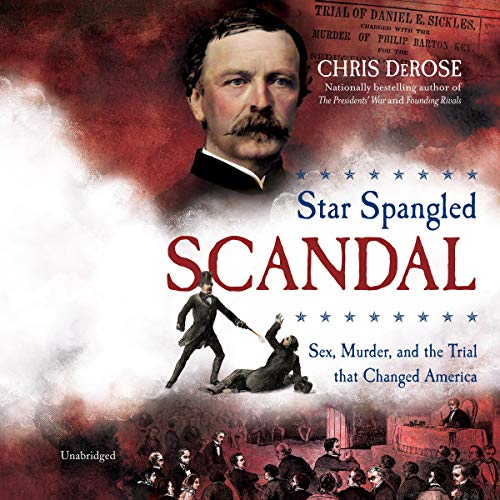
Star Spangled Scandal
Summary
The year is 1859, and Congressman Daniel Sickles and his beautiful wife Teresa are the toast of Washington society. President James Buchanan is godfather to their daughter. Philip Barton Key, US Attorney for the District of Columbia (and the son of Francis Scott Key), is one of the couple's closest friends - so close, in fact, that he often escorts the beautiful Mrs. Sickles to social events when the congressman is too busy. Revelers in DC are accustomed to the sight of the congressman's wife with the tall, Apollo-like Philip Barton Key, who is considered "the handsomest man in all Washington society...foremost among the popular men of the capital." Then one day, Congressman Daniel Sickles receives an anonymous note about his wife and Key, setting into motion a tragic course of events that culminates in a bloody confrontation in the street that leaves one man dead and the other charged with murder. This is the riveting true story of the murder and historic trial that shocked 19th-century America, now brought to vivid life by historian Chris DeRose with the help of Mrs. Sickles' writings and other primary sources.
©2019 Chris DeRose (P)2019 Blackstone Audio, Inc.

Judgment on the Front Line
Summary
Front-line employees can be your greatest asset - here's how to tap their rich vein of insight and leadership. Front-line employees who deal directly with customers are the face of any organization. Not only do they have the most impact on how a brand is perceived, but they are also the most valuable source of insight into what customers want and how to give it to them. Unfortunately, as management experts Chris DeRose and Noel M. Tichy explain, most organizations don't know how to evaluate the risk of giving employees more autonomy. Many of those who are willing to try haven't even invested resources in ensuring that - once the shackles are off - front-line employees make good judgments. Tichy and DeRose offer powerful examples of front-line leadership, such as: How Zappos trusts its people to do anything in service of a customer, including providing free product or reimbursing for mistakes How Mayo Clinic of Arizona enabled its nurses to challenge the hierarchy in order to improve patient care
©2012 Chris DeRose and Noel M. Tichy (P)2012 Gildan Media LLC

Founding Rivals
Summary
In 1789, James Madison and James Monroe ran against each other for Congress - the only time that two future presidents have contested a congressional seat. But what was at stake, as author Chris DeRose reveals in Founding Rivals: Madison vs. Monroe, the Bill of Rights, and the Election That Saved a Nation, was more than personal ambition. This was a race that determined the future of the Constitution, the Bill of Rights, the very definition of the United States of America. Friends and political allies for most of their lives, Madison was the Constitution's principal author, Monroe one of its leading opponents. Monroe thought the Constitution gave the federal government too much power and failed to guarantee fundamental rights. Madison believed that without the Constitution, the United States would not survive. It was the most important congressional race in American history, more important than all but a few presidential elections, and yet it is one that historians have virtually ignored. In Founding Rivals, DeRose, himself a political strategist who has fought campaigns in Madison and Monroe's district, relives the campaign, retraces the candidates' footsteps, and offers the first insightful, comprehensive history of this high-stakes political battle. DeRose reveals: How Madison's election ensured the passage of a Bill of Rights - and how Monroe's election would have ensured its failure How Madison came from behind to win a narrow victory (by a margin of only 336 votes) in a district gerrymandered against him How the Bill of Rights emerged as a campaign promise to Virginia's evangelical Christians Why Madison's defeat might have led to a new Constitutional Convention - and the breakup of the United States Founding Rivals tells the extraordinary, neglected story of two of America's most important Founding Fathers. Brought to life by unparalleled research, it is one of the most provocative books of American political history you will listen to this year.
©2011 Chris DeRose (P)2012 Tantor

Congressman Lincoln
Summary
This is the story of an Abraham Lincoln many Americans aren't at all familiar with: Lincoln as a reluctant husband in an abusive relationship; Lincoln who came within moments of fighting a duel with a political adversary; the first and only president to patent an invention; and the first future president to argue before the Supreme Court. Though remembered as a Republican and even more as a figure that transcended partisan politics, Congressman Lincoln reveals Abraham Lincoln to be a master political strategist and a member of the Whig Party, the party to which he belonged for the majority of his career. Before he appealed to America's purest instincts, he argued, "The Whigs have fought long enough for principle and ought to begin to fight for success." Before "malice toward none", Lincoln bragged of his opponent, "I've got the preacher by the balls." Lincoln the policymaker is remembered for his conduct of the Civil War and his handling of slavery. But even during his presidency, Lincoln was concerned with a broad array of issues. As a party leader, candidate for Congress, and member of the House, Lincoln worked on stimulus spending, international trade, banking, and even the post office. And it would be in the Thirtieth Congress that Lincoln would first move to halt the expansion of slavery, carefully crafting a bill for gradual emancipation in the District of Columbia. This is the story of America at a critical time: the tale of a Congress that ended a conflict, unsure of what had been gained aside from a seat strapped to a powder keg; of a party aiming to win the presidency at all costs, paving the path for its own extinction; and of a country charting an irreversible course toward Civil War. Moreover, it is the story of the man who led the United States during its darkest hours and his role at the center of this gathering storm. This is the story of Congressman Abraham Lincoln.
©2013 Chris DeRose (P)2013 Tantor