David Nasaw has 5 audiobooks on Listento.it, narrated by 5 narrators, with an average listener rating of 4.5★ across 121 ratings. The most-rated is Armada [French Version].
![Cover art for Armada [French Version]](https://m.media-amazon.com/images/I/51r-2CkzGGL._SL500_.jpg)
Armada [French Version]
Summary
Zack Lightman a passé sa vie à rêver. À rêver que la réalité pouvait être un peu plus semblable à celle montrée dans les innombrables livres de science-fiction, films et jeux vidéo qu'il a dévoré toute sa vie. À rêver qu'un jour, un événement particulier viendrait bouleverser la monotonie de son ennuyeuse existence et le propulse dans une aventure galactique lointaine. Il sait bien qu'ici, dans le monde réel, les adolescents ordinaires à tendance colérique et amateurs de jeux vidéo ne sont pas choisis pour sauver l'univers. Et c'est alors qu'il aperçoit une soucoupe volante. Encore plus étrange, le vaisseau alien qu'il a devant lui sort tout droit du jeu vidéo auquel il joue toutes les nuits, un simulateur de vol massivement populaire du nom d'Armada, dans lequel les joueurs doivent justement protéger la terre d'une invasion alien. Non, Zack n'a pas perdu la tête. Aussi incroyable que cela puisse paraître, ce qu'il voit est bien réel. Ses capacités - ainsi que celles de millions de joueurs - vont être nécessaires pour sauver le monde de la menace extraterrestre. C'est enfin la chance pour Zack de jouer les héros. Mais même dans l'excitation du combat, il ne peut s'empêcher de repenser à toutes ces histoires de science-fiction avec lesquelles il a grandi, et de se demander : ce scenario n'aurait-il pas un air de déjà-vu ? En embrassant joyeusement, et en contournant brillamment les conventions de la science-fiction comme seul Ernest Cline sait le faire, Armada est un thriller flamboyant et surprenant, un futur classique de l'aventure. >> Ce livre audio en version intégrale vous est proposé en exclusivité par Audible et est uniquement disponible en téléchargement.
©2018 Hugo Roman (P)2018 Audible Studios
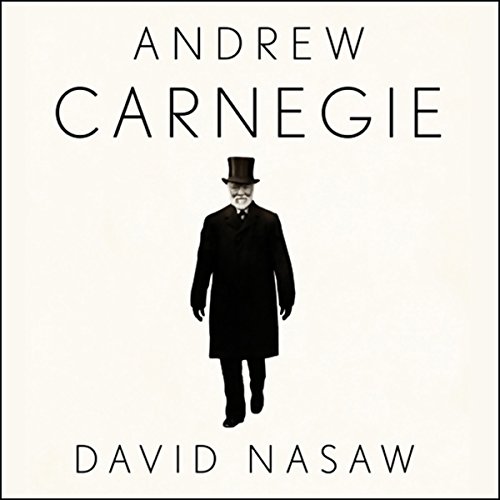
Andrew Carnegie
Summary
Andrew Carnegie, whose lifetime spanned the era from the beginning of the Industrial Revolution to the First World War was America's first modern titan. In this magnificent biography, celebrated historian David Nasaw brings to life this period of unprecedented transition - a time of self-made millionaires, scabs, strikes, and a new kind of philanthropy - through the fascinating rags-to-riches story of one of our most iconic business legends. The Scottish-born son of a failed weaver and a mother who supported the family by binding shoes, Andrew Carnegie was the embodiment of the American dream. In his rise from a job as a bobbin boy in a cotton factory to being the richest man in the world, he was single-minded, relentless, and a major player in some of the most violent and notorious labor strikes of the time. The prototype of today's billionaire, he was a visionary in the way he earned his money and in the way he gave it away. Nasaw explains how Carnegie made his fortune and how he tried to pull the world back from a war he predicted. Brimming with new material, personal letters, diaries, prenuptial agreements, letters to and from presidents and prime ministers, Nasaw plumbs the core of this fascinating man, fixing him in his place as one of the most compelling, elusive, and multifaceted personalities of the 20th century.
©2006 David Nasaw (P)2007 Gildan Media Corp

The Patriarch
Summary
Celebrated historian David Nasaw brings to life the story of Joseph Patrick Kennedy, in this, the first and only biography based on unrestricted and exclusive access to the Joseph P. Kennedy papers. Joseph Patrick Kennedy - whose life spanned the First World War, the Roaring Twenties, the Great Depression, the Second World War, and the Cold War - was the patriarch of America’s greatest political dynasty. The father of President John F. Kennedy and Senators Robert and Edward Kennedy, 'Joe' Kennedy was an indomitable and elusive figure whose dreams of advancement for his nine children were matched only by his extraordinary personal ambition and shrewd financial skills. Trained as a banker, Kennedy was also a Hollywood mogul, a stock-exchange savant, a shipyard manager, the founding chairman of the Securities and Exchange Commission, and ambassador to London during the Battle of Britain. Though his incredible life encompasses the very heart of the American century, Joseph Kennedy has remained shrouded in rumor and prejudice for decades. Drawing on never-before-published material from archives on three continents, David Nasaw - the renowned biographer of Andrew Carnegie and William Randolph Hearst - unearths a man far more complicated than the popular portrait. Was Kennedy an appeaser and isolationist, an anti-Semite and Nazi sympathizer, a stock swindler, a bootlegger, and a colleague of mobsters? Did he push his second son into politics and then buy his elections for him? Why did he have his daughter Rosemary lobotomized? Why did he oppose the Truman Doctrine, the Marshall Plan, the Korean War, and American assistance to the French in Vietnam? What was his relationship to J. Edgar Hoover and his FBI? How did he influence his son’s politics and policies in the White House? In this groundbreaking biography, Nasaw ignores the tired old answers surrounding Kennedy, starting from scratch to discover the truth behind this misunderstood man. Though far from a saint, Joseph Kennedy in many ways exemplifies the best in American political, economic, and social life. His rags-to-riches story is one of exclusion and quiet discrimination overcome by entrepreneurship, ingenuity, and unshakable endurance. Kennedy’s story deserves to be told in full, with no holds barred, and Nasaw’s magnificent The Patriarch is the first book to do so.
©2012 David Nasaw (P)2012 Penguin Audio

The Last Million
Summary
From best-selling author David Nasaw, a sweeping new history of the one million refugees left behind in Germany after WWII. In May of 1945, German forces surrendered to the Allied powers, effectively putting an end to World War II in Europe. But the aftershocks of global military conflict did not cease with the German capitulation. Millions of lost and homeless concentration camp survivors, POWs, slave laborers, political prisoners, and Nazi collaborators in flight from the Red Army overwhelmed Germany, a nation in ruins. British and American soldiers gathered the malnourished and desperate refugees and attempted to repatriate them. But after exhaustive efforts, there remained more than a million displaced persons left behind in Germany: Jews, Poles, Estonians, Latvians, Lithuanians, Ukrainians, and other Eastern Europeans who refused to go home or had no homes to which to return. The Last Million would spend the next three to five years in displaced persons camps, temporary homelands in exile divided by nationality, with their own police forces, churches and synagogues, schools, newspapers, theaters, and infirmaries. The international community could not agree on the fate of the Last Million, and after a year of debate and inaction, the International Refugee Organization was created to resettle them in lands suffering from postwar labor shortages. But no nations were willing to accept the 200,000 to 250,000 Jewish men, women, and children who remained trapped in Germany. In 1948, the United States, among the last countries to accept refugees for resettlement, finally passed a displaced-persons bill. With Cold War fears supplanting memories of World War II atrocities, the bill granted the vast majority of visas to those who were reliably anti-Communist, including thousands of former Nazi collaborators and war criminals, while severely limiting the entry of Jews, who were suspected of being Communist sympathizers or agents because they had been recent residents of Soviet-dominated Poland. Only after the controversial partition of Palestine and Israel's declaration of independence were the remaining Jewish survivors able to leave their displaced-persons camps in Germany. A masterwork from acclaimed historian David Nasaw, The Last Million tells the gripping yet until now largely hidden story of postwar displacement and statelessness. By 1952, the Last Million were scattered around the world. As they crossed from their broken past into an unknowable future, they carried with them their wounds, their fears, their hope, and their secrets. Here for the first time, Nasaw illuminates their incredible history and, with profound contemporary resonance, shows us that it is our history as well.
©2020 David Nasaw (P)2020 Penguin Audio

The Chief
Summary
William Randolph Hearst, known to his staff as the "Chief", was a brilliant business strategist and a man of prodigious appetites. By the 1930s, he controlled the largest publishing empire in the United States, including 28 newspapers, the Cosmopolitan Picture Studio, radio stations, and 13 magazines. He quickly learned how to use this media stronghold to achieve unprecedented political power. The son of a gold miner, Hearst underwent a public metamorphosis from Harvard dropout to political kingmaker; from outspoken populist to opponent of the New Deal; and from citizen to congressman. In The Chief, David Nasaw presents an intimate portrait of the man famously characterized in the classic film Citizen Kane. With unprecedented access to Hearst's personal and business papers, Nasaw details Heart's relationship with his wife, Millicent, and his romance with Marion Davies; his interactions with Hitler, Mussolini, Churchill, and every American president from Grover Cleveland to Franklin Roosevelt; and his acquaintance with movie giants such as Louis B. Mayer, Jack Warner, and Irving Thalberg. An "absorbing, sympathetic portrait of an American original," The Chief sheds light on the private life of a very public man (Chicago Tribune).
©2000 David Nasaw (P)2021 Tantor