Devdutt Pattanaik has 9 audiobooks on Listento.it, narrated by 8 narrators, with an average listener rating of 4.8★ across 9 ratings. The most-rated is 7 Secrets of Shiva.

7 Secrets of Shiva
Summary
Shiva, 'the destroyer' among the Hindu trinity (of gods), is depicted in many contradictory manners. He is an ascetic who wears animal skin, his body smeared with ashes. Contradictory to his wild nature, he is also depicted as having a family, with a beautiful wife and two children. There are many more such varied representations of Shiva, the most prominent of these being the Linga and the Nataraja. The author, Devdutt Pattanaik, introduces listeners to these varied aspects and representations, and then sets about interpreting them. He explains the different anomalies and conflicts in beliefs, as well as the symbolism, rituals and reasons behind Hindu worship.
©2011 Devdutt Pattanaik (P)2017 Audible, Inc.

7 Secrets of Vishnu
Summary
For Hindus, Vishnu is God, who inspires man to discover humanity by engaging with the world. Artists have visualized him with as curlyhaired, dark complexioned man with a smile on his lips and a sparkle in his eyes. Draped in yellow silk, garlanded with forest flowers, bedecked with dolphin-shaped earrings, anointed with sandal paste, he reclines on a thousand hooded serpent that floats on an ocean of milk and rides a golden hawk bearing in his arms a conchshell, a wheel, a mace and a lotus. Poets say that when he is awake, the world takes shape; when he is asleep, the world ceases to be. Lakshmi, the goddess of wealth, follows him wherever he goes. To him is made offerings of rich creamy butter. Sometimes, as the upright Ram, he is worshipped across India as Balaji, Shreenathji, Jagannath, Ranganath and Badrinath. Locked in the stories, symbols and rituals of Vishnu is the wisdom of the ancestors, transmitted over hundreds of years. This book attempts to unlock seven secrets that are relevant even in modern times.
©2011 Devdutt Pattanaik (P)2017 Audible, Inc.

My Gita
Summary
In My Gita, acclaimed mythologist Devdutt Pattanaik demystifies The Bhagavad Gita for the contemporary reader. His unique approach - thematic rather than verse by verse - makes the ancient treatise eminently accessible. In a world that seems spellbound by argument over dialogue, vi-vaad over sam-vaad, Devdutt highlights how Krishna nudges Arjuna to understand rather than judge his relationships. This becomes relevant today when we are increasingly indulging and isolating the self (self-improvement, self-actualization, self-realization - even selfies!). We forget that we live in an ecosystem of others, where we can nourish each other with food, love and meaning, even when we fight. So let My Gita inform your Gita. PLEASE NOTE: When you purchase this title, the accompanying PDF will be available in your Audible Library along with the audio.
©2015 Devdutt Pattanaik, iIllustrations Copyright Devdutt Pattanaik (P)2016 Audible, Inc.
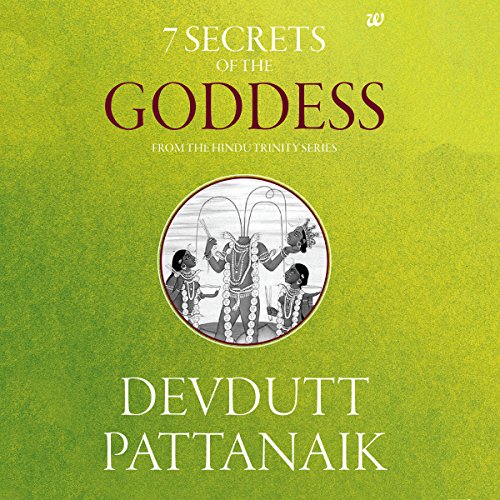
7 Secrets of the Goddess
Summary
Lakshmi massages Vishnu's feet. Is this male domination? Kali stands on Shiva's chest. Is this female domination? Shiva is half a woman. Is this gender quality? Why then is Shakti never half a man? Taken literally, stories, symbols and rituals of Hindu mythology have much to say about gender relationships. Taken symbolically, they reveal many more things about humanity and nature. Which is the correct reading? The third title in the bestselling Hindu Trinity series focuses on the goddess, and respected mythologist Devdutt Pattanaik tries to unravel the secrets locked within her stories, symbols and rituals.
©2014 Devdutt Pattanaik (P)2017 Audible, Inc.
![Cover art for Ramayana Banaam Mahabharata [Ramayana vs. Mahabharata]](https://m.media-amazon.com/images/I/51tFtwwvC8L._SL500_.jpg)
Ramayana Banaam Mahabharata [Ramayana vs. Mahabharata]
Summary
It is a popular belief that the Ramayana is idealistic while the Mahabharata is realistic. Yet these two epics have identical building blocks, identical themes and identical history. In this groundbreaking book, Devdutt Pattanaik, India’s most popular mythologist, explores the similarities and dissimilarities between the two epics in a ‘playful analysis’. Whether it is the family structure, forest exile or war, the comparison between the two epics proves a startling point - the Mahabharata is in fact a reaction to the events in the Ramayana. Ideas in this book are distributed over 56 chapters. In temple ritual, Vishnu is offered 8 different meals daily, different on all seven days of the week - 56 dishes in all. May each chapter serve as a mouthwatering offering to the Vishnu within you. Please note: This audiobook is in Hindi.
©2019 Devdutt Pattanaik (P)2020 Audible, Inc.

The Pregnant King
Summary
"‘I am not sure that I am a man,’ said Yuvanashva. ‘I have created life outside me as men do. But I have also created life inside me, as women do. What does that make me? Will a body such as mine fetter or free me?’" Among the many hundreds of characters who inhabit the Mahabharata, perhaps the world’s greatest epic and certainly one of the oldest, is Yuvanashva, a childless king, who accidentally drinks a magic potion meant to make his queens pregnant and gives birth to a son. This extraordinary novel is his story. It is also the story of his mother Shilavati, who cannot be king because she is a woman; of young Somvat, who surrenders his genitals to become a wife; of Shikhandi, a daughter brought up as a son, who fathers a child with a borrowed penis; of Arjuna, the great warrior with many wives, who is forced to masquerade as a woman after being castrated by a nymph; of Ileshwara, a god on full-moon days and a goddess on new-moon nights; and of Adi-natha, the teacher of teachers, worshipped as a hermit by some and as an enchantress by others. Building on Hinduism’s rich and complex mythology - but driven by a very contemporary sensibility - Devdutt Pattanaik creates a lush and fecund work of fiction in which the lines are continually blurred between men and women, sons and daughters, husbands and wives, fathers and mothers. Confronted with such fluidity the listener is drawn into Yuvanashva’s struggle to be fair to all - those here, those there, and all those in between.
©2008, 2014 Devdutt Pattanaik (P)2019 Random House Audio

Sita: An Illustrated Retelling of the Ramayana
Summary
Sita: An Illustrated Retelling of Ramayana is an epic story based on the life of India’s most admired prince - ‘Rama’ and his wife ‘Sita’. Ramayana is a mythological story, which has been passed down for many generations. Since ages, the character that is most emphasized has been that of Rama, who has always been known to keep his word whatever be the circumstances. The role of Sita has been generally overlooked in the past. Sita, too, is a pivotal character. Being a single mother, she went through many ups and downs all alone. Still, she has often been portrayed as a frail and meek character. In the present audiobook, the author has emphasized on this very fact that Sita, though shown as a submissive character, was a woman who had massive strength. In the book, the author has shown Sita’s childhood in a more detailed manner. Her relationship with her father, King Janaka, who was a very sober and spiritual person; Sita’s forest stay with her husband and after that her lone stay; her connection and conversations with the women in Lanka, at the ‘Ashoka Vatika’, the sentiments that were shared amongst them. Also, depicted is her attachment with her sisters; with the trees in the forest, as she loved her life in forest; her bond with the mother earth. This book has portrayed Sita in a fair and magnanimous way, along with restating the whole story of Ramayana.
©2014 Devdutt Pattanaik (P)2019 Random House Audio

Ramayana Versus Mahabharata
Summary
It is a popular belief that the Ramayana is idealistic while the Mahabharata is realistic. Yet these two epics have identical building blocks, identical themes, and identical history. In this groundbreaking book, Devdutt Pattanaik, India’s most popular mythologist, explores the similarities and dissimilarities between the two epics in a ‘playful analaysis’. Whether it is the family structure, forest exile, or war, the comparison between the two epics prove a startling point - the Mahabharata is in fact a reaction to the events in the Ramayana. Ideas in this book are distributed over 56 chapters. In temples ritual, Vishnu is offered eight different meals daily, different on all seven days of the week - 56 dishes in all. May each chapter serve as a mouthwatering offering to the Vishnu within you.
©2018 Devdutt Pattanaik (P)2019 Audible, Inc.

99 Thoughts on Ganesha
Summary
In the game of cricket, having scored 99 runs, when a bats-man stands poised on the threshold of that much coveted century, he experiences the moment that is best associated with Ganesha. Fear and uncertainty envelope him; between him and his achievement stand hurdles, both real and imaginary: a possible spin from the bowler can overwhelm him, his own anxiety can paralyze him, cheering fans can distract him. He needs divine intervention then. He needs to focus, get rid of all hurdles, perform, get the final run, and achieve what he so longs for. In other words, he needs to think of Ganapati. This book brings together 99 meditations to better understand the stories, symbols and rituals of that adorable elephant-headed Hindu god who removes hurdles and brings prosperity and peace. Known variously as Ganapati, Gajanana, Vinayaka or Pillayar, he can help all of us score a century in the game called life.
©2011; Pattanaik, Devdutt (P)2020 Audible, Inc.