Edmund Morris has 9 audiobooks on Listento.it, narrated by 6 narrators, with an average listener rating of 4.2★ across 70 ratings. The most-rated is The Rise of Theodore Roosevelt.
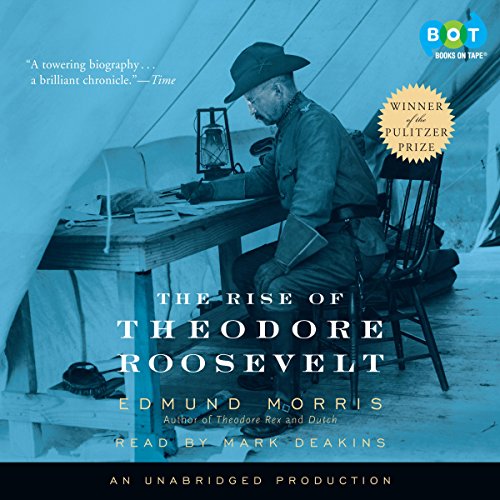
The Rise of Theodore Roosevelt
Summary
Described by the Chicago Tribune as "a classic", The Rise of Theodore Roosevelt stands as one of the greatest biographies of our time. The publication of The Rise of Theodore Roosevelt on September 14th, 2001, marked the 100th anniversary of Theodore Roosevelt becoming president.
©2001 Edmund Morris (P)2010 Random House

Colonel Roosevelt
Summary
Of all our great presidents, Theodore Roosevelt is the only one whose greatness increased out of office. When he toured Europe in 1910 as plain “Colonel Roosevelt”, he was hailed as the most famous man in the world. Crowned heads vied to put him up in their palaces. “If I see another king,” he joked, “I think I shall bite him.” Had TR won his historic “Bull Moose” campaign in 1912 (when he outpolled the sitting president, William Howard Taft), he might have averted World War I, so great was his international influence. Had he not died in 1919, at the early age of 60, he would unquestionably have been reelected to a third term in the White House and completed the work he began in 1901 of establishing the United States as a model democracy, militarily strong and socially just. This biography by Edmund Morris, the Pulitzer Prize and National Book Award-winning author of The Rise of Theodore Roosevelt and Theodore Rex, is itself the completion of a trilogy sure to stand as definitive. Packed with more adventure, variety, drama, humor, and tragedy than a big novel, yet documented down to the smallest fact, it recounts the last decade of perhaps the most amazing life in American history. What other president has written 40 books, hunted lions, founded a third political party, survived an assassin’s bullet, and explored an unknown river longer than the Rhine?
©2010 Edmund Morris; 2010 Random House Audio (P)2010 Random House Audio

Theodore Rex
Summary
Theodore Rex is the story - never fully told before - of Theodore Roosevelt’s two world-changing terms as president of the US. A hundred years before the catastrophe of September 11, 2001, “TR” succeeded to power in the aftermath of an act of terrorism. Youngest of all our chief executives, he rallied a stricken nation with his superhuman energy, charm, and political skills. He proceeded to combat the problems of race and labor relations and trust control while making the Panama Canal possible and winning the Nobel Peace Prize. But his most historic achievement remains his creation of a national conservation policy, and his monument millions of acres of protected parks and forest. Theodore Rex ends with TR leaving office, still only 50 years old, his future reputation secure as one of our greatest presidents.
©2001 Edmund Morris (P)2002 Books on Tape, Inc.

Edison
Summary
New York Times best seller From Pulitzer Prize-winning author Edmund Morris comes a revelatory new biography of Thomas Alva Edison, the most prolific genius in American history. Named one of the Best Books of the Year by Time • Publishers Weekly • Kirkus Reviews Although Thomas Alva Edison was the most famous American of his time, and remains an international name today, he is mostly remembered only for the gift of universal electric light. His invention of the first practical incandescent lamp 140 years ago so dazzled the world - already reeling from his invention of the phonograph and dozens of other revolutionary devices - that it cast a shadow over his later achievements. In all, this near-deaf genius ("I haven’t heard a bird sing since I was 12 years old") patented 1,093 inventions, not including others, such as the X-ray fluoroscope, that he left unlicensed for the benefit of medicine. One of the achievements of this staggering new biography, the first major life of Edison in more than 20 years, is that it portrays the unknown Edison- the philosopher, the futurist, the chemist, the botanist, the wartime defense adviser, the founder of nearly 250 companies - as fully as it deconstructs the Edison of mythological memory. Edmund Morris, winner of the Pulitzer Prize and the National Book Award, brings to the task all the interpretive acuity and literary elegance that distinguished his previous biographies of Theodore Roosevelt, Ronald Reagan, and Ludwig van Beethoven. A trained musician, Morris is especially well equipped to recount Edison’s 50-year obsession with recording technology and his pioneering advances in the synchronization of movies and sound. Morris sweeps aside conspiratorial theories positing an enmity between Edison and Nikola Tesla and presents proof of their mutually admiring, if wary, relationship. Enlightened by seven years of research among the five million pages of original documents preserved in Edison’s huge laboratory at West Orange, New Jersey, and privileged access to family papers still held in trust, Morris is also able to bring his subject to life - the adored yet autocratic and often neglectful husband of two wives and father of six children. If the great man who emerges from it is less a sentimental hero than an overwhelming force of nature, driven onward by compulsive creativity, then Edison is at last getting his biographical due
©2019 Edmund Morris (P)2019 Random House Audio

The Pieces We Keep
Summary
Two years have done little to ease veterinarian Audra Hughes' grief over her husband's untimely death. Eager for a fresh start, Audra plans to leave Portland for a new job in Philadelphia. Her seven-year-old son, Jack, seems apprehensive about flying - but it's just the beginning of an anxiety that grows to consume him. As Jack's fears continue to surface in recurring and violent nightmares, Audra hardly recognizes the introverted boy he has become. Desperate, she traces snippets of information unearthed in Jack's dreams, leading her to Sean Malloy, a struggling U.S. Army veteran wounded in Afghanistan. Together they unravel a mystery dating back to World War II, and uncover old family secrets that still have the strength to wound - and perhaps, at last, to heal. Intricate and beautifully written, The Pieces We Keep illuminates those moments when life asks us to reach beyond what we know and embrace what was once unthinkable. Deftly weaving together past and present, herein lies a story that is at once poignant and thought-provoking, and as unpredictable as the human heart.
©2013 Kristina McMorris (P)2014 Tantor

Theodore Rex
Summary
The most eagerly awaited presidential biography in years, Theodore Rex begins by following new president Theodore Roosevelt as he takes his emergency oath of office in Buffalo, upon the assassination of President McKinley one hundred years ago. Theodore Rex, full of cinematic detail, moves with the exhilarating pace of a novel, yet it rides on a granite base of scholarship. TR's speed of thought and action, and his total command of all aspects of presidential leadership, from bureaucratic subterfuge to manipulation of the press, make him all but invincible in 1904, when he wins a second term by a historic landslide. Surprisingly, this victory transforms him from a patrician conservative to a progressive, responsible between 1905 and 1908 for a raft of enlightened legislation. Interspersed with many stories of Rooseveltian triumphs are some bitter episodes - notably a devastating lynching - that remind us of America's deep prejudices and fears. Theodore Rex does not attempt to justify TR's notorious action following the Brownsville Incident of 1906 - his worst mistake as president - but neither does this resolutely honest biography indulge in the easy wisdom of hindsight. It is written throughout in real time, reflecting the world as TR saw it. By the final chapter, as the great "Teddy" prepares to quit the White House, it will be a hard-hearted listener who does not share the sentiment of Henry Adams: "The old house will seem dull and sad when my Theodore has gone."Listen to a conversation with Edmund Morris.
©2001 Edmund Morris (P)2001 Random House Audio, a Division of Random House Inc.

Dutch
Summary
This book, the only biography ever authorized by a sitting President - yet written with complete interpretive freedom - is as revolutionary in method as it is formidable in scholarship. When Ronald Reagan moved into the White House in 1981, one of his first literary guests was Edmund Morris, the Pulitzer Prize-winning biographer of Theodore Roosevelt. Morris developed a fascination for the genial yet inscrutable president and, after Reagan's landslide reelection in 1984, put aside the second volume of his life of Roosevelt to become an observing eye and ear at the White House. Coming and going with Reagan's benign approval ("I'm not going to ride up San Juan Hill for you"), Morris found the president to be a man of extraordinary power and mystery. Although the historic early achievements were plain to see - the restoration of American optimism and patriotism, a repowering of the national economy, a massive arms buildup deliberately forcing the "Evil Empire" of Soviet Communism to come to terms - nobody, let alone Reagan himself, could explain how he succeeded in shaping events to his will. And when Reagan's second term came to grips with some of the most fundamental moral issues of the late 20th century - at Bitburg and Bergen-Belsen, at Geneva and Reykjavík, publicly outside the Brandenburg Gate ("Mr. Gorbachev, tear down this wall!"), and deep within the mother monastery of the Russian Orthodox Church - Morris realized that he had taken on a subject of epic dimensions. Thus began a long biographical pilgrimage to the heart of Ronald Reagan's mystery, beginning with his birth in 1911 in the heart of rural Illinois (where he is still remembered as "Dutch", the dreamy son of an alcoholic father and a fiercely religious mother) and progressing through the way stations of an amazingly varied career: young lifeguard (he saved 77 lives), aspiring writer, ace sportscaster, film star, soldier, union leader, corporate spokesman, governor, and president. Reagan granted Morris full access to his personal papers, including early autobiographical stories and a handwritten White House diary. The pilgrimage climaxes in 1993, when, in a moment of aching poignancy, Morris escorts his aged and failing subject back up the stairs of his birthplace. "An odd, Dantesque reversal of roles had occurred, as if I were now the leader rather than the led." During 13 years of obsessive archival research and interviews with Reagan and his family, friends, admirers, and enemies (the book's enormous dramatis personae includes such varied characters as Mikhail Gorbachev, Michelangelo Antonioni, Elie Wiesel, Mario Savio, François Mitterrand, Grant Wood, and Zippy the Pinhead), Morris lived what amounted to a doppelgänger life, studying the young "Dutch", the middle-aged "Ronnie". and the septuagenarian chief executive with a closeness and dispassion, not to mention alternations of amusement, horror, and amazed respect, unmatched by any other presidential biographer. This almost Boswellian closeness led to a unique literary method whereby, in the earlier chapters of Dutch: A Memoir of Ronald Reagan, Morris's biographical mind becomes in effect another character in the narrative, recording long-ago events with the same eyewitness vividness (and absolute documentary fidelity) with which the author later describes the great dramas of Reagan's presidency, and the tragedy of a noble life now darkened by dementia. "I quite understand," the author has remarked, "that readers will have to adjust, at first, to what amounts to a new biographical style. But the revelations of this style, which derive directly from Ronald Reagan's own way of looking at his life, are I think rewarding enough to convince them that one of the most interesting characters in recent American history looms here like a colossus."
©2000 Edmund Morris (P)2012 Random House Audio

The Rise of Theodore Roosevelt
Summary
Available for the first time in audio, The Rise of Theodore Roosevelt is the story of seven men - a naturalist, a writer, a lover, a hunter, a ranchman, a soldier, and a politician - who merged at age 42 to become the youngest American President in history. Twenty-one years ago, this classic biography (the first volume of a planned trilogy; the second, Theodore Rex, was published in 2001) won both the Pulitzer Prize and American Book Award, and since then it has never been out of print. Listen to a conversation with Edmund Morris.
©1979 Edmund Morris (P)2002 Random House Inc., Random House Audio, a Division of Random House Inc.

This Living Hand
Summary
When the multitalented biographer Edmund Morris (who writes with equal virtuosity about Theodore Roosevelt, Ronald Reagan, Beethoven, and Thomas Edison) was a schoolboy in colonial Kenya, one of his teachers told him, "You have the most precious gift of all - originality." That quality is abundantly evident in this selection of essays. They cover 40 years in the life of a maverick intellectual who can be, at whim, astonishingly provocative, self-mockingly funny, and richly anecdotal. (The title essay, a tribute to Reagan in cognitive decline, is poignant in the extreme.) Whether Morris is analyzing images of Barack Obama or the prose style of President Clinton, or exploring the riches of the New York Public Library Dance Collection, or interviewing the novelist Nadine Gordimer, or proposing a hilarious "Diet for the Musically Obese", a continuous cross-fertilization is going on in his mind. It mixes the cultural pollens of Africa, Britain, and the United States, and propogates hybrid flowers - some fragrant, some strange, some a shock to conventional sensibilities. Repeatedly in This Living Hand, Morris celebrates the physicality of artistic labor, and laments the glass screen that today’s e-devices interpose between inspiration and execution. No presidential biographer has ever had so literary a "take" on his subjects: He discerns powers of poetic perception even in the obsessively scientific Edison. Nor do most writers on music have the verbal facility to articulate, as Morris does, what it is about certain sounds that soothe the savage breast. His essay on the pathology of Beethoven’s deafness breaks new ground in suggesting that tinnitus may explain some of the weird aural effects in that composer’s works. Masterly monographs on the art of biography, South Africa in the last days of apartheid, the romance of the piano, and the role of imagination in nonfiction are juxtaposed with enchanting, almost unclassifiable pieces such as "The Bumstitch: Lament for a Forgotten Fruit" (Morris suspects it may have grown in the Garden of Eden); "The Anticapitalist Conspiracy: A Warning" (an assault on The Chicago Manual of Style); "Nuages Gris: Colors in Music, Literature, and Art"; and the uproarious "Which Way Does Sir Dress?", about ordering a suit from the most expensive tailor in London. This Living Hand is packed with biographical insights into such famous personalities as Daniel Defoe, Henry Adams, Mark Twain, Evelyn Waugh, Truman Capote, Glenn Gould, Jasper Johns, W. G. Sebald, and Winnie the Pooh - not to mention a gallery of forgotten figures whom Morris lovingly restores to "life". Among these are the pianist Ferruccio Busoni, the poet Edwin Arlington Robinson, the novelist James Gould Cozzens, and 16 so-called "Undistinguished Americans", contributors to an anthology of anonymous memoirs published in 1902. Reviewing that book for The New Yorker, Morris notes that even the most unlettered persons have, on occasion, "power to send forth surprise flashes, illuminating not only the dark around them but also more sophisticated shadows - for example, those cast by public figures who will not admit to private failings, or by philosophers too cerebral to state a plain truth." The author of This Living Hand is not an ordinary person, but he too sends forth surprise flashes, never more dazzlingly than in his final essay, "The Ivo Pogorelich of Presidential Biography".
©2012 Edmund Morris (P)2012 Random House Audio