Elie Wiesel has 8 audiobooks on Listento.it, narrated by 9 narrators, with an average listener rating of 4.4★ across 214 ratings. The most-rated is Night.
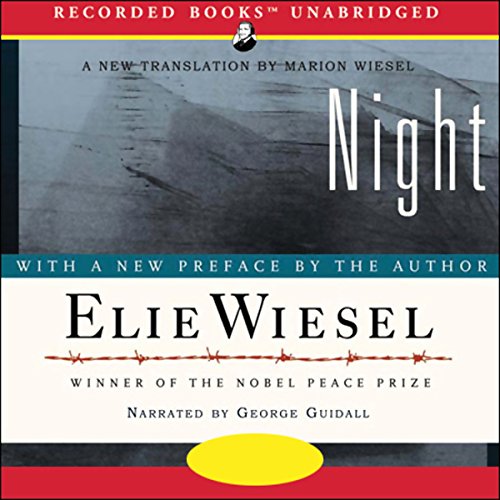
Night
Summary
Awarded the Nobel Peace Prize and the Congressional Gold Medal, Holocaust survivor Elie Wiesel offers an unforgettable account of Hitler's horrific reign of terror in Night. This definitive edition features a new translation from the original French by Wiesel's wife and frequent translator, Marion Wiesel. Night is an unmistakably autobiographical account of the author's own gruesome experiences in Nazi Germany's death camps. Told through the eyes of 14-year-old Eliezer, the tragic fate of the Jews from the little town of Sighet unfolds with a heart-wrenching inevitability. Even as they are stuffed into cattle cars bound for Auschwitz, the townspeople refuse to believe rumors of anti-Semitic atrocities. Not until they are marched toward the blazing crematory at the camp's "reception center" does the terrible truth sink in. Recounting the evils at Auschwitz and Buchenwald, Wiesel's enduring classic of Holocaust literature raises questions of continuing significance for all future generations: How could man commit these horrors, and could such an evil ever be repeated?
©1972, 1985 Elie WieselOriginally published in 1958 by Les Editions de MinuitTranslation 2006 by Marion WieselPreface to the New Translation 2006 Elie Wiesel (P)2006 Recorded Books LLC

La nuit
Summary
Né en 1928 à Sighet en Transylvanie, Elie Wiesel était un adolescent lorsqu'en 1944 il fut déporté avec sa famille à Auschwitz puis à Birkenau. La nuit est le récit des souvenirs qu'Elie Wiesel conserve de la séparation d'avec sa mère et sa petite sœur qu'il ne reverra plus jamais et du camp où avec son père il partage la faim, le froid, les coups, les tortures... et la honte de perdre sa dignité d'homme quand il ne répondra pas à son père mourant. " La nuit, écrivait Elie Wiesel en 1983, est un récit, un écrit à part, mais il est la source de tout ce que j'ai écrit par la suite. Le véritable thème de La nuit est celui du sacrifice d'Isaac, le thème fondateur de l'histoire juive. Abraham veut tuer Isaac, le père veut tuer son fils, et selon une tradition légendaire le père tue en effet son fils. L'expérience de notre génération est, à l'inverse, celle du fils qui tue le père, ou plutôt qui survit au père. La nuit est l'histoire de cette expérience." Elie Wiesel a reçu le prix Nobel de la paix en 1986. La comédienne Guila Clara Kessous a reçu en 2012 le prix d'Artiste pour la paix de l'UNESCO. C'est à elle qu'Elie Wiesel et Josette Keisermann, présidente de l'Association HAC, ont confié la lecture de ce bouleversant témoignage.
©1955 Éditions de Minuit (P)2015 Éditions Gallimard

Dawn (Unabriged)
Summary
With the coming of dawn is the coming of death for a captured English officer in British-controlled Palestine. Elisha, a young Israeli freedom fighter, is his executioner. Ordered to kill the officer in reprisal for Britain's execution of a Jewish prisoner, Elisha thinks about his past, a sorrowful memory of the nightmare of Nazi death camps. As the only surviving member of his family, he dreamt of a wonderful future in his promised homeland. But instead, he finds himself closer to committing heartless murder with the approach of daylight. Dawn presents a haunting glimpse into the soul of one man and a budding nation.
©1961, 2006 Elie Wiesel; 1989 Elie Wiesel (P)2006 Recorded Books, LLC.

The Night Trilogy
Summary
Night is one of the masterpieces of Holocaust literature. First published in 1958, it is the autobiographical account of an adolescent boy and his father in Auschwitz. Elie Wiesel writes of their battle for survival and of his battle with God for a way to understand the wanton cruelty he witnesses each day. In the short novel Dawn (1960), a young man who has survived World War II and settled in Palestine joins a Jewish underground movement and is commanded to execute a British officer who has been taken hostage. In Day (previously titled The Accident, 1961), Wiesel questions the limits of conscience: Can Holocaust survivors forge a new life despite their memories? Wiesel's trilogy offers insights on mankind's attraction to violence and on the temptation of self-destruction.
©2008 Elie wiesel (P)2020 Ruth

All Rivers Run to the Sea
Summary
From his early years with his loving Jewish family to the horrors of Auschwitz to his life as a Nobel Prize-winning writer, Elie Wiesel tells his story. Passionate and poignant, All Rivers Run to the Sea is an unforgettable book of love and rage, doubt and faith, despair and trust, and ultimately, of wisdom.
(P)2006 Random House, Inc. Random House Audio, a division of Random House, Inc.

Day (Unabriged)
Summary
First published in English under the title The Accident, Elie Wiesel's third novel in his trilogy of Holocaust literature has now adopted Wiesel's original title: Day. In the opening scene, a Holocaust survivor and successful journalist steps off a curb in New York City directly into the pathway of an oncoming cab. As he struggles between life and death, the journalist recalls the effects of the historical tragedy of the Holocaust on himself and his family. Like the memoir Night and the novel Dawn, Wiesel again poses important questions involving the meaning of almost an entire annihilation of a race, loss of faith in the face of mass murder and torture, and the aftermath and effects of the Holocaust on individuals and the Jewish people.
©1990 Elie Wiesel; 1962, 2006 Elie Wiesel (P)2006 Recorded Books, LLC.

Open Heart
Summary
A profoundly and unexpectedly intimate, deeply affecting summing up of his life so far, from one of the most cherished moral voices of our time. Eighty-two years old, facing emergency heart surgery and his own mortality, Elie Wiesel reflects back on his life. Emotions, images, faces, and questions flash through his mind. His family before and during the unspeakable Event. The gifts of marriage and children and grandchildren that followed. In his writing, in his teaching, in his public life, has he done enough for memory and the survivors? His ongoing questioning of God - where has it led? Is there hope for mankind? The world's tireless ambassador of tolerance and justice has given us this luminous account of hope and despair, an exploration of the love, regrets, and abiding faith of a remarkable man.
©2012 Elie Wiesel (P)2012 Random House Audio

The Tale of a Niggun
Summary
Elie Wiesel’s heartbreaking narrative poem about history, immortality, and the power of song, accompanied by magnificent full-color illustrations by award-winning artist Mark Podwal. Based on an actual event that occurred during World War II. It is the evening before the holiday of Purim, and the Nazis have given the ghetto’s leaders 24 hours to turn over 10 Jews to be hanged to “avenge” the deaths of the 10 sons of Haman, the villain of the Purim story, which celebrates the triumph of the Jews of Persia over potential genocide some 2,400 years ago. If the leaders refuse, the entire ghetto will be liquidated. Terrified, they go to the ghetto’s rabbi for advice; he tells them to return the next morning. Over the course of the night the rabbi calls up the spirits of legendary rabbis from centuries past for advice on what to do, but no one can give him a satisfactory answer. The 18th century mystic and founder of Hasidism, the Baal Shem Tov, tries to intercede with God by singing a niggun - a wordless, joyful melody with the power to break the chains of evil. The next evening, when no volunteers step forward, the ghetto’s residents are informed that in an hour they will all be killed. As the minutes tick by, the ghetto’s rabbi teaches his assembled community the song that the Baal Shem Tov had sung the night before. And then the voices of these men, women, and children soar to the heavens. How can the heavens not hear?
©2020 Elie Wiesel (P)2020 Random House Audio