Jeffrey Eugenides has 5 audiobooks on Listento.it, narrated by 10 narrators, with an average listener rating of 3.8★ across 121 ratings. The most-rated is Middlesex.
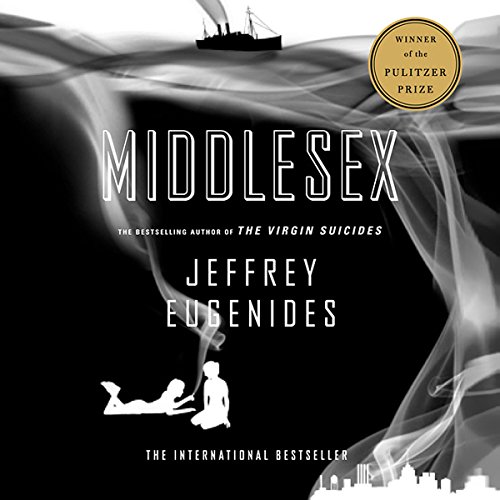
Middlesex
Summary
In the spring of 1974, Calliope Stephanides, a student at a girls' school in Grosse Pointe, finds herself drawn to a chain-smoking, strawberry-blonde classmate with a gift for acting. The passion that furtively develops between them - along with Callie's failure to develop physically - leads Callie to suspect that she is not like other girls. In fact, she is not really a girl at all. The explanation for this shocking state of affairs is a rare genetic mutation - and a guilty secret - that have followed Callie's grandparents from the crumbling Ottoman Empire to Prohibition-era Detroit and beyond, outlasting the glory days of the Motor City, the race riots of 1967, and the family's second migration, into the foreign country known as suburbia. Thanks to the gene, Callie is part girl, part boy. And even though the gene's epic travels have ended, her own odyssey has only begun. Spanning eight decades - and one unusually awkward adolescence - Jeffrey Eugenides' long-awaited second novel is a grand, original fable of crossed bloodlines, the intricacies of gender, and the deep, untidy promptings of desire. Winner of the 2003 Pulitzer Prize for Fiction and the Audie Award for best unabridged fiction, Middlesex marks the fulfillment of a huge talent, named one of America's best young novelists by both Granta and The New Yorker.
©2002 Jeffrey Eugenides (P)2002 Audio Renaissance, a division of Holtzbrinck Publishers, LLC

The Virgin Suicides
Summary
This nationally best-selling novel from Pulitzer Prize-winner Jeffrey Eugenides was adapted into an acclaimed film by Academy Award-winner Sofia Coppola. A haunting yet wickedly funny tale, The Virgin Suicides has captivated countless readers with its intoxicating portrait of lost innocence. A brilliant fusion of dark humor and tragedy, it is an atmospheric, allegorical masterpiece about five oppressed, suicidal sisters and the boys who dream of rescuing them.
©1993 Jeffrey Eugenides (P)2006 Recorded Books, LLC.

The Marriage Plot
Summary
It’s the early 1980s—the country is in a deep recession, and life after college is harder than ever. In the cafés on College Hill, the wised-up kids are inhaling Derrida and listening to Talking Heads. But Madeleine Hanna, dutiful English major, is writing her senior thesis on Jane Austen and George Eliot, purveyors of the marriage plot that lies at the heart of the greatest English novels. As Madeleine tries to understand why “it became laughable to read writers like Cheever and Updike, who wrote about the suburbia Madeleine and most of her friends had grown up in, in favor of reading the Marquis de Sade, who wrote about deflowering virgins in 18th-century France,” real life, in the form of two very different guys, intervenes. Leonard Bankhead—charismatic loner, college Darwinist, and lost Portland boy—suddenly turns up in a semiotics seminar, and soon Madeleine finds herself in a highly charged erotic and intellectual relationship with him. At the same time, her old “friend” Mitchell Grammaticus—who’s been reading Christian mysticism and generally acting strange—resurfaces, obsessed with the idea that Madeleine is destined to be his mate. Over the next year, as the members of the triangle in this amazing, spellbinding novel graduate from college and enter the real world, events force them to reevaluate everything they learned in school. Leonard and Madeleine move to a biology Laboratory on Cape Cod, but can’t escape the secret responsible for Leonard’s seemingly inexhaustible energy and plunging moods. And Mitchell, traveling around the world to get Madeleine out of his mind, finds himself face-to-face with ultimate questions about the meaning of life, the existence of God, and the true nature of love. Are the great love stories of the 19th century dead? Or can there be a new story, written for today and alive to the realities of feminism, sexual freedom, prenups, and divorce? With devastating wit and an abiding understanding of and affection for his characters, Jeffrey Eugenides revives the motivating energies of the Novel, while creating a story so contemporary and fresh that it reads like the intimate journal of our own lives.
©2011 Jeffrey Eugenides (P)2011 Macmillan Audio

Fresh Complaint
Summary
The first collection of short fiction from Pulitzer Prize-winner Jeffrey Eugenides, author of The Virgin Suicides, Middlesex, and The Marriage Plot. Jeffrey Eugenides's best selling novels have shown him to be an astute observer of the crises of adolescence, self-discovery, family love, and what it means to be American in our times. The stories in Fresh Complaint explore equally rich and intriguing territory. Ranging from the bitingly reproductive antics of "Baster" to the dreamy, moving account of a young traveler's search for enlightenment in "Air Mail" (selected by Annie Proulx for Best American Short Stories), this collection presents characters in the midst of personal and national emergencies. We meet a failed poet who, envious of other people's wealth during the real-estate bubble, becomes an embezzler; a clavichordist whose dreams of art founder under the obligations of marriage and fatherhood; and, in "Fresh Complaint," a high school student whose wish to escape the strictures of her immigrant family lead her to a drastic decision that upends the life of a middle-aged British physicist. Narratively compelling, beautifully worded, and packed with a density of ideas despite their fluid grace, these stories chart the development and maturation of a major American author.
©2017 Jeffrey Eugenides (P)2017 Macmillan Audio

Wonderful Town
Summary
New York City is not only The New Yorker magazine's place of origin and its sensibility's lifeblood, it is the heart of American literary culture. Wonderful Town, an anthology of superb short fiction by many of the magazine's most accomplished contributors, celebrates the 75-year marriage between a preeminent publication and its preeminent context with this collection of 44 of its best stories from (so to speak) home. East Side? Philip Roth's chronically tormented alter ego, Nathan Zuckerman, has just moved there, in "Smart Money". West Side? Isaac Bashevis Singer's narrator mingles with the customers in "The Cafeteria" (who debate politics and culture in four or five different languages) and becomes embroiled in an obsessional romance. And downtown, John Updike's Maples have begun their courtship of marital disaster, in "Snowing in Greenwich Village". Wonderful Town touches on some of the city's famous places and stops at some of its more obscure corners, but the real guidebook in and between its lines is to the hearts and the minds of those who populate the metropolis built by its words. Like all good fiction, these stories take particular places, particular people, and particular events and turn them into dramas of universal enlightenment and emotional impact. Each life in it, and each life in Wonderful Town, is the life of us all. Including these stories from the magazine's most iconic writers: "The Five-Forty-Eight" by John Cheever "Distant Music" by Ann Beattle "Sailor off the Bremen" by Irwin Shaw "Physics" by Tama Janowitz "The Whore of Mensa" by Woody Allen "What It Was Like, Seeing Chris" by Deborah Eisenberg "Drawing Room B" by John O’Hara "A Sentimental Journey" by Peter Taylor "The Balloon" by Donald Barthelme "Another Marvelous Thing" by Laurie Colwin "The Failure" by Jonathan Franzen "Apartment Hotel" by Sally Benson "Midair" by Frank Conroy "The Catbird Seat" by James Thurber "I See You, Bianca" by Maeve Brennan "You’re Ugly, Too" by Lorrie Moore "Signs and Symbols" by Vladimir Nabokov "Poor Visitor" by Jamaica Kincaid "In Greenwich, There Are Many Graveled Walks" by Hortense Calisher "Some Nights When Nothing Happens Are the Best Nights in this Place" by John McNulty "Slight Rebellion off Madison" by J. D. Salinger "Brownstone" by Renata Adler "Partners" by Veronica Geng "The Evolution of Knowledge" by Niccolo Tucci "The Way We Live Now" by Susan Sontag "Do the Windows Open?" by Julie Hecht "The Mentocrats" by Edward Newhouse "The Treatment" by Daniel Menaker "Arrangement in Black and White" by Dorothy Parker "Carlyle Tries Polygamy" by William Melvin Kelley "Children Are Bored on Sunday" by Jean Stafford "Notes from a Bottle" by James Stevenson "Man in the Middle of the Ocean" by Daniel Fuchs "Me Spoulets of the Splendide" by Ludwig Bemelmans "Over by the River" by William Maxwell "Baster" by Jeffrey Eugenides "The Second Tree from the Corner" by E. B. White "Rembrandt’s Hat" by Bernard Malamud "Shot: A New York Story" by Elizabeth Hardwick "A Father-to-Be" by Saul Bellow "Farewell, My Lovely Appetizer" by S. J. Perelman "Water Child" by Edwidge Danticat "The Smoker" by David Schickler
©2000 The New Yorker Magazine (P)2000 Random House Audio