Jamaica Kincaid has 10 audiobooks on Listento.it, narrated by 13 narrators, with an average listener rating of 3★ across 24 ratings. The most-rated is Lucy.

Lucy
Summary
The coming-of-age story of one of Jamaica Kincaid's most admired creations Lucy, a teenage girl from the West Indies, comes to North America to work as an au pair for Lewis and Mariah and their four children. Lewis and Mariah are a thrice-blessed couple - handsome, rich, and seemingly happy. Yet almost at once, Lucy begins to notice cracks in their beautiful façade. With mingled anger and compassion, Lucy scrutinizes the assumptions and verities of her employers' world and compares them with the vivid realities of her native place. Lucy has no illusions about her own past, but neither is she prepared to be deceived about where she presently is. At the same time that Lucy is coming to terms with Lewis' and Mariah's lives, she is also unraveling the mysteries of her own sexuality. Gradually a new person unfolds: passionate, forthright, and disarmingly honest. In Lucy, Jamaica Kincaid has created a startling new character possessed with adamantine clear-sightedness and ferocious integrity - a captivating heroine for our time.
©2002 Jamaica Kincaid (P)2017 Blackstone Audio, Inc.

A Small Place
Summary
From the award-winning author of Annie John comes a brilliant look at colonialism and its effects in Antigua. "If you go to Antigua as a tourist, this is what you will see. If you come by aeroplane, you will land at the V. C. Bird International Airport. Vere Cornwall (V. C.) Bird is the prime minister of Antigua. You may be the sort of tourist who would wonder why a prime minister would want an airport named after him - why not a school, why not a hospital, why not some great public monument. You are a tourist and you have not yet seen..." So begins Jamaica Kincaid's expansive essay, which shows us what we have not yet seen of the 10-by-12-mile island in the British West Indies where she grew up. Lyrical, sardonic, and forthright by turns, in a Swiftian mode, A Small Place cannot help but amplify our vision of one small place and all that it signifies.
©2016 Jamaica Kincaid (P)2016 Blackstone Audio, Inc.

Annie John
Summary
Jamaica Kincaid presents a haunting and provocative story of a young girl growing up on the island of Antigua. An adored only child, Annie has until recently lived an idyllic life. She is inseparable from her beautiful mother, a powerful presence at the very center of the little girl's existence. Loved and cherished, Annie grows and thrives within her mother's benign shadow. Looking back on her childhood, she reflects, "It was in such a paradise that I lived". When she turns 12, however, Annie's life changes in ways that are often mysterious to her. She begins to question the cultural assumptions of her island world; at school she instinctively rebels against authority; and, most frighteningly, her mother, seeing Annie as a "young lady", ceases to be the source of unconditional adoration and takes on the new and unfamiliar guise of adversary. At the end of her school years, Annie decides to leave Antigua and her family but not without a measure of sorrow, especially for the mother she once knew and never ceases to mourn. "For I could not be sure," she reflects, "whether for the rest of my life I would be able to tell when it was really my mother and when it was really her shadow standing between me and the rest of the world." A classic coming-of-age story in the tradition of The Catcher in the Rye and A Portrait of the Artist as a Young Man, Annie John focuses on a universal, tragic, and often comic theme: the loss of childhood. Annie's voice - urgent, demanding to be heard - is one that will not soon be forgotten.
©1997 Jamaica Kincaid (P)2016 Blackstone Audio, Inc.

The Autobiography of My Mother
Summary
From the recipient of the 2010 Clifton Fadiman Medal comes an unforgettable novel of one woman's courageous coming of age. Powerful, disturbing, and stirring, Jamaica Kincaid's novel is the deeply charged story of a woman's life on the island of Dominica. Xuela Claudette Richardson, the daughter of a Carib mother and a half-Scottish, half-African father, loses her mother to death the moment she is born and must find her way on her own. Jamaica Kincaid takes us from Xuela's childhood in a home where she can hear the song of the sea to the tin-roofed room where she lives as a schoolgirl in the house of Jack La Batte, who becomes her first lover. Xuela develops a passion for the stevedore Roland, who steals bolts of Irish linen for her from the ships he unloads, but she eventually marries an English doctor, Philip Bailey. Xuela's intensely physical world is redolent of overripe fruit, gentian violet, sulfur, and rain on the road. It seethes with her sorrow, her deep sympathy for those who share her history, her fear of her father, and her desperate loneliness. But underlying all is "the black room of the world" that is Xuela's barrenness and life without a mother. The Autobiography of My Mother is a story of love, fear, loss, and the forging of character, an account of one woman's inexorable evolution, evoked in startling and magical poetry.
©2016 Jamaica Kincaid (P)2016 Blackstone Audio, Inc.

Wonderful Town
Summary
New York City is not only The New Yorker magazine's place of origin and its sensibility's lifeblood, it is the heart of American literary culture. Wonderful Town, an anthology of superb short fiction by many of the magazine's most accomplished contributors, celebrates the 75-year marriage between a preeminent publication and its preeminent context with this collection of 44 of its best stories from (so to speak) home. East Side? Philip Roth's chronically tormented alter ego, Nathan Zuckerman, has just moved there, in "Smart Money". West Side? Isaac Bashevis Singer's narrator mingles with the customers in "The Cafeteria" (who debate politics and culture in four or five different languages) and becomes embroiled in an obsessional romance. And downtown, John Updike's Maples have begun their courtship of marital disaster, in "Snowing in Greenwich Village". Wonderful Town touches on some of the city's famous places and stops at some of its more obscure corners, but the real guidebook in and between its lines is to the hearts and the minds of those who populate the metropolis built by its words. Like all good fiction, these stories take particular places, particular people, and particular events and turn them into dramas of universal enlightenment and emotional impact. Each life in it, and each life in Wonderful Town, is the life of us all. Including these stories from the magazine's most iconic writers: "The Five-Forty-Eight" by John Cheever "Distant Music" by Ann Beattle "Sailor off the Bremen" by Irwin Shaw "Physics" by Tama Janowitz "The Whore of Mensa" by Woody Allen "What It Was Like, Seeing Chris" by Deborah Eisenberg "Drawing Room B" by John O’Hara "A Sentimental Journey" by Peter Taylor "The Balloon" by Donald Barthelme "Another Marvelous Thing" by Laurie Colwin "The Failure" by Jonathan Franzen "Apartment Hotel" by Sally Benson "Midair" by Frank Conroy "The Catbird Seat" by James Thurber "I See You, Bianca" by Maeve Brennan "You’re Ugly, Too" by Lorrie Moore "Signs and Symbols" by Vladimir Nabokov "Poor Visitor" by Jamaica Kincaid "In Greenwich, There Are Many Graveled Walks" by Hortense Calisher "Some Nights When Nothing Happens Are the Best Nights in this Place" by John McNulty "Slight Rebellion off Madison" by J. D. Salinger "Brownstone" by Renata Adler "Partners" by Veronica Geng "The Evolution of Knowledge" by Niccolo Tucci "The Way We Live Now" by Susan Sontag "Do the Windows Open?" by Julie Hecht "The Mentocrats" by Edward Newhouse "The Treatment" by Daniel Menaker "Arrangement in Black and White" by Dorothy Parker "Carlyle Tries Polygamy" by William Melvin Kelley "Children Are Bored on Sunday" by Jean Stafford "Notes from a Bottle" by James Stevenson "Man in the Middle of the Ocean" by Daniel Fuchs "Me Spoulets of the Splendide" by Ludwig Bemelmans "Over by the River" by William Maxwell "Baster" by Jeffrey Eugenides "The Second Tree from the Corner" by E. B. White "Rembrandt’s Hat" by Bernard Malamud "Shot: A New York Story" by Elizabeth Hardwick "A Father-to-Be" by Saul Bellow "Farewell, My Lovely Appetizer" by S. J. Perelman "Water Child" by Edwidge Danticat "The Smoker" by David Schickler
©2000 The New Yorker Magazine (P)2000 Random House Audio

The Writer in the Garden
Summary
The Writer in the Garden adds up to a glorious compendium of writing that is amusing, original, and idiosyncratic. Excerpts span not only the beauties of the garden but such far-reaching topics as weeds, the tribulations of gardening in a cold climate, the dangers of rare plant collecting, the delights of weeding, the pitfalls of growing roses, and the place of "tacky" in a garden. With selections carefully chosen from both sides of the Atlantic, this anthology pays homage to the great garden writers of the 19th and early 20th centuries while, at the same time, introducing the listener to some of the most original voices of today's generation of garden writers. Books on gardening have become a marketing phenomenon. However, this is the first time an anthology of garden writing has appeared on audio. Impeccably read by a group of professional actors, this potpourri of philosophical meanderings, passionate observations, and practical advice is essential listening for all gardeners and garden lovers. The authors include Gertrude Jekyll, Vita Sackville-West, Abby Adams, Edith Wharton, Stephen Lacey, E. B. White, Beverly Nichols, Ken Druse, Eleanor Perenyi, W. S. Merwin, Mirabel Osler, Henry Mitchell, Jamaica Kincaid, Robert Dash, Sara B. Stein, Michael Pollan, M.F.K. Fisher, Anne Raver, Patti Hagan, and Paula Deitz.
©1996 Learning Designs. (P)1996 Learning Designs
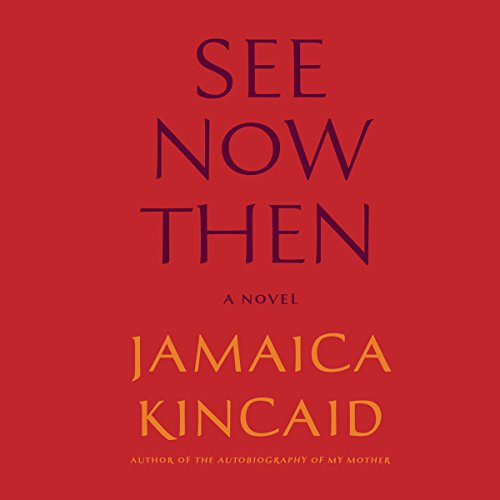
See Now Then
Summary
In See Now Then, the brilliant and evocative new novel from Jamaica Kincaid (her first in 10 years), a marriage is revealed in all its joys and agonies. This piercing examination of the manifold ways in which the passing of time operates on the human consciousness unfolds gracefully, and Kincaid inhabits each of her characters - a mother, father, and two children living in a small village in New England - as they move, in their own minds, between the present, the past, and the future. For, as she writes, "the present will be a now then and the past is now then and the future will be a now then." Her characters, constrained by the world, despair in their domestic situations. But their minds wander, trying to make linear sense of what is, in fact, nonlinear. See Now Then is Kincaid’s attempt to make clear what is unclear, and to make unclear what we assumed was clear: that is, the beginning, the middle, and the end. Since the publication of her first short story collection, At the Bottom of the River, nominated for a PEN / Faulkner Award for fiction, Jamaica Kincaid has demonstrated a unique talent for seeing beyond and through the surface of things. In See Now Then, she envelops the listener in a world that is both familiar and startling - creating her most emotionally and thematically daring work yet.
©2013 Jamaica Kincaid (P)2013 Macmillan Audio

Thalia Book Club: Jamaica Kincaid, 'See Now Then'
Summary
The author of Annie John, Lucy, and The Autobiography of My Mother delves into her long-awaited new novel about a complicated modern family, featuring Mr. and Mrs. Sweet and their two children, Heracles and Persephone, who live in the Shirley Jackson house in Vermont. Kincaid discusses her novel with her old friend Ian Frazier (The Cursing Mommy's Book of Days).
©2013 Symphony Space (P)2013 Symphony Space

Life Is Short - Art Is Shorter
Summary
Life Is Short - Art Is Shorter is not just the first anthology gathering both mini-essays and short-short stories. Listeners, writers, and teachers will get an anthology; a course’s worth of writing exercises; a rally for compression, concision, and velocity in an increasingly digital post-religious age; and a meditation on the brevity of human existence. 1. We are mortal beings. 2. There is no God. 3. We live in a digital culture. 4. Art is related to the body and to culture. 5. Art should reflect these things. 6. Brevity rules. The book’s 40 contributors include Donald Barthelme, Kate Chopin, Lydia Davis, Annie Dillard, Jonathan Safran Foer, Barry Hannah, Amy Hempel, Jamaica Kincaid, Wayne Koestenbaum, Anne Lamott, Daphne Merkin, Rick Moody, Dinty W. Moore, George Orwell, Jayne Anne Phillips, George Saunders, Lauren Slater, James Tate, and Paul Theroux.
©2015 David Shields (P)2021 David Shields

At the Bottom of the River
Summary
This is a collection of Jamaica Kincaid's earliest published writings: her inspired, lyrical short stories. These stories plunge the listener gently into another way of perceiving both the physical world and its elusive inhabitants. Her narrative is, by turns, naïvely whimsical and biblical in its assurance, and it speaks of what is partially remembered, partly divined. The memories often concern a childhood in the Caribbean - family, manners, and landscape - as distilled and transformed by Kincaid's special style and vision. Kincaid leads us to consider, as if for the first time, the powerful ties between mother and child, the beauty and destructiveness of nature, the gulf between the masculine and the feminine, the significance of such familiar things as a house, a cup, a pen. Transfiguring our human form and our surroundings - shedding skin, darkening an afternoon, painting a perfect place - these stories tell us something we didn't know, in a way we hadn't expected.
©2000 Jamaica Kincaid (P)2017 Blackstone Audio, Inc.