Jill Lepore has 7 audiobooks on Listento.it, narrated by 4 narrators, with an average listener rating of 4.3★ across 31 ratings. The most-rated is These Truths.
These Truths
Summary
In the most ambitious one-volume American history in decades, award-winning historian Jill Lepore offers a magisterial account of the origins and rise of a divided nation. The American experiment rests on three ideas - "these truths", Jefferson called them - political equality, natural rights, and the sovereignty of the people. And it rests, too, "[O]n a dedication to inquiry, fearless and unflinching", writes Jill Lepore in a groundbreaking investigation into the American past that places truth itself at the center of the nation's history. In riveting prose, These Truths tells the story of America, beginning in 1492, to ask whether the course of events has proven the nation's founding truths or belied them. "A nation born in contradiction, liberty in a land of slavery, sovereignty in a land of conquest, will fight, forever, over the meaning of its history", Lepore writes, finding meaning in those very contradictions as she weaves American history into a majestic tapestry of faith and hope, of peril and prosperity, of technological progress and moral anguish. A spellbinding chronicle filled with arresting sketches of Americans from John Winthrop and Frederick Douglass to Pauli Murray and Phyllis Schlafly, These Truths offers an authoritative new history of a great, and greatly troubled, nation.
©2018 Jill Lepore (P)2018 Recorded Books

The Secret History of Wonder Woman
Summary
A riveting work of historical detection revealing that the origins of one of the world’s most iconic superheroes hides within it a fascinating family story - and a crucial history of 20th-century feminism. Wonder Woman, created in 1941, is the most popular female superhero of all time. Aside from Superman and Batman, no superhero has lasted as long or commanded so vast and wildly passionate a following. Like every other superhero, Wonder Woman has a secret identity. Unlike every other superhero, she has also has a secret history. Harvard historian and New Yorker staff writer Jill Lepore has uncovered an astonishing trove of documents, including the never-before-seen private papers of William Moulton Marston, Wonder Woman's creator. Beginning in his undergraduate years at Harvard, Marston was influenced by early suffragists and feminists, starting with Emmeline Pankhurst, who was banned from speaking on campus in 1911, when Marston was a freshman. In the 1920s, Marston and his wife, Sadie Elizabeth Holloway, brought into their home Olive Byrne, the niece of Margaret Sanger, one of the most influential feminists of the 20th century. The Marston family story is a tale of drama, intrigue, and irony. In the 1930s, Marston and Byrne wrote a regular column for Family Circle celebrating conventional family life, even as they themselves pursued lives of extraordinary nonconformity. Marston, internationally known as an expert on truth - he invented the lie detector test - lived a life of secrets, only to spill them on the pages of Wonder Woman. The Secret History of Wonder Woman is a tour de force of intellectual and cultural history. Wonder Woman, Lepore argues, is the missing link in the history of the struggle for women’s rights - a chain of events that begins with the women's suffrage campaigns of the early 1900s and ends with the troubled place of feminism a century later.
©2014 Jill Lepore (P)2014 Random House Audio
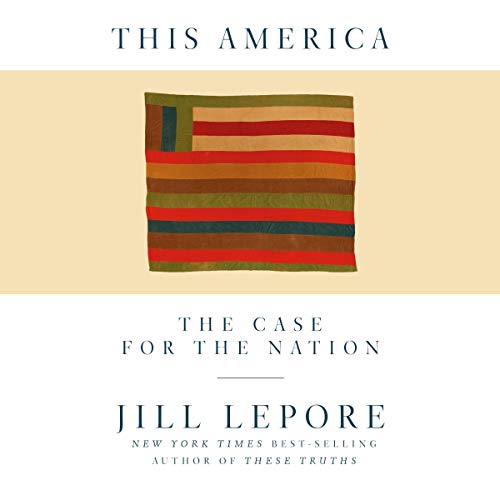
This America
Summary
From the best-selling author of These Truths, a work that examines the dilemma of nationalism and the erosion of liberalism in the 21st century. At a time of much despair over the future of liberal democracy, Harvard historian Jill Lepore makes a stirring case for the nation in This America. Since the end of the Cold War, Lepore writes, American historians have largely retreated from the idea of "the nation", in part because postmodernism has corroded faith in grand narratives, and in part because the rise of political nationalism has rendered it suspect and unpalatable. Bucking this trend, however, Lepore argues forcefully that the nation demands scrutiny. Without an honest reckoning with America's collective past, we will be at the mercy of unscrupulous demagogues who spin their own version of the national story for their own purposes. "When serious historians abandon the study of the nation", Lepore tellingly writes, "nationalism doesn't die. Instead, it eats liberalism." A trenchant work of political philosophy as well as a reclamation of America's national history, This America asks us to look our nation's sovereign past square in the eye to reveal not only a history of contradictions, but a path of promise for the future. Cover art © 2019 Estate of Arcola Pettway / Artists Rights Society (ARS), New York
©2019 Jill Lepore (P)2019 Random House Audio

The Mansion of Happiness
Summary
Renowned Harvard scholar and New Yorker staff writer Jill Lepore has composed a strikingly original, ingeniously conceived, and beautifully crafted history of American ideas about life and death from before the cradle to beyond the grave.
How does life begin? What does it mean? What happens when we die? “All anyone can do is ask,” Lepore writes. “That’s why any history of ideas about life and death has to be, like this book, a history of curiosity.” Lepore starts that history with the story of a 17th-century Englishman who had the idea that all life begins with an egg and ends it with an American who, in the 1970s, began freezing the dead. In between, life got longer, the stages of life multiplied, and matters of life and death moved from the library to the laboratory, from the humanities to the sciences.
Lately, debates about life and death have determined the course of American politics. Each of these debates has a history. Investigating the surprising origins of the stuff of everyday life - from board games to breast pumps - Lepore argues that the age of discovery, Darwin, and the space age turned ideas about life on earth topsy-turvy. “New worlds were found,” she writes, and “old paradises were lost.”
As much a meditation on the present as an excavation of the past, The Mansion of Happiness is delightful, learned, and altogether beguiling.
©2012 Jill Lepore (P)2012 Brilliance Audio, Inc.

Book of Ages
Summary
From one of our most accomplished and widely admired historians, a revelatory portrait of Benjamin Franklin' s youngest sister and a history of history itself. Like her brother, Jane Franklin was a passionate reader, a gifted writer, and an astonishingly shrewd political commentator. Unlike him, she was a mother of twelve Benjamin Franklin, who wrote more letters to his sister than he wrote to anyone else, was the original American self-made man; his sister spent her life caring for her children. They left very different traces behind. Making use of an amazing cache of little-studied material, including documents, objects, and portraits only just discovered, Jill Lepore brings Jane Franklin to life in a way that illuminates not only this one woman but an entire world - a world usually lost to history. Lepore' s life of Jane Franklin, with its strikingly original vantage on her remarkable brother, is at once a wholly different account of the founding of the United States and one of the great untold stories of American history and letters: a life unknown.
©2013 Jill Lepore (P)2013 Recorded Books

Joe Gould's Teeth
Summary
From New Yorker staff writer and Harvard historian Jill Lepore, the dark, spellbinding tale of her restless search for the long-lost longest book ever written, a century-old manuscript called The Oral History of Our Time. Joe Gould, a madman, believed he was the most brilliant historian of the 20th century. So did some of his friends, a group of modernist writers and artists that included E. E. Cummings, Marianne Moore, William Carlos Williams, John Dos Passos, and Ezra Pound. Gould began his life's work before the First World War, announcing that he intended to write down nearly everything anyone ever said to him. "I am trying to preserve as much detail as I can about the normal life of everyday people," he explained, because "as a rule, history does not deal with such small fry." By 1942, when The New Yorker published a profile of Gould written by the reporter Joseph Mitchell, Gould's manuscript had grown to more than nine million words. But when Gould died in 1957 in a mental hospital, the manuscript was nowhere to be found. Then, in 1964, in "Joe Gould's Secret", a second profile, Mitchell claimed that The Oral History of Our Time had been, all along, merely a figment of Gould's imagination. Lepore, unpersuaded, decided to find out. Joe Gould's Teeth is a Poe-like tale of detection, madness, and invention. Digging through archives all over the country, Lepore unearthed evidence that The Oral History of Our Time did in fact once exist. Relying on letters, scraps, and Gould's own diaries and notebooks - including volumes of his lost manuscript - Lepore argues that Joe Gould's real secret had to do with sex and the color line, with modernists' relationship to the Harlem Renaissance, and, above all, with Gould's terrifying obsession with the African American sculptor Augusta Savage. In ways that even Gould himself could not have imagined, what Gould wrote down really is a history of our time: unsettling and ferocious.
©2016 Jill Lepore (P)2016 Random House Audio

New York Burning
Summary
A gripping tale and groundbreaking investigation of a mysterious, and largely forgotten, eighteenth-century slave plot to destroy New York City. Over a few weeks in 1741, 10 fires blazed across Manhattan. With each new fire, panicked whites saw more evidence of a slave uprising. Tried and convicted before the colony's Supreme Court, 13 black men were burned at the stake and 17 were hanged. Four whites, the alleged ringleaders of the plot, were also hanged, and seven more were pardoned on condition that they never set foot in New York again. More than 100 black men and women were thrown into a dungeon beneath City Hall, where many were forced to confess and name names, sending still more men to the gallows and to the stake. In a narrative rich with period detail and vivid description, Jill Lepore pieces together the events and the thinking that led white New Yorkers to make "bonfires of the Negroes". She reconstructs the harsh past of a city that slavery built, and almost destroyed. She explores the social and political climate of the 1730s and '40s and examines the nature and tenor of the interactions between slaves and their masters. She shows too that the 1741 conspiracy can be understood only alongside a more famous episode from the city's past: the 1735 trial of the printer John Peter Zenger. And, weighing both new and old evidence, she makes clear how the threat of black rebellion made white political pluralism palatable. Lucid, probing, captivatingly written, New York Burning is a revelatory study of the ways in which slavery both destabilized and created American politics.
©2005 Jill Lepore (P)2005 HighBridge Company