Richard Overy has 4 audiobooks on Listento.it, narrated by 3 narrators, with an average listener rating of 4★ across 2 ratings. The most-rated is Spitfire Pilot.

Spitfire Pilot
Summary
At the outbreak of the Second World War D. M. Crook, of No. 609 Squadron AAF, was at Yeadon, still undergoing his training; by the winter of 1939-40, he had his wings. Successfully applying to return to his Squadron, then on defense duties in northern England, Crook began to familiarize himself with their new fighter: the Spitfire. Soon they were posted to RAF Northolt, and it was at this time that Crook, much to his chagrin, was left grounded, undergoing knee surgery as they flew over Dunkirk. Following the Allied evacuation from France, Crook returned to the air and found himself facing the relentless sorties as the skies above Britain transformed into a battlefield. In one particularly frank passage, Crook recounts how he mistakenly shot down a Blenheim, going on to illustrate how easy it was for pilots to misidentify aircraft. Spitfire Pilot is a remarkable account of one officer's life in 609 Squadron during one of the most famous battles of the Second World War.
©1942 David M. Crook; Introduction copyright 2006 by Richard Overy; On 609 Squadron copyright 2006 by Sandy Hunter; Preface copyright 2006 by Rosemary Loyd (P)2018 Tantor

A History of War in 100 Battles
Summary
The object of this audiobook is to introduce listeners to a whole range of military history which has all the drama, dangers, horrors and excitement that we associate with Stalingrad or the Somme. Battles are acute moments of history whenever and wherever they have been fought. Through them we can understand how warfare and world history have evolved. Choosing just 100 battles from recorded human history is a challenge, not just because it is necessary to cover almost 6,000 years of history but because men have fought each other almost continuously for millennia. Anyone who knows anything about the history of war may be disappointed by what has had to be left out. However, each of the 100 memorable battles described shows both how the nature of armed combat has changed over human history and how, despite changes in technology, organisation or ideas, many things have remained the same. It is an old adage that you can win a battle but lose a war. The battles featured here almost always resulted in victory for one side or another, but the victor did not necessarily win the war. Some battles are decisive in that broader historical sense; others are not. The further back in time, the more likely it is that an enemy could be finished off in one blow. The wars of the modern age, between major states, have involved repeated battles until one side was battered into submission. Some of the great generals of the recent past - Napoleon, Robert E Lee, Erich von Manstein - have been on the losing side but are remembered nonetheless for their generalship. Some on the winning side have all but disappeared from the history books or from public memory. Equally, in many battles the issue is not victory or defeat but what the battle can tell us about the history of warfare itself. New weapons, new tactics and new ways of organising armed forces can have a sudden impact on the outcome of a battle. But so, too, can leadership or the effects of a clever deception or raw courage. That is why the audiobook has been divided up into clear themes which apply equally to the battles of the ancient world as they do to the battles of today. As Professor Richard Overy laments, 'Battle is not a game to plug in to a computer but a piece of living history, messy, bloody and real. That, at least, has not changed in 6,000 years.'
©2014 Richard Overy (P)2016 HarperCollins Publishers

The Birth of the RAF, 1918
Summary
Penguin presents The Birth of the RAF by Richard Overy, read by Jonathan Keeble. The dizzying pace of technological change in the early 20th century meant that it took only a little over 10 years from the first flight by the Wright Brothers to the clash of fighter planes in the Great War. A period of terrible, rapid experiment followed to gain a brief technological edge. By the end of the war, the British had lost an extraordinary 36,000 aircraft and 16,600 airmen. The RAF was created in 1918 as a revolutionary response to this new form of warfare - a highly contentious decision (resisted fiercely by both the army and navy, who had until then controlled all aircraft) but one which had the most profound impact, for good and ill, on the future of warfare. Richard Overy's superb new audiobook shows how this happened, against the backdrop of the first bombing raids against London and the constant emergency of the Western Front. The RAF's origins were as much political as military and throughout the 1920s still provoked bitter criticism. Published to mark the centenary of its founding, this is an invaluable audiobook, filled with new and surprising material on this unique organisation.
©2018 Richard Overy (P)2018 Penguin Books Ltd
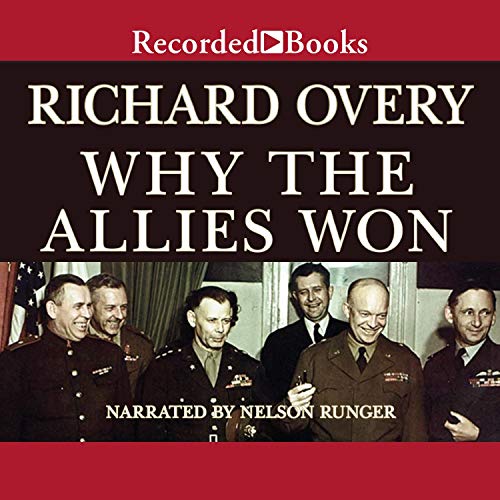
Why the Allies Won
Summary
In this fascinating consideration of the Allied war effort, historian Richard Overy answers one of the great questions of the 20th century: What led to the unmistakable Allied victory when in the early stages of World War II, the balance of power so strongly favored the Axis? Searching for a compelling explanation, the author explores decisive military campaigns: struggles along the Eastern front, the battles for the seas, the war in the air above, and the massive amphibious assault on Europe. He also considers key elements underlying victory, such as the quality of both political and military leadership, the pursuit of industrial strength, and the all-important determination to win. A professor of modern history in London, Richard Overy clearly demonstrates that not one of these factors alone could make the outcome inevitable - only their compounded effect could bring victory. This multifaceted look at the war that shaped the modern world becomes accessible with Nelson Runger's thoughtful performance - and you'll realize how hard-won the Allied victory truly was.
©1995 Richard Overy (P)1999 Recorded Books