S. C. Gwynne has 4 audiobooks on Listento.it, narrated by 4 narrators, with an average listener rating of 4.8★ across 374 ratings. The most-rated is Empire of the Summer Moon.

Empire of the Summer Moon
Summary
Empire of the Summer Moon spans two astonishing stories. The first traces the rise and fall of the Comanches, the most powerful Indian tribe in American history. The second entails one of the most remarkable narratives ever to come out of the Old West: the epic saga of the pioneer woman Cynthia Ann Parker and her mixed-blood son, Quanah, who became the last and greatest chief of the Comanches. Although listeners may be more familiar with the names Apache and Sioux, it was in fact the legendary fighting ability of the Comanches that determined just how and when the American West opened up. They were so masterful at war and so skillful with their arrows and lances that they stopped the northern drive of colonial Spain from Mexico and halted the French expansion westward from Louisiana. White settlers arriving in Texas from the Eastern United States were surprised to find the frontier being rolled backward by Comanches incensed by the invasion of their tribal lands. So effective were the Comanches that they forced the creation of the Texas Rangers and account for the advent of the new weapon specifically designed to fight them: the six-gun. The war with the Comanches lasted four decades, in effect holding up the development of the new American nation. Gwynne's exhilarating account delivers a sweeping narrative that encompasses Spanish colonialism, the Civil War, the destruction of the buffalo herds, and the arrival of the railroads - a historical feast for anyone interested in how the United States came into being. PLEASE NOTE: When you purchase this title, the accompanying PDF will be available in your Audible Library along with the audio.
©2016 S. C. Gwynne (P)2016 Simon & Schuster

Rebel Yell
Summary
General Stonewall Jackson was like no one anyone had ever seen. In April of 1862 he was merely another Confederate general with only a single battle credential in an army fighting in what seemed to be a losing cause. By middle June he had engineered perhaps the greatest military campaign in American history and was one of the most famous men in the Western World. He had given the Confederate cause what it had recently lacked: hope. In four full-scale battles and six major skirmishes in Virginia’s Shenandoah Valley, Jackson had taken an army that never numbered more than 17,000 men and often had far less, against more than 70,000 Union troops whose generals had been ordered specifically to destroy him. And he had humiliated them, in spite of their best efforts, sent the armies reeling backward in retreat. He had done it with the full knowledge that he and his army were alone in a Union-dominated wilderness and surrounded at all times. He had even beaten a trap designed by Lincoln himself to catch him. How did he do this? Jackson marched his men at a pace unknown to soldiers of the era. He made flashing strikes in unexpected places, and assaults of hard and relentless fury. He struck from behind mountain ranges and out of steep passes. His use of terrain reminded observers of Hannibal and Napoleon. His exploits in the valley rank among the most spectacular military achievements of the 19th century. Considered one of our country’s greatest military figures, a difficult genius cited as inspiration by such later figures as George Patton and Erwin Rommel, and a man whose brilliance at the art of war transcends the Civil War itself, Stonewall Jackson’s legacy is both great and tragic in this compelling account, which demonstrates how, as much as any Confederate figure, Jackson embodies the romantic Southern notion of the virtuous lost cause.
©2014 S. C. Gwynne (P)2014 Simon & Schuster Audio
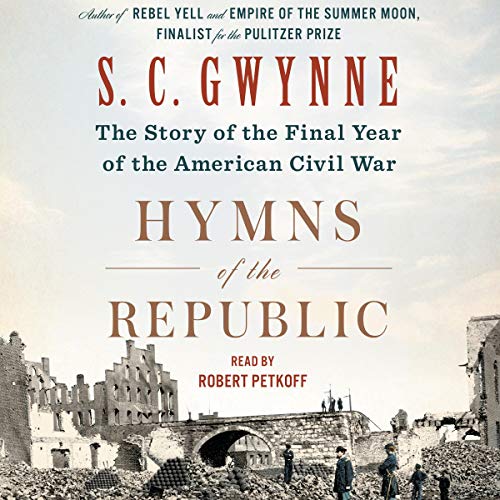
Hymns of the Republic
Summary
From the New York Times best-selling, celebrated, and award-winning author of Empire of the Summer Moon and Rebel Yell comes the spellbinding, epic account of the dramatic conclusion of the Civil War.
The fourth and final year of the Civil War offers one of that era’s most compelling narratives, defining the nation and one of history’s great turning points. Now, S.C. Gwynne’s Hymns of the Republic addresses the time Ulysses S. Grant arrives to take command of all Union armies in March 1864 to the surrender of Robert E. Lee at Appomattox a year later. He breathes new life into the epic battle between Lee and Grant; the advent of 180,000 black soldiers in the Union army; William Tecumseh Sherman’s March to the Sea; the rise of Clara Barton; the election of 1864 (which Lincoln nearly lost); the wild and violent guerrilla war in Missouri; and the dramatic final events of the war, including the surrender at Appomattox and the murder of Abraham Lincoln.
Hymns of the Republic offers angles and insights on the war that will surprise many listeners. Robert E. Lee, known as a great general and southern hero, is presented here as a man dealing with frustration, failure, and loss. Ulysses S. Grant is known for his prowess as a field commander, but in the final year of the war he largely fails at that. His most amazing accomplishments actually began the moment he stopped fighting. William Tecumseh Sherman, Gwynne argues, was a lousy general, but probably the single most brilliant man in the war. We also meet a different Clara Barton, one of the greatest and most compelling characters, who redefined the idea of medical care in wartime. And proper attention is paid to the role played by large numbers of black union soldiers - most of them former slaves. They changed the war and forced the South to come up with a plan to use its own black soldiers.
Popular history at its best, with Hymns of the Republic Gwynne reveals the creation that arose from the destruction in this thrilling listen.
©2019 S. C. Gwynne (P)2019 Simon & Schuster

The Perfect Pass
Summary
New York Times best-selling, award-winning historian S. C. Gwynne tells the incredible story of how Hal Mumme and Mike Leach - two unknown coaches who revolutionized American football in the 1980s, 1990s, and 2000s - changed the way the game is played at every level, from high school to the NFL. Hal Mumme is one of a handful of authentic offensive geniuses in the history of American football. In 2015 ESPN Magazine, the nation's leading sports magazine, called him the single most influential football coach in the last quarter century. Mumme spent 14 mostly losing seasons coaching football before inventing a potent passing offense strategy that would revolutionize the game. That transformation began at a tiny college called Iowa Wesleyan, where Mumme was head coach and Mike Leach his assistant. It was there that Mumme invented the purest and most extreme passing game in the 145-year history of football, where his quarterback once completed 61 of 86 passes (both national records). His teams played blazingly fast - faster than any team ever had before. They rarely punted on a fourth down and routinely beat teams with 10 or 20 times Iowa Wesleyan's students. Mumme did it all with average athletes and without even a playbook. In The Perfect Pass, S. C. Gwynne explores Mumme's genius and the stunning performance of his teams as well as his leading role in changing football from a run-dominated sport to a pass-dominated sport. He also shares the history of a moment in American football when the game changed fundamentally and transformed itself into what tens of millions of Americans now watch on television every weekend. Whether you're a casual or ravenous football fan, this is a truly compelling story of American ingenuity and innovation and how a set of revolutionary ideas made their way into the mainstream of sports culture that we celebrate today. PLEASE NOTE: When you purchase this title, the accompanying reference material will be available in your Library section along with the audio.
©2016 S. C. Gwynne (P)2016 Simon & Schuster