The Americas category has 777 audiobooks on Listento.it, with an average listener rating of 4.5★ across 2,631 ratings. The most-rated is Endurance.

Regime Change: The JFK Assassination
Summary
According to a 2013 Gallup poll, the vast majority of the American people don't believe the government's Warren Report about the assassination of president John F. Kennedy. But there are so many theories about the assassination that it's difficult to make sense of it all - or even know where to start. Who has the time to delve into the controversy and figure it out? And what difference does it make anyway? If that describes the way you feel about the Kennedy assassination, then this book is for you. It is a primer for understanding the assassination of John Kennedy, and it provides the only paradigm in which all the pieces of the puzzle of the Kennedy assassination fall into place and make sense. The thesis of this book is a simple one: On November 22, 1963, the U.S. national-security establishment violently removed John Kennedy from the presidency through assassination. This particular regime-change operation occurred within the context of other regime-change operations conducted by the U.S. national-security state during the Cold War, such as those in Iran in 1953, Guatemala in 1954, Cuba in the 1960s, and Chile in 1973. What was the reason for the Kennedy regime-change operation? The reason was the same as it was for all the other Cold War regime-change operations: "national security."
©2015 The Future of Freedom Foundation (P)2016 Listen and Think Audio

The Empire of Necessity
Summary
From the acclaimed author of Fordlandia, the story of a remarkable slave rebellion that illuminates America' s struggle with slavery and freedom during the Age of Revolution and beyond One morning in 1805, off a remote island in the South Pacific, Captain Amasa Delano, a New England seal hunter, climbed aboard a distressed Spanish ship carrying scores of West Africans he thought were slaves. They weren' t. Having earlier seized control of the vessel and slaughtered most of the crew, they were staging an elaborate ruse, acting as if they were humble servants. When Delano, an idealistic, anti-slavery republican, finally realized the deception, he responded with explosive violence. Drawing on research on four continents, The Empire of Necessity explores the multiple forces that culminated in this extraordinary event - an event that already inspired Herman Melville' s masterpiece Benito Cereno. Now historian Greg Grandin, with the gripping storytelling that was praised in Fordlandia, uses the dramatic happenings of that day to map a new transnational history of slavery in the Americas, capturing the clash of peoples, economies, and faiths that was the New World in the early 1800s.
©2014 Greg Grandin (P)2014 Recorded Books

The Teacher Wars
Summary
A brilliant young scholar's history of 175 years of teaching in America shows that teachers have always borne the brunt of shifting, often impossible expectations. In other nations, public schools are one thread in a quilt that includes free universal child care, health care, and job training. Here, schools are the whole cloth. Today we look around the world at countries like Finland and South Korea, whose students consistently outscore Americans on standardized tests, and wonder what we are doing wrong. Dana Goldstein first asks the often-forgotten question: "How did we get here?" She argues that we must take the historical perspective, understanding the political and cultural baggage that is tied to teaching, if we have any hope of positive change. In her lively, character-driven history of public teaching, Goldstein guides us through American education's many passages, including the feminization of teaching in the 1800s and the fateful growth of unions, and shows that the battles fought over nearly two centuries echo the very dilemmas we cope with today. Goldstein shows that recent innovations like Teach for America, merit pay, and teacher evaluation via student testing are actually as old as public schools themselves. Goldstein argues that long-festering ambivalence about teachers - are they civil servants or academic professionals? - and unrealistic expectations that the schools alone should compensate for poverty's ills have driven the most ambitious people from becoming teachers and sticking with it. In America's past, and in local innovations that promote the professionalization of the teaching corps, Goldstein finds answers to an age-old problem.
©2014 Dana Goldstein (P)2014 Audible Inc.

The Salem Witch Trials
Summary
Based on 27 years of original archival research, including the discovery of previously unknown documents, this day-by-day narrative of the hysteria that swept through Salem Village in 1692 and 1693 reveals new connections behind the events and shows how rapidly a community can descend into bloodthirsty madness. Roach opens her work with chapters on the history of the Puritan colonies of New England and explains how these people regarded the metaphysical and the supernatural. The account of the days from January 1692 to March 1693 keeps in order the large cast of characters, places events in their correct contexts, and occasionally contradicts earlier assumptions about the gruesome events. The last chapter discusses the remarkable impact of the events, pointing out how the 300th anniversary of the trials made headlines in Japan and Australia.
©2002 Marilynne K. Roach (P)2020 Tantor

1969
Summary
In 1969, man landed on the moon; the "Miracle Mets" captivated sports fans; students took over college campuses and demonstrators battled police; America witnessed the Woodstock music festival; Hollywood produced Easy Rider; Kurt Vonnegut published Slaughterhouse-Five; punk music was born; and there was murder at Altamont Speedway. Compelling, timely, and a blast to read, 1969 chronicles the year in culture and society, sports, music, film, politics, and technology. This rich, comprehensive history is perfect for those who survived 1969 or for those who simply want to feel as though they did.
©2011 Rob Kirkpatrick (P)2012 Audible, Inc.

Philosophy and Opinions of Marcus Garvey, Volume 2
Summary
The Jamaican orator and entrepreneur Marcus Mosiah Garvey Jr. (1887-1940) preached success to the African diaspora. He believed that attaining economic, cultural, and political success would free African Americans in this life. Identifying integrity of character as the first step toward achievement, Garvey promoted capitalism as the means to establish African Americans as an independent group. He believed that economic success was the quickest route to autonomy and self-reliance and slammed poverty for facilitating immorality and crime: “I would prefer to be honestly wealthy, than miserably poor.” In The Philosophy and Opinions of Marcus Garvey, he formulated the "black is beautiful" ideal and championed the Back-to-Africa movement.
Public Domain (P)2020 Museum Audiobooks

New York: Guide to NYC: History of New York - Where the Most Important People, Places, and Events Shaped the History of New York City
Summary
How can a city grow into a nation’s largest metropolis in less than 500 years? This is the story of one of the greatest cities in the world. New York. A city that has grown economically and culturally beyond imagining into a prosperous metropolis with one of the most diverse populations in the nation. A city that fought for equality and civil rights and has been the epicenter of social progress and a source of inspiration throughout the world. With New York: Guide to NYC: History of New York - Where the Most Important People, Places, and Events Shaped the History of New York City, Raymond C. Nelson takes readers on a tour through time of the Big Apple. You’ll: Meet the culture that inhabited New York for thousands of years before European’s discovered a new continent Glimpse the city’s early colonial days as settlers traded and farmed on Manhattan and in Brooklyn Watch the city grow prosperous through trade and exploitation See New York gain independence from British rule Look at the population explode through the 19th century and witness the events that made it the financial center of the United States of America Learn about New York’s landmarks and essential places to see and visit Whether you live in New York City or are planning a visit, New York: Guide to NYC: History of New York - Where the Most Important People, Places, and Events Shaped the History of New York City is an excellent way to learn more about America’s largest city. Don’t miss anything that New York has to offer.
©2017 Lean Stone Publishing (P)2017 Lean Stone Publishing

The Education of the Negro Prior to 1861
Summary
Carter G. Woodson (1875-1950) has been called the Father of African American Studies. In The Education of the Negro Prior to 1861 (1919), he documents the ways that education took place among African Americans from the beginning of slavery to the Civil War. There was fierce opposition to teaching slaves to read and write, while some slave owners thought it important for slaves to learn book- and record-keeping. Others wished for slaves to become educated enough to read the bible and become Christians; in this, Catholics and Quakers were at the forefront. At one stage, the South made draconian laws against educating slaves, specifically targeted to prevent Northerners from educational initiatives, which hampered the efforts of Abolitionists. As regards higher education, the debate about whether to teach a trade or a liberal education was ongoing, and White trade unions protested the potential competition. Woodson’s work is a thorough investigation of the history of education among Afro Americans.
Public Domain (P)2020 Museum Audiobooks

The Kennedy Autopsy
Summary
For half a century, people have debated the Kennedy assassination. Some claim that the Warren Commission got it right - that Kennedy was assassinated by Lee Harvey Oswald, a lone-nut assassin. Others contend that Kennedy was killed as part of a conspiracy. It is not the purpose of this book to engage in that debate. The purpose of this book is simply to focus on what happened at Bethesda Naval Hospital on the evening of November 22, 1963. What happened that night is so unusual that it cries out for truthful explanation even after all these years. In this book you will learn that: 1. Kennedy's body was actually delivered to the Bethesda morgue twice, at separate times and in separate caskets. 2. Some photographs and X-rays from the autopsy went missing from the record, and other photographs in the record were forged or otherwise fraudulent. 3. The president's body was altered by tampering with the wounds before the autopsy took place. And much more.
©2014 The Future of Freedom Foundation (P)2015 The Future of Freedom Foundation

Patterns and Coincidences
Summary
This volume is a continuation of the autobiography of John G. Neihardt All Is But a Beginning, offering a final glimpse into his fascinating life. Covering the years 1901-1908, he weaves a mosaic of personal fulfillment, joy and sorrow, reflecting on the successes and failures he experienced during his "mature" years. As only he could, Neihardt shares a mingling of romantic anecdotes alive with names and faces he sought out or fought for along the way. Writing with warmth and sensitivity, the late Poet Laureate of Nebraska tells of his early newspaper days, his struggle to write poetry, his family, his encounters with nature, his relationships with Indians, and the various people who, whether met once or often, had a profound effect on his life. Using a conversational style, the author does not present episodes in chronological order. Rather he begins to elaborate on one memorable experience, then quickly draws out, without warning, another one that occurred years later, tying them into a pattern or coincidence. The audiobook's epilogue is written by Neihardt's daughter, Hilda Neihardt Petri. Summarizing her father's visions, daydreams, and philosophy, she movingly concludes that with his death on 3 November 1973 Neihardt's "great adventure had begun." The late John G. Neihardt is best remembered as an authority on the traditions and customs of the Sioux Indians. Neihardt, named Poet Laureate of Nebraska in 1921 and Prairie Poet Laureate of America in 1968, was literary editor of the St. Louis Post-Dispatch from 1926 to 1938 and poet in residence and lecturer in English at the University of Missouri-Columbia from 1949 to 1965. The author of some 25 volumes of poetry, fiction, and philosophy, his works include Black Elk Speaks, Lyric and Dramatic Poems, and A Cycle of the West.
©1978 The John G. Neihardt Trust (P)2013 The John G. Neihardt Trust

The Oilman's Daughter
Summary
What would you do if you were given the opportunity to become another person - one whose life promised to be more glamorous and prosperous than your own? That was the question posed to Judith Patterson when, at age 33, she met the birth mother who had given her up for adoption as a child and who now revealed to her an extraordinary secret. Patterson, her mother told her, was the illegitimate daughter of a Texas oil mogul, one of the most powerful businessmen in the country in his day. The news sent Patterson on a two-decade search for the truth about her identity - and part of the fortune she believed she was owed. The only problem was that someone else had gotten to it first. Patterson's pursuit of the truth would grow into an obsessive personal quest laced with love, deception, and danger. In The Oilman's Daughter, author Evan Ratliff sets out to untangle a family drama that raises questions about the durability of identity, the slipperiness of truth, and the ways that greed can turn even the closest relatives into strangers.
©2013 Evan Ratliff, The Atavist (P)2013 Evan Ratliff, The Atavist

Days on the Road
Summary
Can you visualize today what it meant to cross America's Great Plains in the mid-19th century? It was a wondrous, perilous, often fatal journey without assurance of a successful life at the other end. Yet tens of thousands made the journey and lucky for us, many set aside modesty, often at the request of children or grandchildren, to put the account of their travels into words. Young Sarah Raymond Herndon was one of these pioneer women. Her classic story of days on the road are part of American history. She describes the beauty of the country and the wrenching heartbreak of losing loved ones. What she found along the way and at the end will thrill and inspire you. Every memoir of the American West provides us with another view of the movement that changed the country forever. Listen to a sample.
Public Domain (P)2017 Big Byte Books
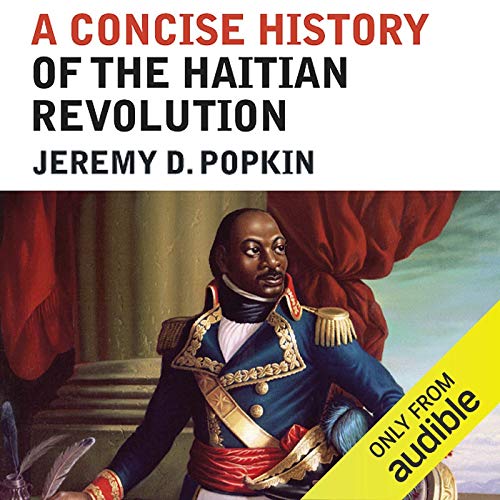
A Concise History of the Haitian Revolution
Summary
This book offers students a concise and clearly written overview of the events of the Haitian Revolution, from the slave uprising in the French colony of Saint-Domingue in 1791 to the declaration of Haiti’s independence in 1804. Draws on the latest scholarship in the field as well as the author’s original research Offers a valuable resource for those studying independence movements in Latin America, the history of the Atlantic World, the history of the African diaspora, and the age of the American and French revolutions Written by an expert on both the French and Haitian revolutions to offer a balanced view Presents a chronological, yet thematic, account of the complex historical contexts that produced and shaped the Haitian Revolution. Jeremy D. Popkin is T. Marshall Hahn Jr. Professor of History at the University of Kentucky, and is the author of You Are All Free: The Haitian Revolution and the Abolition of Slavery (2010) and Facing Racial Revolution: Eyewitness Accounts of the Haitian Uprising (2008).
©2011 Jeremy D. Popkin (P)2013 Audible Ltd

Poor Richard's Almanack
Summary
Poor Richard's Almanack is an almanac published annually from 1732 to 1758 by Benjamin Franklin, under the pseudonym of "Poor Richard" or "Richard Saunders". Almanacks were very popular in colonial America, usually offering a mixture of weather forecasts, practical household hints, puzzles, and other amusements. Poor Richard's Almanack contained the calendar, astronomical and astrological information, poems, and sayings. In the spaces that occurred between noted calendar days, Franklin included proverbial sentences about industry and frugality. Franklin also included the occasional mathematical exercise, and the 1750 Almanack features an early example of demographics. It is mainly remembered, however, for being a repository of Franklin's aphorisms and proverbs, many of which live on in American English.
Public Domain (P)2019 Museum Audiobooks

Computing: A Concise History
Summary
The history of computing could be told as the story of hardware and software or the story of the Internet or the story of "smart" handheld devices, with subplots involving IBM, Microsoft, Apple, Facebook, and Twitter. In this concise and accessible account of the invention and development of digital technology, computer historian Paul Ceruzzi offers a broader and more useful perspective. He identifies four major threads that run throughout all of computing's technological development: digitization - the coding of information, computation, and control in binary form, ones and zeros; the convergence of multiple streams of techniques, devices, and machines, yielding more than the sum of their parts; the steady advance of electronic technology, as characterized famously by "Moore's Law"; and the human-machine interface. Ceruzzi guides us through computing history, telling how a Bell Labs mathematician coined the word digital in 1942 (to describe a high-speed method of calculating used in antiaircraft devices) and recounting the development of the punch card (for use in the 1890 US Census). He describes the ENIAC, built for scientific and military applications; the UNIVAC, the first general purpose computer; and ARPANET, the Internet's precursor. Ceruzzi's account traces the world-changing evolution of the computer from a room-size ensemble of machinery to a "minicomputer" to a desktop computer to a pocket-sized smartphone. He describes the development of the silicon chip, which could store ever-increasing amounts of data and enabled ever-decreasing device size. He visits that hotbed of innovation, Silicon Valley, and brings the story up to the present with the Internet, the World Wide Web, and social networking.
©2012 Smithsonian Institution (P)2015 Gildan Media LLC

Dust Bowl
Summary
In the mid-1930s, North America's Great Plains faced one of the worst man-made environmental disasters in world history. Donald Worster's classic chronicle of the devastating years between 1929 and 1939 tells the story of the Dust Bowl in ecological as well as human terms. Twenty-five years after his book helped to define the new field of environmental history, Worster shares his more recent thoughts on the subject of the land and how humans interact with it. In a new afterword, he links the Dust Bowl to current political, economic, and ecological issues - including the American livestock industry's exploitation of the Great Plains and the ongoing problem of desertification, which has now become a global phenomenon. He reflects on the state of the plains today and the threat of a new dustbowl. He outlines some solutions that have been proposed, such as "the Buffalo Commons", where deer, antelope, bison, and elk would once more roam freely, and suggests that we may yet witness a Great Plains where native flora and fauna flourish while applied ecologists show farmers how to raise food on land modeled after the natural prairies that once existed.
©2004 Oxford University Press, Inc. (P)2017 Tantor

History in Blue
Summary
In 1893, Chicago's mayor gave Marie Owens the title of "patrolman", even though she had no authority to walk a beat. She did "women's work" and was a patrolman in name only. Throughout her 30 years of service, she was never allowed to wear a uniform. It would take nearly a century for women to be able to join the police ranks as full-fledged officers. Even today, women comprise just 15 percent of the nation's nearly one million law enforcement officers. Spanning 160 years, History in Blue is the first book to tell the riveting story of the uphill struggle for respect and recognition sustained by women in the modern police force. Featuring rare photographs and original interviews with pioneering female officers, this fascinating book chronicles the ongoing fight for equality in the world of law enforcement. In this vivid and remarkable history, Allan T. Duffin tells of the extraordinary women who broke down the barriers of gender so that they - and many generations of successors - could do the work they loved most.
©2012 Duffin Creative (P)2014 Duffin Creative

Meet You in Hell
Summary
Two founding fathers of American industry. One desire to dominate business at any price. “Masterful...Standiford has a way of making the 1890s resonate with a 21st century audience.” (USA Today) “The narrative is as absorbing as that of any good novel - and as difficult to put down.” (Miami Herald) The author of Last Train to Paradise tells the riveting story of Andrew Carnegie, Henry Clay Frick, and the bloody steelworkers’ strike that transformed their fabled partnership into a furious rivalry. Set against the backdrop of the Gilded Age, Meet You in Hell captures the majesty and danger of steel manufacturing, the rough-and-tumble of the business world, and the fraught relationship between “the world’s richest man” and the ruthless coke magnate to whom he entrusted his companies. The result is an extraordinary work of popular history. Praise for Meet You in Hell “To the list of the signal relationships of American history...we can add one more: Andrew Carnegie and Henry Clay Frick...The tale is deftly set out by Les Standiford.” (Wall Street Journal) “Standiford tells the story with the skills of a novelist...a colloquial style that is mindful of William Manchester’s great The Glory and the Dream.” (Pittsburgh Tribune-Review) “A muscular, enthralling read that takes you back to a time when two titans of industry clashed in a battle of wills and egos that had seismic ramifications not only for themselves but for anyone living in the United States, then and now.” (Dennis Lehane, author of Mystic River)
©2005 Les Standiford (P)2005 Books on Tape, Inc.
![Cover art for La Independencia de Colombia: El primer grito de libertad [Independence of Colombia: The First Cry of Freedom]](https://m.media-amazon.com/images/I/51ZEObd1YDL._SL500_.jpg)
La Independencia de Colombia: El primer grito de libertad [Independence of Colombia: The First Cry of Freedom]
Summary
La gesta emancipadora de Simón Bolívar en Venezuela motivó la inmediata reacción de sus vecinos colombianos quienes buscaban hace mucho la libertad. Sin embargo, la recuperación del trono español por parte de Fernando VII en el año 1806 pondría a prueba las aspiraciones independentistas. Sólo la fe inquebrantable de los patriotas lograría cambiar el destino de las cosas. Please note: This audiobook is in Spanish.
©2015 Online Studio Productions (P)2015 Online Studio Productions

Bold They Rise
Summary
After the Apollo program put 12 men on the moon and safely brought them home, anything seemed possible. In this spirit, the team at NASA set about developing the space shuttle, arguably the most complex piece of machinery ever created. The world's first reusable spacecraft, it launched like a rocket, landed like a glider, and carried out complicated missions in between. Bold They Rise tells the story of the space shuttle through the personal experiences of the astronauts, engineers, and scientists who made it happen - in space and on the ground, from the days of research and design through the heroic accomplishments of the program to the tragic last minutes of the Challenger disaster. In the participants' own voices, we learn what so few are privy to: what it was like to create a new form of spacecraft, to risk one's life testing that craft, to float freely in the vacuum of space as a one-man satellite, to witness a friend's death. A "guided tour" of the shuttle - in historical, scientific, and personal terms - this book provides a fascinating, richly informed, and deeply personal view of a feat without parallel in the human story.
©2014 Board of Regents of the University of Nebraska (P)2017 Redwood Audiobooks