The Archaeology category has 66 audiobooks on Listento.it, with an average listener rating of 4.3★ across 606 ratings. The most-rated is Fingerprints of the Gods.

A Short History of Humanity
Summary
“A highly readable, personal guide to the twists and turns in unravelling ancient DNA: Krause and Trappe expertly recount the story of archaeogenetics to reveal how this new field has utterly transformed understanding of our deep past.” (Rebecca Wragg Sykes, author of Kindred: Neanderthal Life, Love, Death and Art) Johannes Krause is the director of the Max Planck Institute for Evolutionary Anthropology and a brilliant pioneer in the field of archaeogenetics - archaeology augmented by DNA sequencing technology - which has allowed scientists to reconstruct human history reaching back hundreds of thousands of years before recorded time. In this surprising account, Krause and journalist Thomas Trappe rewrite a fascinating chapter of this history, the peopling of Europe, that takes us from the Neanderthals and Denisovans to the present. We know now that a wave of farmers from Anatolia migrated into Europe 8,000 years ago, essentially displacing the dark-skinned, blue-eyed hunter-gatherers who preceded them. This Anatolian farmer DNA is one of the core genetic components of people with contemporary European ancestry. Archaeogenetics has also revealed that indigenous North and South Americans, though long thought to have been East Asian, also share DNA with contemporary Europeans. Krause and Trappe vividly introduce us to the prehistoric cultures of the ancient Europeans: the Aurignacians, innovative artisans who carved flutes and animal and human forms from bird bones more than 40,000 years ago; the Varna, who buried their loved ones with gold long before the Pharaohs of Egypt; and the Gravettians, big-game hunters who were Europe’s most successful early settlers until they perished in the ice age. Genetics has earned a reputation for smuggling racist ideologies into science, but cutting-edge science makes nonsense of eugenics and “pure” bloodlines. Immigration and genetic exchanges have always defined our species; who we are is a question of culture, not biological inheritance. This revelatory book offers us an entirely new way to understand ourselves, both past and present.
©2021 Johannes Krause and Thomas Trappe (P)2021 Random House Audio

Finders Keepers
Summary
To whom does the past belong? Is the archeologist who discovers a lost tomb a sort of hero - or a villain? If someone steals a relic from a museum and returns it to the ruin it came from, is she a thief? In his trademark lyrical style, Craig Childs's riveting new book is a ghost story - an intense, impassioned investigation into the nature of the past and the things we leave behind. We visit lonesome desert canyons and fancy Fifth Avenue art galleries, journey throughout the Americas, Asia, the past and the present. The result is a brilliant book about man and nature, remnants and memory, a dashing tale of crime and detection.
©2010 Craig Childs (P)2018 Hachette Audio

Portillo's Hidden History of Britain
Summary
Portillo's Hidden History of Britain presents a compelling and wonderfully evocative history of Britain through the stories of its 'lost' or abandoned buildings. The chapters will cover a variety of historical themes: Crime and Punishment, Health and Medicine, Defence and Warfare, Manufacturing Industry, Transport and Communication, and Entertainment and Leisure. Using a combination of his own investigations and archive research, plus memories and quotations from the contributors he interviewed for the series, Michael will explain what the buildings were used for and by whom, why they were abandoned and what they can tell us about our past. For example: Learn what the ruins of London Road Fire and Police Station in Manchester reveal about the history of the emergency services in the last 100 years. How Bradford's art deco Odeon cinema encapsulates a century of filmmaking and movie-going. The walls of all these buildings have ears, and Michael's mission is to find out what they heard. With evocative text that brings each location vividly to life, Michael describes the building and its activities in its heyday and compares this past life with its faded grandeur or melancholic abandonment seen today. Filled with fascinating insights and observations, his narrative provides a compelling and original perspective on Britain's social, military and industrial history.
©2018 Michael Portillo (P)2018 Michael O'Mara

The Creative Spark
Summary
In the tradition of Jared Diamond's million-copy-selling classic Guns, Germs, and Steel, a bold new synthesis of paleontology, archaeology, genetics, and anthropology that overturns misconceptions about race, war and peace, and human nature itself, answering an age-old question: What made humans so exceptional among all the species on Earth? Creativity. It is the secret of what makes humans special, hiding in plain sight. Agustín Fuentes argues that your child's finger painting comes essentially from the same place as creativity in hunting and gathering millions of years ago and throughout history in making war and peace, in intimate relationships, in shaping the planet, in our communities, and in all of art, religion, and even science. It requires imagination and collaboration. Every poet has her muse; every engineer, an architect; every politician, a constituency. The manner of the collaborations varies widely, but successful collaboration is inseparable from imagination, and it brought us everything from knives and hot meals to iPhones and interstellar spacecraft. Weaving fascinating stories of our ancient ancestors' creativity, Fuentes finds the patterns that match modern behavior in humans and animals. This key quality has propelled the evolutionary development of our bodies, minds, and cultures, both for good and for bad. It's not the drive to reproduce, nor competition for mates or resources or power, nor our propensity for caring for one another that has separated us out from all other creatures. As Fuentes concludes, to make something lasting and useful today you need to understand the nature of your collaboration with others, what imagination can and can't accomplish, and, finally, just how completely our creativity is responsible for the world we live in. Agustín Fuentes' resounding multimillion-year perspective will inspire listeners - and spark all kinds of creativity.
©2017 Agustin Fuentes (P)2017 Penguin Audio

Return to Sodom and Gomorrah
Summary
A brilliant author, scientist, and adventurer who has been called "the real Indiana Jones", Dr. Charles Pellegrino takes us on a remarkable journey from the Nile to the Tigris-Euphrates rivers - crossing time, legend, and ancient lands to explore the unsolved mysteries of the Old Testament. Return to Sodom and Gomorrah is an epic saga of discovery that interweaves science, history, and suspense - the first book ever to bring archaeologists, scientists, and theologians together to examine the same evidence. In this enthralling revelatory adventure, Pellegrino introduces us to dedicated pioneers like Benjamin Mazar, Leonard Woolley, and T. E. Lawrence, who retraced the steps of Moses to demystify the Exodus and the Flood. In the process, he enables us to view ancient relics in an extraordinary new light - as both fascinating windows on the past and vivid signposts to the future.
©1994 Charles Pellegrino (P)1995 Recorded Books

Jungle of Stone
Summary
"Thrilling.... A captivating history of two men who dramatically changed their contemporaries' view of the past." (Kirkus) In 1839 rumors of extraordinary yet baffling stone ruins buried within the unmapped jungles of Central America reached two of the world's most intrepid travelers. Seized by the reports, American diplomat John Lloyd Stephens and British artist Frederick Catherwood - each already celebrated for their adventures in Egypt, the Holy Land, Greece, and Rome - sailed together out of New York Harbor on an expedition into the forbidding rainforests of present-day Honduras, Guatemala, and Mexico. What they found would rewrite the West's understanding of human history. In the tradition of The Lost City of Z and In the Kingdom of Ice, former San Francisco Chronicle journalist and Pulitzer Prize finalist William Carlsen reveals the unforgettable true story of the discovery of the ancient Maya. Enduring disease, war, and the torments of nature and terrain, Stephens and Catherwood uncovered and documented the remains of an astonishing civilization that had flourished in the Americas at the same time as classic Greece and Rome. Their remarkable book about the experience became a sensation and is recognized today as the birth of American archeology. Most importantly, Stephens and Catherwood were the first to grasp the significance of the Maya remains, recognizing that their antiquity and sophistication overturned the West's assumptions about the development of civilization. By the time of the flowering of classical Greece (400 BC), the Maya were already constructing pyramids and temples around central plazas. Within a few hundred years, the structures took on a monumental scale. Over the next millennium dozens of city-states evolved, each governed by powerful lords, some with populations larger than any city in Europe at the time. The Maya developed a unified cosmology, an array of common gods, a creation story, and a shared artistic and architectural vision. They created dazzling stucco and stone monuments and bas reliefs, sculpting figures and hieroglyphs with refined artistic skill. At their peak an estimated 10 million people occupied the Maya's heartland on the Yucatan Peninsula. And yet, by the time the Spanish reached the "New World", the classic-era Maya had all but disappeared; they would remain a mystery for the next 300 years. Today the tables are turned: The Maya are justly famous, if sometimes misunderstood, while Stephens and Catherwood have been all but forgotten. Based on Carlsen's rigorous research and his own 2,500-mile journey throughout the Yucatan and Central America, Jungle of Stone is equally a thrilling adventure narrative and a revelatory work of history that corrects our understanding of the Maya and the two remarkable men who set out in 1839 to find them.
©2016 William Carlsen (P)2016 HarperCollins Publishers

The Western River Steamboat
Summary
The first Western steamboat was built in 1811 in Pittsburgh, and thousands more were constructed in the years before the Civil War. These waterborne vehicles helped define the nineteenth century trans-Appalachian West. Decades of incremental changes created a distinctive watercraft, and the steamboat became perfectly suited to the conditions of the western rivers, transforming the west from a wilderness into a place of economic significance. In The Western River Steamboat, nautical archaeologist Adam I. Kane traces the development of this once commonplace vessel. Kane describes the importance and impact of the steamboat in American history and complements his historical analysis with clear, concise technical explanations of the construction and evolution of western river steamboats. Kane explains how the rivers dictated the design of the hull, why stern wheels replaced side wheels, how hogging chains kept hulls from buckling, and why safety valves were of little use when engineers regularly overloaded them.
©2004 Adam I. Kane (P)2017 Redwood Audiobooks
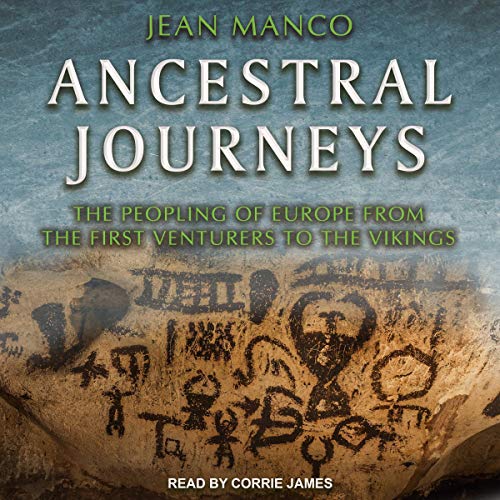
Ancestral Journeys
Summary
Who are the Europeans? Where did they come from? New research in the fields of archaeology and linguistics, a revolution in the study of genetics, and cutting-edge analysis of ancient DNA are dramatically changing our picture of prehistory, leading us to question what we thought we knew about these ancient peoples. This paradigm-shifting book paints a spirited portrait of a restless people that challenges our established ways of looking at Europe's past. The story is more complex than at first believed, with new evidence suggesting that the European gene pool was stirred vigorously multiple times. Genetic clues are also enhancing our understanding of European mobility in epochs with written records, including the arrival of the Anglo-Saxons, the spread of the Slavs, and the adventures of the Vikings. Now brought completely up to date with all the latest findings from the fast-moving fields of genetics, DNA, and dating, Jean Manco's highly accessible account weaves multiple strands of evidence into a startling new history of the continent, of interest to anyone who wants to truly understand Europeans' place in the ancient world.
©2013, 2015 Thames & Hudson Ltd. (P)2020 Tantor

A Pocket History of Human Evolution
Summary
Why aren't we more like other apes? How did we win the evolutionary race? Find out how "wise" Homo sapiens really are. Prehistory has never been more exciting: New discoveries are overturning long-held theories left and right. Stone tools in Australia date back 65,000 years -a time when, we once thought, the first Sapiens had barely left Africa. DNA sequencing has unearthed a new hominid group - the Denisovans - and confirmed that crossbreeding with them (and Neanderthals) made Homo sapiens who we are today. A Pocket History of Human Evolution brings us up-to-date on the exploits of all our ancient relatives. Paleoanthropologist Silvana Condemi and science journalist François Savatier consider what accelerated our evolution: Was it tools, our "large" brains, language, empathy, or something else entirely? And why are we the sole survivors among many early bipedal humans? Their conclusions reveal the various ways ancient humans live on today - from gossip as modern "grooming" to our gendered division of labor - and what the future might hold for our strange and unique species.
©2019 Silvana Condemi and François Savatier (P)2019 Tantor

Forgotten History
Summary
This book contains valuable information on leaders that changed our world and altered the course of humanity forever. Although each leader had an impact that was completely unique, certain parallels can be drawn about their effect on history. Anyone who is hoping to become a more effective leader or a stronger person in general can learn from the examples of these men. It's time for you to become an amazing historian in your own right. When it is all said and done, introduce your peers to these amazing people. Their stories deserve to be told. Here is a preview of what you'll learn: Detailed depictions of riveting figures Where they came from Where they went The legacies they left behind
©2016 Robert Paulson (P)2016 Robert Paulson

The World of the Ancient Maya
Summary
The ancient Maya were the only fully literate pre-Colombian people in the Americas. Superb scientists, they developed highly sophisticated mathematics and an intricate and accurate calendar system. Theirs was one of the few complex societies to emerge in and to adapt successfully to a tropical-forest environment. Their architecture, sculpture, and painting were sophisticated and compellingly beautiful. In this comprehensive survey, updated for this new edition, Henderson explores the entire Maya cultural tradition, from the earliest traces of settlement through the period of the Spanish conquest in the 16th century. His wide-ranging account treats diverse aspects of the Maya world, from religion and philosophy to the environments of the various Maya peoples, using deciphered Maya texts to reconstruct the ancient societies.
©1981 Cornell University Press (P)2006 Blackstone Audio Inc.
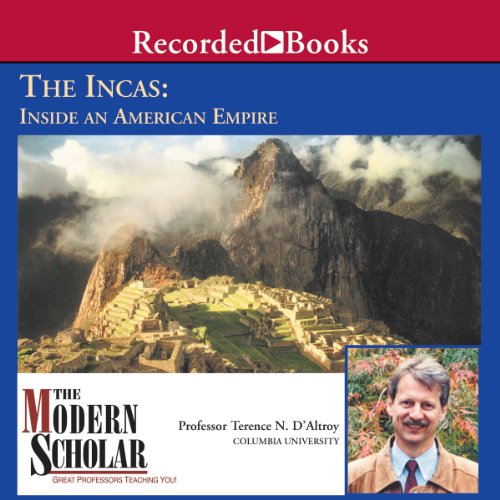
The Modern Scholar
Summary
In the land of Tawantinsuyu (The Four Parts Together) the Incas reigned in the late 15th century over the greatest empire ever seen in the independent Americas. Their territory included parts of the present-day countries of Peru, Ecuador, Bolivia, Chile, and Argentina. Yet we know little of these people, especially from firsthand written accounts. This course introduces the Incas, a small ethnic group from the southern Peruvian highlands, who forged a civilization rich in material and culture and expanded their domain to control large expanses of territory in a short period of time through diplomacy, enculturation, and military force. A Powerful Story and a Potent Legacy The story of the Incas is a powerful one, and their legacy remains a potent influence in the Andes of South America. In this insightful lecture series, Columbia University professor Terence D'Altroy focuses on Inca life at the height of the empire, the society's origins, its military, religion, ruling structure, and finally, the Inca legacy today.
©2004 Terence N. D'Altroy (P)2004 Recorded Books

Shakespeare's Restless World
Summary
What was life like for Shakespeare's first audiences? In a time of political and religious unrest and economic expansion, how did Elizabethan play-goers make sense of their changing world? What did the plays mean to the public when they were first performed?
In this fascinating series, Neil MacGregor attempts to answer these questions by examining 20 objects from that turbulent period. There are grand objects such as a communion chalice, a Venetian goblet, and Dr Dee's mirror, as well as everyday items such as a theatregoer's fork and an apprentice's cap. From Drake's circumnavigation medal to an eye relic, he uses these objects to explore the issues that shaped Shakespeare's plays, and considers what they reveal about the concerns and beliefs of Shakespearean England. Speaking to scholars, historians and experts, he discusses the topics raised - everything from exploration and discovery to violence, entertainment, and the plague.
©2012 Neil MacGregor (P)2012 AudioGO Ltd

The Spartans
Summary
The image of Sparta, and the Spartans, is one dyed indelibly into the public consciousness: musclebound soldiers with long hair and red cloaks, bearing shiny bronze shields emblazoned with the Greek letter lambda. "This is Sparta!", bellows Leonidas on the silver screen, as he decides to lead his 300 warriors to their deaths at Thermopylae. But what was Sparta? The myths surrounding Sparta are as old as the city itself. Even in antiquity, Sparta was a unique society, considered an enigma. The Spartans' often bizarre rules and practices have the capacity to horrify as much they do to fascinate us today. But the truth behind these stories of the exotic other can be hard to discover, lost amongst the legend of Sparta which was even perpetuated by later Spartans, who ran a thriving tourist industry that exaggerated the famed brutality of their ancestors. As Andrew Bayliss explores in this book, there was also much to admire in ancient Sparta, such as the Spartans' state-run education system which catered even to girls, or the fact that Sparta was almost unparalleled in the pre-modern world in allowing women a clear voice, with no fewer than 40 sayings by Spartan women preserved in our sources. This book reveals the best and the worst of the Spartans, separating myth from reality.
©2020 Andrew J. Bayliss (P)2020 Tantor

Past Mistakes
Summary
From the fall of Rome to the rise of the Wild West, David Mountain brings colour and perspective to historical mythmaking. The stories we tell about our past matter. But those stories have been shaped by prejudice, hoaxes and misinterpretations that have whitewashed entire chapters of history, erased women and invented civilisations. Today history is often used to justify xenophobia, nationalism and inequality as we cling to grand origin stories and heroic tales of extraordinary men. Exploring myths, mysteries and misconceptions about the past - from the legacies of figures like Pythagoras and Christopher Columbus, to the realities of life in the gun-toting Wild West, to the archaeological digs that have upset our understanding of the birth of civilisation - David Mountain reveals how ongoing revolutions in history and archaeology are shedding light on the truth. Full of adventures, and based on detailed research and interviews, Past Mistakes will make you reconsider your understanding of history - and of the world today.
©2020 by David Mountain. (P)2020 Brilliance Publishing, Inc., all rights reserved.

Orcadia
Summary
The Orkney archipelago is home to a remarkable array of prehistoric sites, most notably the Ring of Brodgar, the Stones of Stenness, the passage grave of Maeshowe and the village of Skara Brae - evidence of a dynamic Late Neolithic society with connections binding Orkney to Ireland, to southern Britain and to the western margins of Continental Europe. Despite 150 years of archaeological investigation, however, there is much that we do not know about the societies that created these sites. What historical background did they emerge from? What social and political interests did their monuments serve? And what was the nature of the connections between Neolithic societies in Orkney and elsewhere? Following a broadly chronological narrative, and highlighting different lines of evidence as they unfold, Mark Edmonds traces the development of the Orcadian Neolithic from its beginnings in the early 4th millennium through to the end of the period nearly 2,000 years later. Edmonds uses artefacts, architecture and the wider landscape to re-create the lives of Neolithic communities across the region. A lyrical account of the prehistory and archaeology of the Orkney archipelago and a uniquely appealing fusion of archaeological, historical and topographic writing, rooted in knowledge of and deep affection for one of the most ancient and distinctive landscapes in the British Isles.
©2019 Mark Edmonds (P)2019 Head of Zeus

The Isles
Summary
Here is the best-selling and controversial history of the British Isles, including Ireland, from the author of Europe: A History. Emphasizing long-standing European connections and positing a possible break-up of the United Kingdom, this agenda-setting work is destined to become a classic.
© Norman Davies; (P) Macmillan Publishers Ltd

The World Before Us
Summary
Brought to you by Penguin. Fifty thousand years ago, we were not the only species of human in the world. There were at least four others, including the Neanderthals, Homo floresiensis, Homo luzonesis and the Denisovans. At the forefront of the latter's ground-breaking discovery was Oxford Professor Tom Higham. In The World Before Us, he explains the scientific and technological advancements - in radiocarbon dating and ancient DNA, for example - that allowed each of these discoveries to be made, enabling us to be more accurate in our predictions about not just how long ago these other humans lived, but how they lived, interacted and live on in our genes today. This is the story of us, told for the first time with its full cast of characters. PLEASE NOTE: When you purchase this title, the accompanying PDF will be available in your Audible Library along with the audio.
©2021 Tom Higham (P)2021 Penguin Audio

A Little History of Archaeology
Summary
The thrilling history of archaeological adventure, with tales of danger, debate, audacious explorers, and astonishing discoveries around the globe What is archaeology? The word may bring to mind images of golden pharaohs and lost civilizations or Neanderthal skulls and Ice Age cave art. Archaeology is all of these, but also far more: the only science to encompass the entire span of human history - more than three million years! This Little History tells the riveting stories of some of the great archaeologists and their amazing discoveries around the globe: ancient Egyptian tombs, Mayan ruins, the first colonial settlements at Jamestown, mysterious Stonehenge, the incredibly preserved Pompeii, and many, many more. In 40 brief, exciting chapters, the book recounts archaeology's development from its 18th-century origins to its 21st-century technological advances, including remote sensing capabilities and satellite imagery techniques that have revolutionized the field. Shining light on the most intriguing events in the history of the field, this absolutely up-to-date book illuminates archaeology's controversies, discoveries, heroes and scoundrels, global sites, and newest methods for curious listeners of every age. Cover illustrations by Joe McLaren
©2018 Brian Fagan (P)2018 Audible, Inc.

A History of the World in 100 Objects
Summary
In 2010, the BBC and the British Museum embarked on an ambitious project: to tell the story of 2,000,000 years of human history using 100 objects selected from the museum's vast and renowned collection. Presented by the British Museum's then director Neil MacGregor, each episode focuses on a single object - from a Stone Age tool to a solar-powered lamp - and explains its significance in human history. A stone pillar tells us about a great Indian emperor preaching tolerance to his people; Spanish pieces of eight tell us about the beginning of a global currency; and an early Victorian tea set speaks to us about the impact of empire. Music, interviews with specialists and quotations from written texts enrich the listener's experience. Objects from a similar period of history are grouped together to explore a common theme and make connections across the world. Seen in this way, history is a kaleidoscope: shifting, interlinked, constantly surprising and shaping our world in ways that most of us have never imagined. This download also includes an illustrated booklet with additional background information and photographs. PLEASE NOTE: When you purchase this title, the accompanying PDF will be available in your Audible Library along with the audio.
©2021 BBC Studios Distribution Ltd (P)2021 BBC Studios Distribution Ltd