Brian Fagan has 7 audiobooks on Listento.it, narrated by 6 narrators, with an average listener rating of 4.3★ across 4 ratings. The most-rated is Cro-Magnon.

Cro-Magnon
Summary
Best-selling author Brian Fagan brings early humans out of the deep freeze with his trademark mix of erudition, cutting-edge science, and vivid storytelling. Cro-Magnon reveals human society in its infancy, facing enormous environmental challenges - including a rival species of humans, the Neanderthals. For ten millennia, Cro-Magnons lived side by side with Neanderthals, an encounter that Fagan fills with drama. Using their superior intellects and tools, these ingenious problem solvers survived harsh conditions that eventually extinguished their Neanderthal cousins. Cro-Magnon captures the indomitable adaptability that has made Homo sapiens an unmatched success as a species. Living on a frozen continent with only the most basic tools, Ice Age humans survived and thrived.
©2010 Brian Fagan (P)2010 Tantor
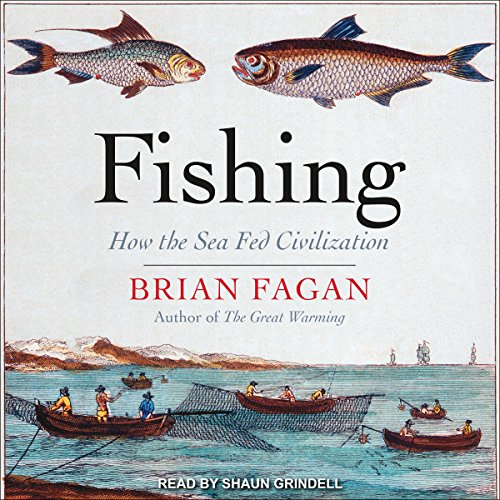
Fishing
Summary
In this history of fishing - not as sport but as sustenance - archaeologist and best-selling author Brian Fagan argues that fishing was an indispensable and often overlooked element in the growth of civilization. It sustainably provided enough food to allow cities, nations, and empires to grow, but it did so with a different emphasis. Where agriculture encouraged stability, fishing demanded movement. It frequently required a search for new and better fishing grounds; its technologies, centered on boats, facilitated movement and discovery; and fish themselves, when dried and salted, were the ideal food - lightweight, nutritious, and long-lasting - for traders, travelers, and conquering armies. This history of the long interaction of humans and seafood tours archaeological sites worldwide to show listeners how fishing fed human settlement, rising social complexity, the development of cities, and ultimately the modern world.
©2017 Brian Fagan (P)2017 Tantor

The Great Warming
Summary
A breakout best seller on how the earth's previous global warming phase reshaped human societies from the Arctic to the Sahara. From the 10th to the 15th centuries, the earth experienced a rise in surface temperature that changed climate worldwide, a preview of today's global warming. In some areas, including Western Europe, longer summers brought bountiful harvests and population growth that led to cultural flowering. In the Arctic, Inuit and Norse sailors made cultural connections across thousands of miles as they traded precious iron goods. Polynesian sailors, riding new wind patterns, were able to settle the remotest islands on earth. But in many parts of the world, the warm centuries brought drought and famine. Elaborate societies in western and Central America collapsed, and the vast building complexes of Chaco Canyon and the Mayan Yucatn were left empty. The history of the Great Warming of a half millennium ago suggests that we may yet be underestimating the power of climate change to disrupt our lives today - and our vulnerability to drought, writes Fagan, is the silent elephant in the room.
©2009 Brian Fagan (P)2010 Audible, Inc.
Floods, Famines, and Emperors
Summary
In 1999, few people had thought to examine the effects of climate on civilization. Now, due in part to the groundbreaking work of archaeologist Brian Fagan, climate change is a central issue.Revised and updated 10 years after its first publication, Floods, Famines and Emperors remains the definitive account of how the world's best-known climate event had an indelible impact on history.
©2009 Brian Fagan (P)2009 Audible, Inc.

The Attacking Ocean
Summary
The past fifteen thousand years--the entire span of human civilization--have witnessed dramatic sea level changes, which began with rapid global warming at the end of the Ice Age, when sea levels were more than 700 feet below modern levels. Over the next eleven millennia, the oceans climbed in fits and starts. These rapid changes had little effect on those humans who experienced them, partly because there were so few people on earth, and also because they were able to adjust readily to new coastlines. Global sea levels stabilized about six thousand years ago except for local adjustments that caused often quite significant changes to places like the Nile Delta. So the curve of inexorably rising seas flattened out as urban civilizations developed in Egypt, Mesopotamia, and South Asia. The earth's population boomed, quintupling from the time of Christ to the Industrial Revolution. The threat from the oceans increased with our crowding along shores to live, fish, and trade. Since 1860, the world has warmed significantly and the ocean's climb has speeded. The sea level changes are cumulative and gradual; no one knows when they will end. The Attacking Ocean, from celebrated author Brian Fagan, tells a tale of the rising complexity of the relationship between humans and the sea at their doorsteps, a complexity created not by the oceans, which have changed but little. What has changed is us, and the number of us on earth.
©2013 Brian Fagan (P)2013 Audible Inc.

Elixir
Summary
Elixir spans five thousand years, from the beginnings of civilization to the parched American Sun Belt of today. It is a story of human endeavor: our present-day interaction with this most essential resource has deep roots in the remote past, and every human culture has been shaped by its relationship to water. For the earliest hunter-gatherers, knowing where to find water was a matter of life and death; the "songlines" of Australia's Aborigines define the whole landscape as a map of sacred water sources. In many agricultural societies, from Africa to the rice fields of Bali, a communal "water philosophy" surrounds the precious resource with social traditions that preserve fair access for people upstream and down. The sweeping narrative moves from the Greeks and Romans, whose mighty acqueducts still water modern cities, to China, where emperors marshaled armies of laborers in a centuries-long struggle, still ongoing today, to tame the country's powerful rivers. Medieval Europe and then the Industrial Revolution brought ingenious new solutions to water management---but, for the first time, turned water into a commodity to be bought, sold, and exploited rather than a natural force to be worshiped and husbanded. By the twentieth century, technology allowed the American desert to sparkle with swimming pools and lush golf courses---with little regard for sustainability. With his customary elegance and peerless scholarship, Brian Fagan illustrates that the past teaches us that technologies for solving one or another water problem are not enough. From a practical standpoint, we still live at the mercy of the natural world. To solve the water crises of the future we may need to adapt the water ethos of our ancestors.
©2011 Brian Fagan (P)2011 Tantor

A Little History of Archaeology
Summary
The thrilling history of archaeological adventure, with tales of danger, debate, audacious explorers, and astonishing discoveries around the globe What is archaeology? The word may bring to mind images of golden pharaohs and lost civilizations or Neanderthal skulls and Ice Age cave art. Archaeology is all of these, but also far more: the only science to encompass the entire span of human history - more than three million years! This Little History tells the riveting stories of some of the great archaeologists and their amazing discoveries around the globe: ancient Egyptian tombs, Mayan ruins, the first colonial settlements at Jamestown, mysterious Stonehenge, the incredibly preserved Pompeii, and many, many more. In 40 brief, exciting chapters, the book recounts archaeology's development from its 18th-century origins to its 21st-century technological advances, including remote sensing capabilities and satellite imagery techniques that have revolutionized the field. Shining light on the most intriguing events in the history of the field, this absolutely up-to-date book illuminates archaeology's controversies, discoveries, heroes and scoundrels, global sites, and newest methods for curious listeners of every age. Cover illustrations by Joe McLaren
©2018 Brian Fagan (P)2018 Audible, Inc.